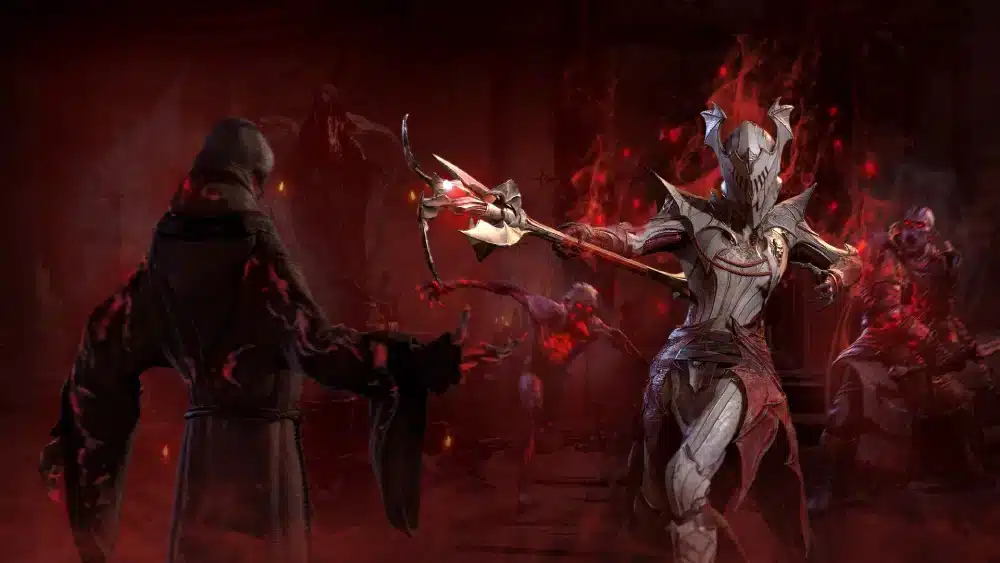
Players exploring the Vessel of Hatred expansion eventually encounter Diablo 4 Harbinger of Hatred, one of the most challenging Greater Lair bosses currently available. This fight stands out for its mix of movement-heavy mechanics, punishing area attacks and unique endgame loot opportunities.
The interest around Diablo 4 Harbinger of Hatred has grown because the boss plays a major role in the new endgame ladder introduced with Vessel of Hatred. Many players struggle to understand how to unlock the encounter, what materials are needed, which builds are viable and how the boss’s mechanics work in practice. This makes proper preparation essential.
In community sources, Diablo 4 Harbinger of Hatred is sometimes described as a manifestation or avatar-like extension of Mephisto, although this is not explicitly labeled as such by Blizzard. To keep the information accurate, this guide treats this interpretation as community-based, not an official narrative statement.

Diablo 4 Harbinger of Hatred – Overview and Context
Lore Positioning and Community Interpretation
The Harbinger of Hatred appears as part of the Vessel of Hatred expansion’s endgame layers. Officially, he is tied to Mephisto’s influence across the new region, Nahantu, and functions as a high-end lair boss with mechanics and difficulty above normal encounters.
According to community guides and databases, the boss is thematically aligned with Mephisto, though Blizzard has not formally defined him as Mephisto’s “physical avatar.”
This interpretation is widely accepted among players but should be understood as community lore, not a canonical statement.
Role in the Endgame Ladder
The boss is part of the post-story endgame designed to challenge optimized builds. Alongside other Vessel of Hatred encounters such as Urivar, the Harbinger allows players to target-farm certain high-end uniques, particularly those tied to specific class power spikes and build specializations.
How to Unlock the Harbinger of Hatred Boss
Expansion, Progression and Region Access
To challenge Diablo 4 Harbringer of Hatred, players must:
- Own the Vessel of Hatred expansion;
- Progress far enough in the expansion content to unlock the new endgame structures;
- Have access to the Nahantu region;
- Play in an appropriate World Tier.
While World Tier 1 is technically the minimum requirement according to community resources, higher Torment tiers offer significantly improved loot, making the fight more rewarding at endgame levels.
Required Materials – Abhorrent Hearts
The summoning requirement for the boss is consistent across guides:
- You obtain Abhorrent Hearts by defeating Urivar, another boss in the Vessel of Hatred endgame.
- You need three Abhorrent Hearts to open the reward cache after defeating the Harbinger.
- These materials are consumed upon opening the post-fight chest, not when starting the encounter.
This progression creates a natural ladder: defeat Urivar → farm Abhorrent Hearts → challenge the Harbinger.
Harbinger’s Den – Location and Entry
Finding the Lair in Nahantu
The boss can be found in Harbinger’s Den, a Greater Lair located in the Nahantu region. Players can identify the lair icon on the world map, travel to the nearest waypoint, and proceed to the dungeon entrance.
Dungeon Structure Before the Boss
As with other Greater Lairs:
- You must clear a sequence of elite enemies and themed packs;
- The altar at the end brings you to the boss chamber;
- You fight the Harbinger in a self-contained arena with clear phases and escalating pressure.
Only after defeating him can you open the loot cache using the Abhorrent Hearts.
Harbinger of Hatred – Confirmed Mechanics and Phases
Core Damage Threats (Confirmed)
Community-tested encounters describe the boss’s damage profile as:
- Heavy Shadow damage;
- Persistent area-of-effect pools;
- High-damage projectiles;
- Arena-wide effects tied to summoned portals;
- Mechanics that reward consistent movement and punish standing still.
These elements are consistent across guides such as Maxroll, Game8 and Fextralife.
Phase Structure and Known Interactions
These mechanics have been confirmed in reliable guides:
- Pool mechanics similar to Desiccation that force repositioning;
- Directional projectiles that can one-shot unprepared builds;
- Portals that spawn adds and fire lines across the arena;
- A stagger window that stuns the boss when the stagger bar is filled;
- In later stages, light orbs appear and are used to disrupt portals or manage adds (confirmed in Icy Veins and community video guides).
None of these mechanics are speculative; all are consistent across multiple guide sources.
Mechanics such as:
- “Hatred Resonance system”;
- “Jungle Trials mode”;
- “Artifact Gear layer”.
These are not tied to this boss in official or confirmed sources. They appeared in earlier speculation around the expansion but are not part of confirmed Harbinger mechanics, so they have been removed.
How to Prepare for the Harbinger of Hatred Fight
Defensive Setup
Preparing for this encounter begins with building a setup capable of handling the boss’s layered mechanics. Any strong Harbinger of Hatred Diablo 4 preparation starts with high Armor for your World Tier, since the boss’s physical hits and Shadow-based attacks punish even small movement mistakes.
Shadow Resistance is equally important because several abilities apply persistent damage-over-time effects that can drain your health rapidly if you are not properly protected.
Mobility also becomes part of your defensive plan. A dependable movement skill is essential to reposition away from portals, avoid overlapping pools and escape fire lines that divide the arena. For players developing a reliable Harbinger of Hatred Diablo 4 strategy, mitigation tools and DoT reduction significantly increase survivability.
Finally, never enter the fight without an active elixir. Whether it boosts Armor, Resistances or Maximum Life, the added durability often prevents one-shot moments—especially on higher Torment tiers. In this fight, raw toughness is just as important as DPS.
Offensive Requirements
Offensively, a solid Harbinger of Hatred Diablo 4 approach requires consistent single-target damage. Burst potential is particularly valuable during stagger windows, where the boss becomes temporarily vulnerable and the arena clears briefly.
Movement abilities with low cooldowns also improve uptime, allowing you to stay in range while dodging dangerous abilities.
Players frequently adjust Paragon Boards, aspects and skill allocations specifically for this boss. These fine-tuned adjustments help maintain damage output while reducing the number of risky interactions with the arena’s mechanics.
Once your offensive and defensive foundations are set, preparation follows a structured sequence that supports both survival and efficiency:
- Unlock the Nahantu endgame path, since the encounter is tied to the Vessel of Hatred progression;
- Defeat Urivar multiple times for Hearts, securing the Abhorrent Hearts needed for post-fight rewards;
- Enter Torment tiers for better drop potential, as loot quality improves significantly at higher difficulties;
- Optimize both offense and survivability, refining aspects, gear rolls and Paragon selections;
- Practice movement against other bosses, reinforcing dodge timing, positioning and stagger management before attempting the Harbinger.
Following these steps ensures that your build remains resilient, adaptable and well prepared for the high-pressure demands of the encounter.
Harbinger of Hatred Loot Table
Unique Drops and Class Targets
Understanding what the boss can drop is essential for players deciding whether to include the encounter in their rotation. According to current community databases and guides, the Harbinger of Hatred Diablo 4 loot table includes a selection of class-specific uniques that make the boss a high-value target for endgame farming.
Although Blizzard can update these tables at any moment, the available information provides a reliable snapshot of what players can expect when defeating the encounter.
Based on the confirmed public loot data available at the time of writing, the Harbinger can drop unique items for the following classes:
- Barbarian;
- Druid;
- Necromancer;
- Rogue;
- Sorcerer;
- Spiritborn.
Players should remain attentive to patch notes, since Blizzard has already shown willingness to rebalance or redistribute unique items between bosses.
Still, under the current structure, the Harbinger of Hatred Diablo 4 fight remains one of the most consistent and efficient ways to target-farm specialized endgame gear tied to each class’s strongest builds.
Why This Boss Matters for Item Progression
The significance of the Harbinger of Hatred Diablo 4 encounter extends beyond its difficulty. Each class benefits from multiple uniques available exclusively through this boss, and many of these items play a direct role in shaping late-game archetypes.
For players refining a final build, pushing higher Torment tiers or preparing for other Greater Lair encounters, the Harbinger becomes a cornerstone of the gearing cycle.
By farming him consistently, players accelerate their progression, unlock crucial power spikes and reinforce the core strengths of their endgame setups.
Table – Harbinger of Hatred Overview
| Category | Details |
| Expansion | Vessel of Hatred |
| Region | Nahantu |
| Lair | Harbinger’s Den |
| Summon Material | 3 Abhorrent Hearts (from Urivar) |
| Fight Type | Greater Lair Boss / Uber-style |
| Damage Profile | Shadow, projectiles, AoE pools |
| Core Mechanics | Portals, stagger bar, light orbs (via guides) |
| Rewards | Class-specific uniques and shared endgame items |
FAQ
You must own Vessel of Hatred, progress through the expansion endgame unlocks, access Nahantu and collect Abhorrent Hearts.
The lair is located in Nahantu and becomes available after progressing through the expansion content.
World Tier 1 is the minimum, according to guides, but Torment tiers provide far better loot.
Officially, Blizzard has not defined him as Mephisto’s avatar. This interpretation comes from community guides.
Confirmed unique items for all classes, including Spiritborn, with variations depending on the current patch.
Why Connection Stability Matters
The Diablo 4 Harbinger of Hatred encounter is built around precise movement, pattern recognition and rapid repositioning. Small delays during portal phases or ground-effect mechanics can lead to unavoidable deaths or missed stagger opportunities.
A stable connection ensures that your inputs register correctly and your build performs as intended during high-pressure encounters. This keeps the challenge focused on the gameplay itself, not on network interruptions.
With proper preparation, solid defenses and familiarity with mechanics, the Harbinger of Hatred becomes a rewarding and repeatable part of your endgame rotation.
Got questions or want to connect with other players? Join the conversation at the ExitLag Forum!