The maplestory classic leveling guide is built around one fundamental idea: efficient progression comes from killing monsters consistently, not simply fighting the strongest enemies available. Classic-style MapleStory rewards players who understand maps, their class, resource consumption, and the time required to move between targets.
Following a maplestory classic leveling guide can make the grind considerably more efficient because older-style progression demands more planning than simply jumping between modern progression systems. Choosing good MapleStory Classic Training Spots, preparing enough potions, improving equipment, and spending Skill Points correctly can all affect how quickly you advance.
What is the best way to level in Classic MapleStory? The maplestory classic leveling guide approach is to maximize sustainable EXP per hour by combining monsters you can defeat quickly with efficient Grind Maps, appropriate MapleStory Classic Builds, and a Skill Planner suited to your character.
That distinction matters because Classic progression is heavily influenced by your specific class. A map that works perfectly for a ranged Bowman may feel slow for a Warrior, while a Magician can approach certain platforms differently because of its skill set.
Therefore, there is no single training map that automatically becomes the best choice for every player. The smartest route changes as your damage, skills, equipment, Job Advancement, and available resources improve.
MapleStory Classic Leveling Guide: How Leveling Works
EXP, monsters, and progression
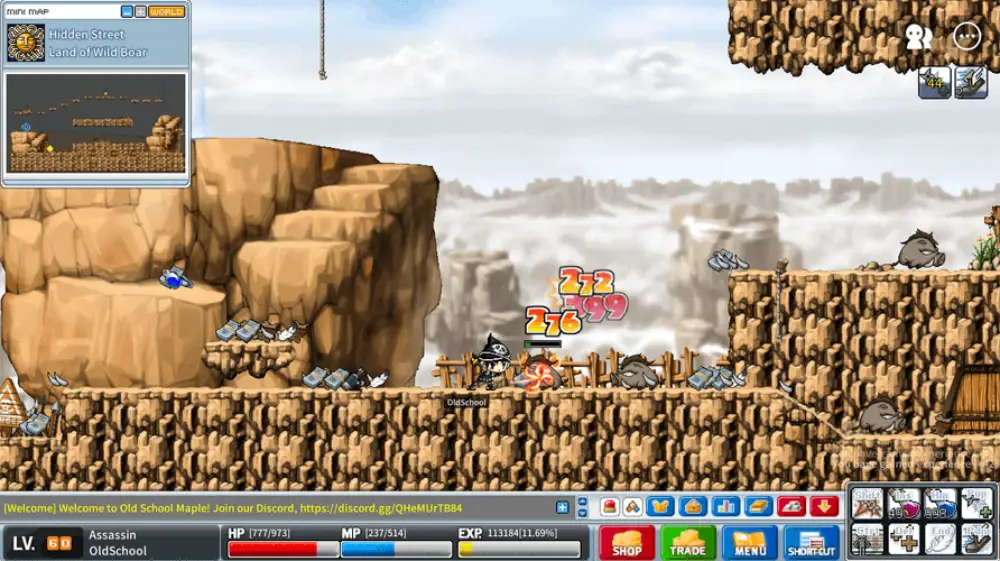
Leveling in MapleStory revolves around earning EXP until your character reaches the next level. Hunting monsters is one of the most repeatable ways to achieve that goal, while quests and other available content can supplement your progression.
In a Classic environment, grinding becomes especially important because many of the acceleration systems associated with modern MapleStory may not exist or may function differently.
That makes the fundamentals much more important.
Instead of relying on a large collection of account-wide progression systems, your character's immediate damage, skills, equipment, map selection, and resources have a direct impact on how productive a training session feels.
Your goal is therefore not simply to find monsters with high EXP values.
You need monsters that provide good EXP relative to how quickly and consistently you can defeat them.
Why kill speed matters more than monster level
Suppose one monster awards significantly more EXP but takes several attacks to defeat. Another gives less EXP but dies almost immediately.
The second monster can easily produce better EXP per hour.
This is why good Class Guides evaluate training locations according to more than monster level. You should consider:
- EXP per monster.
- Average time required to defeat it.
- Number of monsters available on the map.
- Distance between spawns.
- Platform layout.
- HP and MP potion consumption.
- Travel time to and from the location.
- How effectively your class attacks the map.
The best location is the one that keeps your character gaining EXP consistently.
If you spend too much time walking, waiting for enemies, recovering resources, or attacking individual monsters, your actual leveling rate suffers.
MapleStory Classic Training Spots: How to Choose the Right Map
Early-game training priorities
Early levels are where you should become comfortable with your character rather than obsess over perfect EXP rates.
Your available skills are limited, equipment is basic, and your character may not yet have the mobility or area coverage that defines later gameplay.
At this stage, convenient MapleStory Classic Training Spots are often more useful than distant maps that theoretically offer slightly better EXP.
Look for monsters that die quickly and maps that are easy to navigate. Nearby quests can also be worthwhile when they provide useful rewards or EXP without requiring excessive travel.
Early training should help you accomplish three things:
- Gain levels consistently.
- Learn the range and behavior of your attacks.
- Prepare for your next Job Advancement.
As new skills become available, reconsider your map choices.
An attack that can hit several enemies or reach another platform may suddenly make a map much more efficient than it was a few levels earlier.
Mid-game and later training
As your character advances, map efficiency becomes increasingly important.
You now have more skills, better equipment, and a clearer class identity. Consequently, simply staying at the same famous training spot because other players recommend it may no longer be optimal.
Start paying attention to how many monsters you can eliminate during each rotation.
For example, a ranged character may efficiently clear multiple platforms without climbing between them. A melee character might instead perform better on compact maps where enemies remain close together.
Mobility also changes the equation.
Classes capable of moving between platforms quickly can take advantage of larger Grind Maps, while slower characters may benefit from compact layouts with predictable enemy placement.
Best Grind Maps for Efficient EXP
What makes Grind Maps efficient?
The best Grind Maps minimize the amount of time you spend doing anything other than defeating monsters.
A famous map is not necessarily a good map for your character.
Instead, look for layouts where your attacks naturally cover large portions of the available spawn. Ideally, your movement route should connect groups of monsters without forcing you to repeatedly climb awkward platforms or cross empty areas.
Good training maps usually offer:
- Consistent monster availability.
- Compact or class-friendly layouts.
- Enemies that die in relatively few attacks.
- Convenient platform positioning.
- Reasonable potion consumption.
- Low downtime between groups.
- Accessible routes from useful towns or supply points.
Crowding can also affect efficiency.
If another player is already occupying a location, searching for another channel or choosing a comparable map may be faster than fighting over monsters.
When should you leave a training map?
One of the most common leveling mistakes is staying at a familiar location for too long.
A map may have been excellent ten levels ago. However, your character has since gained skills, stats, and equipment that may make stronger enemies more efficient.
Test your progression instead of guessing.
A simple method is:
- Record your current EXP percentage or value.
- Train on the map for a fixed period.
- Record the EXP you gained.
- Note how many potions or resources you consumed.
- Repeat the test at another appropriate map.
- Compare the results.
Even a short controlled test can reveal a surprising difference.
The important metric is sustainable EXP over time, not how impressive each individual monster looks.
MapleStory Classic Builds for Faster Leveling
Stats and class identity
Good MapleStory Classic Builds start with understanding what your class actually needs.
Classic-style MapleStory can be much less forgiving than modern character progression. Depending on the specific version being played, stat allocation, equipment requirements, accuracy, and class mechanics may require more attention.
That means blindly copying a modern MapleStory build is a bad idea.
Warriors, Magicians, Bowmen, Thieves, and Pirates have different combat ranges and progression needs. Those differences affect not only bossing but also the maps where each character can train efficiently.
Your build should support what your character does most frequently.
For leveling, reliable damage can be more useful than optimizing around a theoretical late-game situation that your character will not reach for many levels.
Damage versus utility
Damage matters, but it is not the only factor behind efficient MapleStory Classic Builds.
Mobility can save seconds during every map rotation. MP efficiency can reduce potion expenses. Survivability can prevent deaths and interruptions. Useful passives can make every attack more effective.
Think about your build as a complete leveling system.
For example, increasing damage enough to reduce a monster from three attacks to two is a major improvement. Increasing damage without changing the number of attacks required may produce a much smaller practical difference.
Likewise, an important mobility or passive skill can improve your performance across an entire training session.
Build for consistent results rather than attractive numbers alone.
Skill Planner: How to Spend SP Efficiently
Why Skill Points matter
A good Skill Planner helps you decide which abilities provide the most immediate value as you progress through Job Advancements.
Skill Points, commonly called SP, are used to increase skill levels. Each skill has its own effects and maximum level, while some abilities can also require other skills before they become available.
In Classic-style progression, the order in which you develop those abilities can noticeably affect the leveling experience.
An attack skill that improves your kill speed can immediately increase EXP rates. Meanwhile, mobility, mastery, or passive improvements can make training smoother over longer periods.
Therefore, do not distribute SP randomly.
Read what each ability actually does and identify which improvements affect your current training routine.
Building a practical Skill Planner
Your exact Skill Planner will depend on your class and the specific Classic version you are playing.
However, a useful general priority is:
- Unlock the essential attack skills for your advancement.
- Invest in important mobility where appropriate.
- Improve reliable damage and weapon efficiency.
- Develop core passive skills.
- Add class-specific utility and survivability.
- Complete remaining skills according to prerequisites and your version's SP limits.
Do not assume that every modern skill build applies to a Classic environment.
Skill availability, maximum levels, prerequisites, and balance can vary substantially between versions. When in doubt, verify the rules of the specific Classic implementation before committing valuable resources.
Class Guides: Training Strategies for Every Playstyle
Warrior, Magician, Bowman, Thief, and Pirate
Useful Class Guides should explain how a character's toolkit affects leveling rather than simply giving every player the same list of maps.
Warriors generally operate closer to enemies and may prefer compact layouts where they can move quickly between targets.
Magicians can have powerful ranged or area-focused tools, although MP consumption can become an important part of training economics.
Bowmen benefit from range and can take advantage of maps where enemies are accessible from favorable positions.
Thieves bring their own mobility and attack patterns, while Pirates vary considerably depending on the advancement path and combat style.
These differences become more pronounced after Job Advancements.
How your class changes the best map
Imagine two maps containing monsters with identical EXP and HP.
The first has several narrow platforms stacked vertically. The second is wider, with enemies distributed horizontally.
Those maps may provide completely different results depending on your character.
When using Class Guides to select a location, consider:
- Attack range.
- Number of targets hit.
- Horizontal versus vertical coverage.
- Movement speed.
- Platform mobility.
- Required attack positioning.
- MP consumption.
- Survivability.
Do not be afraid to ignore the most popular map if another location works better for your class.
Efficiency is personal.
MapleStory Classic Training Spots vs. Quests

When grinding is better
Continuous grinding becomes attractive when you find a map that your character can clear efficiently.
There is little travel involved, monster behavior becomes predictable, and you can settle into a consistent rotation.
Good MapleStory Classic Training Spots can therefore produce reliable progression over long sessions.
Grinding is particularly attractive when:
- Monsters die quickly.
- Spawn availability remains consistent.
- Your potion usage is sustainable.
- The map suits your attacks.
- Alternative quests require extensive travel.
- You want predictable EXP gains.
However, repetition can become tiring.
Efficiency also includes your ability to maintain concentration over the entire session.
When quests are worth completing
Quests can provide more than EXP.
Depending on the content and Classic version, they may unlock locations, introduce useful areas, provide equipment, award items, or simply give you a break from continuous grinding.
A quest becomes particularly attractive when its objectives overlap with your current training.
If you already need to defeat monsters in an efficient area, collecting a quest item while doing so can add extra value without significantly reducing your EXP rate.
Travel-heavy quests require more consideration.
Spending a large amount of time moving between distant locations for a small EXP reward may be less efficient than continuing to train.
How to Optimize Your MapleStory Classic Leveling Route
Measure EXP instead of following hype
Players naturally gravitate toward famous training locations.
However, popularity does not guarantee efficiency.
Your damage may be lower or higher than the players who recommended the map. Your class may have different attack coverage. The location may also be crowded when you arrive.
Instead, measure your own results.
Compare several appropriate Grind Maps using equal testing periods and track the amount of EXP gained.
You can use a simple comparison like this:
| Leveling Factor | Why It Matters | Recommended Approach |
| Monster HP | Controls time to kill | Target enemies you defeat consistently |
| EXP reward | Determines return per kill | Compare it with kill speed |
| Spawn density | Controls available targets | Favor active, efficient layouts |
| Map structure | Changes clearing speed | Match platforms to your class |
| Travel time | Creates downtime | Favor convenient routes |
| Potion usage | Affects grind sustainability | Track HP and MP costs |
| Mobility | Determines map coverage | Match maps to movement options |
| Crowding | Reduces available monsters | Change channels or locations |
This approach turns leveling into something you can optimize rather than simply copy.
Reduce downtime before you start
Preparation is one of the easiest ways to improve a long training session.
Imagine reaching a distant map only to discover that you have almost no MP potions. Returning to town immediately wastes time that could have been avoided.
Before leaving, check:
- HP potions.
- MP potions.
- Inventory space.
- Equipment.
- Ammunition or class-specific consumables when applicable.
- Available mesos.
- Required quest items.
- Your planned training route.
Small preparation habits become increasingly valuable during long Classic grinds.
Common MapleStory Classic Leveling Mistakes
Fighting monsters that are too strong
Higher-level monsters can be tempting because their EXP rewards look better.
However, the number that matters is EXP over time.
If you constantly require several attacks to defeat one enemy, take heavy damage, or consume expensive resources, moving to a slightly weaker monster can produce faster and cheaper progression.
Test both options.
If weaker enemies die significantly faster, they may remain the superior choice for several additional levels.
Copying another class's route
Another common mistake is following someone else's training route exactly.
A Bowman guide may recommend a map because its platforms perfectly match ranged attacks. That does not mean a Warrior will achieve the same results there.
Similarly, a class with strong area attacks can benefit from dense monster groups that another character struggles to clear.
Other mistakes include:
- Staying at an outdated training location.
- Ignoring potion expenses.
- Traveling constantly between maps.
- Neglecting equipment upgrades.
- Spending SP without a plan.
- Choosing maps based only on monster level.
- Training in crowded locations when alternatives are available.
Your route should evolve alongside your character.
How ExitLag Can Help During MapleStory Grinding Sessions
Why connection stability matters
MapleStory may involve long periods of repetitive training, and those sessions depend on an online connection.
A carefully optimized route cannot prevent network-related interruptions. Latency fluctuations, unstable routing, and connection issues can disrupt movement and combat regardless of how good your MapleStory Classic Builds are.
That is where connection optimization can complement character optimization.
You still need the right training spot, build, equipment, and skills. However, improving the network route can help create a more consistent environment in which to use them.
Using ExitLag for MapleStory on PC
ExitLag is designed to optimize connections for online gaming on PC and Mobile. Its proprietary technology evaluates network routes and helps direct game traffic through optimized paths.
Real-Time Optimization continuously works with available routes, while Multipath Connection can send packets through multiple simultaneous routes to improve connection stability.
ExitLag also offers technologies such as Traffic Shaper, Multi-Internet, and FPS Boost, giving players additional tools for optimizing their gaming environment.
For long MapleStory sessions, the benefit is straightforward: ExitLag can help reduce network-related instability so you can focus on maintaining your training rotation instead of worrying about an inconsistent connection.
Setup is simple: sign up, download ExitLag, choose your game, apply the routes, and play.
FAQ
What is the fastest way to level in MapleStory Classic?
The fastest method is generally the one producing the highest sustainable EXP per hour for your specific character. Do not evaluate monsters exclusively by their level or individual EXP reward. Kill speed, spawn density, map layout, travel time, potion consumption, and your class's attacks all affect the final result.
What are the best MapleStory Classic Training Spots?
The best MapleStory Classic Training Spots depend on your level, class, damage, equipment, and the specific Classic version you are playing. Look for maps with monsters you can eliminate efficiently and layouts that match your attacks. Testing several locations is more reliable than assuming one famous training spot is automatically optimal.
What makes good Grind Maps?
Good Grind Maps minimize downtime. They usually have accessible enemies, efficient platform layouts, reliable monster availability, and targets that your character can defeat quickly. A good map should also be sustainable in terms of HP and MP potion usage.
Should I grind or complete quests?
Use both when they make sense. Grinding is excellent for predictable EXP, while quests may provide EXP, equipment, access, items, or other useful rewards. Quests that overlap with your current training location can be especially efficient because they provide additional rewards without forcing you to abandon your grind.
How do I make good MapleStory Classic Builds?
Good MapleStory Classic Builds prioritize the stats and abilities required by your class while considering the mechanics of the particular Classic version. For leveling, focus on improvements that increase consistent kill speed, mobility, survivability, and resource efficiency. Avoid importing modern MapleStory builds without checking whether those systems and recommendations exist in your Classic environment.
How should I use a Skill Planner?
A Skill Planner should prioritize abilities that have the greatest practical impact on your character. Start with essential attacks, then consider mobility, damage-related passives, mastery, utility, and survivability according to your class. Always check skill prerequisites and maximum levels before spending SP.
Do different classes need different leveling routes?
Yes. The best map for a Warrior is not necessarily the best map for a Bowman, Magician, Thief, or Pirate. Attack range, area coverage, mobility, HP and MP consumption, and platform access can dramatically change training efficiency. That is why useful Class Guides should explain how a class interacts with a map instead of giving every character an identical route.
Is the highest-level monster always best for leveling?
No. A stronger monster is only better if the additional EXP compensates for the extra time and resources required to defeat it. If weaker enemies die much faster and appear in greater numbers, they can provide substantially better EXP over a complete training session.
Should I stay on one training map for many levels?
Only while the map remains efficient. Your damage and skills improve as you level, so periodically test stronger monsters and different layouts. At the same time, avoid changing maps every few minutes. Constant travel can erase the small efficiency gains you were trying to achieve.
MapleStory Classic Leveling Guide: Build a Better Training Route
The maplestory classic leveling guide is ultimately about understanding your character instead of blindly following a list of recommended monsters. Efficient leveling comes from matching your damage, skills, mobility, and resources with maps that allow you to defeat enemies continuously.
Using MapleStory Classic Training Spots, efficient Grind Maps, thoughtful MapleStory Classic Builds, a practical Skill Planner, and class-specific strategies gives you a much stronger foundation for progression. As your character changes, test new locations and adjust your route rather than assuming yesterday's best map will remain optimal forever.
Most importantly, measure progress over time. A famous location with stronger monsters can still lose to a simple map that your character clears quickly and consistently. Combine that approach with a stable online environment through ExitLag, and your maplestory classic leveling guide strategy becomes focused on what matters most: spending more of your gaming session actually earning EXP.
All game images used in this blog belong to Nexon. They are used for informational/educational purposes only and do not imply endorsement or affiliation with the rights holders.