

Factorio has always been known for deep automation systems, massive industrial scaling, and complex logistical challenges. However, the arrival of Factorio Space Age completely transforms the gameplay experience by introducing interplanetary expansion, advanced production systems, and entirely new strategic mechanics.
For longtime players, the expansion dramatically changes how factories evolve during the late game. Meanwhile, newer players may feel overwhelmed by the scale of the new systems, planets, and technologies available throughout progression.
Today, Factorio Space Age represents one of the biggest gameplay evolutions ever introduced to the franchise. Instead of remaining limited to a single planetary factory, players now expand across multiple worlds with unique environmental conditions, resources, and logistical demands.
So, what is Factorio Space Age? Factorio Space Age is the official expansion for Factorio that introduces space travel, multiple planets, advanced automation mechanics, and expanded late-game systems designed to increase factory complexity and strategic progression.
This complete guide explains the new mechanics, planets, progression systems, and strategies players should understand before starting the expansion.
Factorio Space Age basics and expansion overview
The expansion fundamentally changes the structure of progression compared to the base game.
Instead of focusing exclusively on one massive factory, players must now manage interplanetary production chains and resource transportation systems.
What the Space Age DLC adds
The Space Age DLC introduces several major systems that expand gameplay dramatically.
Key additions include:
- Multiple explorable planets;
- Interplanetary logistics;
- Advanced technologies;
- New enemy challenges;
- Expanded production chains;
- Late-game automation mechanics.
These systems create significantly more strategic depth compared to traditional Factorio gameplay.
Why the expansion changes progression
In the original game, progression centered primarily around scaling a single factory efficiently.
However, the expansion introduces:
- Specialized planetary industries;
- Unique environmental hazards;
- Complex transportation networks;
- Resource dependency between planets.
As a result, players must think on a much larger logistical scale.
Is Factorio Space Age beginner friendly?
Although experienced players adapt faster, beginners can still enjoy the expansion with proper preparation.
Helpful beginner priorities include:
- Learning train systems first;
- Understanding automation fundamentals;
- Mastering throughput balancing;
- Practicing modular factory layouts.
Without these basics, interplanetary logistics may become overwhelming later.
Factorio expansion guide for early progression
Starting efficiently is extremely important because mistakes become harder to fix during late-game expansion.
A proper Factorio expansion guide helps players avoid major logistical problems later.
Early factory priorities
Before reaching space systems, players should stabilize core production.
Important early goals include:
- Automated iron production;
- Reliable power generation;
- Green circuit scaling;
- Train infrastructure;
- Science automation.
Strong foundations make later planetary expansion much smoother.
Resource management strategies
Resource shortages become more punishing in Space Age because multiple planets may depend on shared production chains.
Players should prioritize:
- Large ore buffers;
- Modular smelting systems;
- Expandable layouts;
- High-capacity storage.
Planning ahead prevents massive restructuring later.
Common beginner mistakes
Many players struggle because they underestimate scaling requirements.
Frequent mistakes include:
- Building factories too compactly;
- Ignoring future train expansion;
- Weak power infrastructure;
- Poor belt organization;
- Inconsistent production ratios.
Fixing these issues early saves enormous amounts of time.
Factorio planets and interplanetary logistics
One of the biggest features introduced by the expansion is the addition of multiple worlds.
The new Factorio planets system completely changes resource planning and factory specialization.
How planets work in Space Age
Each planet contains different environmental conditions, resources, and strategic advantages.
Planetary systems may include:
| Feature | Impact |
| Unique resources | Specialized manufacturing |
| Environmental hazards | Defensive planning |
| Different terrain | Factory layout changes |
| Logistics limitations | Transport optimization |
Consequently, every planet requires different infrastructure strategies.
Why planetary specialization matters
Trying to produce everything on one planet often becomes inefficient.
Instead, successful players specialize production.
Examples include:
- Mining-focused worlds;
- Science production planets;
- Energy generation hubs;
- Manufacturing-focused colonies.
This specialization improves scalability significantly.
Transportation between planets
Interplanetary transportation becomes one of the expansion’s most important mechanics.
Players must manage:
- Cargo transfer systems;
- Rocket launches;
- Resource balancing;
- Supply chain timing.
Efficient logistics networks become essential during advanced progression.
Space Age mechanics and automation systems
The new Space Age mechanics expand automation complexity far beyond the original game.
Advanced logistics systems
Players now manage multiple layers of transportation simultaneously.
Core systems include:
- Belts;
- Trains;
- Bots;
- Space logistics;
- Rocket transport.
Balancing all these systems creates major strategic depth.
New production chain complexity
Factories become more interconnected than ever before.
Challenges include:
- Cross-planet dependencies;
- Rare material processing;
- Delayed transport timing;
- Production bottlenecks.
As factory scale increases, small inefficiencies may create massive systemic problems.
Why modular design becomes critical
Modular construction allows easier scaling and troubleshooting.
Good modular practices include:
- Expandable smelting arrays;
- Separated science sectors;
- Dedicated train hubs;
- Isolated production blocks.
Large monolithic factories often become difficult to maintain in late-game Space Age progression.
Factorio late game progression strategies
The Factorio late game changes dramatically with the Space Age expansion.
Instead of simply scaling science output endlessly, players now manage multiple industrial ecosystems simultaneously.
Late-game factory scaling
Late-game expansion requires careful throughput planning.
Important scaling priorities include:
- High-capacity train systems;
- Rocket production efficiency;
- Planetary specialization;
- Resource redundancy.
At this stage, optimization becomes more important than basic survival.
Managing massive production networks
As factories grow larger, organizational systems become essential.
Recommended practices include:
- Labeling train stations clearly;
- Standardizing blueprint layouts;
- Separating production categories;
- Monitoring bottlenecks constantly.
Without proper organization, large factories quickly become chaotic.
Performance optimization in huge factories
Massive bases may eventually create performance issues.
Players often optimize by:
- Reducing unnecessary inserters;
- Simplifying logistics paths;
- Improving train efficiency;
- Optimizing bot usage.
Good optimization helps maintain smooth gameplay during large-scale automation.
Multiplayer gameplay and connection stability
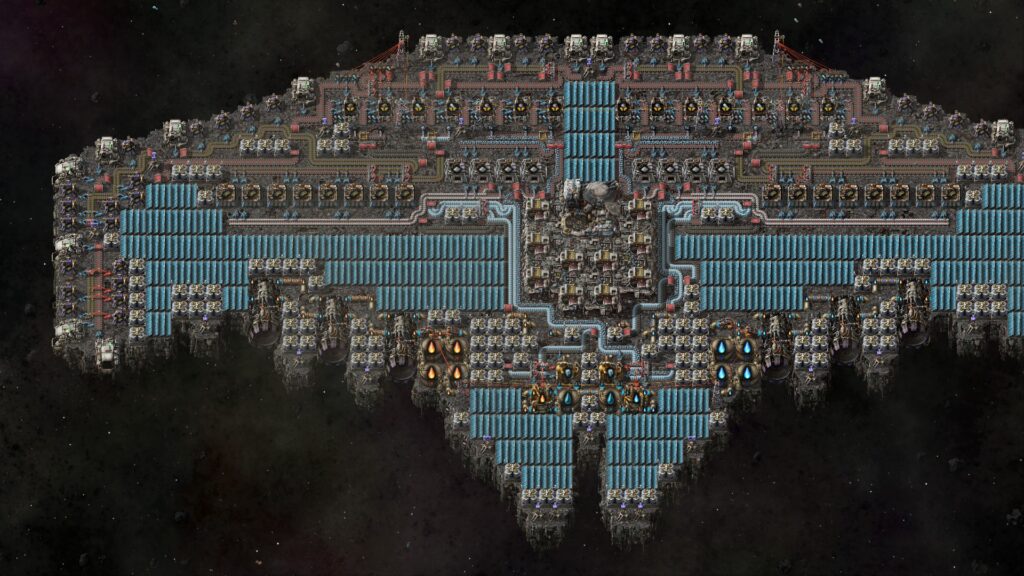
Factorio multiplayer sessions can become extremely demanding due to constant synchronization between players and factory systems.
Stable networking becomes increasingly important as factory complexity grows.
Why stable connections matter in Factorio
Unlike fast-paced shooters, Factorio depends heavily on simulation synchronization.
Poor connections may cause:
- Desync issues;
- Delayed actions;
- Multiplayer instability;
- Rubberbanding;
- Save synchronization problems.
These issues become more noticeable during large multiplayer factories.
Common multiplayer performance problems
Players often experience:
- High latency spikes;
- Packet loss;
- Server instability;
- Simulation delays;
- Lag during heavy automation.
As factories become more advanced, networking stability becomes increasingly important.
How ExitLag helps multiplayer stability
Unlike VPN services, ExitLag focuses specifically on optimizing gaming traffic through intelligent routing systems.
Key benefits include:
- More stable multiplayer connections;
- Reduced packet loss;
- Better route optimization;
- Improved synchronization consistency;
- Lower connection fluctuations.
For large multiplayer factories and long cooperative sessions, stable routing can significantly improve overall gameplay quality.
Best strategies for mastering Factorio Space Age
Mastering the expansion requires patience, planning, and scalability awareness.
Prioritize scalable infrastructure
Players should always build with future expansion in mind.
Important scalable systems include:
- Wide train corridors;
- Expandable power grids;
- Large production buffers;
- Standardized blueprints.
These systems simplify future upgrades dramatically.
Learn logistics before overbuilding
Many players rush factory expansion without understanding throughput limitations.
Instead, focus first on:
- Belt balancing;
- Train scheduling;
- Resource prioritization;
- Production flow consistency.
Strong logistics knowledge improves every stage of progression.
Stay flexible during expansion
No factory remains perfect forever.
Successful players constantly:
- Redesign bottlenecks;
- Improve layouts;
- Reorganize transportation;
- Expand modular systems.
Adaptability becomes one of the most important late-game skills.
FAQ
What is Factorio Space Age?
Factorio Space Age is the official expansion that adds planets, space logistics, advanced automation systems, and expanded late-game progression.
What does the Space Age DLC include?
The DLC introduces multiple planets, interplanetary transport, advanced technologies, new enemies, and expanded production chains.
Is Factorio Space Age difficult for beginners?
The expansion can be challenging, especially for new players unfamiliar with automation and logistics systems.
How do Factorio planets work?
Each planet has unique resources, terrain, and strategic mechanics that affect factory design and logistics planning.
Why is modular factory design important?
Modular factories are easier to scale, optimize, and troubleshoot during large late-game expansion.
Does multiplayer require stable internet?
Yes. Large multiplayer factories depend heavily on stable synchronization and low connection instability.
Expand your Factorio experience with ExitLag
Factorio Space Age transforms automation gameplay into a massive interplanetary industrial challenge filled with logistics optimization, advanced scaling, and strategic factory planning. From specialized planets to complex transportation systems, every stage of progression introduces deeper layers of complexity and creativity.
However, large multiplayer factories and advanced logistics systems also increase the importance of stable networking performance. Packet loss, desync issues, and unstable routing may negatively affect long cooperative sessions and synchronized gameplay.If you want smoother multiplayer experiences, improved connection stability, and more reliable factory synchronization, try ExitLag today and optimize your gameplay performance.