

The Keg is one of the most profitable crafting stations in Stardew Valley. Placing a crop inside and waiting produces artisan goods that sell for significantly more than the raw ingredients, and understanding how the Keg Stardew Valley system works unlocks some of the biggest income jumps available on the farm.
Stardew Valley Keg setups turn ordinary crops into high-value products like Wine, Juice, and Beer. The transformation multipliers are generous, and with enough Kegs running simultaneously, a single type of fruit can fund every major farm upgrade you need in short order.
However, not every crop benefits equally from Keg processing. Knowing the Keg Recipe Stardew Valley requirements, the best inputs, and how to scale your operation efficiently separates an average farmer from a Stardew millionaire. This guide covers everything from crafting your first Keg to building a full artisan empire.
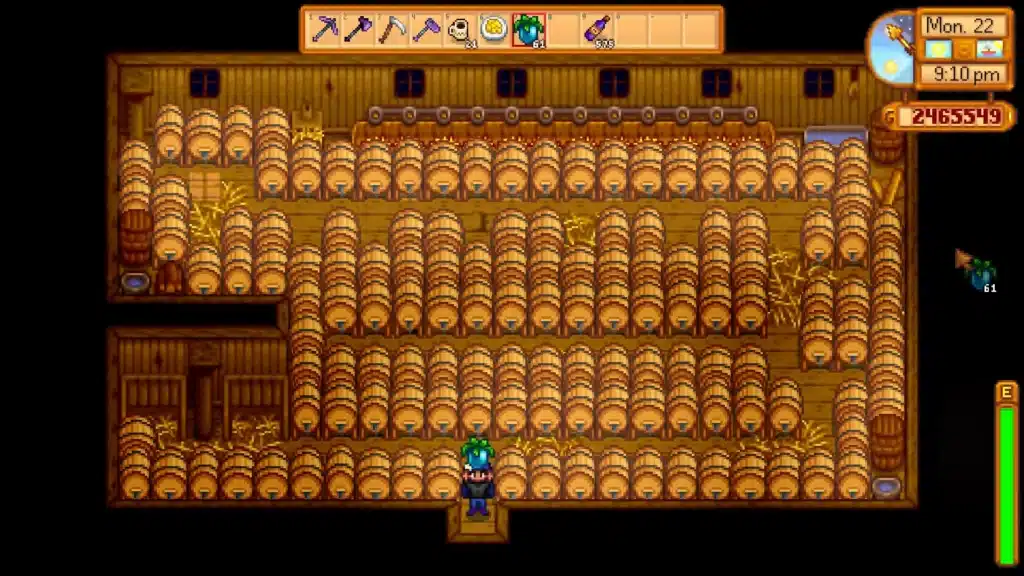
What Is the Keg in Stardew Valley?
The Stardew Valley Keg is an Artisan Equipment item that processes crops and other inputs into valuable artisan goods. When you place a crop inside, it ferments or processes over time and emerges as a product that sells for a multiple of the original crop’s base value.
What the Keg Produces
The output depends entirely on what you put in:
- Fruit inputs: Produce Wine that sells for 3x the base crop price
- Vegetable inputs: Produce Juice that sells for 2.25x the base crop price
- Wheat: Produces Beer at a flat 200g base price
- Hops: Produces Pale Ale at a flat 300g base price
- Honey: Produces Mead at around 200g base (higher with flower honey)
Wine is the most valuable Keg output category, which is why fruit farms dominate late-game Stardew Valley income strategies.
How to Get a Keg in Stardew Valley
There are two main ways to obtain the Keg Stardew Valley item: crafting it yourself or finding one pre-built.
Crafting the Keg
The Stardew Valley Keg Recipe is unlocked automatically when you reach Farming Level 8. No additional steps are required. Once you hit Level 8 in Farming, the recipe appears in your Crafting menu.
Keg Recipe Stardew Valley: Required Materials
To craft one Keg, you need:
- 30 Wood
- 1 Copper Bar
- 1 Iron Bar
- 1 Oak Resin
Wood and Copper Bar are easy to obtain early in the game. Iron Bar requires smelting Iron Ore in a Furnace. However, the most time-consuming ingredient is Oak Resin, which requires a Tapper placed on an Oak Tree to collect over a few in-game days.
Alternative Ways to Get Kegs
Beyond crafting, Kegs can also be obtained through:
- The Minecart Room Bundle: Completing this Community Center Bundle rewards you with a Keg
- The Dumpster: Very rarely found in town trash cans (unreliable)
- Tailoring: No, but if you find extras at the Traveling Cart occasionally
The crafting route at Farming Level 8 is by far the most reliable method for building a large Keg operation.
How to Get Keg Stardew Valley: Farming Level 8 Guide
Reaching Farming Level 8 is the prerequisite for the Keg Recipe Stardew Valley unlock. Leveling Farming requires planting and harvesting crops every season.
How to Level Farming Fast
- Plant every tile you can afford during the first few seasons, even cheap crops like Parsnips
- Use quality fertilizer on crops as soon as you can afford it, since fertilized harvests provide more XP
- Harvest multiple times per season by planting fast-growing crops like Cauliflower (Spring), Radish (Summer), or Pumpkin (Fall)
- Avoid letting crops die since unharvested crops give no XP
- Use the Greenhouse year-round once unlocked to continue leveling outside of growing seasons
With consistent farming across Spring and Summer of Year 1, reaching Level 8 by mid-Year 1 is achievable.
Best Crops to Put in the Keg
Not all crops are created equal when it comes to Stardew Valley Kegs. The most profitable inputs produce the highest-value wine, and some crops are dramatically better than others.
Top Keg Inputs by Profit
| Crop | Base Price | Keg Product | Sell Price (Artisan) |
|---|---|---|---|
| Ancient Fruit | 550g | Ancient Fruit Wine | 3,234g |
| Starfruit | 750g | Starfruit Wine | 3,375g |
| Pumpkin | 320g | Pumpkin Wine | 1,386g |
| Blueberry | 50g | Blueberry Wine | 210g |
| Wheat | 25g | Beer | 200g |
| Hops | 25g | Pale Ale | 420g |
Note: Prices above assume the Artisan Profession (Level 10 Farming, Artisan path), which adds a 40% bonus to all artisan goods.
Why Ancient Fruit Wins
Ancient Fruit is the single best Keg input in the game. It grows in all seasons (including Greenhouse), regrows every 7 days after the first harvest, and produces Wine worth 3,234g per bottle with the Artisan profession.
A single Greenhouse filled with Ancient Fruit seeds and paired with a large Keg barn produces more gold per year than almost any other income source in the game.
How to Scale Your Keg Operation
The real power of How to Get Kegs Stardew Valley knowledge comes from scaling. One or two Kegs is a start. Fifty to one hundred Kegs is where income becomes truly transformative.
Scaling Steps
- Unlock the recipe at Farming Level 8 (or complete the Minecart Bundle for a free Keg)
- Build a Shed or Barn specifically to house Kegs. A standard Shed holds 33 Kegs per row with strategic placement.
- Fill the structure with Kegs by stockpiling the crafting materials
- Plant Ancient Fruit or Starfruit in a dedicated growing zone
- Cycle input through Kegs weekly since Wine takes 7 days for most fruits

Keg vs. Preserves Jar: Which Is Better?
A common dilemma is whether to build Kegs or Preserves Jars. The answer depends on the crop:
- High-value fruits (Ancient Fruit, Starfruit): Keg wins dramatically. Wine at 3x vs. Jelly at 2x, with higher base values amplifying the difference.
- Low-value crops: Preserves Jar wins because the fixed bonus of Jelly is proportionally larger than the 3x multiplier on a cheap crop.
- Vegetables: Kegs at 2.25x vs. Pickles at 2x. Keg wins slightly on value but takes longer to process.
Pro Tips: Maximizing Your Stardew Valley Keg Setup
- Choose the Artisan Profession at Level 10 Farming to add 40% to all Keg outputs. This is the single biggest income multiplier available through skill choices. Artisan Profession turns Ancient Fruit Wine from 2,310g to 3,234g per bottle.
- Oak Resin Tappers should be set up early. Oak Resin is the hardest Keg ingredient to stockpile quickly. Place Tappers on every Oak Tree you can find starting in Spring Year 1 so you have resin ready when you hit Farming Level 8.
- Build a dedicated Keg Shed. Keeping Kegs in your farmhouse clutters storage. A dedicated Shed with 33+ Kegs organized in rows makes weekly cycling fast and organized.
- Stagger your Keg fills so Wine output is spread across different days rather than 33 bottles all ready on the same morning. This smooths your weekly income and prevents inventory management chaos.
Common Mistakes Stardew Valley Keg Players Make
- Building Kegs before stockpiling Oak Resin: Players rush toward Kegs before they have enough Resin, then stall for weeks waiting. Fix: Start Tappers on Oak Trees before you hit Farming Level 8 so Resin is waiting when you unlock the recipe.
- Using Kegs on low-value crops: Processing Parsnips or Potatoes into Juice rarely beats selling the crop raw when you factor in processing time. Fix: Reserve Kegs exclusively for high-value fruits (Ancient Fruit, Starfruit) and Hops. Use Preserves Jars for everything else.
- Choosing the wrong Level 10 Profession: Some players pick Agriculturist (faster crop growth) over Artisan (40% artisan goods bonus) at Level 10. Fix: Artisan is almost always the correct choice for Keg-focused farms. The income difference over a year of Keg operations is enormous.

Play Stardew Valley Multiplayer Without Lag
The Stardew Valley Kegs setup shines in multiplayer, where multiple players can divide the farming and Keg-cycling duties for faster income growth. However, multiplayer Stardew needs a stable connection to avoid desync issues that can corrupt farm saves.
ExitLag optimizes your connection for co-op gaming by routing your traffic through the most stable network paths available. It is not a VPN. It works specifically within supported games to reduce latency and prevent the rubber-banding and session drops that ruin multiplayer farming sessions.
With Multipath Technology, ExitLag maintains your co-op connection even when your network has congestion. Multi-Internet support enables backup ISP switching so your session never drops in the middle of a long farming day. Download it and keep your co-op farm running smoothly: Download ExitLag for PC
All game images used in this blog post belong to ConcernedApe. They are used for informational and educational purposes only and do not imply endorsement or affiliation with the rights holders.
Got questions or want to connect with other players? Join the conversation at the ExitLag Forum!