

League of Legends players across the Middle East and North Africa have experienced different connection conditions throughout 2026. While some players enjoy low latency on the regional server, others report high ping, unstable connections, and occasional lag spikes. The situation raises an important question: why is League of Legends Middle East server ping sometimes higher than on European servers?
For players in Saudi Arabia, the United Arab Emirates, Kuwait, and Egypt, the answer often involves more than geographical distance. Internet routing, infrastructure interconnections, and local network conditions can significantly influence gameplay. Here is what players should know about the League of Legends Middle East Server ping, its regional infrastructure, and ways to troubleshoot connection problems.
 Riot Games officially launched the Middle East (ME) region on June 25, 2024.
The announcement followed years of requests from players seeking lower latency and better regional support.
In March 2024, Riot confirmed plans to introduce Middle Eastern servers alongside Arabic localization.
The company expected the infrastructure to improve connections for players previously relying on distant regions.
According to Patch 14.11, eligible players could initially transfer to ME for one Blue Essence.
The promotional transfer period ended in September 2024.
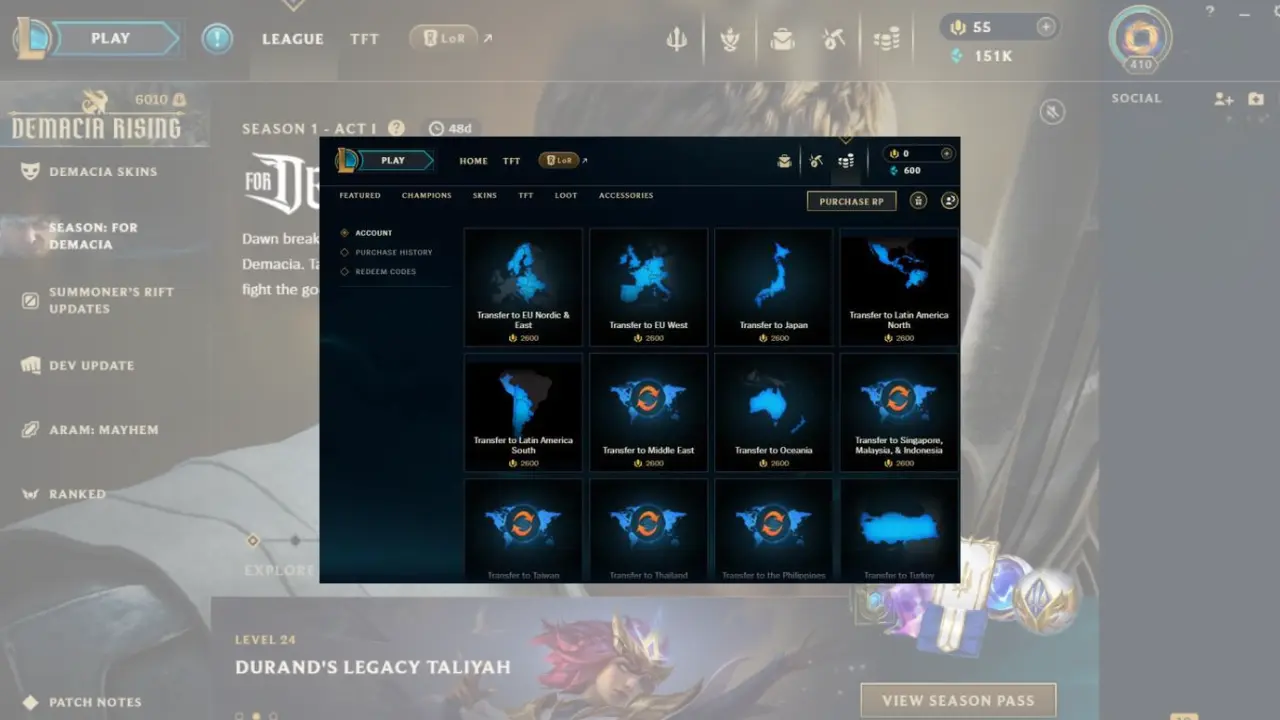 The Middle East remains listed as a supported League of Legends region in Riot's official documentation.
Its account transfer information, updated in May 2026, also includes Middle East among the available regional shards.
There is no verified official announcement establishing that the entire ME region was permanently shut down or transferred to Europe during the March infrastructure crisis.
Nevertheless, this does not guarantee uninterrupted service.
Players experiencing LoL ME server lag should check the Riot Games Service Status before attempting local troubleshooting.
Select League of Legends and the Middle East region to review available incident notices.
The regional incident feed should be checked again before publication, as its live status could not be independently confirmed on October 20.
An individual player experiencing high ping does not necessarily indicate a regional outage.
 Choosing between LoL Middle East and EUW ping depends on the player's location and internet provider.
Generally, geographically closer infrastructure offers lower latency.
However, actual performance depends on the route used to reach Riot's network.
Players in Saudi Arabia and the Gulf may benefit from nearby infrastructure.
For North African countries, including Egypt, European regions can sometimes provide comparable or better connections.
A March 2026 Reddit discussion illustrates this difference.
One Egyptian player reported approximately 40 ms on both ME and Europe Nordic & East (EUNE).
Another player described unexpectedly high latency while connecting from Dubai.
These are individual observations rather than representative regional averages.
 Players experiencing League of Legends MENA connection issues should start with basic network tests.
Where Is the League of Legends Middle East Server Located?
Riot Games officially launched the Middle East (ME) region on June 25, 2024.
The announcement followed years of requests from players seeking lower latency and better regional support.
In March 2024, Riot confirmed plans to introduce Middle Eastern servers alongside Arabic localization.
The company expected the infrastructure to improve connections for players previously relying on distant regions.
According to Patch 14.11, eligible players could initially transfer to ME for one Blue Essence.
The promotional transfer period ended in September 2024.
Is the LoL ME1 server located in Saudi Arabia?
Middle East is the official regional designation, commonly associated with the ME1 server identifier. However, Riot's original announcement did not publicly identify the precise physical address of its infrastructure. Saudi Arabia's Communications, Space and Technology Commission (CST) provides additional information. Its Q2 2026 Game Mode report classified the measured League of Legends server destination as Saudi Arabia. The report recorded an average national latency of 11 milliseconds. These findings support the availability of Saudi-based League of Legends infrastructure during that quarter. However, they do not establish the exact city, data center, or complete network architecture used by Riot.Is the LoL Middle East Server Still Available in 2026?
The Middle East remains listed as a supported League of Legends region in Riot's official documentation.
Its account transfer information, updated in May 2026, also includes Middle East among the available regional shards.
There is no verified official announcement establishing that the entire ME region was permanently shut down or transferred to Europe during the March infrastructure crisis.
Nevertheless, this does not guarantee uninterrupted service.
Players experiencing LoL ME server lag should check the Riot Games Service Status before attempting local troubleshooting.
Select League of Legends and the Middle East region to review available incident notices.
The regional incident feed should be checked again before publication, as its live status could not be independently confirmed on October 20.
An individual player experiencing high ping does not necessarily indicate a regional outage.
Why Is Ping High on the LoL ME Server?
High ping occurs when information takes longer to travel between a player's computer and Riot's servers. Even when the destination is geographically nearby, the connection may follow an inefficient path. Several factors can explain LoL ME server high ping.ISP routing and international connections
Internet service providers determine how traffic moves between networks. Sometimes, data must pass through international exchange points before reaching its destination. For example, traffic between two neighboring Middle Eastern countries may follow a less efficient path than traffic traveling toward Europe. This can happen because of routing policies, commercial interconnection agreements, and infrastructure limitations. As a result, a player geographically close to the ME server may experience higher latency than expected.Network congestion and packet loss
Congestion can increase latency during periods of heavy network activity. Packet loss occurs when information fails to reach its destination. Meanwhile, jitter describes variations in latency over time. These conditions can cause delayed abilities, inconsistent movement, and sudden disconnections. Importantly, low average ping does not guarantee a stable connection. A player experiencing constant 45 ms latency may have smoother gameplay than someone fluctuating between 20 and 120 ms.Middle East vs EUW: Which LoL Server Has Better Ping?
Choosing between LoL Middle East and EUW ping depends on the player's location and internet provider.
Generally, geographically closer infrastructure offers lower latency.
However, actual performance depends on the route used to reach Riot's network.
Players in Saudi Arabia and the Gulf may benefit from nearby infrastructure.
For North African countries, including Egypt, European regions can sometimes provide comparable or better connections.
A March 2026 Reddit discussion illustrates this difference.
One Egyptian player reported approximately 40 ms on both ME and Europe Nordic & East (EUNE).
Another player described unexpectedly high latency while connecting from Dubai.
These are individual observations rather than representative regional averages.
Can you switch from ME to EUW?
Unlike VALORANT, League of Legends does not let players freely select a different regional shard before each match. Accounts are associated with specific regions. According to Riot's Account Transfer FAQ, standard transfers cost 2,600 RP. Transfers also have a 90-day cooldown and can affect ranked placement. Players can alternatively create a separate account in another region. Before transferring an established account, consider latency, matchmaking preferences, friends, and account restrictions. Changing regions should not be the first solution for temporary connection problems.How to Check Ping and Packet Loss in League of Legends
League of Legends includes an in-game latency indicator. Players can display their ping and FPS using Ctrl + F, depending on their configured keybindings. Ping measures network response time, while FPS reflects local rendering performance. To investigate connection instability:- Launch a Practice Tool session.
- Enable the ping display.
- Record your average latency.
- Observe sudden increases while moving or casting abilities.
- Repeat the test at different times.
Use Riot's connection diagnostics
Riot provides additional troubleshooting tools through its Network and Connection Support. Its Connection Log Reader can analyze network information automatically recorded during matches. Where available, Riot's Lag Report also compares connection quality with other players and providers. For persistent issues, collect network logs using the Riot Repair Tool. These records can help Riot Support distinguish between local problems, ISP issues, and server-related failures.How to Reduce League of Legends Ping in MENA
Players experiencing League of Legends MENA connection issues should start with basic network tests.
1. Improve your local network
Riot recommends several measures to reduce connection instability:- Use Ethernet instead of Wi-Fi.
- Restart your modem and router.
- Pause background downloads.
- Reduce simultaneous network usage.
- Update network adapter drivers.
2. Investigate your ISP routing
If high latency continues, compare results during different hours. Record your ISP, connection type, ping, and any packet loss symptoms. Contact your provider if latency remains consistently higher than expected. Ask whether international routing or network congestion could affect connections to Riot's infrastructure. A high-speed internet subscription alone does not guarantee low gaming latency.3. Test alternative routes with ExitLag
When inefficient routing contributes to connection problems, optimization software may provide another option. ExitLag analyzes alternative network paths for supported games and attempts to improve connection efficiency. This can be relevant for players whose ISP uses congested or unnecessarily long routes toward Riot's servers. To evaluate the results:- Launch League of Legends without ExitLag.
- Record your baseline ping and stability.
- Close the game and activate ExitLag for League of Legends.
- Apply the recommended route configuration.
- Repeat the test on the same regional shard.