
Overwatch 2 ranked mode is where the game truly becomes competitive. It is the place where teamwork, mechanics, game sense, and consistency are tested match after match. For many players, climbing the ladder is the ultimate goal, while for others, ranked matches offer a more structured and balanced experience compared to casual play.
Understanding Overwatch 2 ranks is essential if you want to improve, avoid frustration, and set realistic goals. Without knowing how the system works, it is easy to feel stuck, confused, or even unfairly placed. Ranked mode is not only about winning games; it is about how the system evaluates your performance over time.
In simple terms, the Overwatch 2 ranking system exists to group players of similar skill together. It determines who you play with, who you play against, and how competitive your matches feel. Knowing how ranks function gives you an advantage before the match even starts.
Overwatch 2 Ranks: All Competitive Tiers Explained
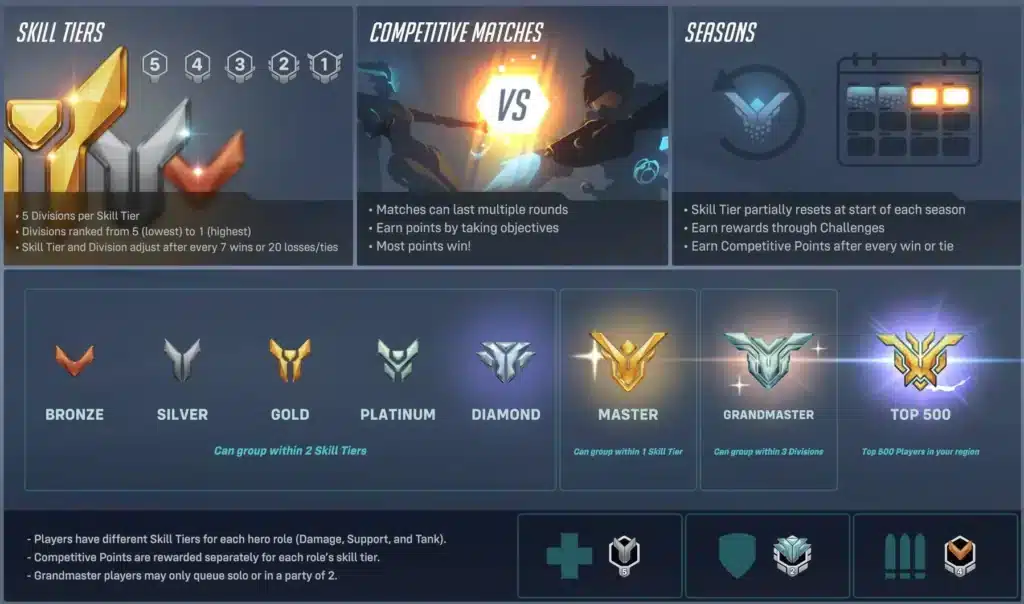
The ranked ladder in Overwatch 2 is divided into several tiers that represent different skill levels. Each rank reflects your overall effectiveness, decision-making, and ability to perform consistently in competitive environments.
Full List of Ranks in Overwatch 2 (Lowest to Highest)
Here are all the ranks in Overwatch 2, ordered from lowest to highest:
- Bronze
- Silver
- Gold
- Platinum
- Diamond
- Master
- Grandmaster
- Champion
- Top 500
Bronze and Silver: Learning the Competitive Basics
Bronze represents the entry point of competitive play. Players in this tier are usually learning the fundamentals, including positioning, hero abilities, and basic teamwork.
Silver players generally understand the basics but struggle with consistency. Mechanical skills and awareness are improving, yet mistakes still happen frequently.
Gold and Platinum: The Core of the Player Base
Gold is where the largest portion of the player base resides. Players here have a solid understanding of the game and can perform well, but execution and decision-making are not always reliable.
Platinum players show stronger mechanics and better game sense. Team coordination improves, and mistakes are punished more often.
Diamond: Where Skill Gaps Become Noticeable
Diamond marks a noticeable jump in skill. Players react faster, position better, and understand win conditions more clearly. Matches become less forgiving, and individual mistakes have a higher impact on outcomes.
Master and Grandmaster: High-Level Competitive Play
Master and Grandmaster are reserved for highly skilled players with excellent mechanics, deep game knowledge, and strong adaptability. Consistency, communication, and mental discipline are critical at this level.
Champion and Top 500: The Elite Tier
Champion is the newest competitive tier introduced in Overwatch 2. It sits above Grandmaster and represents the highest standard of ranked play.
Top 500 is not a traditional rank. It is a leaderboard that highlights the best players in each role and region during a competitive season.
Rank Divisions Explained (Bronze 5 to Champion 1)
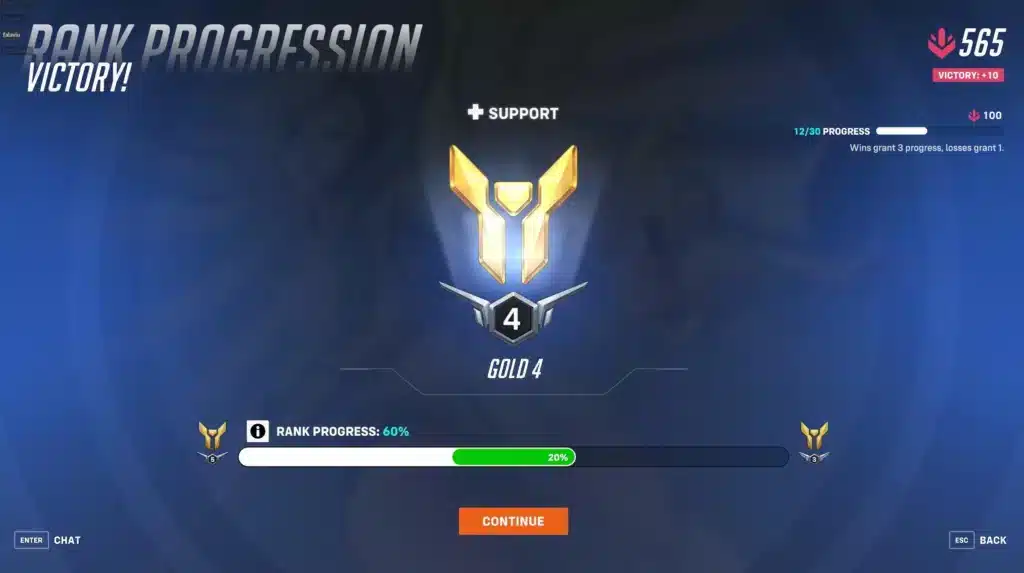
Each competitive rank is divided into five sub-tiers, ranging from Tier 5 to Tier 1. For example:
- Gold 5 (lowest in Gold)
- Gold 1 (highest in Gold)
These divisions allow the system to measure progression more accurately. Moving from Gold 5 to Gold 1 shows steady improvement without immediately jumping to a new rank.
Divisions help reduce frustration by providing clearer feedback. Even when you are not ranking up, you can still see progress within your current tier.
How Overwatch 2 Ranked Mode Works
The Overwatch 2 ranked experience is built around matchmaking accuracy and long-term evaluation. It is not designed to react instantly to one good or bad match.
Role Queue vs Open Queue Rankings
Overwatch 2 offers two main ranked formats:
- Role Queue
- Open Queue
In Role Queue, each player has a separate rank for Tank, Damage, and Support. This means you might be a Platinum Tank but only a Gold Support. The system evaluates your performance independently for each role.
Open Queue uses a single rank regardless of hero role. While it offers flexibility, Role Queue is generally considered more balanced and competitive.
Most players choose Role Queue because it creates clearer expectations and more consistent team compositions.
Placement Matches and Hidden MMR
When you first enter ranked mode, you complete placement matches. These matches help determine your starting rank by analyzing wins, losses, and in-game performance.
Behind the scenes, Overwatch 2 uses a hidden MMR (Matchmaking Rating). This value updates constantly and plays a major role in who you are matched with.
Your visible rank may lag behind your MMR. This is intentional, as the system prefers long-term accuracy over instant changes.
Overwatch 2 Rank Distribution Explained
Rank distribution shows where the majority of players are placed across the ladder. Understanding this helps set realistic expectations for progression.
Current Rank Distribution Overview
Most players fall between Gold and Platinum. These ranks represent the average to above-average skill range in Overwatch 2.
Lower ranks like Bronze and Silver contain a smaller percentage of players, while Diamond and above become increasingly rare.
Master, Grandmaster, and Champion represent only a tiny fraction of the competitive population. Reaching these ranks requires exceptional consistency and performance.
What Each Rank Says About Player Skill
Each rank reflects more than mechanical skill alone:
- Bronze and Silver focus on learning fundamentals
- Gold and Platinum emphasize consistency and teamwork
- Diamond rewards decision-making and adaptability
- Master and above demand precision, awareness, and mental resilience
Climbing is not only about playing more games. It is about understanding mistakes, improving execution, and maintaining performance under pressure.
Why Understanding Overwatch 2 Rankings Matters for Performance
Knowing how the ranking system works helps players focus on improvement instead of frustration. Ranked mode rewards consistency, not perfection.
How Ranks Affect Match Quality and Consistency
As your rank increases, matches become faster and more punishing. Mistakes are noticed immediately, and reaction times matter more.
This is why stable performance, both mechanically and technically, becomes critical in higher tiers.
Competitive Stability, Ping, and Performance
In ranked matches, every second matters. High ping, packet loss, or unstable routing can directly impact ability usage, reaction time, and ultimate timing.
Competitive integrity depends on fair conditions. Players climbing the Overwatch 2 ranking system benefit significantly from stable connections and consistent performance, especially as matches become more demanding at higher ranks.
How the Overwatch 2 Ranking System Really Works
Understanding the Overwatch 2 ranking system goes beyond understanding visible tiers. Ranked progression is influenced by hidden systems, long-term performance trends, and consistency across matches. This is why two players with similar win rates can experience very different ranking results.
Hidden MMR vs Visible Rank
At the core of Overwatch 2 ranked lies a hidden Matchmaking Rating, commonly known as MMR. This value represents how the system internally evaluates your skill level.
Your visible Overwatch 2 rank is essentially a reflection of this hidden MMR, but it updates more slowly. This design prevents extreme rank swings after short win or loss streaks.
Because of this, players often feel stuck even when winning games. In reality, the system is checking for consistency over time rather than short-term performance spikes.
What Actually Makes You Rank Up or Down
Ranking up in Overwatch 2 rankings is not solely about individual performance. While stats matter, match outcomes remain the primary factor.
Key elements that affect rank changes include:
- Win and loss streaks over multiple matches
- Consistent performance within your expected MMR range
- Playing against higher or lower-rated opponents
- Maintaining impact throughout entire matches
Carrying a single game does not guarantee immediate rank progression. The system prioritizes reliability and long-term impact.
Overwatch 2 Rank Distribution and What It Means
The Overwatch 2 rank distribution follows a curve designed to keep matches competitive and balanced.
Why Most Players Are Gold and Platinum
Gold and Platinum contain the largest percentage of players. These tiers represent the average to above-average competitive population.
This distribution exists because the system naturally stabilizes most players where their skill level is consistent. Rapid climbs become increasingly difficult once players reach their natural plateau.
Understanding this helps reduce frustration and creates realistic expectations for progression.
How Rank Distribution Changes by Role
In Role Queue, each role has a separate MMR and rank. This means:
- Tank players often experience slower climbs due to responsibility weight
- Damage roles face higher competition and longer queue times
- Support players are evaluated heavily on consistency and fight impact
As a result, it is common for players to have different ranks across roles.
Rank Resets, Seasons, and Competitive Updates
Every competitive season introduces adjustments designed to maintain balance within ranks in Overwatch 2.
How Seasonal Rank Resets Work in Overwatch 2
Overwatch 2 uses a soft reset system. Your hidden MMR remains mostly intact, while your visible rank is slightly adjusted.
This encourages active play each season without forcing players to completely restart their competitive journey.
Champion Rank and Recent Ranking Changes
Champion is the highest tier in the Overwatch 2 ranking system, positioned above Grandmaster.
Its purpose is to separate the absolute top performers from the rest of the high-ranked population, improving matchmaking accuracy at elite levels.
Champion also directly affects Top 500 placement, making competition at the highest level even more demanding.
How to Climb Faster in Overwatch 2 Ranked
Climbing efficiently requires a strategic mindset rather than grinding games endlessly.
Common Mistakes That Stop Players from Ranking Up
Many players stall due to avoidable habits:
- Playing while tilted or fatigued
- Constantly switching heroes without mastery
- Ignoring objectives in favor of eliminations
- Poor communication or refusal to adapt
Avoiding these mistakes alone can significantly improve your results.
Smart Habits That Improve Your Overwatch 2 Rank
Effective habits include:
- Specializing in a small hero pool
- Reviewing lost matches to identify patterns
- Playing ranked during consistent hours
- Prioritizing team fights over individual duels
Progression comes from discipline, not shortcuts.
Network Stability and Performance in Overwatch 2 Ranked
As ranks increase, margins for error shrink dramatically.
Why Lag and Packet Loss Hurt Your Ranking
Latency issues affect aim precision, ability timing, and ultimate usage. In high-pressure ranked matches, even small delays can decide entire fights.
Unstable connections lead to missed opportunities and inconsistent performance, directly impacting your ability to climb.
How ExitLag Improves Overwatch 2 Ranked Performance
ExitLag enhances ranked performance by optimizing routing between your connection and game servers. Through multipath connections and real-time optimization, it reduces ping spikes, packet loss, and instability.
This creates fairer conditions for climbing the Overwatch 2 rank ladder, especially in high-tier matches where consistency is critical.
Overwatch 2 Ranks Overview Table
| Rank | Skill Level | Player Presence | Common Challenges |
| Bronze | Beginner | Low | Positioning |
| Silver | Developing | Medium | Consistency |
| Gold | Average | High | Decision-making |
| Platinum | Above Average | High | Awareness |
| Diamond | Advanced | Low | Execution |
| Master | Expert | Very Low | Precision |
| Grandmaster | Elite | Rare | Mental endurance |
| Champion | Top Tier | Extremely Rare | Perfection |
All game images used in this blog belong to Blizzard Entertainment. They are used for informational/educational purposes only and do not imply endorsement or affiliation with the rights holders.
Got questions or want to connect with other players? Join the conversation at the ExitLag Forum!