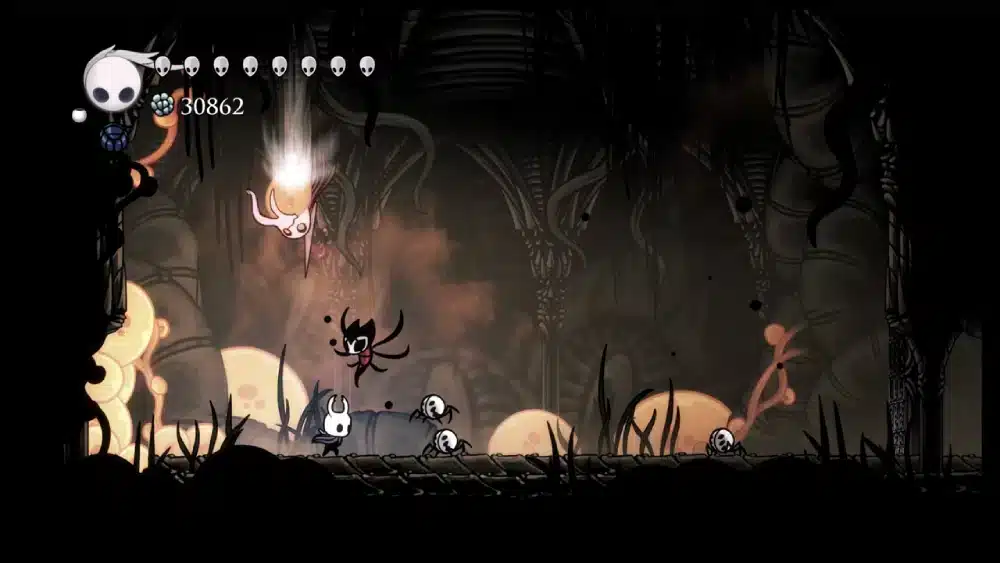

If you're preparing to face the Path of Pain Hollow Knight, you’re stepping into one of the most demanding precision challenges in the entire game. This hidden route inside the White Palace is infamous for its unforgiving design and relentless pacing, requiring absolute control of every movement ability.
The intensity of the Path of Pain Hollow Knight becomes clear the moment you enter. Sawblades, tight corridors, spike-lined walls and long platforming chains appear instantly, pushing players to rely on rhythm, awareness and learned timing rather than instinct alone.
Because the Path of Pain Hollow Knight offers no guidance, hints or visual cues to help you understand its mechanics, most players turn to community insights and technical explanations. This guide focuses on real player experience, separating confirmed game behavior from community interpretation to help you approach the challenge with clarity and confidence.
What exactly is the Path of Pain Hollow Knight?
In simple terms, it’s an optional, extremely difficult platforming sequence hidden inside the White Palace. It does not alter endings, it does not unlock extra areas, and it is not required for 100% or 112% completion.
Instead, the Hollow Knight Path of Pain is a personal challenge, a test of execution, patience and mastery. Your reward is symbolic, emotional and narrative rather than mechanical progression.
How to Unlock Path of Pain Hollow Knight
Reaching the Path of Pain is itself part of the challenge. The entrance is intentionally hidden and unmarked, which is why many players only discover it accidentally or through community tips.
Unlike typical breakable walls elsewhere in the game, the entrance here offers no visual cues, making experimentação, curiosity or luck the primary ways players uncover it.
Step-by-Step Access (with accurate clarification)
Follow these steps carefully:
- Enter the White Palace using the Awoken Dream Nail on the Pale King’s corpse;
- Progress upward through the palace until you reach the upper sawblade section, the one with long vertical shafts;
- In one of these shafts, on the upper-left side, there is a hidden, invisible breakable wall;
- This wall looks identical to the surrounding environment — no cracks, no sound cues, nothing;
- Strike the wall repeatedly;
- A new passage opens, leading to a secluded route and, eventually, to the entrance of the Path of Pain.
Why the Entrance Is Hard to Find
Players often mention that:
- There are no visual indicators of the hidden wall;
- The Path of Pain is meant to be a secret challenge, not an obvious quest;
- It fits the White Palace’s theme of meticulous precision and careful exploration;
- Many discover it only because they try attacking suspicious areas or read about it online.
Common Misunderstandings About the Entrance
Some players assume there must be a clue or hint, but the consensus is that:
- The entrance functions like a “developer secret”;
- Discovery depends on trial, error or community knowledge;
- The invisibility of the wall is intentional and contributes to the mystique surrounding the Hollow Knight Path of Pain.
Platforming Strategy for Path of Pain Hollow Knight
The platforming inside the Path of Pain is unlike anything else in the game. It demands discipline, sharp timing, and the ability to correct mistakes quickly. Many players compare its rhythm to a musical pattern — the sawblades, jumps and dashes create a tempo you must sync with.
Below are strategic foundations widely shared by experienced players who completed the Hollow Knight Path of Pain.
Maintain Flow Instead of Hesitation
Stopping too often breaks your rhythm and makes many obstacles harder. The Path of Pain rewards continuous flow because:
- Sawblade cycles repeat consistently;
- Movement momentum becomes part of your timing;
- Long sequences feel easier when you’re not second-guessing.
Still, this does not mean you must rush, the key is smooth, stable pacing.
Learn Sawblade Timing Through Repetition
Sawblade patterns appear overwhelming at first, but they follow predictable, consistent loops. Community experience suggests:
- Vertical blades alternate like mirrored pendulums;
- Horizontal blades often give slightly longer safe windows;
- Rotating sawblades require rhythmic movement rather than speed;
- No section contains random movement, everything is learnable.
Practice Micro-Movements and Controlled Inputs
Small mistakes have big consequences in the Path of Pain. You’ll need:
- Feathered tap jumps;
- Double-jump height control;
- Nail pogo fall-speed modulation;
- Dash + double-jump sync;
- Wall-jump resets for timing correction.
These micro-adjustments transform panic into control, a crucial mindset inside the Hollow Knight Path of Pain.
Pogoing With Intention
Pogoing is one of the most dangerous tools here. It helps you:
- Cross large gaps safely;
- Reset aerial control;
- Extend airtime precisely;
- Move past rotating blades.
But misuse leads to instant failure. Because pogoing on sawblades is so risky, your approach must be deliberate, patient and rhythm-focused.
Platforming Table of Key Techniques
Before diving into the specific techniques needed for the Path of Pain, it’s important to understand why they matter.
The challenge is built around precise execution, rhythm control and complete familiarity with Hollow Knight’s movement tools. Many sections are designed so tightly that even a slight misalignment, a jump that’s a frame too early, a pogo too shallow, or a dash released half a beat late, forces an immediate restart.
By understanding the core techniques below, players can transform repeated failures into meaningful progress and gradually shape the consistency required to clear the Path of Pain.
| Technique | Use Case | Difficulty | Notes |
| Short Hop | Tight gaps | Medium | Most essential fundamental |
| Dash → Double Jump | Reposition midair | Hard | Used constantly in Path of Pain |
| Pogo Control | Vertical movement | High | Small errors = restart |
| Wall-Cling Reset | Rhythm correction | Low | Reduces panic in long rooms |
| Cloak Dash | Phasing technique | High | Requires precise timing |
Recommended Charms for Path of Pain Hollow Knight
Charm selection in the Path of Pain is highly individual. There is no universal best build, and many community discussions emphasize that what works for one player may hinder another. Think of charms as tools — some support your rhythm, others interfere with it.
Below are commonly mentioned suggestions, not strict rules.
Charms That Many Players Find Helpful
Hiveblood
- Slowly regenerates health after damage;
- Helps reduce frustration during long sequences;
- Especially useful for players learning the route.
Grubsong
- Builds Soul after taking damage;
- Helps heal between attempts;
- Works best when paired with Hiveblood.
Shape of Unn
- Allows mobility while healing;
- Useful for players who take safe pauses between sections.
Charms for Aerial Reach and Stability
Longnail / Mark of Pride
- Increase nail range for pogoing;
- Makes vertical sequences more controlled.
Steady Body
- Prevents knockback from nail strikes;
- Helpful in rooms requiring consecutive pogo hits.
Charms to Use Carefully
Dashmaster
- While some players appreciate the movement rhythm boost;
- Others warn that it can cause accidental down-dashes during pogoing;
- Making certain Hollow Knight Path of Pain segments objectively harder.
Use Dashmaster only if you’re fully comfortable with precision pogo and sawblade interactions.
Reminder: Experimentation Is Essential
Charm effectiveness depends on:
- Player comfort;
- Nail bounce control;
- Rhythm consistency;
- Healing style;
- Spacing accuracy.
Every player should test multiple setups to find what complements their style.
Timing and Precision Tips for Path of Pain Hollow Knight
Timing is the true core of the Path of Pain. Even players with perfect control struggle if their timing is inconsistent. Improving your precision dramatically increases your success rate.
Build Muscle Memory Through Iteration
Muscle memory is key in the Hollow Knight Path of Pain. Players report that success comes from:
- Repeating rooms until you internalize their tempo;
- Memorizing where you can pause safely;
- Recognizing the natural “beat” of each sawblade cycle;
- Breaking large rooms into smaller, digestible chunks.
Stay Calm and Recover Between Attempts
Many failures come from panic, not lack of skill. Try:
- Breathing consistently before hard jumps;
- Resetting your posture after deaths;
- Using benches or rest points to clear your mind;
- Avoiding the urge to rush back after a good start.
Essential Micro-Skills to Practice
Skills that greatly help Path of Pain consistency:
- Feather tap jumps;
- Wall-jump timing correction;
- Controlled downward pogo;
- Diagonal dash input accuracy;
- Moment-to-moment spacing management.
Common Mistakes Players Should Avoid
- Using double jump too early, losing midair correction;
- Overjumping narrow platforms;
- Mis-timing rotating sawblade sections;
- Acting too quickly after a successful streak;
- Forgetting that hesitation causes cycle desync.
Rewards for Completing Path of Pain Hollow Knight
The Path of Pain is entirely optional, but players attempt it because the emotional reward is worth the effort. The sense of mastery and satisfaction is often described as one of the strongest feelings in the entire game.
Official Rewards
Completing the Path of Pain grants:
- A unique cutscene;
- The Seal of Binding journal entry.
These are symbolic rewards. They do not:
- Affect story endings;
- Unlock new regions;
- Increase game completion %;
- Gate any essential content.
Emotional and Personal Rewards
Many players say the real reward is:
- Overcoming a rare and difficult challenge;
- Feeling genuine mastery of the movement mechanics;
- Understanding the emotional message of the cutscene;
- Earning “bragging rights” within the community.
Community Perspective
Players of all skill levels agree that:
- The challenge is subjective, some take hours, others less;
- The Path of Pain is more a test of discipline than raw mechanics;
- The journey itself is the reward;
- Completing it teaches movement skills valuable everywhere else in Hallownest.
Take the Challenge and Master Your Movement
Now that you understand how to unlock the Path of Pain, how its hidden entrance works, how platforming rhythm dictates success, which charm suggestions tend to help (and which require caution), how timing defines survival, and why the reward is primarily symbolic, you’re fully prepared to face Hollow Knight’s most infamous challenge.
The Path of Pain Hollow Knight is less about progression and more about proving to yourself that you can master precision, embrace patience, and refine your understanding of every movement mechanic in the game. If you approach it with the mindset of growth instead of frustration, completing it becomes one of the most satisfying experiences Hollow Knight has to offer.
Ready for even smoother gameplay experiences across your PC library? Try ExitLag and keep your connection optimized whenever you jump into online adventures.