Understanding PUBG reports is one of the fastest ways to gain a clearer picture of how the game handles player behavior, competitive performance, and account activity. Whether you want to understand a report received after a match, improve your own performance, or learn how reporting fits into the broader PUBG experience, knowing where the relevant information comes from gives you an important advantage.
If you take the time to understand PUBG reports, you can also become more informed about what you are seeing in your account history and why certain forms of player behavior matter. The same approach applies to performance statistics: reviewing your results, identifying weaknesses, and understanding how the game's systems work can help you make smarter decisions in future matches.

What are PUBG reports and why do they matter?
PUBG reports are part of the system players use to flag behavior they believe violates the game's rules or negatively affects a match. Depending on the situation, a player may report another participant for suspected cheating, abusive behavior, griefing, exploiting bugs, or other inappropriate conduct.
The reporting system exists because competitive multiplayer games depend on players being able to identify behavior that cannot always be detected immediately through normal gameplay. A report can therefore provide an additional signal for moderation and security systems.
At the same time, a report is not automatically proof that a player has violated a rule. Players can misunderstand situations, report someone after losing a fight, or submit reports without sufficient evidence. That distinction is important when discussing PUBG reports, because the existence of a report and the confirmation of misconduct are not necessarily the same thing.
The purpose of reporting in PUBG
The basic purpose of reporting is to give players a way to flag suspicious or inappropriate behavior.
Common reasons for submitting a report include:
- Cheating, including suspected aimbot or wallhack use.
- Toxic behavior, such as offensive communication or disruptive conduct.
- Griefing, where a player intentionally interferes with teammates or the normal flow of a match.
- Exploits or bug abuse, particularly when a player deliberately uses an unintended game mechanic to gain an advantage.
- Other behavior that appears to violate the game's rules.
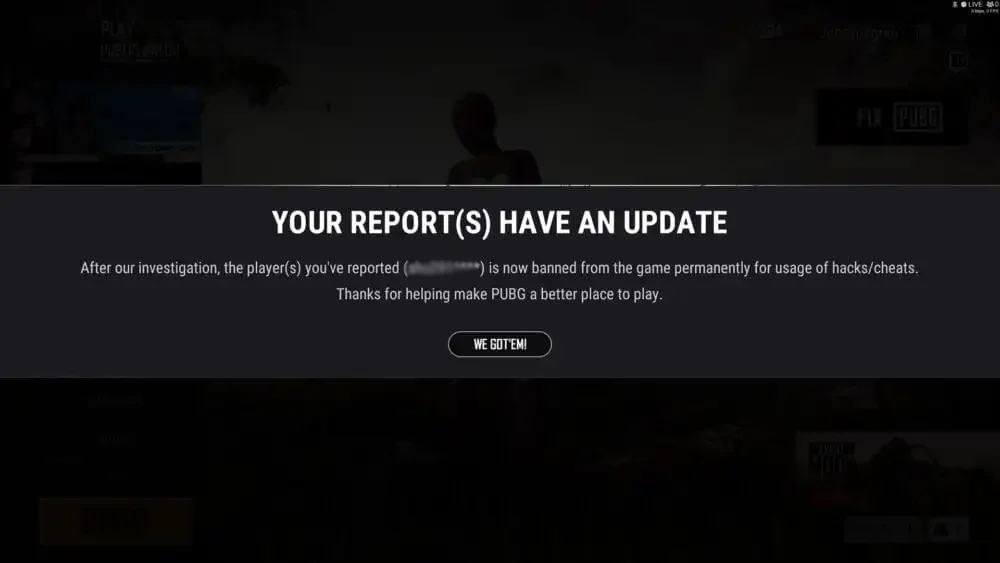
The system is therefore designed to protect the competitive environment rather than simply punish players based on individual accusations.
Why a report does not automatically mean a ban
One of the most important distinctions surrounding PUBG reports is the difference between a submitted report and a confirmed violation.
A player can receive a report without having cheated. Likewise, someone can be reported because another player disagreed with a tactical decision, suspected an unusual shot, or reacted emotionally to losing a fight.
For that reason, reports should be understood as signals rather than final verdicts.
When moderation and security systems evaluate suspicious behavior, additional information can be relevant. Depending on the specific system and situation, this can include gameplay patterns, automated detection signals, account activity, and other evidence.
This approach is particularly important in a competitive game where unusual but legitimate plays can sometimes look suspicious.
Reporting in PUBG is part of a broader ecosystem
Reporting in PUBG should not be viewed as an isolated feature. It exists alongside anti-cheat technology, moderation procedures, player statistics, matchmaking, account systems, and game updates.
That means a player's experience is shaped by several systems working at the same time.
For example, a player may have excellent combat statistics while still receiving reports because opponents interpret an unusual playstyle as suspicious. Conversely, a player may have average statistics but repeatedly engage in disruptive behavior.
The numbers alone do not tell the entire story.
What information can your PUBG profile reveal?
Before focusing entirely on reports, it is useful to understand how player statistics provide context. Performance data can show how consistently you perform, where your strengths are, and which aspects of your gameplay need attention.
The original approach to analyzing PUBG performance centers on statistics such as K/D ratio, win rate, accuracy, survival time, and headshot percentage. These metrics remain useful because they transform individual matches into longer-term patterns.
The most important PUBG performance metrics
Several statistics are especially valuable when evaluating your performance.
| Metric | What it measures | Why it matters |
| K/D Ratio | Kills compared with deaths | Shows combat effectiveness |
| Win Rate | Matches successfully won | Indicates finishing and survival ability |
| Accuracy | Percentage of shots that hit | Helps evaluate aim and weapon control |
| Survival Time | Average time alive | Reflects positioning and awareness |
| Headshot Percentage | Share of kills involving headshots | Helps assess precision and aim control |
| Damage per Round | Average damage dealt | Shows overall combat impact |
| Match History | Results across individual games | Helps identify trends over time |
A K/D ratio around 1.0 generally means a player averages approximately one kill per death. A higher number suggests stronger combat results, although it does not automatically mean the player has better overall decision-making.
Win rate provides another perspective. A player can have a high K/D but a lower win rate if they take unnecessary fights or struggle during late-game rotations.
Accuracy and headshot percentage can reveal mechanical weaknesses, while survival time can expose problems with positioning, rotations, or risk management.
Why statistics should be analyzed together
Looking at one number in isolation can produce misleading conclusions.
For example, suppose a player has high damage but a relatively low number of kills. That could indicate that the player consistently weakens opponents but struggles to finish engagements.
Likewise, a player with a high survival time but low damage may be prioritizing passive play. This can be effective in some situations, but it may also indicate that the player avoids opportunities to secure eliminations.
This is why the most effective approach is to compare multiple statistics.
Your K/D, win rate, accuracy, survival time, and damage can create a much more complete picture than any individual number.
How player statistics connect to reports
Statistics and PUBG reports measure different aspects of the game.
Stats describe what happened during matches. Reports describe concerns raised about player behavior.
A high K/D does not prove cheating. A low K/D does not prove that a player is legitimate. Similarly, receiving several reports does not automatically prove that an account violated the rules.
This distinction prevents one of the most common misunderstandings about competitive statistics: performance data and moderation data should not be treated as interchangeable.
How the PUBG report system works
The basic concept behind PUBG reports is straightforward. A player observes behavior they believe violates the rules and submits a report through the available reporting interface.
The report then becomes part of the information available to the game's broader moderation and security processes.
What players can report
Players may encounter situations where reporting appears appropriate because another participant is:
- Using suspected cheats.
- Deliberately disrupting teammates.
- Engaging in abusive or offensive communication.
- Exploiting a bug or unintended mechanic.
- Repeatedly interfering with normal gameplay.
However, the most useful approach is to report behavior based on what you actually observed rather than making assumptions about a player's intentions.
For example, seeing an opponent perform an unusually accurate shot does not necessarily mean that the player is cheating. Competitive games can produce impressive plays through legitimate skill, favorable positioning, weapon control, or simple timing.
Why false reports can happen
False reporting is a natural risk in any competitive multiplayer environment.
Players are more likely to become suspicious when:
- They lose an unexpected fight.
- An opponent appears to react unusually quickly.
- A teammate makes a decision they disagree with.
- Network conditions create unusual visual behavior.
- A replay or spectator perspective makes an action look different from the original encounter.
These situations demonstrate why PUBG reports should be treated as investigative signals rather than automatic punishment mechanisms.
What makes responsible reporting different
Responsible reporting focuses on observable behavior.
Instead of reporting every opponent who wins a difficult gunfight, players should consider whether there is a meaningful reason to suspect a violation.
A more responsible approach is to:
- Identify the behavior that appears suspicious.
- Consider whether there could be a legitimate explanation.
- Use the appropriate report category.
- Avoid repeatedly reporting players simply because you lost.
- Continue playing rather than attempting to confront or harass the suspected player.
This keeps the reporting system more useful for everyone.
Understanding PUBG reports and account reputation
One of the biggest concerns players have is whether receiving reports automatically damages their account.
The supplied material emphasizes that report history can form part of the broader information associated with player behavior. However, it also makes clear that false reports happen and that reports need to be reviewed rather than interpreted as automatic evidence of misconduct.
Why account behavior matters
A clean behavioral history is valuable in any competitive multiplayer game.
Players who consistently avoid cheating, harassment, griefing, and exploit abuse are less likely to encounter moderation problems.
At the same time, players should not assume that a single report means their account has been permanently damaged.
The important distinction is between a report being submitted and a violation being confirmed.
Reports versus confirmed violations
These two concepts should always be separated.
A report is an accusation or signal submitted by another player.
A confirmed violation is a conclusion reached through the game's relevant enforcement processes.
This distinction matters because the reporting system would be unreliable if every accusation automatically resulted in punishment.
It also protects legitimate players who are reported after unusual but legal gameplay.
How players can protect their accounts
The most straightforward strategy is to maintain consistent, legitimate behavior.
That includes:
- Avoiding unauthorized software.
- Avoiding deliberate exploitation of bugs.
- Treating teammates and opponents respectfully.
- Using the game's systems as intended.
- Avoiding harassment after matches.
- Reporting suspicious behavior through the appropriate tools instead of escalating conflicts.
Account health is ultimately about more than one match.
Where to check your PUBG statistics
Once you understand the relationship between performance and behavior systems, the next step is learning where to find your statistics.
PUBG provides an in-game statistics system that can give players a useful overview of their performance. However, players interested in deeper analysis may also use third-party tracking services.
In-game stat tracking
PUBG's built-in statistics can provide information such as:
- Kill totals.
- K/D ratio.
- Damage per round.
- Matches played.
- Wins.
- Rankings.
- Performance across different game modes.
- Seasonal history.
This information is useful because it is directly connected to your game profile.
For most players, the in-game tracker is the best starting point. It provides enough information to identify broad trends without requiring additional tools.
Limitations of basic statistics
The main limitation is depth.
Summary statistics can tell you that your survival time is low, but they may not immediately explain why.
Likewise, a low win rate does not automatically tell you whether your problem is poor positioning, inefficient rotations, weak late-game decision-making, or inconsistent combat performance.
That is where deeper match analysis can become useful.
Third-party PUBG tracking platforms
Third-party services can provide additional views of player performance.
The original material highlights platforms such as Tracker.gg, PUBG.OP.GG, and PUBG Lookup.
These services can offer different ways of viewing information, including match histories, leaderboards, weapon performance, seasonal progression, and comparisons between players.
The exact information available can vary by platform, account, region, game version, and data access.
For that reason, players should treat third-party trackers as analytical tools rather than assuming that every service contains a complete representation of their account.
Tracker.gg and detailed PUBG performance analysis
Tracker.gg is presented in the original material as one of the most popular tools for viewing PUBG statistics.
Its value comes from presenting information in a format designed for comparison and progression tracking.
What players can analyze
Depending on available data, a PUBG tracker can help players examine:
- K/D performance.
- Win rate.
- Headshot percentage.
- Match history.
- Regional leaderboards.
- Game-mode performance.
- Seasonal progression.
- Weapon-related performance.
This makes it easier to compare short-term results with longer-term trends.
Using trackers without becoming obsessed with numbers
Statistics are useful only when they lead to better decisions.
Constantly refreshing a tracker after every match can create unnecessary pressure. A better approach is to analyze performance in sessions.
For example, after several matches, ask:
- Did my survival time improve?
- Am I taking more unnecessary fights?
- Is my damage increasing?
- Am I finishing engagements more effectively?
- Am I surviving longer because of better positioning?
- Is my win rate changing over several sessions?
This approach makes statistics a tool for learning rather than a source of frustration.
PUBG.OP.GG and player comparisons
PUBG.OP.GG is another platform identified in the original material as useful for performance analysis.
Its strength is presented through visual breakdowns and comparisons that can help players understand recent matches and overall progression.
Comparing performance with other players
Comparisons can be useful when they are used as benchmarks rather than judgments.
For example, a player might compare their performance with someone at a similar rank and discover that their damage is significantly lower despite having a similar survival time.
That could suggest a need for more aggressive but controlled engagement strategies.
Similarly, a player with high damage but poor finishing results may need to improve target selection and engagement discipline.
Why comparisons need context
Not all statistics are directly comparable.
Different players may use different modes, maps, team compositions, or playstyles.
A squad player may naturally have different results from a solo player. A player who prioritizes survival may also have a different K/D profile from someone who actively hunts engagements.
Therefore, comparison should always consider the context behind the numbers.
PUBG Lookup and historical match data
PUBG Lookup is highlighted in the original material as another option for players who want more raw information.
Its appeal is the ability to examine individual matches and historical trends.
Match-by-match analysis
A match-level view can help identify recurring problems.
For example, if several losses occur because of late rotations, the issue becomes easier to recognize when viewed across multiple games.
Likewise, repeated early deaths in similar situations can reveal that the problem is not simply bad luck.
Building a personal performance timeline
Historical data is especially useful because improvement rarely happens in a straight line.
A player may experience:
- A period of rapid improvement.
- A temporary decline after changing sensitivity.
- Better survival after learning a new map.
- A K/D increase after improving recoil control.
- A win-rate decline caused by overly aggressive play.
Looking at these changes over time provides more useful information than judging one match.
PUBG maintenance and its effect on the player experience
Another important keyword in this topic is PUBG maintenance.
Maintenance periods are a normal part of operating a live multiplayer game. They allow developers and infrastructure teams to apply updates, address technical problems, implement changes, and keep online services functioning.
Why PUBG maintenance matters
A live-service game depends on a complex online infrastructure.
Maintenance can be required for:
- Game updates.
- Server-side changes.
- Security improvements.
- Bug fixes.
- Performance improvements.
- New content.
- Technical infrastructure work.
During maintenance, players may temporarily lose access to certain online features or be unable to enter matches.
Maintenance is not the same as a player problem
Players sometimes interpret connection or matchmaking issues as account problems.
However, if a game is undergoing scheduled maintenance, the issue may affect a large portion of the player base rather than an individual account.
This distinction matters when troubleshooting.
Before changing settings, reinstalling the game, or assuming that your account has been restricted, check whether there is an active maintenance period or service disruption.
How maintenance can affect statistics
Maintenance can temporarily affect the ability to access match history, matchmaking, leaderboards, or other online features.
This does not necessarily mean that your statistics have disappeared.
For that reason, players should avoid drawing conclusions from temporary interruptions.
Performance, connectivity, and PUBG reports
Competitive performance depends on more than mechanical skill.
Connection quality can affect how accurately a player experiences a match, particularly during fast engagements.
Why connection stability matters
A player can have excellent aim and positioning but still experience problems when the connection becomes unstable.
Potential symptoms include:
- Delayed actions.
- Sudden movement.
- Packet loss.
- Inconsistent hit registration.
- Rubber-banding.
- Unexpected disconnections.
These issues can make a legitimate encounter appear unusual.
Why this matters when interpreting reports
Connection problems can sometimes complicate what players see during a match.
An opponent may appear to move unpredictably because of network conditions rather than cheating.
Similarly, a player experiencing latency may react later than expected or appear to perform an action differently from what actually happened on the server.
This is another reason why PUBG reports should be based on meaningful evidence rather than immediate assumptions.
How to improve your PUBG statistics
Understanding your numbers is only the beginning. The real value comes from using them to change how you play.
Improving your PUBG performance requires consistency, observation, and deliberate adjustments.
Improve map knowledge
Every PUBG map has different landing locations, terrain, rotations, sightlines, and risk levels.
Map knowledge can directly improve survival time because you become better at predicting where fights are likely to happen and which routes offer safer movement.
Try to:
- Learn reliable landing locations.
- Memorize high-value loot areas.
- Understand common rotation routes.
- Identify strong defensive positions.
- Study locations where late-game circles frequently create difficult engagements.
Better map knowledge can also reduce unnecessary deaths.
Master weapon handling
Weapon control remains one of the most important mechanical skills in PUBG.
Different weapons have different recoil patterns, firing characteristics, and effective ranges.
Training mode can help you practice:
- Recoil control.
- Spray consistency.
- Burst firing.
- Sensitivity adjustments.
- Attachment choices.
- Long-range precision.
A player who can control recoil consistently is more likely to convert opportunities into eliminations.
Build stronger awareness
Situational awareness has a direct relationship with survival.
Before moving, consider:
- Where the next safe zone is.
- Where enemies may have rotated.
- Whether nearby vehicles could reveal your position.
- Whether you have sufficient cover.
- Whether the next fight is actually necessary.
Small decisions accumulate over the course of a match.
Avoid unnecessary engagements
One of the easiest ways to damage your win rate is to take fights that provide little strategic value.
Not every opponent needs to be eliminated immediately.
Sometimes the better decision is to rotate, reposition, heal, or wait.
A more disciplined player can survive longer while still taking decisive fights when the circumstances are favorable.
How to use your statistics to identify weaknesses
Statistics become much more valuable when they answer specific questions.
Low headshot percentage
If your headshot percentage is consistently low, focus on aim placement and recoil control.
Instead of simply trying to shoot faster, practice keeping your crosshair at the expected head level.
Low survival time
A low average survival time can indicate several possible problems.
You may be:
- Landing in excessively contested areas.
- Rotating too late.
- Moving without cover.
- Taking unnecessary fights.
- Failing to read the safe zone.
- Exposing yourself during looting.
The correct solution depends on the pattern.
High damage but low kills
This combination can be particularly informative.
It may indicate that you are consistently winning the first stage of engagements but failing to finish opponents.
In that case, consider improving target confirmation, positioning, timing, and team coordination.
High K/D but low win rate
This can indicate excessive aggression.
A player may be very effective in gunfights but still lose because they prioritize eliminations over positioning and endgame survival.
If your K/D is strong but your win rate remains low, consider whether your aggression is creating avoidable risks.
A practical routine for analyzing PUBG performance
A structured routine can make statistical analysis much easier.
Before playing
Set one specific objective.
For example, focus on:
- Better positioning.
- More controlled rotations.
- Recoil management.
- Avoiding unnecessary fights.
- Improving late-game decision-making.
Avoid trying to improve every aspect at once.
During the session
Pay attention to recurring decisions rather than individual mistakes.
Ask yourself:
- Why did I die?
- What information did I have before the fight?
- Did I have a better position available?
- Did I rotate too late?
- Was the engagement necessary?
These questions provide more useful feedback than simply looking at the final result.
After the session
Review several matches together.
Look for patterns rather than isolated incidents.
If the same mistake appears repeatedly, it becomes a clear training priority.
Over time, this method can make PUBG reports and player statistics easier to understand because you begin to separate actual account information from emotional reactions to individual matches.
The relationship between PUBG, reporting, and competitive integrity
PUBG is built around competition, survival, and decision-making.
That means competitive integrity is important for everyone, regardless of skill level.
Why fair play matters
A competitive match is meaningful when players believe that the outcome reflects legitimate gameplay.
Cheating and deliberate exploitation undermine that principle.
Reporting therefore has an important role because it gives players a way to flag behavior that appears inconsistent with fair play.
Why players should not abuse reporting
The reporting system is most useful when reports are meaningful.
Excessive or emotional reporting can make it harder to distinguish legitimate concerns from ordinary competitive frustration.
A player who reports every opponent who defeats them is not contributing useful information.
The strongest approach is simple: observe, evaluate, and report when there is a reasonable basis.
How PUBG's evolving player base affects statistics
PUBG has evolved significantly since its original release.
The game has developed different modes, maps, competitive environments, and player populations over time.
That evolution affects how statistics should be interpreted.
The impact of the free-to-play model
PUBG: Battlegrounds moved to a free-to-play model in 2022.
That change increased accessibility and brought additional players into the game.
A larger player base can create a broader range of skill levels in matchmaking.
For experienced players, this can mean that individual match results vary more depending on lobby composition and player behavior.
Why long-term statistics remain useful
The more matches you play, the more valuable trends become.
A single match can be influenced by:
- Drop location.
- Loot quality.
- Zone position.
- Team decisions.
- Unexpected encounters.
- Network conditions.
- Opponent behavior.
Over dozens or hundreds of matches, these random factors become easier to contextualize.
That is why long-term analysis is more useful than judging performance from one session.
Common mistakes players make when interpreting PUBG reports
Understanding PUBG reports also means understanding what not to assume.
Mistake one: assuming every report means punishment
A submitted report is not automatically equivalent to a confirmed violation.
Players should not panic simply because they believe another player may have reported them.
Mistake two: assuming good statistics prove legitimacy
Excellent performance does not prove that a player is legitimate.
Statistics show outcomes, not necessarily the methods used to achieve them.
Mistake three: assuming poor statistics mean a player is harmless
The opposite assumption is also unreliable.
A player can have average statistics and still violate rules.
Mistake four: confusing technical problems with moderation
A maintenance period, connection issue, or temporary service interruption does not automatically mean that an account has been restricted.
Always consider the broader technical context.
Mistake five: treating third-party trackers as official enforcement records
Third-party platforms are useful for statistics and analysis, but their information should not automatically be interpreted as an official moderation record.
Their purpose is generally performance tracking, not determining whether an account has violated game rules.
How to build a healthier PUBG improvement strategy
A strong improvement strategy combines mechanical practice, statistical analysis, game knowledge, and behavioral discipline.
Focus on measurable objectives
Instead of saying "I want to become better," choose something measurable.
Examples include:
- Increase average survival time.
- Improve accuracy.
- Reduce unnecessary early deaths.
- Increase damage per match.
- Improve late-game decision-making.
- Maintain a more consistent win rate.
Specific objectives make progress easier to identify.
Review trends instead of chasing perfection
No player performs perfectly every match.
A bad game does not erase weeks of improvement.
Likewise, one exceptional match does not necessarily mean that a player has permanently improved.
The goal is consistency.
Combine statistics with gameplay context
Numbers tell you what happened.
Gameplay review helps explain why it happened.
If your survival time decreases, examine your rotations.
If your K/D falls, examine your engagement choices.
If your accuracy drops, review your weapon control and sensitivity.
If your win rate declines while your damage increases, consider whether you are becoming too aggressive.
This creates a practical feedback loop.
PUBG reports, stats, and the importance of informed decision-making
The most useful way to understand PUBG reports is to place them within the larger PUBG ecosystem.
Reports concern player behavior and potential rule violations.
Statistics concern gameplay performance.
Maintenance concerns the availability and technical operation of the live game.
Connectivity affects how smoothly players interact with the servers.
These systems are different, but they can all influence the way players experience a match.
A complete view of the player experience
A player trying to improve should therefore look at several categories at once:
- Performance: K/D, accuracy, damage, survival time, and win rate.
- Behavior: reports, fair-play decisions, and communication.
- Technical conditions: connection stability and service availability.
- Game knowledge: maps, weapons, rotations, and positioning.
- Consistency: long-term trends rather than isolated matches.
This broader perspective is more useful than focusing on a single number or report.
Why knowledge creates a competitive advantage
When players understand the systems behind the game, they can react more rationally.
Instead of assuming that every unusual event is cheating, they can consider legitimate explanations.
Instead of blaming poor statistics on bad luck, they can identify recurring weaknesses.
Instead of assuming that maintenance means an account problem, they can distinguish service availability from account status.
That awareness ultimately leads to better decisions both inside and outside matches.
Final thoughts on PUBG reports and better performance
Understanding PUBG reports is not simply about learning how to click a report button. It is about understanding how player behavior, competitive integrity, statistics, technical conditions, and game maintenance fit together. And to improve your gaming even further, you can count on tools such as ExitLag, which optimizes your connection and reduces lag.
FAQ – PUBG Reports
What are PUBG reports?
PUBG reports are player-submitted reports used to flag suspected cheating, toxic behavior, griefing, exploit abuse, or other conduct that may violate the game's rules. A report is a signal for review and does not automatically mean that the reported player will receive a penalty.
How does reporting in PUBG work?
Reporting in PUBG allows players to flag suspicious or inappropriate behavior through the available reporting tools. Reports can provide information to the game's moderation and security systems, where additional evidence and gameplay information may be considered before enforcement action is taken.
Can PUBG reports result in a ban?
A report does not automatically result in a ban. PUBG reports are treated as part of a broader evaluation process. If a violation is confirmed, consequences may vary depending on the nature and severity of the behavior, while false or unsupported reports do not necessarily result in punishment.
Where can I check my PUBG stats?
You can check your PUBG statistics through the game's built-in statistics and career features. Third-party services such as Tracker.gg, PUBG.OP.GG, and PUBG Lookup can also provide additional information, including match history, rankings, seasonal performance, and other available statistics.
What is PUBG maintenance?
PUBG maintenance refers to periods when the game's online services may temporarily be unavailable while technical teams apply updates, fixes, security improvements, or other server-side changes. During maintenance, players may be unable to access matchmaking or certain online features until service is restored.