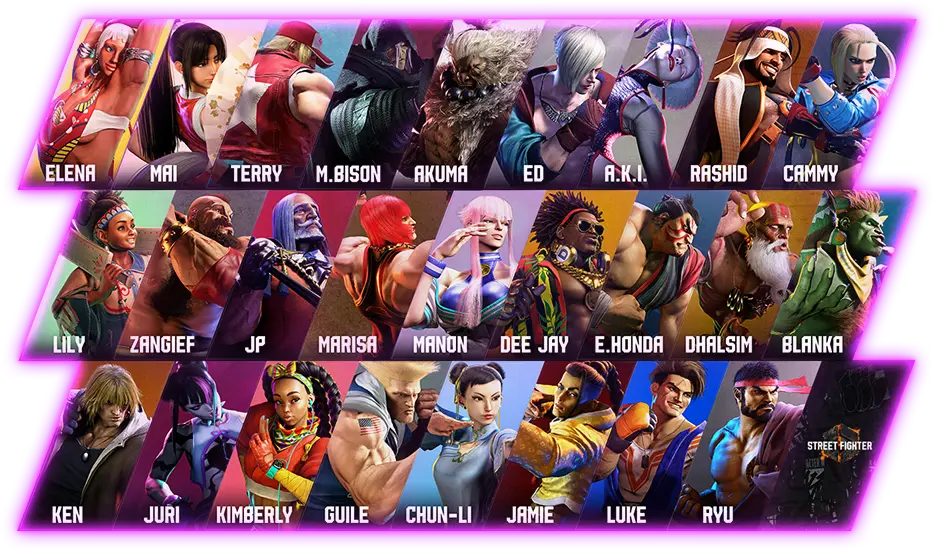

The Street Fighter 6 tier list changes whenever Capcom releases balance adjustments, players discover new strategies, or major tournaments reveal which fighters perform consistently under pressure. A character considered dominant during one season can fall behind after universal mechanics, damage routes, or defensive options change.
Players interested in Street Fighter 6 tier list placements should also study individual game plans instead of looking only at letters. Cammy, for example, remains a strong competitive choice because of her movement, pressure, corner carry, and ability to punish predictable zoning. Our complete Cammy guide for Street Fighter 6 explains how her tools work beyond a simple tier placement.
This Street Fighter 6 tier list reflects the playable roster and competitive environment available in July 2026. It includes Ingrid and the rest of the Year 3 lineup, while considering tournament performance, matchup spread, consistency, execution demands, Drive Gauge efficiency, defensive options, and ranked viability.
Tier lists are never official declarations from Capcom. They are analytical snapshots created by players, competitors, coaches, and communities. Therefore, disagreements are expected, especially when comparing theoretical strength with real tournament results.
What is the current Street Fighter 6 tier list?
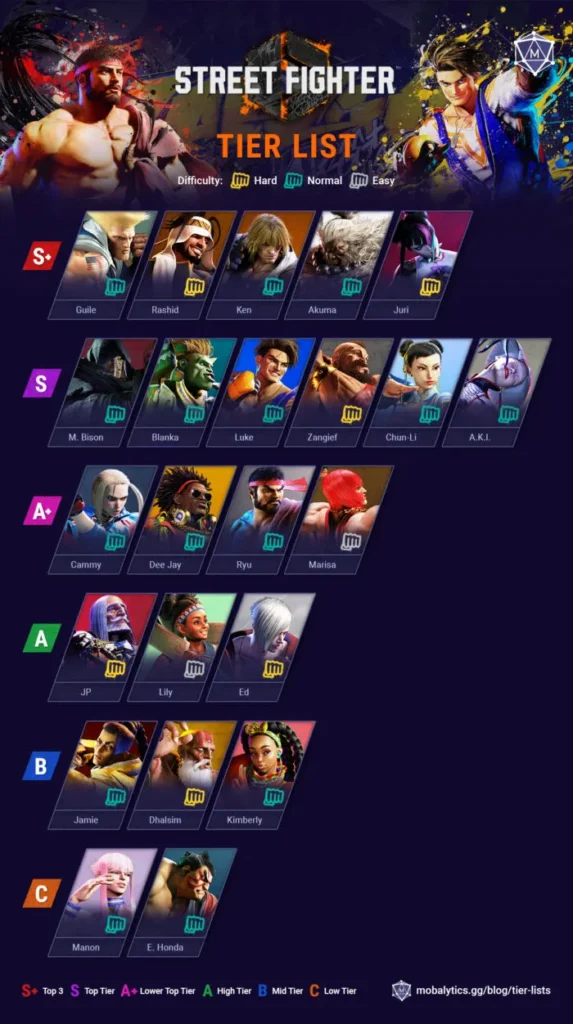
The current SF6 tier list places characters into broad competitive groups. S-tier fighters generally have powerful neutral tools, reliable conversions, strong Drive Gauge interaction, and few severely unfavorable matchups. Lower-tier fighters remain playable, but they may require more precise decisions or encounter problems that stronger characters avoid.
This ranking is designed primarily for high-level competitive play. At beginner and intermediate levels, unfamiliar matchups, simple strategies, execution consistency, and player comfort can matter more than professional tier placement.
| Tier | Characters | General competitive outlook |
| S | Mai, Ed, JP, Sagat, M. Bison, Ryu | Consistent top-level tools with strong tournament potential |
| A | Akuma, Guile, Cammy, Terry, Rashid, Luke, Ken, Chun-Li, Blanka, Zangief | Highly competitive fighters with manageable weaknesses |
| B | Kimberly, Ingrid, Dee Jay, A.K.I., Juri, Dhalsim, Elena, Alex, Jamie, C. Viper | Strong in the right hands but more dependent on execution or matchups |
| C | Manon, E. Honda, Lily, Marisa | Viable specialists who face more pronounced competitive limitations |
Every fighter can win online matches, reach advanced ranks, and succeed in tournaments with the right player. The differences become more meaningful when opponents understand the matchup and consistently punish weaknesses.
S tier: the strongest competitive choices
Mai combines excellent neutral control, mobility, pressure, projectile tools, and efficient conversions. Her kit gives her answers at several ranges without forcing the player into one narrow game plan.
Ed remains one of the most stable competitive fighters. His unusual boxing range, strong punish opportunities, flexible combos, and effective pressure reward players who understand spacing and opponent habits.
JP continues to control large portions of the screen. Although experienced players have developed better counterplay, his projectiles, portals, command grab threat, and corner sequences still make him one of the most dangerous Street Fighter 6 characters.
Sagat brings powerful ground control, strong normals, effective fireballs, and substantial damage. His ability to dictate the pace of neutral makes approaching him difficult, especially when the player manages Drive Gauge carefully.
M. Bison creates intense offensive pressure through strong movement, damaging confirms, and Psycho Mine setups. He can force opponents into uncomfortable defensive situations, although some matchups require greater risk management.
Ryu has developed into a complete and dependable tournament character. His damage, fireball control, anti-air options, Drive Rush conversions, and Denjin-based routes make him much more than a basic beginner choice.
A tier: tournament-ready fighters with clear strengths
Akuma has exceptional mobility, offensive variety, and damage potential, but his lower health increases the cost of mistakes. That tradeoff prevents him from being universally safer than every S-tier option.
Guile remains one of the game’s strongest defensive characters. Sonic Boom controls space, Flash Kick discourages careless approaches, and his normals allow experienced players to dominate neutral.
Cammy, Terry, Rashid, Luke, Ken, and Chun-Li all have the tools needed to win major matches. Their positions can change depending on the criteria used for the SF6 rankings, but none should be considered a weak competitive choice.
Blanka is especially difficult to rank. His unusual movement, Blanka-chan setups, mobility, and matchup-specific tricks can look overwhelming in the hands of a specialist. However, his risk profile and unconventional decision-making make his results heavily dependent on the player.
Zangief also demonstrates why tier lists require context. His movement and difficult matchups can limit him, but his damage, command grabs, defensive reads, and ability to transform one mistake into a lost round make him a serious competitive threat.
Players who want to compare the complete roster, archetypes, DLC additions, and playstyles can read our overview of all Street Fighter 6 characters. Choosing between the available fighters becomes easier once you understand how charge characters, grapplers, zoners, rushdown specialists, and all-rounders approach a match.
Who is the best character in Street Fighter 6?
There is no undisputed answer because the best fighter depends on the patch, matchup, control scheme, player level, and ranking criteria. Nevertheless, Mai, Ed, JP, and Sagat are among the strongest candidates in the current Street Fighter 6 tier list.
A professional competitor may value tournament consistency and matchup coverage. A ranked player may prefer a fighter with a straightforward game plan, reliable anti-airs, and easy conversions under online conditions.
Best characters for high-level competition
Mai is one of the most complete fighters in the current environment. She can control horizontal space, convert stray hits, apply pressure, and alter her approach without abandoning her core game plan.
Ed rewards strong spacing and preparation. His toolkit can look less immediately overwhelming than explosive rushdown characters, but his consistency becomes clear when a skilled player controls the range of every interaction.
JP is still a premier choice for players who enjoy controlling space. His ability to create layered threats forces opponents to navigate projectiles, portals, feints, and grabs before they can begin normal offense.
Sagat is an excellent option for disciplined players. His fireball patterns and long-reaching attacks punish impatience, while his damage makes each successful read meaningful.
The best choice is not necessarily the character ranked first. It is often the highest-ranked fighter whose movement, inputs, pressure patterns, and preferred range match the player’s instincts.
Best characters for ranked progression
Ryu and Luke are strong choices for learning fundamentals. Both can teach anti-air reactions, fireball control, confirms, spacing, and the relationship between normal attacks and Drive Rush.
Ken provides stronger offensive momentum. His corner carry and pressure can help ranked players capitalize on an opponent’s defensive mistakes, although reckless approaches become easier to punish at higher levels.
Cammy is excellent for players who enjoy movement and close-range pressure. She can challenge projectiles, walk quickly, and punish poor spacing, but she still requires disciplined offense against opponents who understand her common sequences.
E. Honda and Lily can be effective at lower or intermediate levels because opponents may struggle against their specialized tools. However, their placement in a competitive SF6 tier list becomes lower when experienced players know how to challenge those options.
Modern Controls can also change the beginner experience. Immediate access to special moves and simplified reactions can make some SF6 characters easier to operate, although reduced move access or damage adjustments may affect specific strategies.
Which SF6 character has the best high low mixups?
The question which SF6 character has the best high low mixups does not have one permanent answer. Street Fighter 6 generally emphasizes strike-or-throw pressure more than repeated unreactable high-low sequences, and many overheads become strongest when combined with Drive Rush, knockdowns, burnout, or character-specific setups.
Rashid, Kimberly, A.K.I., Blanka, and Ingrid can all create difficult layered situations. However, the strongest mix-up character depends on whether the player values overheads, cross-ups, side switches, throws, frame traps, or ambiguous movement.
Rashid, Kimberly, and A.K.I. pressure
Rashid is one of the best choices for layered offense. His movement, airborne options, projectiles, corner pressure, and Ysaar setups can create situations where the defender must process several possibilities quickly.
Kimberly relies heavily on speed, corner setups, teleports, run options, throws, overhead attacks, and Shuriken Bomb pressure. Her neutral can be less stable than that of higher-tier fighters, but her advantage state is extremely threatening.
A.K.I. becomes dangerous after establishing poison and forcing the opponent to respect her movement. Her stance transitions, command grab threat, unusual angles, and damaging poison interactions reward players who enjoy complex offensive sequences.
Elena offers a different style based on long-reaching attacks, mobility, stance options, and rhythmic pressure. Our Elena guide for Street Fighter 6 covers her moves, strategy, and practical game plan for players deciding where she belongs among their preferred fighters.
Ingrid is still developing competitively because she is a newer addition to the roster. Her teleportation, crest resources, counter-based tools, and unusual movement create opportunities that players are continuing to explore.
How to defend against high-low pressure
The first step is identifying whether a sequence is a real mix-up or a knowledge check. Some attacks appear difficult to interrupt but leave a gap, lose to reversal options, or become punishable when blocked correctly.
Learn the opponent’s overhead animations. Most grounded overheads are slower than low attacks, although Drive Rush and visual effects can make reactions more difficult.
Drive Parry can defend against both highs and lows, but it loses to throws and may create a severe punish-counter situation. Holding parry without considering the opponent’s grab range is rarely a complete defensive solution.
Invincible reversals can stop some pressure strings, but they are risky. If the opponent blocks or delays an attack, the failed reversal can lead to a damaging punish.
Back recovery, delay tech, backdash, jumping, and blocking all answer different offensive choices. Strong defense comes from rotating options rather than repeating one response.
When analyzing which SF6 character has the best high low mixups, consider how the character earns the situation. A powerful mix-up is less valuable when the fighter struggles to approach, secure a knockdown, or maintain enough Drive Gauge to continue pressure.
How should beginners use an SF6 tier list?
Beginners should treat an SF6 tier list as supporting information rather than a command to select the highest character. Early improvement depends more on understanding one fighter’s buttons, anti-air options, punish combo, Drive Impact response, and basic pressure.
Switching mains after every tournament result can slow progress. The strongest character on paper will not compensate for unfamiliar movement, missed inputs, or a lack of matchup experience.
Choose a character you will continue practicing
Visual design and personality matter because motivation affects practice. Players are more likely to study matchups, spend time in Training Mode, and recover from losing streaks when they genuinely enjoy their character.
The best beginner choice usually has:
- A reliable anti-air attack.
- A simple punish combo.
- A safe way to control neutral.
- Clear options after a knockdown.
- Manageable special-move inputs.
- A game plan the player understands.
- Enough depth to support long-term growth.
Ryu, Luke, Cammy, Ken, Terry, and Marisa can all provide relatively understandable starting points, although they teach different habits. Guile may also be accessible to players who are comfortable with charge inputs and defensive play.
More complex Street Fighter 6 characters such as Dhalsim, C. Viper, JP, Rashid, or Chun-Li may require additional practice. That does not mean beginners must avoid them. It only means that early progress may involve more system-specific learning.
Compare competitive strength with ease of use
A competitive Street Fighter 6 tier list assumes a high level of execution and matchup knowledge. Beginners do not always benefit from the same strengths that professional players value.
Ed, for example, can be extremely powerful, but using his range and conversions optimally requires practice. Similarly, Dhalsim has exceptional control tools but demands unusual movement and defensive awareness.
Honda may rank lower in professional analysis while still producing excellent results against players who cannot counter Headbutt, Sumo Slam, or close-range pressure. This difference explains why online win rates and tournament rankings do not always match.
Players can use TierMaker to build and share a custom ranking based on personal experience, difficulty, design, ranked results, or matchup preferences. A beginner-focused list may look completely different from competitive SF6 rankings, and both can be useful when their criteria are clearly stated.
Review the list again after learning the game. A character that initially feels weak may become powerful once the player understands spacing, safe jumps, Drive Rush pressure, frame advantage, and opponent habits.
What factors determine SF6 character rankings?
Strong rankings combine several forms of evidence. Tournament results matter, but they can be influenced by the players attending, regional preferences, bracket matchups, and individual specialists.
Frame data also matters, but a character is more than the sum of individual move values. Range, movement, resource requirements, mental pressure, combo consistency, and practical execution all shape real performance.
Neutral, offense, and defensive stability
Neutral describes the phase where neither fighter has established clear pressure. Strong neutral characters can control space with reliable normals, projectiles, movement, or whiff-punish tools.
Offensive strength includes more than raw damage. A character may gain value from corner carry, safe pressure, throw loops, frame traps, resource-efficient conversions, or strong options after knockdowns.
Defense is often the difference between two otherwise powerful characters. Fighters with invincible reversals, fast normals, useful anti-airs, escape tools, or high health can survive pressure more reliably.
Drive Gauge interaction affects every part of the match. The best SF6 characters can create offense without immediately entering burnout, damage the opponent’s gauge, and remain dangerous with limited resources.
Matchups, tournament results, and player specialization
A fighter with several slightly favorable matchups may be more reliable than one who dominates certain opponents but struggles heavily against others. That consistency becomes valuable during long tournament brackets.
Representation alone does not prove strength. A popular character will naturally appear more often, while a rare specialist may achieve strong results with a fighter the wider community considers average.
Blanka illustrates this problem. Exceptional competitors can make his movement and setups look nearly unstoppable, but it is difficult to separate the character’s objective strength from years of specialist experience.
New characters are particularly volatile. Ingrid’s placement may change as players develop optimized combos, discover counterplay, and test her against the entire roster.
For official announcements, future fighters, updates, products, and character information, check the official Street Fighter 6 website. A community Street Fighter 6 tier list should always be reconsidered after meaningful balance changes.
How does ExitLag support Street Fighter 6 online play?
ExitLag does not increase a character’s damage, change frame data, improve offline execution, or move anyone higher in the Street Fighter 6 tier list. Its purpose is to optimize network routes for supported online games.
Street Fighter 6 uses rollback netcode, which can make many connections feel responsive. However, packet loss, unstable routing, congestion, Wi-Fi interference, and latency variation can still affect online matches.
Connection problems ExitLag may help reduce
ExitLag analyzes available routes between the player and online services. When an alternative route is more stable, it may reduce packet loss, ping variation, or connection instability.
Potential network-related symptoms include:
- Frequent rollback during otherwise stable matches.
- Sudden latency spikes.
- Inconsistent connection quality across sessions.
- Disconnections linked to unstable routing.
- Packet loss during online play.
- A route that performs poorly despite adequate internet speed.
Results depend on the player’s region, internet provider, opponent, server infrastructure, and available routes. ExitLag cannot guarantee lower ping or perfect matches.
A stable connection also does not replace good execution. It simply helps ensure that network instability is less likely to interfere with the actions the player is already attempting.
Problems ExitLag cannot solve
ExitLag cannot improve low FPS caused by hardware, repair a controller, change a monitor’s input delay, or correct mistakes in a combo.
It also cannot control the opponent’s connection. A match can still become unstable when the other player has severe network problems or when the path between both users performs poorly.
Tier placement remains based mainly on offline and controlled competitive performance. Online conditions may affect how easy certain strategies are to react to, but lag should not be treated as a legitimate character strength.
Players experiencing inconsistent ranked matches can test ExitLag and compare connection quality under similar conditions. Focus on packet loss, stability, and repeated results instead of expecting every match to become perfect.
Frequently asked questions
The answers below summarize the main points players should understand before choosing a main or interpreting the latest rankings.
No. Capcom does not publish an official strength ranking for the roster. This list is an editorial assessment based on the current patch environment, competitive results, character tools, matchups, and practical consistency.
Mai, Ed, JP, and Sagat are among the strongest candidates. The answer can change according to the player, matchup, control style, and future balance updates.
No. Every character can win ranked matches and tournaments. Lower placement indicates more difficult matchups, limited tools, greater risk, or a need for specialization rather than an inability to succeed.
Yes. Cammy remains a strong competitive fighter because of her speed, pressure, anti-projectile options, corner carry, and reliable neutral tools.
Ryu, Luke, Ken, Cammy, Terry, and Marisa are approachable options for different reasons. The easiest choice depends on whether the player prefers balanced fundamentals, rushdown, damage, or simple pressure.
Rashid and Kimberly are among the best choices for layered mix-ups, while A.K.I., Blanka, and Ingrid can also create difficult defensive situations. Street Fighter 6 offense often combines overheads with throws, frame traps, movement, and side switches.
It can. Modern Controls may improve reaction-based options and simplify special moves, but some characters lose important normal attacks or receive different damage outcomes. A separate Modern-focused SF6 tier list may produce different placements.
Major balance updates usually cause the largest changes, but rankings can also shift when players discover new technology or achieve important tournament results. New DLC characters often require several weeks or months of testing before their placement stabilizes.
No. Character enjoyment, control comfort, preferred playstyle, execution, and willingness to practice are more important for most players. Tier placement becomes increasingly relevant at advanced competitive levels.
No. ExitLag does not alter characters, attacks, damage, inputs, or matchmaking. It may help optimize network routes and improve connection stability when routing problems are affecting online matches.
The Street Fighter 6 tier list is a valuable way to understand the current meta, but it should not determine every character choice. Select a fighter you enjoy, practice essential matchups, follow balance updates, and test ExitLag when network instability is disrupting your online sessions.
All game images used in this article belong to their respective owners. They are used for informational and educational purposes only and do not imply endorsement or affiliation with the rights holders.
Got questions or want to connect with other players? Join the conversation at the ExitLag Forum!