The overwatch ranking system determines how players progress through Competitive Play, from their first placement matches to the highest levels of ranked competition. Whether you're learning the basics or trying to reach Grandmaster, understanding how ranks, divisions, and matchmaking work can help you approach every match with a clearer strategy.
The overwatch ranking system uses visible competitive ranks alongside a hidden matchmaking rating, commonly called MMR. Your displayed rank reflects your competitive progression, while the matchmaking system estimates your skill to create balanced matches. Although these systems are connected, they are not identical.
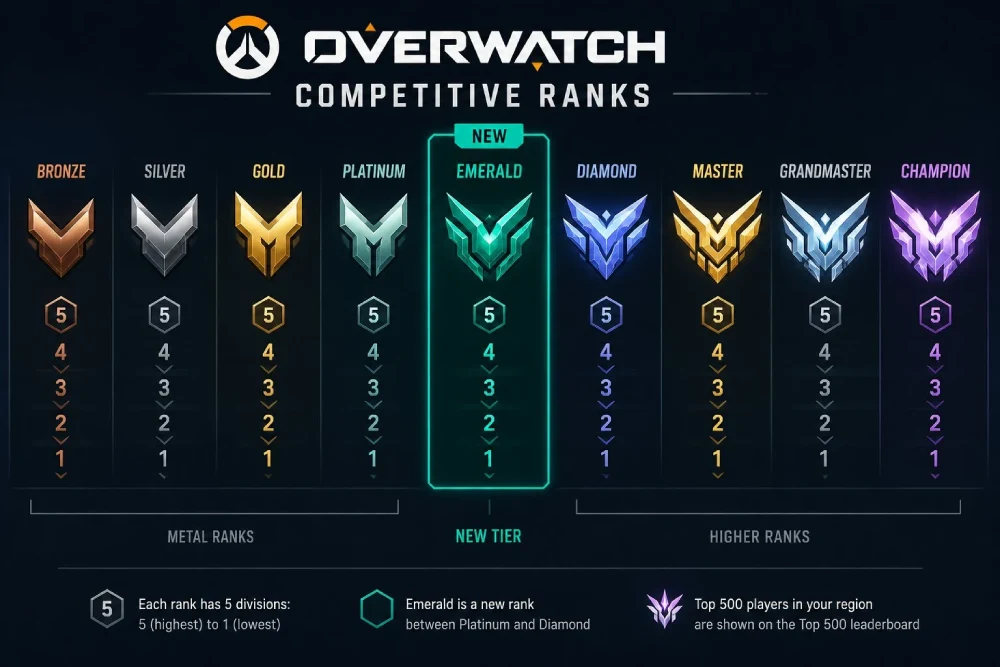
So, what is the overwatch ranking system in 2026? It is Blizzard Entertainment's competitive progression structure, featuring nine ranks: Bronze, Silver, Gold, Platinum, Emerald, Diamond, Master, Grandmaster, and Champion. Players advance through divisions by earning rank progress, while placement matches and periodic resets help establish their competitive standing.
The introduction of Emerald in August 2026 changed the competitive ladder by adding another rank between Platinum and Diamond. As a result, older Overwatch 2 guides that omit Emerald no longer describe the complete ranking structure.
However, climbing the ladder involves more than winning an occasional match. Players must understand rank progress, matchmaking modifiers, seasonal changes, and the differences between Role Queue and Open Queue.
In this guide, you'll discover how Overwatch ranks work, why your rank changes after matches, how placement games affect progression, and which strategies can help you improve consistently.
Overwatch Ranking System: How Does Competitive Play Work?
Competitive Play is Overwatch's ranked environment, where players compete against opponents selected through matchmaking.
Unlike casual modes, Competitive Play tracks your progress through a structured ladder.
However, your visible rank is only one part of the system.
Blizzard also uses internal skill estimates to help determine suitable matches.
Understanding both elements makes competitive progression easier to interpret.
What Is the Overwatch Ranking System?
Players asking what is the overwatch ranking system are usually trying to understand how the game evaluates their competitive performance.
The system organizes players into ranks representing different levels of competitive progression.
Each rank contains divisions that provide smaller milestones.
For example, a player might begin in Gold 5 and progress toward Gold 1.
After advancing beyond the highest division, the player can enter the next rank.
However, progression is not based on a fixed number of victories.
Instead, the game adjusts rank progress after competitive matches.
The amount gained or lost depends on factors including the match result and the system's expectations.
Therefore, two victories do not necessarily produce identical progress.
The same principle applies to defeats.
How Visible Ranks and Hidden MMR Work Together
One of the most important concepts in the ranking system in overwatch is matchmaking rating.
MMR is an internal estimate of player skill.
Blizzard uses this information to help create competitive matches between players of similar estimated ability.
However, MMR is not displayed as a simple numerical value.
Instead, players see their competitive rank and division.
The visible rank provides a clearer sense of progression.
Meanwhile, the hidden rating supports matchmaking decisions.
For example, a player's internal skill estimate may not perfectly match their displayed rank immediately after a reset.
As they complete more matches, the systems can become better aligned.
However, players should not assume that one strong performance automatically causes a major MMR increase.
Blizzard's matchmaking explanations emphasize that match outcomes are central to skill evaluation.
Additionally, the system considers its confidence in the player's estimated skill.
This helps explain why progression may feel different for new accounts or players returning after a long absence.
Role Queue Versus Open Queue
Overwatch offers different competitive queue formats.
The two most important are Role Queue and Open Queue.
In Role Queue, players select a specific role before entering matchmaking.
The available roles are:
- Tank: Creates space and helps protect teammates.
- Damage: Applies pressure and helps secure eliminations.
- Support: Provides healing, utility, and assistance to the team.
Each role has its own competitive progression.
Therefore, a player can have different ranks for Tank, Damage, and Support.
For example, someone might be Platinum in Tank but Diamond in Support.
Open Queue uses a different format.
Players have greater flexibility when selecting heroes and team compositions.
However, Open Queue maintains its own competitive ranking.
Therefore, your Open Queue rank does not automatically match your Role Queue ranks.
This separation allows the game to evaluate performance across different competitive environments.
All Overwatch Ranks in Order: Bronze to Champion
Understanding the rank ladder is essential for players researching how do overwatch ranks work.
The competitive structure contains nine ranks in 2026.
Each rank represents a different stage of progression.
However, moving between ranks requires advancing through the relevant divisions.
Bronze, Silver, and Gold
Bronze is the first rank in the competitive ladder.
Players in this tier are often developing foundational skills.
These include positioning, hero familiarity, and understanding team objectives.
However, Bronze players can still have different levels of experience.
Silver represents the next step.
Players may demonstrate stronger mechanical consistency and a better understanding of team interactions.
Gold follows Silver.
At this level, players often benefit from improving decision-making and reducing repeated mistakes.
However, these descriptions are general coaching observations rather than official Blizzard definitions of player ability.
A player's rank reflects competitive results, not a complete description of their strengths.
Platinum, Emerald, and Diamond
Platinum sits above Gold.
Players climbing through this tier often need to improve consistency across different match situations.
However, Platinum is no longer followed directly by Diamond.
In August 2026, Blizzard introduced Emerald between the two ranks.
This addition expanded the competitive ladder.
Therefore, players progressing beyond Platinum now encounter Emerald before reaching Diamond.
Diamond remains an important milestone.
At this level, competitive matches can reward more consistent positioning, teamwork, and decision-making.
However, the presence of Emerald changes how players should interpret older ranking guides.
Any current rank-order explanation should include the new tier.
Master, Grandmaster, and Champion
Master is one of the highest competitive ranks.
Players reaching this level have progressed beyond Diamond.
Grandmaster follows Master.
It represents another major milestone in the upper competitive ladder.
Champion is the highest named rank.
However, reaching Champion does not automatically guarantee a particular leaderboard position.
The Top 500 Challenger system has additional eligibility and ranking requirements.
Therefore, the highest visible rank and leaderboard placement should not be treated as identical.
Players interested in elite competition should review the current Challenger rules.
How Divisions 5 Through 1 Work
The ranking system overwatch uses divisions within each competitive rank.
These divisions are numbered from 5 to 1.
Division 5 is the lowest within a rank.
Division 1 is the highest.
For example, a player progressing through Gold would move through Gold 5, Gold 4, Gold 3, Gold 2, and Gold 1.
After advancing beyond Gold 1, the next rank is Platinum 5.
However, losing enough progress can cause demotion.
The following table shows the complete rank order.
| Order | Competitive Rank | Division Progression |
| 1 | Bronze | Bronze 5 → Bronze 1 |
| 2 | Silver | Silver 5 → Silver 1 |
| 3 | Gold | Gold 5 → Gold 1 |
| 4 | Platinum | Platinum 5 → Platinum 1 |
| 5 | Emerald | Emerald 5 → Emerald 1 |
| 6 | Diamond | Diamond 5 → Diamond 1 |
| 7 | Master | Master 5 → Master 1 |
| 8 | Grandmaster | Grandmaster 5 → Grandmaster 1 |
| 9 | Champion | Champion 5 → Champion 1 |
This structure provides smaller progression milestones.
Therefore, players can track improvement even when they have not reached a completely new rank.
How Does the Overwatch Ranking System Work After Every Match?
Players frequently ask how does the overwatch ranking system work when their rank progress changes by different amounts after victories and defeats.
The answer involves match outcomes, system expectations, and competitive modifiers.
However, the game does not use a simple formula where every victory awards exactly the same percentage.
Instead, the Competitive Progress screen explains the relevant adjustments.
How Wins and Losses Change Rank Progress
Winning a competitive match generally increases rank progress.
Losing generally decreases it.
However, the exact amount can vary.
For example, a victory against opponents the system expected you to defeat may provide less progress than an unexpected victory.
Similarly, losing a match you were favored to win can have a different effect from losing against stronger opponents.
Therefore, players should focus on long-term performance rather than individual percentage changes.
One match rarely provides enough information to evaluate a player's true competitive level.
Instead, consistent results across many games are more meaningful.
Additionally, rank progress can be affected by modifiers.
These modifiers help explain why the adjustment differs from a typical match.
Understanding Rank Modifiers and Match Favorability
The Competitive Progress screen can display modifiers after matches.
These provide additional context for the rank adjustment.
For example, the system may identify a match as expected or unexpected.
A favorable match is one where the system considered your team more likely to win.
An unfavorable match is one where your team was considered less likely to win.
However, these predictions are not guarantees.
They reflect matchmaking expectations.
Therefore, winning an unfavorable match can produce a different adjustment from winning a favorable one.
Likewise, losing an expected victory may have a different impact.
Other modifiers can relate to streaks or calibration.
However, the available modifiers and their effects may change through competitive updates.
Players should review the labels displayed after each match.
Win Streaks, Calibration, and Unexpected Rank Changes
Players researching how does overwatch ranking work often notice that rank progress changes during extended winning or losing streaks.
The system may apply streak-related modifiers when results consistently move in one direction.
However, players should not assume that every consecutive victory produces an identical bonus.
Calibration can also influence progression.
This is particularly relevant when the system has limited recent information about a player's skill.
For example, a player returning after a long absence may experience different progression behavior from someone with extensive recent match history.
Additionally, placement matches can create temporary uncertainty.
Therefore, early competitive progress may appear less stable than later results.
However, the system continues updating its skill estimates as more matches are completed.
Why Rank Progress Is Not Always Identical
The question how does the ranking work in overwatch becomes easier to answer when players understand that matchmaking is probabilistic.
The game estimates which team is more likely to win.
However, actual match results can differ from those predictions.
Rank adjustments reflect more than the final scoreboard.
Therefore, two matches with similar personal statistics may produce different progression changes.
Additionally, personal damage or elimination totals should not be treated as a direct formula for rank progress.
Winning remains the most reliable long-term path toward climbing.
For practical improvement, focus on these priorities:
- Play consistently rather than chasing one large rank increase.
- Review the Competitive Progress screen after matches.
- Learn what different modifiers mean.
- Avoid judging your skill from a single victory or defeat.
- Track performance across multiple sessions.
- Focus on decisions that help your team win.
Understanding these principles can reduce confusion and make competitive progression more manageable.
Overwatch Placement Matches and Seasonal Rank Resets
Understanding placement matches is essential when learning how does rank work in overwatch.
Placements help establish your competitive standing after a reset or when entering a queue without a current rank.
However, they do not evaluate your skill in isolation.
The matchmaking system can also use information from previous competitive activity when available.
How the 10 Placement Matches Work
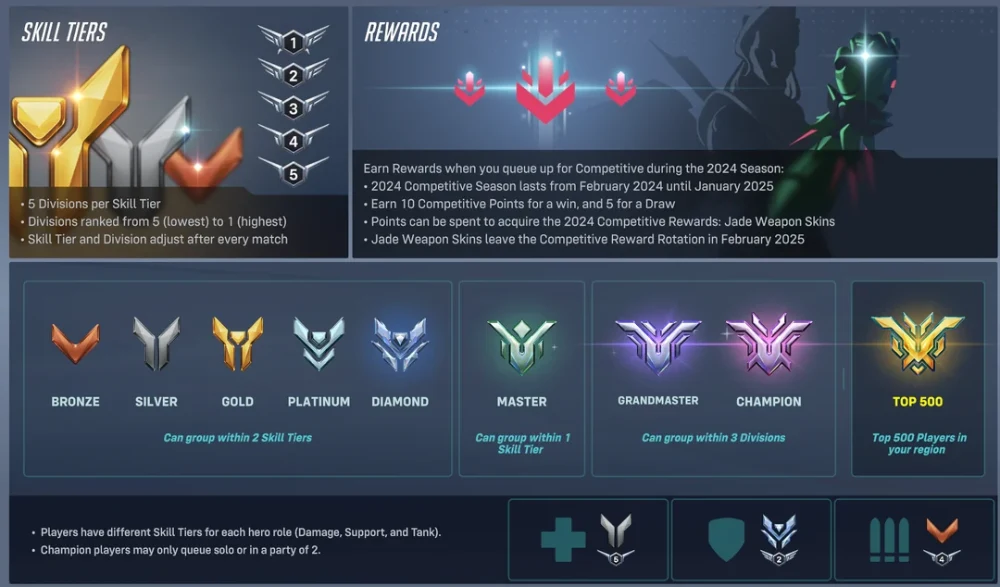
During the February 2026 competitive reset, Blizzard required players to complete 10 placement matches for each relevant role or queue.
These matches determine the player's initial displayed rank for that competitive period.
However, completing placements does not guarantee a completely fresh matchmaking history.
The system may retain information that helps estimate skill.
For example, a returning player can receive different matchmaking expectations from a completely new competitor.
During placements, players may see a predicted rank.
This prediction can change as additional matches are completed.
Therefore, avoid treating an early prediction as a final result.
The displayed rank becomes established after the required placements are completed.
What a Soft Rank Reset Actually Changes
A soft reset changes how competitive progression is displayed and recalibrated.
However, it does not necessarily erase every internal estimate of player skill.
Blizzard has used competitive resets to create new progression opportunities.
For example, the February 2026 update reset Role Queue and Open Queue ranks to Unranked.
Players then completed placements to establish their new ranks.
However, a reset should not be interpreted as everyone starting with identical matchmaking expectations.
The system can still consider previous skill information.
Additionally, Blizzard does not necessarily reset ranks in the same way every season.
Therefore, players should review the official competitive update notes.
A seasonal transition does not automatically mean a complete rank reset.
Why Your Predicted Rank May Change During Placements
Players asking how does the overwatch ranking work often notice that their predicted rank changes during placements.
This happens because the system continues evaluating match results.
For example, winning several matches may improve the predicted outcome.
Meanwhile, losses can affect the estimate differently.
However, the size of each adjustment depends on the system's current expectations.
Therefore, the predicted rank should be treated as provisional.
A practical placement strategy includes:
- Select the role or queue you want to prioritize.
- Choose heroes you understand well.
- Avoid experimenting with unfamiliar strategies unnecessarily.
- Focus on objectives and team coordination.
- Review mistakes between matches.
- Complete all required placements.
- Evaluate your final rank before planning your climb.
Remember that placements are only the beginning.
Long-term competitive progress depends on subsequent results.
How Do Overwatch Ranks Work in Role Queue and Open Queue?
Players researching how do overwatch ranks work should understand that competitive progression depends on the selected queue.
Role Queue and Open Queue use separate ranking systems.
However, both operate within Overwatch's broader competitive structure.
Separate Ranks for Tank, Damage, and Support
Role Queue allows players to select Tank, Damage, or Support before matchmaking.
Each role has its own competitive rank.
Therefore, players can progress differently across the three roles.
For example, a player might reach Diamond as Support while remaining Platinum as Damage.
This does not necessarily indicate inconsistent matchmaking.
Instead, the system evaluates the roles separately.
However, players should remember that each role requires different skills.
Tank players often focus on creating space and managing pressure.
Damage players must balance offensive opportunities with survival.
Support players contribute through healing, utility, positioning, and team coordination.
Therefore, improving one role does not automatically improve another.
How Open Queue Ranks Differ
Open Queue provides greater flexibility in hero selection.
Players are not restricted to the same role-based team structure used in Role Queue.
However, Open Queue has its own competitive progression.
Therefore, your Open Queue rank can differ from your Tank, Damage, and Support ranks.
Additionally, strategies that work in Role Queue may not transfer directly.
Team compositions can vary more significantly.
Therefore, players should adapt their hero choices to the available teammates and opponents.
If you want consistent progression, consider focusing on one queue.
However, exploring multiple queues can help develop a broader understanding of the game.
Grouping Restrictions and Competitive Matchmaking
Competitive grouping rules help manage differences in player skill.
However, the exact restrictions depend on the current matchmaking system.
Blizzard has introduced Narrow and Wide Groups to accommodate different party compositions.
Narrow Groups contain players whose ranks fall within the permitted skill range.
Wide Groups allow certain larger skill differences but use separate matchmaking considerations.
However, Wide Groups may experience longer queue times.
Additionally, some competitive progression and leaderboard systems treat Wide matches differently.
Therefore, players should check the current grouping rules before forming a party.
For example, a group containing players from significantly different ranks may face different matchmaking conditions from a closely matched team.
Top 500 Challenger Leaderboard Requirements
The Top 500 Challenger system represents another competitive milestone.
However, it is not simply another rank above Champion.
Instead, it is a leaderboard with separate eligibility requirements.
Blizzard's October 2026 update changed how the Challenger leaderboard is organized.
Challenger Score now determines eligibility among the top 500 qualifying players.
However, actual competitive rank determines the ordering of eligible players.
This means a player with a higher rank can appear above another eligible player with more Challenger Score.
Additionally, Blizzard removed the Heat Bonus.
Therefore, older explanations based entirely on Challenger Score ordering are outdated.
| Competitive Feature | Main Purpose |
| Visible rank | Shows competitive progression |
| Hidden MMR | Supports skill-based matchmaking |
| Role Queue ranks | Tracks Tank, Damage, and Support separately |
| Open Queue rank | Tracks progression in the flexible queue |
| Challenger Score | Determines Top 500 leaderboard eligibility |
| Actual competitive rank | Determines ordering among eligible Challenger players |
Players pursuing Top 500 should review the current requirements before planning their competitive schedule.
How to Rank Up Faster in Overwatch Competitive
Understanding how does the ranking system work in overwatch is useful, but knowledge alone does not guarantee higher ranks.
Players must also improve their gameplay consistently.
However, improvement does not require mastering every hero or playing continuously.
A focused approach can be more effective.
Choose a Focused Hero Pool
One common mistake is switching heroes constantly without developing consistency.
Although flexibility is valuable, mastering a smaller group of heroes can make decision-making easier.
For example, a Support player might focus on two or three heroes with different strengths.
This provides options without requiring extensive practice across the entire roster.
However, the ideal hero pool depends on personal preference and team needs.
A practical approach involves:
- Choosing a primary role.
- Selecting a small number of comfortable heroes.
- Learning their abilities and cooldowns.
- Understanding common matchups.
- Practicing positioning on different maps.
- Expanding the hero pool gradually.
Additionally, avoid switching heroes solely because a match becomes difficult.
Sometimes improving your positioning or timing is more valuable.
Improve Positioning, Objectives, and Team Coordination
Players asking how does the ranking in overwatch work often focus on eliminations and damage statistics.
However, winning requires more than individual scoreboard numbers.
Positioning is particularly important.
For example, a player who consistently survives longer may contribute more effectively across multiple fights.
Additionally, objective awareness matters.
Securing eliminations without controlling the objective may not produce a victory.
Therefore, players should consider how their actions support the team's immediate goal.
Communication can also improve coordination.
However, useful communication should remain concise.
Call out relevant threats, important cooldowns, and objective information.
Avoid unnecessary arguments during matches.
Review Losses and Manage Competitive Sessions
Losing matches is part of competitive progression.
However, repeated mistakes can slow improvement.
Therefore, reviewing losses can be more useful than immediately entering another match.
Focus on decisions you could control.
For example, consider whether you used cover effectively or entered fights without teammates.
Additionally, identify repeated problems.
If you frequently lose fights because of poor positioning, prioritize that skill during practice.
Another important factor is session management.
Playing while frustrated or exhausted can reduce decision-making quality.
Therefore, take breaks when concentration declines.
A useful improvement routine involves:
- Play a manageable number of competitive matches.
- Identify one recurring mistake.
- Review the relevant situation.
- Choose one specific improvement goal.
- Practice that goal during the next session.
- Track progress over several days.
This approach encourages consistent improvement.
Separate Network Lag From FPS and Gameplay Mistakes
Technical performance can affect the experience of competitive matches.
However, not every problem has the same cause.
Network latency involves communication between your device and game services.
Packet loss can interfere with the delivery of network information.
Meanwhile, low FPS involves rendering performance.
Therefore, changing network settings will not necessarily solve a graphics bottleneck.
Similarly, lowering visual settings does not directly repair unstable routing.
Players should identify the likely problem before choosing a solution.
For example, consistent frame rate drops may indicate hardware limitations.
Unexpected connection interruptions may indicate network instability.
However, server-side issues can also affect gameplay.
How ExitLag Can Improve Overwatch Connection Stability
The overwatch ranking system rewards consistent competitive results.
However, online matches also depend on stable communication between players and game servers.
Network instability can make competitive gameplay more frustrating.
Therefore, maintaining a reliable connection is an important part of preparing for ranked sessions.
Reducing Network-Related Interruptions in Ranked Matches
Competitive Overwatch requires responsive online communication.
Latency fluctuations and packet loss can contribute to delayed interactions or temporary connection problems.
These issues may become especially noticeable during intense team fights.
However, not every missed ability or delayed reaction is caused by the network.
Mechanical mistakes, frame rate drops, and server-side conditions can produce different symptoms.
Therefore, players should monitor their connection and system performance separately.
Additionally, connection optimization does not directly change competitive rank.
It cannot modify MMR, guarantee victories, or provide additional rank progress.
Optimizing Supported PC and Mobile Connections
ExitLag uses proprietary connection optimization technology designed for supported online games.
Its Real-Time Optimization system helps identify efficient network routes when available.
Meanwhile, Multipath Connection technology can use multiple simultaneous routes to improve stability.
These features may help reduce certain network-related problems.
ExitLag helps optimize supported PC and Mobile gaming connections through intelligent routing, potentially reducing lag, packet loss, and connection instability when better network paths are available. For Overwatch players on PC, this can support more consistent online gameplay during competitive matches, where stable communication and responsive interactions are important. With automatic optimization and advanced configuration options, ExitLag offers a practical way to improve connection stability while players focus on teamwork, positioning, and climbing the ranked ladder.
However, ExitLag cannot guarantee lower latency in every situation.
It also cannot directly increase hardware performance or eliminate every server-side problem.
ExitLag is available for PC and Mobile, but it does not support consoles.
Players should verify that their specific game and platform are supported before configuring an optimized connection.
FAQ: MMR, Emerald, and Rank Progress
Players researching the overwatch ranking system often have questions about MMR, rank resets, and competitive progression.
The following answers explain the most important mechanics.
How Does Overwatch Ranking Work?
The system tracks competitive progression through ranks and divisions.
Winning generally increases rank progress, while losing generally decreases it.
However, the exact adjustment depends on matchmaking expectations and applicable modifiers.
Therefore, every victory does not provide an identical percentage increase.
What Is the Ranking System in Overwatch?
Players asking what is the ranking system in overwatch are referring to the competitive ladder.
In 2026, the ladder includes Bronze, Silver, Gold, Platinum, Emerald, Diamond, Master, Grandmaster, and Champion.
Each rank contains divisions from 5 to 1.
Additionally, the game uses hidden MMR to support matchmaking.
How Does Rank Work in Overwatch After a Loss?
A competitive loss generally reduces rank progress.
However, the amount can vary depending on the match and relevant modifiers.
For example, an unexpected defeat may produce a different adjustment from a loss against stronger opponents.
Therefore, review the Competitive Progress screen for additional context.
Is Emerald Higher Than Platinum?
Yes. Emerald was introduced in August 2026.
It sits between Platinum and Diamond.
Therefore, players must progress through Emerald before reaching Diamond.
This makes older guides that omit Emerald incomplete.
Why Did My Rank Reset?
Blizzard periodically introduces competitive resets.
For example, the February 2026 update reset Role Queue and Open Queue ranks to Unranked.
Players then completed placement matches to establish new displayed ranks.
However, not every seasonal transition includes the same reset.
Can You Rank Up With a Negative Win Rate?
It is possible for rank progress to vary depending on matchmaking expectations and modifiers.
However, a consistently negative win rate generally makes sustained climbing difficult.
Players should focus on improving their long-term results.
Additionally, short-term win rates may not accurately represent overall progression.
How Does the Ranking System Work in Overwatch for Top 500?
The current Challenger system uses Challenger Score to determine leaderboard eligibility.
However, actual competitive rank determines ordering among eligible players.
This structure was updated in October 2026.
Therefore, players should not assume that the highest Challenger Score automatically means the highest leaderboard position.
Does Personal Performance Affect Rank Progress?
Blizzard's competitive system emphasizes match outcomes and matchmaking expectations.
However, players should not assume that individual scoreboard statistics directly determine rank gains.
For example, high damage does not automatically guarantee extra progress.
Winning consistently remains the most reliable long-term strategy.
Can ExitLag Help You Rank Up?
ExitLag may help improve connection stability in supported online games when more efficient network routes are available.
However, it does not change MMR, increase rank progress directly, or guarantee victories.
Competitive improvement still depends on gameplay decisions, teamwork, and consistent results.
Ultimately, mastering the overwatch ranking system means understanding how visible ranks, hidden MMR, placement matches, and competitive modifiers work together. With Emerald now positioned between Platinum and Diamond, players have a more detailed ladder to climb in 2026. By focusing on consistent victories, stronger positioning, effective teamwork, and reliable online performance, players can approach Competitive Play with greater confidence. Meanwhile, ExitLag can help optimize supported PC connections, allowing players to focus on improving their gameplay with fewer avoidable network interruptions.
All game images used in this blog belong to Blizzard Entertainment. They are used for informational/educational purposes only and do not imply endorsement or affiliation with the rights holders.