
Knowing the Assassins Creed games in order can be confusing because the franchise jumps between historical periods, protagonists, and locations. A game released recently can take place centuries before an older title, while the modern-day storyline generally develops according to release order.
The Assassins Creed games in order can therefore be organized in two main ways: release order and historical chronological order. Assassin's Creed has traveled from Ancient Greece and Ptolemaic Egypt to medieval Baghdad, Renaissance Italy, the Caribbean, revolutionary France, Victorian London, and feudal Japan.
So, what are the Assassins Creed games in order? For first-time players, release order is generally the easiest way to experience the evolution of the franchise and its overarching story. Chronological order instead arranges the major games according to their historical settings, beginning with Odyssey in Ancient Greece before moving through Origins, Mirage, Valhalla, and the later historical periods.
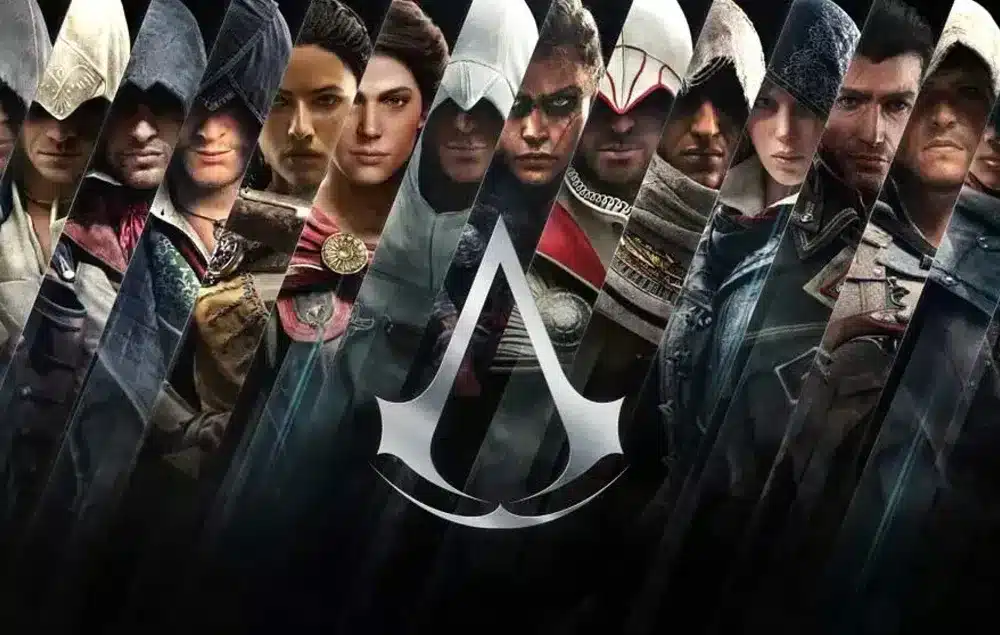
Assassins Creed Games in Order by Release Date
If this is your first journey through the franchise, playing the major Assassin's Creed games by release date provides the clearest view of how Ubisoft developed its stealth, parkour, combat, open worlds, naval systems, and RPG mechanics.
Here is the mainline release sequence:
| Game | Original release | Main historical setting |
| Assassin's Creed | 2007 | Third Crusade |
| Assassin's Creed II | 2009 | Renaissance Italy |
| Assassin's Creed Brotherhood | 2010 | Renaissance Rome |
| Assassin's Creed Revelations | 2011 | Constantinople |
| Assassin's Creed III | 2012 | American Revolution |
| Assassin's Creed IV: Black Flag | 2013 | Golden Age of Piracy |
| Assassin's Creed Rogue | 2014 | Seven Years' War |
| Assassin's Creed Unity | 2014 | French Revolution |
| Assassin's Creed Syndicate | 2015 | Victorian London |
| Assassin's Creed Origins | 2017 | Ptolemaic Egypt |
| Assassin's Creed Odyssey | 2018 | Ancient Greece |
| Assassin's Creed Valhalla | 2020 | Viking Age |
| Assassin's Creed Mirage | 2023 | 9th-century Baghdad |
| Assassin's Creed Shadows | 2025 | Feudal Japan |
In 2026, Ubisoft also released Assassin's Creed Black Flag Resynced, a modern remake of the 2013 pirate adventure rather than a new chronological chapter.
For most newcomers, this release sequence is the best starting point because later games frequently build on concepts, characters, and narrative ideas introduced earlier.
Assassins Creed Games in Chronological Order
Historical chronological order is very different. Instead of asking when each game was released, this approach asks when its main historical story takes place.
A simplified chronological order of the major games is:
- Assassin's Creed Odyssey;
- Assassin's Creed Origins;
- Assassin's Creed Mirage;
- Assassin's Creed Valhalla;
- Assassin's Creed;
- Assassin's Creed II;
- Assassin's Creed Brotherhood;
- Assassin's Creed Revelations;
- Assassin's Creed Shadows;
- Assassin's Creed IV: Black Flag;
- Assassin's Creed Rogue;
- Assassin's Creed III;
- Assassin's Creed Unity;
- Assassin's Creed Syndicate.
This order is useful if your main interest is watching the historical universe progress through time.
However, there is an important catch.
The franchise also contains a modern-day narrative, and that story does not follow the historical chronology. Playing strictly according to historical date can therefore reveal characters and concepts in a different order from the one originally intended.
Release Order vs. Chronological Order: Which Is Better?
For a first playthrough, release order is generally the better choice.
It allows gameplay systems to evolve naturally rather than moving unpredictably between newer and older mechanics.
For example, playing Odyssey first because it has the earliest historical setting and then eventually reaching the original 2007 Assassin's Creed creates a huge mechanical jump backward.
Choose release order if you:
- Have never played Assassin's Creed;
- Care about the modern-day storyline;
- Want gameplay mechanics to evolve naturally;
- Want to understand references as they were introduced;
- Want the original franchise experience.
Choose chronological order if you:
- Already know the series;
- Primarily care about historical periods;
- Want to follow the fictional world's historical development;
- Are replaying the franchise;
- Don't mind moving between different generations of gameplay.
There is no mandatory order.
Most Ubisoft games in the series tell substantial self-contained historical stories, although characters and narrative threads frequently connect different entries.
Assassin's Creed Odyssey: The Earliest Historical Setting
If you organize the Assassins Creed games in order historically, Odyssey comes first among the major titles.
Set in Ancient Greece during the Peloponnesian War, Odyssey takes place centuries before the Assassin Brotherhood formally exists.
Players choose between Kassandra and Alexios and embark on a story involving family, political conflict, mercenary life, and the Cult of Kosmos.
Why does Odyssey come before Origins?
Origins explores the creation of the Hidden Ones, the organization that eventually develops into the Assassin Brotherhood.
Odyssey takes place even earlier.
That is why you will not encounter the traditional Brotherhood structure associated with later games.
Instead, Odyssey expands the ancient history surrounding concepts and artifacts that become important throughout the wider franchise.
It is chronologically first, but that does not necessarily make it the ideal first Assassin's Creed game for a new player.
Assassin's Creed Origins: The Birth of the Hidden Ones
Next historically comes Assassin's Creed Origins, set in Ptolemaic Egypt.
The game follows Bayek of Siwa and Aya through a personal tragedy that develops into a much larger conflict.
Origins is especially important because it explains the foundation of the Hidden Ones.
Why is Origins important?
The Hidden Ones eventually become the Assassin Brotherhood.
Origins therefore provides crucial context for the philosophy, symbols, and organization that define much of the franchise.
The game also represented a major gameplay transition for Assassin's Creed.
Ubisoft moved toward a larger action-RPG structure featuring equipment, levels, expansive exploration, and a redesigned combat system.
That design direction continued and expanded through Odyssey and Valhalla.
Assassin's Creed Mirage: Basim's Beginning
Assassin's Creed Mirage takes players to ninth-century Baghdad and follows Basim before the events players know from Valhalla.
Basim begins as a street thief before becoming involved with the Hidden Ones.
Mirage deliberately returns to several ideas associated with earlier Assassin's Creed titles, placing greater emphasis on stealth, assassination, urban navigation, and a more concentrated world.
Should Mirage be played before Valhalla?
Historically, yes. Narratively, the answer is more complicated. Mirage tells an earlier part of Basim's life, but the character was introduced to players through Valhalla.
If you are following release order, play Valhalla first and Mirage afterward.
If you are intentionally following historical chronology, Mirage comes first.
This is a perfect example of why the two approaches produce different experiences.
Assassin's Creed Valhalla: The Viking Age
Valhalla follows Eivor, a Viking warrior who travels from Norway to England and becomes involved in conflicts that extend far beyond building a new settlement.
The story takes place during the ninth century.
It also connects strongly with the broader mythology surrounding the Assassins, Templars, and Isu.
How does Valhalla connect to Mirage?
Basim appears as an important character in Valhalla. Mirage later explores his younger years.
That means players who experienced Valhalla when it launched already knew where Basim's life would eventually lead before exploring his origins in Mirage.
Chronological players experience the relationship in reverse. They meet young Basim first and then see the older character in Valhalla.
Both approaches work, but they create very different narrative perspectives.
The Original Assassin's Creed
The first Assassin's Creed launched in 2007 and established the central conflict between Assassins and Templars for a new generation of action-adventure games.
Its historical story follows Altaïr Ibn-La'Ahad during the Third Crusade.
Players travel between locations such as Jerusalem, Acre, Damascus, and Masyaf while carrying out investigations and assassinations.
Why should you still know the original game?
Even if its mechanics feel simpler compared with modern entries, the original establishes fundamental ideas for the franchise.
These include:
- The Assassin Brotherhood;
- Templars;
- The Animus;
- Genetic memories;
- The Creed;
- Social stealth;
- Historical conspiracy;
- The modern-day storyline.
Altaïr also remains important beyond the first game. His legacy becomes particularly significant again in Assassin's Creed Revelations.
Assassin Creed 2 Game: The Beginning of Ezio's Story
The Assassin Creed 2 game, officially titled Assassin's Creed II, introduced Ezio Auditore da Firenze and became one of the defining entries in the franchise.
Set during the Italian Renaissance, it follows Ezio from his early life in Florence into the Assassin Brotherhood.
His story does not end with one game.
The Ezio trilogy in order
The correct Ezio order is:
- Assassin's Creed II;
- Assassin's Creed Brotherhood;
- Assassin's Creed Revelations.
Playing these three consecutively provides one of the most continuous character arcs in the franchise.
Assassin's Creed II introduces Ezio. Brotherhood follows him to Rome as he grows into a leader.
Revelations takes an older Ezio to Constantinople, where his story becomes deeply connected with Altaïr's legacy.
For players who want one tightly connected Assassin's Creed experience, the Ezio trilogy remains an excellent option.
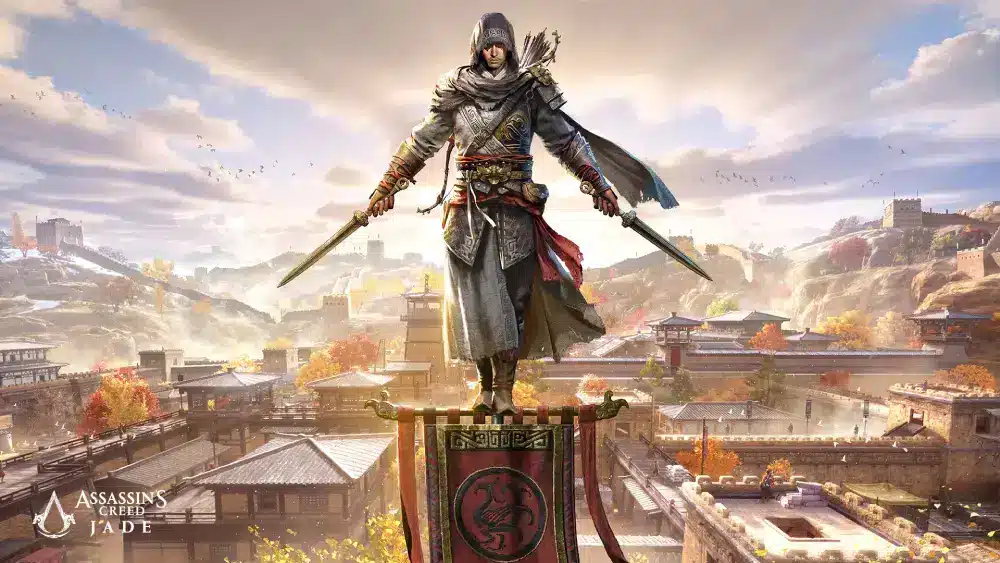
Assassin's Creed Shadows: Feudal Japan
Assassin's Creed Shadows finally brought the mainline franchise to feudal Japan, one of the settings fans had requested for years.
The game follows two protagonists with significantly different approaches: Naoe, a shinobi Assassin, and Yasuke, a powerful samurai.
This dual-protagonist design lets players approach encounters through contrasting styles.
Where does Shadows fit chronologically?
Shadows takes place in 16th-century Japan.
That places its historical setting after the major Ezio-era games and before Black Flag's 18th-century Caribbean.
Chronologically, the simplified sequence around this period becomes:
Revelations → Shadows → Black Flag
However, Shadows was released much later, in 2025. If you are following release order, it belongs after Mirage rather than between Revelations and Black Flag.
Assassin's Creed IV: Black Flag
Black Flag takes the series into the Golden Age of Piracy and follows Edward Kenway, a pirate who becomes entangled in the conflict between Assassins and Templars.
Edward is also part of the Kenway family line that connects several games.
Black Flag became particularly famous for its naval exploration and combat.
Players command the Jackdaw, explore Caribbean locations, hunt treasure, attack ships, and move between naval adventures and traditional Assassin's Creed gameplay.
Where does Black Flag fit in the Kenway story?
Historically, Black Flag comes before Assassin's Creed III. Edward Kenway is the grandfather of Connor, the protagonist of Assassin's Creed III.
Edward's son Haytham Kenway also plays a major role in Assassin's Creed III.
This makes Black Flag useful for understanding the family history behind that game, even though Assassin's Creed III was released first.
Assassin's Creed Black Flag Resynced
In 2026, Ubisoft returned to Edward Kenway's adventure with Assassin's Creed Black Flag Resynced.
Resynced is a remake of the original 2013 Black Flag rather than a sequel.
This distinction matters when building your list of Assassins Creed games in order.
Where should you put Black Flag Resynced?
From a story perspective, Resynced occupies essentially the same historical position as Black Flag because it retells Edward Kenway's pirate adventure.
You therefore do not need to play both versions to advance through the basic historical chronology.
If you want to experience Edward's adventure with the modern remake, you can choose Resynced.
If you want to experience the franchise according to its original release history, play the 2013 version.
Resynced launched on July 9, 2026, for PS5, Xbox Series X|S, and PC.
Assassin's Creed Rogue
Rogue offers a different perspective from most entries.
Players control Shay Patrick Cormac, who begins as an Assassin before his journey takes him toward the Templar Order.
The game is set during the Seven Years' War.
Why is Rogue important before Assassin's Creed III and Unity?
Rogue connects several parts of the franchise.
Its historical period overlaps with characters and events connected to the Kenway era, and its ending links directly into Assassin's Creed Unity.
That makes Rogue particularly interesting for players following chronological order.
The transition from Rogue into Unity creates one of the clearest direct historical connections between separate protagonists in the franchise.
Assassin's Creed III
Assassin's Creed III takes place primarily during the American Revolution and follows Ratonhnhaké, better known as Connor.
Connor is the grandson of Edward Kenway and son of Haytham Kenway.
His personal story unfolds alongside major historical events involving the American colonies.
Why does AC III come after Rogue chronologically?
Rogue's main historical events begin earlier.
By following the simplified historical timeline, you therefore encounter Shay's story before Connor's primary journey.
Release order reverses this because Assassin's Creed III launched in 2012 and Rogue arrived in 2014.
Again, neither order is inherently wrong.
The best choice depends on whether you prioritize original storytelling order or historical chronology.
Assassin's Creed Unity
Unity takes players to Paris during the French Revolution.
Its protagonist, Arno Dorian, becomes caught between personal relationships and the wider conflict involving Assassins and Templars.
The dense recreation of Paris places a strong emphasis on urban movement and parkour.
Rogue and Unity connection
The end of Rogue connects directly with an important event in Arno's life.
For this reason, chronological players can move naturally from Rogue toward Unity, although Assassin's Creed III occupies part of the historical period between them.
Unity is also notable for its cooperative multiplayer missions, distinguishing it from many other mainline entries.
Its approach to movement and dense city design remains one of the most recognizable styles in the franchise.
Assassin's Creed Syndicate
Syndicate brings the historical timeline forward to Victorian London. Players control twins Jacob and Evie Frye, who have different personalities and approaches to Assassin work.
London's scale also led Ubisoft to introduce tools such as the rope launcher and vehicles to help players navigate the city.
Why does Syndicate come last historically among these main games?
Its primary setting is 1868, making it later than the historical settings of the other major games listed above.
That does not mean it is the final game in the franchise's modern narrative. Remember that historical chronology and release chronology are separate.
Syndicate launched in 2015, years before Origins, Odyssey, Valhalla, Mirage, and Shadows.
What About Assassin's Creed Spin-Off Games?
The franchise includes considerably more than the mainline titles.
There are handheld games, mobile releases, side stories, remasters, expansions, and smaller projects.
Trying to insert every one into a beginner's play order can make the list unnecessarily complicated.
Notable additional Assassin's Creed games
Players exploring beyond the main series may encounter titles such as:
- Assassin's Creed Liberation;
- Assassin's Creed Freedom Cry;
- Assassin's Creed Chronicles: China;
- Assassin's Creed Chronicles: India;
- Assassin's Creed Chronicles: Russia;
- Assassin's Creed Nexus VR;
- Assassin's Creed Rebellion;
- Various mobile and handheld releases.
Some expand characters or historical settings introduced elsewhere, while others provide largely independent experiences.
You do not need to complete every spin-off before moving to the next mainline title.
The Kenway Saga in Order
Players interested specifically in the Kenway family can follow a smaller sequence within the franchise.
Historically, the core Kenway-related progression is:
Black Flag → Rogue → Assassin's Creed III
The connections are not always as straightforward as the Ezio trilogy, but these games share characters, organizations, historical periods, and family relationships.
Who are the Kenways?
Edward Kenway is the protagonist of Black Flag. His son, Haytham Kenway, becomes one of the central figures in Assassin's Creed III.
Haytham's son Connor becomes that game's main Assassin protagonist.
This family structure creates a fascinating contrast because different generations do not necessarily stand on the same side of the Assassin-Templar conflict.
That complexity makes the Kenway era one of the franchise's most interconnected historical arcs.
Which Assassin's Creed Game Should You Play First?
For someone completely new to Assassin's Creed, there are several reasonable starting points.
The original 2007 game provides the historical foundation of the franchise's gameplay and narrative structure, but its age may make it less accessible for players accustomed to modern games.
Start with Assassin's Creed II for classic gameplay
Assassin's Creed II is a strong starting point for players interested in the classic era.
It expands significantly on the original while introducing Ezio, whose story continues across three games.
Starting here gives you:
- Classic parkour;
- Social stealth;
- Assassination missions;
- Renaissance cities;
- A major protagonist;
- A continuous trilogy.
You can still learn about Altaïr and the first game before or afterward.
Start with Origins for the RPG era
If you prefer modern open-world action RPGs, Origins is another logical entry point.
It introduces Bayek and explains the foundation of the Hidden Ones while establishing the gameplay direction that Odyssey and Valhalla expand.
This gives newcomers a more modern control and combat experience.
Afterward, you can continue through Odyssey and Valhalla or explore the classic games.
Start with Shadows for the newest major era
Players primarily interested in feudal Japan can begin with Shadows without completing every previous game first.
However, you will inevitably miss some broader franchise context.
That is acceptable if the historical setting is your main motivation.
Assassin's Creed games are interconnected, but Ubisoft generally designs their historical adventures so newcomers can still understand the central protagonist and conflict.
Do You Need to Play Every Assassin's Creed Game?
No. The enormous number of Ubisoft Entertainment games associated with Assassin's Creed can make the franchise appear more intimidating than it needs to be.
You can choose an era or protagonist that interests you and begin there.
Best approach for story-focused players
If overarching lore matters to you, prioritize release order. Start with the original Assassin's Creed and progress through the mainline titles.
This gives you the clearest understanding of how concepts were originally introduced. You can then add important side games when they interest you.
Best approach for casual players
Pick a historical period you enjoy.
Want pirates? Play Black Flag or Black Flag Resynced.
Want Ancient Egypt? Play Origins.
Want Ancient Greece? Play Odyssey.
Want Vikings? Play Valhalla.
Want Baghdad and classic stealth? Play Mirage.
Want feudal Japan? Play Shadows.
There is no requirement to finish hundreds of hours of earlier games before enjoying a setting that interests you.
How Assassin's Creed Gameplay Changed Over Time
One reason release order remains interesting is that Assassin's Creed has changed significantly since 2007.
The early games focused heavily on urban navigation, social stealth, assassinations, and relatively structured missions.
Later entries expanded the formula.
The classic Assassin's Creed era
Games from the original through Syndicate generally emphasize recognizable franchise mechanics such as:
- Parkour;
- Social stealth;
- Hidden Blade assassinations;
- Urban exploration;
- Mission-based progression;
- Assassin Brotherhood stories.
Each title experiments with the formula, but the overall identity remains recognizable.
Black Flag adds extensive naval gameplay, while Unity emphasizes dense urban parkour and cooperative missions.
The RPG era
Origins marked a major shift. The series adopted larger open worlds, redesigned combat, loot and equipment systems, and more RPG-oriented progression.
Odyssey pushed those ideas further with dialogue choices and an enormous Greek world.
Valhalla combined RPG systems with Viking settlement development, raids, and exploration.
Mirage later deliberately moved back toward a more compact stealth-focused experience while retaining technology developed during the modern era.
Shadows combines modern open-world systems with stronger distinctions between stealth and combat through its dual protagonists.
Ubisoft Games and the Evolution of Assassin's Creed
Among Ubisoft games, Assassin's Creed has become one of the publisher's most recognizable franchises.
What began as an action-adventure game centered on Altaïr evolved into a series capable of supporting very different experiences while retaining its historical-fiction identity.
Players have sailed pirate ships, raided medieval England, explored Egyptian tombs, climbed Renaissance architecture, investigated revolutionary Paris, and infiltrated castles in Japan.
Why does the series keep changing?
Historical settings naturally create different gameplay opportunities. A pirate game benefits from naval exploration. A Viking setting encourages raids and settlement building.
A shinobi protagonist creates opportunities for stealth mechanics that would not necessarily fit every other period.
Ubisoft has therefore repeatedly adjusted the formula rather than requiring every Assassin's Creed game to function identically.
That can divide fans, but it also explains why different entries appeal to different types of players.
Best Way to Play Assassins Creed Games in Order
If you want a straightforward recommendation, use release order for your first journey and historical chronology for a later replay.
This provides the best balance between narrative clarity and historical experimentation.
Recommended first-time order
For the core experience:
Assassin's Creed → Assassin's Creed II → Brotherhood → Revelations → Assassin's Creed III → Black Flag → Rogue → Unity → Syndicate → Origins → Odyssey → Valhalla → Mirage → Shadows
Black Flag Resynced can replace the original Black Flag if you prefer experiencing Edward Kenway's story through the 2026 remake, although doing so changes the natural evolution of gameplay mechanics.
Recommended historical replay
For a history-focused replay:
Odyssey → Origins → Mirage → Valhalla → Assassin's Creed → Assassin's Creed II → Brotherhood → Revelations → Shadows → Black Flag/Resynced → Rogue → Assassin's Creed III → Unity → Syndicate
Remember that these dates refer primarily to each game's central historical setting.
Some games contain flashbacks, modern-day sequences, DLC, or story elements set in other periods, so no simplified list can place every scene perfectly.
Assassin's Creed and Online Connection Quality
Learning the Assassins Creed games in order is mainly about choosing how you want to experience the franchise, and many of its campaigns are heavily focused on single-player gameplay.
However, some Assassin's Creed releases and connected Ubisoft services can include online functionality, downloads, account services, or other network-dependent features.
What network problems can affect online gaming?
Depending on the game, service, and network route, players may encounter:
- High latency;
- Packet loss;
- Connection instability;
- Routing problems;
- Download fluctuations.
These issues are different from local performance problems such as low FPS or hardware limitations.
The specific network requirements also vary significantly between Assassin's Creed titles because the franchise spans almost two decades of game design.
How can ExitLag help supported games?
ExitLag is designed to optimize network routes for supported online games and services. Its technology analyzes multiple paths and works to select faster and more stable routes for supported gaming traffic.
Because Assassin's Creed includes games with very different online requirements, always check whether the specific title and service you are using is supported.
While you explore Ubisoft games and other online experiences, ExitLag can help optimize supported gaming routes where applicable.
FAQ
Understanding the Assassins Creed games in order raises questions about release chronology, historical chronology, Ezio's trilogy, Black Flag Resynced, and the best starting point. Here are five essential answers.
What are the Assassin's Creed games in release order?
The core sequence begins with Assassin's Creed, followed by Assassin's Creed II, Brotherhood, Revelations, Assassin's Creed III, Black Flag, Rogue, Unity, Syndicate, Origins, Odyssey, Valhalla, Mirage, and Shadows. Black Flag Resynced launched in 2026 as a remake of Black Flag rather than a new chronological sequel.
What is the first Assassin's Creed game chronologically?
Among the major games, Assassin's Creed Odyssey has the earliest main historical setting. It takes place in Ancient Greece during the Peloponnesian War, centuries before the formal Assassin Brotherhood exists.
What order should I play the Ezio games?
Play Assassin's Creed II first, followed by Assassin's Creed Brotherhood and then Assassin's Creed Revelations. Together, the three games form Ezio Auditore's main trilogy.
Should I play Assassin's Creed games in release or chronological order?
New players should generally choose release order because it preserves the evolution of gameplay and the broader narrative. Chronological order is particularly interesting for returning players who want to experience the historical settings sequentially.
Is Black Flag Resynced a new Assassin's Creed story?
No. Assassin's Creed Black Flag Resynced is a 2026 remake of the original Assassin's Creed IV: Black Flag from 2013. It retells Edward Kenway's pirate adventure with updated technology, gameplay improvements, and additional content.
Play the Assassins Creed Games in Order With ExitLag
The Assassins Creed games in order can be experienced in two very different ways: follow release order to see the franchise evolve from Altaïr through Ezio and into the modern open-world era, or follow historical chronology to travel from Ancient Greece through centuries of Assassin and Templar history.
Choose your era, enter the Animus, and optimize your supported gaming connections with ExitLag!