
Cards Clash Royale are the foundation of every battle, determining how you defend, attack, manage Elixir, build pushes, and react to an opponent’s strategy. The collection has grown considerably since Clash Royale launched, with troops, spells, buildings, Tower Troops, Champions, Evolutions, Hero forms, and other systems making deck building far more complex than simply choosing eight strong units.
A strong deck still depends on being able to play each card at the right moment, and connection instability can make precise deployment more difficult. If your Cards Clash Royale strategy feels inconsistent because of delayed placements, connection warnings, or unstable matches, our guide to reducing lag in Clash Royale explains how to troubleshoot networking separately from deck-building mistakes. Improving your connection will not make a weak deck stronger, but it can help you evaluate your decisions under more consistent conditions.
Understanding Cards Clash Royale now also means knowing the difference between a base card and the special forms attached to some cards. As of September 2026, Clash Royale has 127 cards in the collection, while Evolutions and Hero forms can modify how eligible cards behave without simply functioning as an entirely separate traditional deck card.
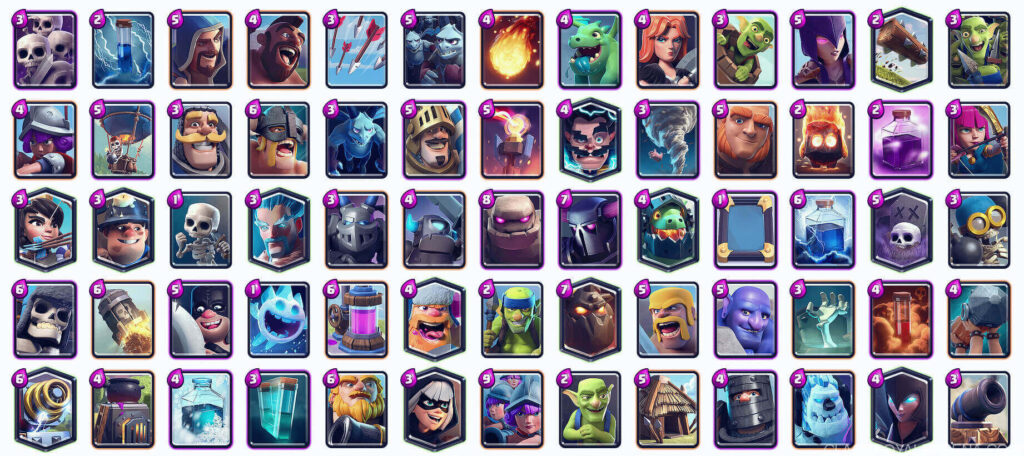
How many cards are in Clash Royale?
As of September 2026, there are 127 cards in Clash Royale.
That number has continued to change as Supercell releases new cards. The 2026 additions include Ronin, a Legendary melee troop introduced in July, and Minion Giant, a Rare flying win condition introduced during the Minion Academy season in September.
When looking for all Clash Royale cards, remember that the total collection includes more than the traditional troops most players immediately think about.
What counts as a Clash Royale card?
The collection can broadly be understood through several gameplay categories.
| Card category | Main purpose |
| Troops | Deploy units that move and fight in the Arena |
| Spells | Create immediate or temporary effects |
| Buildings | Place structures for defense, offense, or utility |
| Tower Troops | Change how your Crown Towers attack |
| Champions | Special units with activatable abilities |
Troops make up most of the familiar Clash Royale characters, including cards such as Knight, Musketeer, Hog Rider, P.E.K.K.A, Skeletons, and Mega Knight.
Spells work differently because they usually produce an effect at a chosen location rather than remaining on the battlefield like a normal troop. Fireball, The Log, Arrows, Poison, and Freeze are recognizable examples.
Buildings occupy a fixed position. Some are primarily defensive, while others produce troops or create offensive pressure.
Tower Troops are technically cards as well, but they do not occupy one of the eight standard deck slots. Instead, they determine how your Crown Towers function during battle.
Champions have their own mechanics and can use abilities by spending additional Elixir while they are active.
If you want a broader card-by-card overview rather than only the systems behind them, our guide covering all Clash Royale cards and their roles can help you explore the collection in more detail.
Are Evolutions and Heroes separate cards?
Not exactly.
Evolutions and Heroes are special forms associated with eligible base cards.
An Evolution changes how an eligible card performs after its required cycle has been completed. To activate an Evolution in normal deck play, the card must be placed in an Evolution-compatible special slot.
Hero forms work differently. When an eligible card is placed in the appropriate Hero or Wild slot and the Hero form has been unlocked, the card gains a special ability that can be manually activated during battle by spending Elixir.
This distinction is useful when discussing C R cards because simply counting every Evolution or Hero form as a separate traditional card would make the collection number misleading.
In the current deck structure, special slots include:
- one Evolution Slot;
- one Hero Slot;
- one Wild Slot.
The Evolution Slot activates Evolutions.
The Hero Slot can activate Heroes or Champions.
The Wild Slot can accommodate eligible Evolutions, Heroes, or Champions.
The underlying eight-card deck remains central to Clash Royale, but these systems add another layer to how those cards function.
What types of Clash Royale cards should every deck have?
There is no mandatory formula that every deck must follow.
However, successful decks generally need answers to several common situations. Selecting eight individually powerful Clash Royale cards without considering their roles can leave you unable to defend against air troops, break through buildings, stop tanks, or apply reliable Crown Tower pressure.
Instead of thinking only about rarity, consider what each card contributes to the complete deck.
Win conditions, support, and defensive cards
A win condition is the card or strategy you primarily expect to use to damage Crown Towers.
Common examples include cards that can consistently threaten buildings or create a repeatable offensive plan.
A deck might be built around:
- Hog Rider;
- Royal Giant;
- Balloon;
- Graveyard;
- X-Bow;
- Goblin Barrel;
- Lava Hound;
- Miner-based pressure;
- other building-targeting or repeatable offensive combinations.
Not every win condition behaves the same way.
A fast Hog Rider deck may rely on inexpensive cycling. A heavier push can invest much more Elixir before crossing the bridge.
Support cards help the primary strategy succeed. They may eliminate swarms, defend against air units, control lanes, protect a tank, or convert a defensive interaction into a counterpush.
Defensive cards exist to prevent your opponent from freely executing their own strategy.
One card can perform several of these jobs.
That flexibility is valuable because you only have eight standard deck positions.
For example, a cheap troop might defend efficiently while also helping you cycle toward your win condition. A spell can eliminate support troops while creating Crown Tower damage. A building may pull an attacker away from your tower while giving you enough time to generate an Elixir advantage.
Learning those interactions is more useful than memorizing a static ranking of all Clash Royale cards.
Spells, buildings, and cycle cards
Spells are important because they make your offense and defense more predictable.
Suppose your win condition repeatedly gets stopped by low-health troops. Carrying the appropriate small spell may allow your push to continue.
Larger spells can remove valuable support units or punish opponents who group expensive cards.
Buildings serve another purpose.
They can redirect troops that target structures, control the center of the Arena, force an opponent to spend extra Elixir, or contribute to a broader defensive strategy.
Cycle cards usually have low Elixir costs and help you return to important cards more quickly.
However, low cost alone does not make a card good for a deck.
Each cheap card still needs a purpose.
Skeletons may distract a single-target attacker. An inexpensive Spirit can create useful interactions. A low-cost spell may reset or finish particular units.
This is where knowledge of individual Clash Royale characters becomes important. Even extremely simple-looking cards can produce large positive Elixir trades when deployed correctly.
A good example is the Skeleton family, whose usefulness comes from far more than raw hit points. Our Larry Clash Royale guide explores the iconic Skeleton and the wider role these units play throughout the game.
How do card rarities and levels work in Clash Royale?
Rarity influences how a card enters your collection and how its progression works, but higher rarity does not automatically mean a card is stronger in battle.
A well-built deck can contain cards across several rarities.
The important factor is how those cards interact at the relevant level.
Common, Rare, Epic, Legendary, and Champion cards
Traditional card rarities include:
- Common;
- Rare;
- Epic;
- Legendary;
- Champion.
Tower Troops also have rarities and exist within the card progression ecosystem.
Do not assume a Legendary card should automatically replace a Common card.
For example, inexpensive Common cards can be essential to the cycle and defensive structure of highly competitive decks. Legendary cards often introduce distinctive mechanics, but uniqueness is different from universal strength.
Champions have special abilities and use special deck slots, adding another layer to deck construction.
The current system also includes Hero forms, which should not simply be treated as another conventional rarity. A Hero is an unlocked alternate form of an eligible card with an activated ability.
This is a significant change from older explanations of Cards Clash Royale that reduced the collection to Common, Rare, Epic, and Legendary cards.
The game now has several overlapping systems:
| System | What it changes |
| Rarity | Collection and upgrade classification |
| Card level | Base stats such as health and damage |
| Evolution | Special evolved ability after cycling |
| Hero form | Activatable ability for eligible cards |
| Star Level | Cosmetic appearance only |
| Tower Troop | Crown Tower offensive behavior |
The result is a deeper progression system than the original version of Clash Royale had at launch.
For historical context about the game’s development and release, the Clash Royale overview and history provides background on how Supercell’s real-time strategy title evolved from its 2016 global launch into its current form.
How high can you upgrade Clash Royale cards?
Cards can currently be upgraded to Level 16.
Upgrading improves gameplay statistics where applicable, such as health and damage.
That makes card level fundamentally different from Star Level.
Level differences can change interactions. A troop surviving one additional attack, a spell failing to eliminate a particular target, or a defensive unit dealing more damage can affect the outcome of an entire push.
However, competitive modes may apply their own level rules or caps.
For that reason, do not assume every mode uses your collection exactly as it appears on Trophy Road.
The 2026 progression overhaul also introduced Collection Levels as a clearer measure of overall account progression. Your Collection Level increases as you unlock and upgrade cards, while unlocked Evolutions and Hero forms also contribute additional progression.
This gives value to developing a broader collection instead of focusing only on one deck forever.
For players searching C R cards because they want to level everything immediately, prioritization is still useful.
Start with a functional primary deck.
Then improve alternative cards that let you adapt to balance changes, new metas, events, and different archetypes.
What does Star Level do in Clash Royale?
The answer to what does Star Level do in Clash Royale is much simpler than many new players expect: Star Levels change a card’s appearance, not its competitive strength.
They are cosmetic upgrades.
A Star Level does not increase damage, health, range, attack speed, movement speed, or another combat statistic.
Do Star Levels make cards stronger?
No.
Two otherwise identical cards at the same normal card level perform the same regardless of Star Level.
Star Levels can introduce visual changes such as golden details and other cosmetic effects, depending on the specific card.
Some cards have more available Star Levels than others.
This makes Star Levels a progression and customization feature rather than a gameplay upgrade.
When someone asks what does Star Level do in Clash Royale, the important distinction is:
- Card Level = gameplay stats.
- Star Level = cosmetics.
Do not spend resources or make deck choices because you assume a Star Level provides a competitive advantage.
It does not.
This is particularly important when comparing players visually. An opponent with a flashy high-Star-Level troop has not gained extra damage from that cosmetic upgrade.

How are Star Levels different from Evolutions?
Evolutions directly affect gameplay.
Star Levels do not.
An Evolution can give a card additional mechanics or altered combat behavior when its evolved form is activated.
A Star Level only changes presentation.
Hero forms also affect gameplay because they provide active abilities that can be used during battle.
Therefore, these systems should not be grouped together simply because they all modify or expand a card beyond its basic collection screen.
When evaluating all Clash Royale cards, think of them through separate layers:
- the base card;
- its normal level;
- its possible Evolution;
- its possible Hero form;
- its cosmetic Star Level.
Not every card supports every layer.
Some cards have Evolutions. Some have Hero forms. Some may have different numbers of available Star Levels.
Supercell continues to expand these systems, so current in-game information should take priority over old screenshots or guides.
How do you build a strong Clash Royale deck?
Building a strong deck starts with a clear win condition rather than eight favorite cards.
Once you know how you intend to damage Crown Towers, the remaining cards should help you execute that plan while preventing your opponent from doing the same.
That is where knowledge of Cards Clash Royale becomes practical.
Balance Elixir cost and card synergy
Average Elixir matters because it determines how easily you can respond to pressure and cycle through the deck.
A very expensive deck can create powerful pushes, but mistakes become costly because rebuilding Elixir takes time.
A very cheap deck cycles quickly but may struggle if it lacks the tools to handle high-health threats.
Neither approach is automatically better.
The deck should support its archetype.
When building one, ask:
- What is my main win condition?
- How do I stop tanks?
- How do I defend against air?
- Which card handles swarms?
- Do I have a useful spell package?
- Can I defend both lanes?
- What happens if my main win condition is countered?
- How quickly can I cycle?
- Do my cards create positive Elixir trades?
- Can my defense turn into a counterpush?
The Clash Royale cards should reinforce each other.
For example, if your win condition struggles with swarm troops, include a reliable answer to swarms.
If your deck relies on a large slow push, use support units that cover the tank’s most common counters.
If your strategy depends on quick pressure, filling the deck with multiple five- and six-Elixir support cards works against that goal.
Good synergy means the cards solve one another’s problems.
Learn interactions instead of copying decks blindly
Copying a strong deck can help you learn.
However, simply importing eight cards does not teach you why the deck works.
Watch how each card creates value.
Suppose an opponent spends five Elixir and you defend efficiently with three. You have created an opportunity to use the remaining Elixir advantage elsewhere.
Likewise, deploying an expensive troop unnecessarily can create an opening for the opponent to pressure the opposite lane.
Card knowledge therefore includes:
- deployment timing;
- troop placement;
- tile positioning;
- range;
- target priorities;
- cycle tracking;
- Elixir tracking;
- spell interactions;
- Evolution cycles;
- Hero abilities.
Understanding Clash Royale characters also means learning their movement and targeting behavior.
A building-targeting troop can often be redirected using structures. A melee troop can be distracted. Ranged units can sometimes be positioned so the Crown Tower assists with defense.
These details separate meaningful card knowledge from simply knowing names and rarities.
You can check current official game information, new seasons, cards, balance changes, and major systems through the official Clash Royale website. This is especially useful because balance patches can alter card interactions even when your deck itself has not changed.
How should you choose which Clash Royale cards to upgrade?
Upgrading everything equally is rarely the fastest way to strengthen a new account.
Resources are limited, so early progression is easier when you have a reliable deck that receives upgrades consistently.
Later, expanding your collection gives you more flexibility.
Upgrade your core deck first
Identify the cards you expect to use regularly.
Prioritize upgrades that affect important interactions.
A win condition that is too underleveled may struggle to create enough pressure. A spell may stop eliminating targets it normally counters. A defensive unit may die before completing its job.
This does not mean you should ignore every other card.
The Collection Level system rewards broader account development, and metas change.
However, spreading resources across all Clash Royale cards before establishing one usable deck can leave every option underpowered.
A practical progression order is:
- establish one functional deck;
- prioritize the win condition and essential interaction-dependent cards;
- improve the complete deck toward a similar usable level;
- develop substitutes for balance changes;
- expand into a second archetype;
- gradually strengthen the wider collection.
This creates both short-term usability and long-term flexibility.
Do not upgrade only by rarity
A Legendary is not automatically a better investment than a Common.
Upgrade the cards that support your strategy.
A Common card used in hundreds of matches may provide far more value than a Legendary that never enters your deck.
The same applies to C R cards with Evolutions or Hero forms.
An Evolution may significantly change how a card functions, but that does not mean you should immediately rebuild your deck around it.
Ask whether the evolved card fits your archetype.
Similarly, Hero forms introduce powerful abilities, but deck slots are limited. You still need a coherent eight-card strategy around them.
Balance changes can also affect your priorities.
A card that dominates one season may receive a nerf, while an underused card may be buffed.
Building knowledge across the collection makes adaptation easier than blindly investing in whatever appears strongest today.
How can ExitLag help while playing Clash Royale?
ExitLag does not change card levels, Elixir costs, matchups, or your deck.
Its role is related to network routing.
Clash Royale requires precise timing, and an unstable connection can affect the moment a card deployment reaches the game server.
Separate network problems from card strategy
If you repeatedly lose because your deck cannot stop a particular win condition, that is a strategic problem.
If card deployment feels delayed during connection spikes, that may be a networking problem.
These are different issues.
ExitLag can help optimize network routes for supported connections and may improve stability when inefficient or unstable routing contributes to the problem.
Results depend on the network, ISP, region, destination, and current route.
It cannot:
- increase card damage;
- upgrade Clash Royale cards;
- give you Evolutions;
- unlock Heroes;
- change Star Levels;
- alter matchmaking;
- provide free resources;
- fix an incorrect deck;
- resolve a global Clash Royale outage.
Use network optimization only when the symptoms actually point toward connectivity.
Why stable timing matters
Many Clash Royale interactions happen within small timing windows.
Placing a defensive card too late may allow extra Crown Tower damage.
A mistimed spell can miss the support troops it was intended to eliminate.
An ability activated late may lose much of its value.
Good networking does not automatically improve your decisions, but consistent connection behavior makes it easier to practice those decisions.
If connection routing is unstable, test ExitLag under comparable conditions and evaluate whether it helps your specific route.
Once networking is stable, improvement still comes from understanding Cards Clash Royale, managing Elixir, tracking cycles, learning matchups, and making better placements.
FAQ about Cards Clash Royale
The card system has changed significantly over the years, especially with Evolutions, Heroes, Tower Troops, Collection Levels, and higher card levels.
These answers cover some of the most common questions players have about the modern collection.
How many Clash Royale cards are there in 2026?
As of September 2026, there are 127 cards.
The count increased during the year with new releases such as Ronin and Minion Giant.
Because Supercell continues adding content, the number will eventually change again.
What are the main Clash Royale card types?
The main gameplay categories include troops, spells, buildings, and Tower Troops.
Champions are special cards with activatable abilities, while Evolutions and Hero forms add special versions to eligible cards.
What are the Clash Royale card rarities?
The traditional rarity structure includes Common, Rare, Epic, Legendary, and Champion cards.
Rarity affects collection and progression systems but does not mean a higher-rarity card automatically wins against a lower-rarity card.
Matchups, levels, positioning, and strategy still determine interactions.
What does Star Level do in Clash Royale?
For players specifically searching what does Star Level do in Clash Royale, the answer is cosmetic customization.
Star Levels can change how eligible cards look but do not increase their combat statistics.
What is the maximum card level in Clash Royale?
The current maximum normal card level is Level 16.
Gameplay stats increase as cards are upgraded where applicable.
Star Levels are separate from this normal upgrade progression.
Are Evolutions new cards?
No.
Evolutions are enhanced forms of eligible existing cards.
You unlock the Evolution and place the card into an appropriate special deck slot. After meeting the card’s cycle requirement during battle, its next deployment can use the evolved form.
Are Heroes the same as Champions?
No.
Heroes are special forms of eligible existing cards, while Champions are their own cards.
However, both interact with the modern special-slot system, and the Hero Slot can accommodate Heroes or Champions.
How many cards are in a normal Clash Royale deck?
A standard deck contains eight cards.
Tower Troops are managed separately and do not take one of those eight original deck positions.
The special Evolution, Hero, and Wild slots determine which eligible cards in the deck can activate those advanced forms.
Which Clash Royale characters are best?
There is no permanent best character.
The value of Clash Royale characters depends on deck synergy, current balance, matchups, card level, game mode, and the player’s ability to use them.
A card that performs extremely well in one archetype can be a poor fit in another.
Should I upgrade every card?
Eventually developing a broad collection is useful, especially because Collection Levels reward overall card progression.
However, newer players usually benefit from establishing one reliable deck before spreading resources across the entire collection.

Are high-rarity cards always better?
No.
Common and Rare cards can be fundamental pieces of competitive decks.
A card’s usefulness depends on cost, mechanics, synergy, matchups, and role rather than rarity alone.
Where can I see all Clash Royale cards?
You can explore your Collection directly in the game.
The collection interface is the most relevant place for your own unlocked cards, levels, Evolutions, Hero forms, and available upgrades.
Guides can provide broader explanations, but always consider the current patch because new cards and balance changes can make older information outdated.
Can ExitLag improve my Clash Royale cards?
No.
ExitLag cannot modify cards or gameplay statistics.
It focuses on network routing and may help provide a more stable connection when routing problems are involved. Results depend on your network conditions.
Learning Cards Clash Royale is ultimately about understanding far more than card names. You need to know each role, Elixir cost, matchup, cycle, level interaction, special form, and how the complete deck works together. Start with a clear win condition, build enough defense around it, upgrade the cards you actually use, and gradually expand your collection as your understanding improves. If network instability is interfering with deployment timing, you can also test ExitLag to determine whether route optimization helps your connection. The more confidently you understand Cards Clash Royale, the easier it becomes to adapt when new cards, balance changes, Evolutions, and Heroes reshape the Arena.
All game images used in this article belong to their respective owners. They are used for informational and educational purposes only and do not imply endorsement or affiliation with the rights holders.
Got questions or want to connect with other players? Join the conversation at the ExitLag Forum!