

The Clash Royale tier list helps players identify cards that currently provide reliable value across Ranked battles, challenges, tournaments, and popular deck archetypes. However, card strength changes whenever Supercell adjusts statistics, introduces new mechanics, or releases additions such as Heroes, Evolutions, Tower Troops, and the Ronin.
A strong deck cannot be created by selecting eight S-tier cards without considering their roles. Players using this Clash Royale tier list should first understand how to build a balanced Clash Royale deck, including its win condition, defensive options, spells, cycle cost, and support units.
This Clash Royale tier list reflects the competitive environment available in July 2026, following the season’s major balance update. The placements are editorial estimates based on current performance, versatility, deck compatibility, matchup reliability, and the practical difficulty of replacing each card.
The list is not an official Supercell ranking. Moreover, live statistics can move quickly as players test new combinations and counters. A card that performs well in Grand Challenges may be less effective on Trophy Road, while a lower-ranked option can dominate when it is overleveled or used by an experienced specialist.
What is the current Clash Royale tier list?
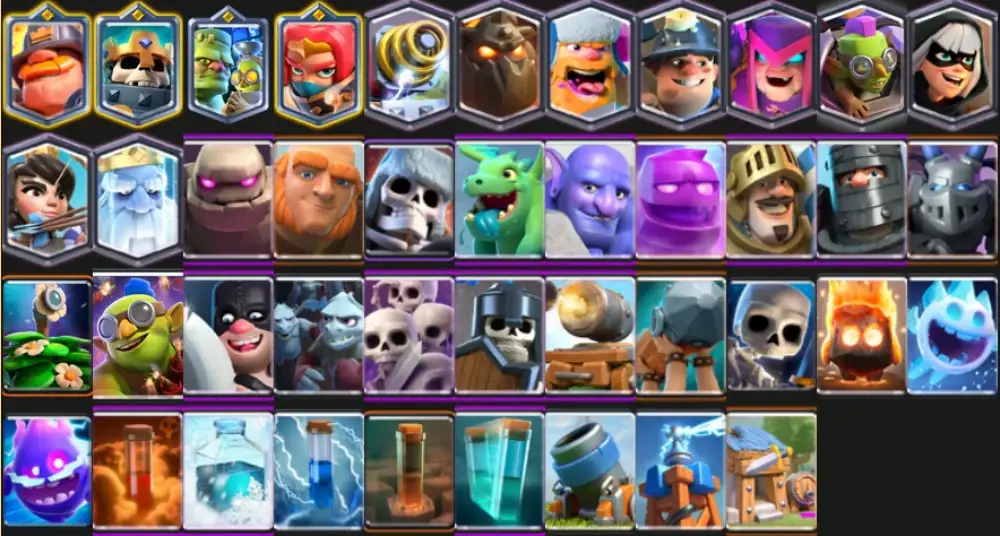
The current meta includes standard units, spells, buildings, Tower Troops, Champions, Heroes, and evolved versions of existing cards. These forms should not always share the same placement because an Evolution or Hero ability can dramatically change how a card performs.
The table below highlights some of the most relevant options in the July 2026 environment. It does not attempt to place all Clash Royale cards into permanent categories because statistics vary between modes, levels, and player groups.
| Tier | Card highlights | General role in the meta |
| S | Heal Spirit, Zap Evolution, Three Musketeers, Royal Ghost Evolution, Battle Ram Evolution, Lava Hound, Barbarian Barrel, Mother Witch, Hero Giant, Cannon Cart | Excellent performance, strong synergy, or unusually efficient value |
| A | Hunter, Goblin Cage Evolution, Barbarians Evolution, Bowler, Rascals, Phoenix, Hero Mega Minion, Zappies, Skeleton Dragons, Baby Dragon Evolution, Mortar Evolution, Electro Giant | Highly competitive choices with manageable weaknesses |
| B | Golden Knight, Bandit, Inferno Dragon Evolution, Giant Skeleton, Vines, Hero Goblins, Tornado, Lightning, Fireball, Graveyard, Golem, Ram Rider | Effective cards that depend more heavily on archetype or matchup |
| C or specialist | Ronin, Inferno Tower, Tesla Evolution, Goblin Drill, Royal Hogs, Skeleton King, Goblin Curse, Lumberjack, base Baby Dragon, Elixir Golem | Situational options that may need specific support or further meta development |
A C-tier placement does not mean that a card is unusable. It indicates that the card may currently have more difficult matchups, weaker statistics, limited deck compatibility, or a higher opportunity cost than the alternatives above it.
S tier: cards defining the July 2026 meta
Heal Spirit provides remarkable value for one Elixir. It cycles quickly, supports pushes, restores health to surviving troops, and can force opponents to account for much more total hitpoint value than its cost suggests.
Zap Evolution combines a familiar low-cost spell with additional control and utility. It can support several archetypes without forcing major changes to the deck, which makes it one of the most flexible evolved Clash Royale cards.
Three Musketeers have returned as a powerful split-lane threat. Their high cost remains dangerous when the opponent has an efficient spell combination, but successful players can create pressure that is difficult to answer without overspending.
Royal Ghost Evolution and Battle Ram Evolution are central to aggressive bridge-pressure strategies. Both can create immediate threats while supporting defensive counterpushes.
Lava Hound remains one of the strongest dedicated air win conditions. Its decks can overwhelm opponents whose anti-air cards are out of rotation, especially when the supporting units survive behind the tank.
Barbarian Barrel continues to offer reliable ground control, spell utility, and a surviving troop for a low cost. Mother Witch can transform swarm-heavy defenses into additional pressure, making her extremely influential in the correct matchup.
Hero Giant adds a powerful ability to traditional Giant strategies. Cannon Cart provides damage, range, defensive stability, and counterpush potential, allowing it to fit into several deck styles.
These cards are not automatically the correct choices for every player. A highly ranked card still needs a deck that can protect its weaknesses and convert its strengths into Crown Tower damage.
A tier: strong and reliable alternatives
Hunter remains an effective defensive card because his damage changes according to distance. At close range, he can stop tanks and win conditions, while his ranged spread helps against groups and air units.
Goblin Cage Evolution provides both building-based defense and a threatening counterpush. It can pull building-targeting units while creating additional value after the structure breaks.
Bowler and Rascals are strong defensive options in decks that benefit from lane control. Bowler pushes ground troops backward, while Rascals divide their defensive value between a durable front unit and ranged support.
Phoenix is still one of the coolest Clash Royale cards from a visual and mechanical perspective. Its rebirth mechanic creates additional pressure, although its competitive placement is no longer as universally dominant as some older lists claimed.
Zappies can slow pushes, reset dangerous units, and support split-lane strategies. Skeleton Dragons and Baby Dragon Evolution provide splash damage against both air and ground targets.
Mortar Evolution gives cycle and control players a flexible defensive building that can become a win condition. Electro Giant also became more threatening after receiving additional hitpoints in the July balance changes.
Players interested in team formats should remember that card value can change when four decks interact in the same arena. The best 2v2 Clash Royale deck strategies explain how shared defense, spell overlap, communication, and teammate compatibility affect card selection.
How should all Clash Royale cards be ranked?
Ranking all Clash Royale cards requires more than checking one win-rate column. A card can have a strong percentage because it appears mainly in one optimized deck, while another may show a lower rate because it is used by a much larger and less experienced audience.
Usage, win rate, clean win rate, deck diversity, challenge performance, competitive results, and matchup spread should be considered together. Short samples can also become distorted after a balance update or new-card release.
Evolutions, Heroes, and base versions
An evolved card should usually be evaluated separately from its base version. Baby Dragon Evolution, for example, can perform significantly better than the normal Baby Dragon because the Evolution adds value unavailable to the original form.
The same principle applies to Wizard Evolution, Zap Evolution, Battle Ram Evolution, and the other evolved Clash Royale cards. A strong Evolution does not automatically make the base card equally strong whenever its cycle is unavailable.
Heroes also require separate analysis because their activated or passive abilities change normal interactions. Hero Giant, Hero Goblins, Hero Balloon, and Hero Magic Archer cannot be judged only by comparing their original card statistics.
The July 2026 balance update reduced the strength of several Heroes. Hero Balloon’s Skeletroopers became less dangerous, Hero Goblins received a slower deployment, Hero Knight lost shield durability, and Hero Magic Archer received significant ability reductions.
These changes do not necessarily make every affected card weak. Instead, they reduce the situations in which the cards produce excessive value without giving the opponent enough time to respond.
Hero Tombstone received a more substantial rework. Its ability became cheaper, and the Tomb Queen received more hitpoints, but the continuous Skeleton generation was removed. That changes the purpose of the ability rather than creating a simple numerical buff.
Therefore, a useful Clash Royale tier list must be updated after players have tested the new interactions. Immediate reactions to patch notes can be wrong because some changes require different deck construction.
Roles, costs, and deck compatibility
Cards should also be compared within their roles. Barbarian Barrel is not competing directly with Lava Hound because one is a small spell and the other is an air win condition.
A complete deck usually needs several functions:
- A reliable win condition.
- Defensive damage against tanks.
- An answer to air units.
- A small or medium spell.
- A way to control swarms.
- Support for counterpushes.
- A reasonable average Elixir cost.
- Answers to popular opposing strategies.
The best card of Clash Royale cannot perform all these roles alone. Even the most efficient option can become ineffective when placed in a deck with no clear game plan.
Elixir cost affects card value as well. A one-Elixir Heal Spirit can create an advantage without delaying the next card cycle, while a nine-Elixir Three Musketeers deployment can expose the player to an immediate opposite-lane attack.
Versatility is one of the strongest indicators of a high-tier card. Fireball may not dominate one specific interaction, but it remains relevant against many support units and can provide Crown Tower damage.
Specialized cards are more difficult to rank. Fisherman can completely reshape certain matchups with correct placement, while a poorly timed pull can help the opponent. Tornado also depends heavily on activation timing, positioning, and synergy with splash damage.
Players can follow their own results through Clash Royale tracker tools and statistics. Personal win rates, recurring matchup problems, and deck history may be more useful than a global tier list when deciding which card to upgrade.
What is the best card of Clash Royale?
The best card of Clash Royale depends on how the question is defined. The best universal support card is not necessarily the best win condition, defensive building, spell, Evolution, or Hero.
In the July 2026 environment, Heal Spirit and Barbarian Barrel are among the strongest general-value options. Battle Ram Evolution, Lava Hound, Hero Giant, and Mortar Evolution are more appropriate candidates when evaluating win conditions.
Best cards for general deck value
Heal Spirit is an excellent cycle card because it can support troops, recover hitpoints, and create positive Elixir interactions. However, it cannot defend every threat or deal reliable Tower damage independently.
Barbarian Barrel is another candidate for the best card of Clash Royale because it combines a spell effect with a troop. It clears small ground units, damages support cards, and leaves a Barbarian that can defend or join a counterpush.
Cannon Cart provides unusually broad defensive value. It can attack from range, survive as a building after losing its shield, and become dangerous if it crosses the bridge behind another unit.
Mother Witch becomes one of the strongest cards whenever swarm strategies are common. She punishes Skeletons, Goblins, Bats, and other low-hitpoint units by creating Cursed Hogs.
Zap Evolution is valuable because small spells appear in many archetypes. It can reset Inferno units, clear weak troops, support pushes, and improve interactions without requiring an expensive commitment.
A card’s popularity should not be confused with objective superiority. Hog Rider has remained popular for years because it is recognizable, direct, and compatible with fast-cycle decks. That does not mean it is always the strongest win condition in every patch.
Best win conditions and specialist choices
Lava Hound is one of the strongest current win conditions when supported by an appropriate air deck. It can create overwhelming pushes, but its high cost and slow movement require careful defense before deployment.
Battle Ram Evolution works well in bridge-spam decks. It forces immediate responses and can support Bandit, Royal Ghost, P.E.K.K.A, and ranged pressure.
Hero Giant is effective in beatdown and counterpush decks. Its ability can create additional value against defensive units, but the surrounding deck still needs answers to buildings, swarms, and air pressure.
Mortar Evolution is a strong option for players who prefer control. It can defend in the center of the arena or apply long-range pressure to a Crown Tower.
Graveyard remains dangerous when paired with a tank and a spell that controls defensive swarms. Its performance depends heavily on timing and surviving support units.
The new Ronin deserves special attention but not an automatic S-tier placement. His ability to parry ground melee attacks creates unusual interactions, yet ranged units, air troops, swarms, and spells can limit his impact.
Because Ronin entered the game recently, his placement may continue changing as players refine decks and learn efficient counters. New cards frequently appear stronger or weaker during their first weeks because experimentation affects both usage and win rates.
Players can visit the official Clash Royale game page for current announcements, seasonal information, downloads, and official update news. Tier placements should always be reconsidered after meaningful balance changes.
Which are the coolest Clash Royale cards?
The coolest Clash Royale cards are a matter of visual design, animation, sound, lore, and personal playstyle rather than competitive statistics. A card can be memorable even when it is not part of the strongest current decks.
Some players prefer dramatic tanks and win conditions. Others enjoy cards with unusual movement, transformations, or abilities that create surprising interactions.
Cards with memorable designs and mechanics
Phoenix remains visually distinctive because it can return through its egg. Its animations communicate the rebirth mechanic clearly and make every surviving egg feel important.
Magic Archer is popular for his geometry-based attacks. A correctly aligned shot can damage defensive troops and the Crown Tower simultaneously, creating one of the most satisfying interactions in the game.
Sparky is another of the coolest Clash Royale cards because of its enormous charged shot. The long preparation time creates tension, and a successful connection can decide a match immediately.
Mega Knight has one of the game’s most recognizable deployment animations. His jump and area damage make him popular among casual and mid-ladder players, even when competitive tier lists rank alternatives more highly.
Monk can reflect projectiles, creating dramatic reversals against spells and ranged attacks. Golden Knight can chain dashes across several targets, while Mighty Miner changes lanes with an explosive ability.
Ronin’s parry mechanic also makes him visually and mechanically distinctive. He can reflect melee damage at intervals, encouraging players to track when the defensive effect is available.
Card Evolutions add more dramatic versions of familiar units. Royal Ghost Evolution, Battle Ram Evolution, Mortar Evolution, and Inferno Dragon Evolution can make older cards feel completely different.
Style versus competitive performance
Visual appeal should not determine an entire deck, but enjoying a card can make practice more rewarding. Players are more likely to learn difficult matchups when they genuinely like the archetype they are using.
A Sparky player must understand reset cards, cycle tracking, and how to protect a high-cost threat. A Lava Hound player needs to manage tower damage while preparing an air push.
Similarly, a Three Musketeers player must recognize spell cycles and split-lane pressure. These skills cannot be learned by looking only at the Clash Royale tier list.
The most stylish card may also perform differently across modes. A visually impressive Mega Knight can dominate opponents who group troops, while experienced players may activate the King Tower, pull him toward the center, or punish his cost.
Cosmetics, Star Levels, banners, emotes, and Tower Skins also influence which designs players prefer. These elements do not change competitive card strength.
For additional context about the game’s release, development, esports presence, and major systems, see this overview of Clash Royale history. The game has continued expanding far beyond its original 2016 card pool.
How do you build a deck using the Clash Royale tier list?
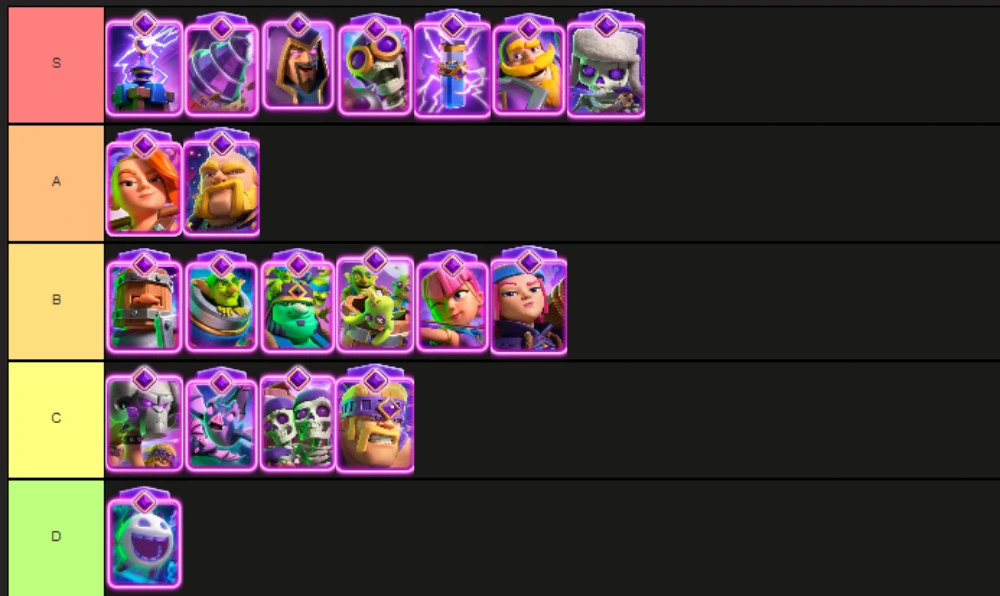
A tier list is most useful when it helps players make targeted improvements. It should not encourage them to replace an entire upgraded deck after every balance update.
Begin with a clear win condition, then select cards that cover its weaknesses. The finished deck should have enough defense to survive while still creating realistic opportunities to damage a Crown Tower.
Build around one clear win condition
Choose a win condition that fits your preferred pace. Hog Rider, Mortar, Goblin Drill, and Miner-based strategies usually support faster cycles or control. Giant, Golem, Lava Hound, and Electro Giant are associated with heavier pushes.
Next, add support that solves specific problems. Lava Hound decks need air damage and ways to protect supporting units. Graveyard decks need a tank and reliable swarm control.
A practical deck-building sequence is:
- Select the primary win condition.
- Add a defensive unit that can counter tanks.
- Include an answer to air troops.
- Choose a small spell.
- Add a medium or heavy spell when needed.
- Include a building or reliable pulling unit.
- Add support for counterpushes.
- Review the average Elixir cost.
Not every deck needs two traditional spells or a permanent building. The correct structure depends on the archetype, but every card should have a clear reason for being included.
Avoid adding the highest-ranked Clash Royale cards simply because they appear in S tier. Three Musketeers, Lava Hound, and Hero Giant do not automatically belong in the same deck.
Synergy is more important than the average rank of the individual cards. An established B-tier combination can outperform eight unrelated S-tier options.
Adapt the list to mode and card levels
Ranked, Trophy Road, Grand Challenges, Classic Challenges, 2v2, Clan Wars, and special events create different conditions.
Tournament-standard modes reduce the effect of uneven card levels. Trophy Road and other progression-based environments may reward players who use their most upgraded cards, even when those cards rank lower in competitive data.
Card levels can change important interactions. A spell that normally defeats a support unit may fail when underleveled, while an overleveled troop can survive an expected counter.
For that reason, do not spend every resource immediately after seeing a new Clash Royale tier list. Wait to see whether the card remains useful after the meta stabilizes.
Consider upgrading flexible cards first. Small spells, reliable defensive units, and established win conditions tend to appear in more decks than highly specialized support choices.
The deck should also reflect your own execution. A theoretically powerful cycle deck may perform poorly when the player repeatedly misses placements or cannot track the opponent’s rotation.
Test changes individually. Replacing three cards at once makes it difficult to determine which adjustment improved or weakened the deck.
How can ExitLag support Clash Royale matches?
ExitLag does not increase card levels, provide Elixir, change matchmaking, improve chest rewards, or move a card higher in the Clash Royale tier list. Its function is limited to network optimization.
Clash Royale is a real-time online game. Inputs must reach the game service while both players deploy cards, activate abilities, and react to changing positions.
Network problems that may affect battles
An unstable network can create delayed deployments, connection warnings, disconnections, or moments when the game stops responding normally.
Even a short interruption can matter. A delayed defensive card may allow a win condition to reach the Tower, while a disconnected player may lose the opportunity to activate a Hero ability or cast a spell.
Potential network-related symptoms include:
- Repeated Wi-Fi or connection warnings.
- Delayed card deployment.
- Battles freezing before reconnecting.
- Unstable access at certain times.
- Packet loss on the local network.
- Disconnections during Ranked matches.
- Slow loading before or after battles.
ExitLag can analyze available network routes and may direct supported traffic through a more stable path. The result depends on the player’s region, internet provider, device, local network, and available routes.
Players should compare several matches under similar conditions. One victory or loss does not prove that a route is better.
Problems ExitLag cannot solve
ExitLag cannot fix weak deck construction, incorrect placements, underleveled cards, poor Elixir management, or a difficult matchup.
It also cannot resolve:
- A global Supercell outage.
- Account suspensions.
- Missing purchases.
- Device performance limitations.
- An outdated game version.
- Insufficient storage.
- Incorrect Supercell ID credentials.
- Balance problems within the game.
- Opponent behavior.
- Mistakes caused by rushing decisions.
When the problem is related to routing, ExitLag may help improve connection stability. When the issue involves strategy, players should review replays, study matchups, and adjust their decks.
The service should not be described as a guaranteed way to win. A stable connection helps actions reach the game consistently, but it does not choose the correct card or placement.
Frequently asked questions
The questions below summarize how players should interpret the current ranking and apply it to their own decks.
No. Supercell publishes balance changes and game information but does not maintain an official S-to-C ranking of every card.
A Clash Royale tier list is normally created by players, analysts, statistics platforms, or content creators. Different lists may use different modes and criteria.
There is no universal answer. Heal Spirit, Barbarian Barrel, Zap Evolution, Cannon Cart, and Mother Witch currently provide strong general value.
The best card of Clash Royale for one deck may be completely unsuitable for another. Win conditions should be compared separately from support units and spells.
Current highlights include Heal Spirit, Zap Evolution, Three Musketeers, Royal Ghost Evolution, Battle Ram Evolution, Lava Hound, Barbarian Barrel, Mother Witch, Hero Giant, and Cannon Cart.
These placements can change after balance updates or new strategy discoveries.
Ronin has a unique melee-parry mechanic, but his early competitive performance has been inconsistent. He is powerful against certain melee units and weaker against ranged damage, swarms, air troops, and spells.
His placement should be treated as provisional while players develop better decks and counters.
No. A lower-tier card may work in one specific archetype, against a particular meta, or for a skilled specialist.
Card levels also matter outside tournament-standard modes. An upgraded lower-tier card can be more practical than an underleveled S-tier alternative.
Popular choices include Phoenix, Sparky, Magic Archer, Mega Knight, Monk, Golden Knight, Mighty Miner, and Ronin.
The coolest Clash Royale cards depend on personal preferences for animations, mechanics, character design, and playstyle.
No. Upgrade cards that fit decks you actively use. Meta rankings can change, and an expensive upgrade provides little value when the card does not work with your preferred strategy.
Flexible spells and support units are usually safer investments than highly specialized cards.
Review the ranking after major balance changes, new cards, Evolutions, Heroes, or important competitive events.
Statistics from the first days of a patch may be unstable, so players should avoid making permanent upgrade decisions based only on immediate results.
No. ExitLag does not change damage, hitpoints, Elixir cost, card levels, abilities, or matchmaking.
It may help optimize the network route when instability is causing delayed deployments, warnings, or disconnections.
The Clash Royale tier list is most useful when combined with deck synergy, replay analysis, card levels, and personal experience. Choose a reliable win condition, test changes carefully, and try ExitLag when a genuine routing problem is disrupting your Ranked battles or challenges.
All game images used in this article belong to their respective owners. They are used for informational and educational purposes only and do not imply endorsement or affiliation with the rights holders.
Got questions or want to connect with other players? Join the conversation at the ExitLag Forum!