
Clay Stardew Valley is one of those resources that players rarely think about until they suddenly need a large quantity for a specific craft or building. By that point, stockpiling it from scratch can feel tedious. Understanding the most efficient clay farming methods from early in your save file prevents the frustration of scrambling for it later.
Clay stardew valley is obtained primarily through tilling soil with the Hoe, breaking open geodes, and mining clay nodes on Ginger Island. It is not a flashy resource, but it is required for several important crafting recipes and the construction of the Silo, which is itself essential for animal farming.
How to get clay in stardew valley efficiently comes down to understanding that while clay has a relatively low drop rate from random tilling, specific locations dramatically increase yield per energy spent. Floor 15 of the Mines is the most widely used early-game clay farming spot, and the Ginger Island Dig Site provides a reliable late-game source once unlocked.

Clay Stardew Valley: What Is It and What Does It Do?
Crafting Recipes and Clay Uses
Clay is used in the following recipes and buildings in stardew valley:
- Silo (100g, 100 Stone, 10 Copper Bars, 5 Clay): Essential animal farming building that stores hay.
- Fiber Seeds (1 Mixed Seeds, 1 Sap, 1 Clay): Produces a Fiber plant, useful for crafting various items.
- Deluxe Retaining Soil (3 Stone, 1 Fiber, 1 Clay): Upgraded soil that retains water indefinitely, eliminating daily watering for that tile.
- Bone Mill (10 Bone Fragment, 3 Clay, 20 Stone): Converts bone fragments into fertilizer.
- Dehydrator (30 Wood, 15 Clay, 1 Gold Bar): Processes certain crops into preserved versions for higher sell prices.
The stardew valley clay demand is front-loaded: the Silo is your first major clay requirement, and it comes early. After that, clay accumulates faster than you need it unless you are heavily investing in Deluxe Retaining Soil for a large number of crop tiles.
How Rare Is Clay?
Clay has a base drop chance of approximately 3% when tilling random soil tiles. This sounds low, but high-volume tilling in the right location produces substantial quantities. Furthermore, artifact spots (the glittering patches in the ground) have a much higher clay drop rate than random soil, making them the highest-yield targets during normal farm exploration.
How to Get Clay in Stardew Valley: Best Methods
Method 1: Tilling Mine Floor 15
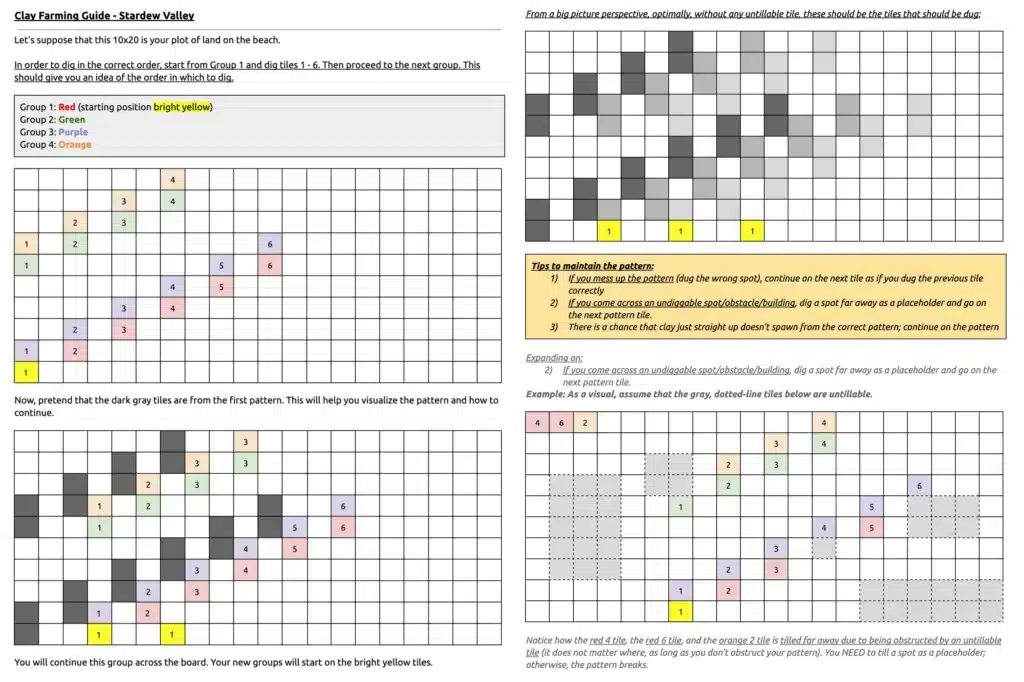
The fastest early-game clay farming method is repeatedly tilling the dirt floor on Level 15 of the Mines. Floor 15 has a large area of tillable soil and can be reset by exiting and re-entering the mine.
Step-by-step process:
- Reach Floor 15 of the Mines (accessible from the start of the game).
- Equip your Hoe and till every visible soil patch on the floor.
- Collect any clay that drops.
- Exit the Mine and re-enter to reset the floor’s soil tiles.
- Repeat for 70-120 clay per dedicated session.
This method is most energy-efficient in Spring and Summer when food buffs for Energy are easier to obtain. Bring a stack of food (Salmonberry, Spring Onion, or cooked dishes) to sustain Energy through multiple tilling cycles.
Method 2: Artifact Spots on Your Farm
Stardew valley clay farming from artifact spots is the most passive method. Artifact spots appear as small glittering patches on your farm and around the world each day. Tilling them with the Hoe produces either artifacts, minerals, or clay, with clay being the most common result.
Walk your farm perimeter every morning and till any artifact spots you find. You are not guaranteed clay from each one, but artifact spots appear frequently enough that consistent daily checking produces meaningful clay quantities without dedicated farming sessions.
Method 3: Geodes at Clint’s Blacksmith
Breaking geodes at Clint’s Blacksmith shop produces minerals, gems, and occasionally clay. Geodes are found by breaking rocks in the Mines and around your farm.
Geode types and clay availability:
- Regular Geode: Can contain clay among other minerals
- Frozen Geode: Lower clay rate, better for other minerals
- Magma Geode: Rarely contains clay
- Omni Geode: Can contain any mineral including clay
Breaking geodes for clay is not the most efficient primary method, but it is a useful secondary source when you already break geodes for other resources and incidentally accumulate clay from the process.
Method 4: Ginger Island Dig Site
The Ginger Island Dig Site, unlocked after repairing Willy’s boat and reaching the island, contains dedicated Clay Nodes that can be mined consistently. This is the most reliable how to get clay stardew valley source in the late game.
| Method | Efficiency | Availability | Energy Cost |
| Mine Floor 15 Tilling | Very High | Year 1 | Medium |
| Farm Artifact Spots | Low-Medium (passive) | Year 1 | Low |
| Geode Breaking | Low (secondary source) | Year 1 | None (gold cost) |
| Ginger Island Dig Site | High (dedicated nodes) | Year 2+ | Medium |
| Treasure Totems (v1.6) | Very High (burst) | Late Game | None (crafted) |
Method 5: Treasure Totems (Version 1.6)
Version 1.6 introduced the Treasure Totem, a craftable item that spawns a ring of artifact spots around the player when activated. Since artifact spots have high clay drop rates, using a Treasure Totem in a large open area produces a concentrated burst of clay in a single session.
The Treasure Totem recipe is unlocked through Foraging Mastery and requires 10 Moss, 5 Hardwood, and 1 Mystic Sap. This makes it a late-game clay farming tool that excels when you need a large quantity quickly.

Clay Stardew Valley: Early Game Priority Guide
When Do You Need Clay First?
The stardew valley clay farming priority order for most players looks like this:
- Silo (5 Clay): Your first and most urgent clay need. Build it before the Coop to ensure hay storage is ready immediately.
- Bone Mill (3 Clay): Mid-game recipe for converting bone fragments to fertilizer. Useful but not urgent.
- Deluxe Retaining Soil (1 Clay each): Late-game investment for greenhouse and high-value crop tiles.
- Dehydrator (15 Clay): Late-game processing tool for specific crops.
For most of Year 1, keeping 20-30 clay in reserve is sufficient. Build up a larger stockpile only when approaching late-game recipes that require it in quantity.
Where to Find Clay Stardew Valley on the Farm
Beyond dedicated farming sessions, where to find clay stardew valley in daily play comes down to scanning for artifact spots. These appear:
- On your farm’s tillable soil areas
- Along paths between the farm and town
- In the Mines between floors
- On the Beach and other outdoor areas
Develop a habit of checking for the sparkle effect that indicates an artifact spot whenever you walk through tillable areas. Tilling every spot you find is always worth the one Energy cost.
Pro Tips: Clay Stardew Valley
- Build the Silo immediately after it becomes affordable: The Silo requires only 5 clay, but its function is critical to animal farming. Do not delay it waiting to stockpile more clay than you need.
- Run a Mine Floor 15 session before any big crafting push: If you know you need a large clay quantity for Deluxe Retaining Soil, dedicate one full morning to Floor 15 tilling. Bring Energy food and plan for 60-100 clay per session.
- Never skip artifact spots on your daily farm route: Tilling every glittering spot costs only 1 Energy each and takes seconds. Over the course of a year, passively tilling all artifact spots produces significant clay without any dedicated farming effort.
- Save geode breaking for other minerals primarily: Breaking geodes for clay specifically is not efficient. However, if you break geodes regularly for gems and minerals, collect the incidental clay without attempting to target it.
- Use Treasure Totems for bulk clay in late game: Once unlocked, a single Treasure Totem produces dozens of artifact spots simultaneously, delivering the largest single-session clay yield available in the game.
Common Mistakes Clay Stardew Valley Players Make
- Scrambling for clay after deciding to build the Silo last-minute. Players who try to buy animals before building the Silo face an immediate hay storage crisis. Fix: Make the Silo your first permanent structure purchase, even before the Coop. It costs only 5 clay plus other cheap materials.
- Ignoring artifact spots throughout the year and then farming clay desperately when a recipe requires it. This is an easily avoided resource crunch. Fix: Add “check for artifact spots” to your daily farm route as a default habit from Year 1 Spring.
- Spending Energy on random soil tilling across the farm instead of Floor 15. Random farm soil has the same clay rate as Floor 15, but Floor 15 has a much denser concentration of tillable tiles in a smaller area, making it dramatically more efficient per energy spent. Fix: Always go to Mine Floor 15 for dedicated clay farming sessions rather than tilling your farm fields randomly.
Farm Smart and Play Lag-Free With ExitLag
Clay stardew valley farming is most efficient in multiplayer co-op, where one player can run dedicated Mine Floor 15 tilling sessions while another manages the farm, crops, and animals simultaneously. However, co-op sessions depend on stable connections to function properly.
ExitLag is a game connection optimizer that routes your traffic through the fastest, most stable network path in real time. It is not a VPN and does not affect game files or save data.
For stardew valley clay farming co-op sessions and all multiplayer play, ExitLag provides:
- Reduced lag and packet loss during shared farm sessions
- Multipath Technology maintaining connection stability throughout extended co-op runs
- Multi-Internet support for instant fallback if your primary network drops mid-session
Download ExitLag for PC and run your next co-op clay farming session without interruptions
All game images used in this blog post belong to ConcernedApe. They are used for informational and educational purposes only and do not imply endorsement or affiliation with the rights holder.
Got questions or want to connect with other players? Join the conversation at the ExitLag Forum!