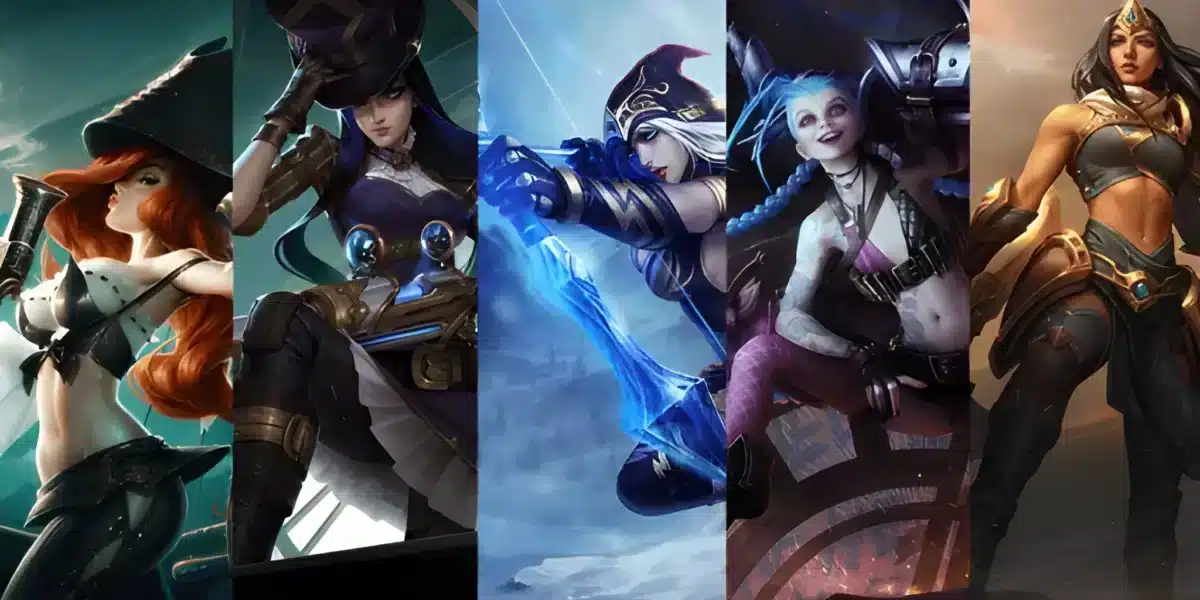

Dota 2 vs League of Legends is the longest-running argument in competitive gaming, and in 2026 both games are stronger than ever. Despite sharing the MOBA label, they are fundamentally different experiences that attract different kinds of players and reward different approaches to competition.
The numbers alone tell the first part of the story. League of Legends has approximately 130 to 160 million monthly active players globally and was the most-watched game on Twitch in 2025 with over 1.67 billion hours viewed. Dota 2 maintains around 600,000 to 620,000 average concurrent players on Steam, reaching daily peaks above 800,000, with a compound annual growth rate of roughly 12 to 13% over the past three years.
The main differences between Dota 2 and League of Legends go much deeper than player numbers. Gameplay philosophy, hero access, map design, economy systems, and esports structure all diverge significantly, making a direct comparison useful for anyone choosing between the two.

What Are the Main Differences Between Dota 2 and League of Legends?
Hero and Champion Access
This is one of the most practically significant differences for new players.
Dota 2: All heroes are unlocked from day one. Every character, every ability, and every strategy is available to a player on their first session. There is no paywall separating you from any hero.
League of Legends: Champions must be purchased with Blue Essence (earned through playing) or Riot Points (purchased with real money). New champions typically cost the most. The free champion rotation provides 15 to 20 weekly champions to test without buying, but permanent access requires either time investment or spending.
This difference shapes the early experience dramatically. A Dota 2 new player can immediately experiment with Invoker, a 10-spell hero considered one of the most complex in any MOBA. A League new player works through a limited roster while building enough currency to expand their pool.
Gameplay Mechanics and Complexity
Dota 2 operates at significantly higher mechanical and strategic complexity than League. Unique mechanics that do not exist in League:
- Denying: Players can attack their own creeps to deny gold and experience to the enemy
- Day/Night cycle: Vision range changes between day and night, altering how aggressive plays work
- Buyback: Dead players can spend gold to immediately respawn, creating late-game economic decisions
- Courier system: A shared flying unit that delivers items from the shop directly to heroes in the field
- High ground advantage: Attacking from below high ground gives attackers a significant disadvantage
- True sight and various vision mechanics: Multiple layers of vision complexity beyond simple wards
League of Legends streamlined these systems to lower the barrier to entry. No denying. No buyback. No day/night cycle. Simpler vision mechanics. The game rewards champion mastery, team coordination, and objective control without requiring players to simultaneously manage additional economic and logistical layers.
Map Design
Dota 2: Uses a symmetrical map where both sides have an identical layout. The map features different terrain for high ground and low ground, river areas, and jungle camps distributed differently across each side.
League of Legends: Summoner’s Rift is not symmetrical. The lane orientations, jungle path structure, and objective positions create different attack and defense dynamics for each side. Baron Nashor is on the top river side; Dragon is on the bottom. This asymmetry means team compositions are sometimes side-dependent.
Objectives and Win Conditions
| Objective | Dota 2 | League of Legends |
| Primary objective | Ancient (enemy base structure) | Nexus (enemy base structure) |
| Major neutral objective | Roshan (grants Aegis of Immortality) | Baron Nashor, Rift Herald |
| Scaling objective | Barracks (weakens enemy creeps when destroyed) | Elemental Dragons (permanent team buffs) |
| Secondary objectives | Outposts, bounty runes | Towers, void grubs |
Monetization
Both games are free to play, but their monetization philosophies differ.
Dota 2: All gameplay content is free. Cosmetic items including skins, terrain packs, and hero sets are sold. Dota Plus ($4/month) provides additional hero progression tracking and small gameplay perks. A real secondary market exists where players can trade and sell cosmetic items freely.
League of Legends: Champions require purchase. Cosmetic items (skins, emotes, icons) are sold through a premium currency. No real secondary market: items cannot be traded between players.
Which Game Is More Popular in the Esports Scene?
Both titles have thriving esports ecosystems, but they operate on very different models.
League of Legends Esports follows a franchised league system with guaranteed spots, regular weekly schedules, and an organized international calendar. Regional leagues (LCK, LPL, LEC, LCS) run structured splits that culminate in Worlds, the annual World Championship. League of Legends was the most-watched esport on Twitch in 2025. The ecosystem maintains steady year-round viewership.
Dota 2 Esports runs on a more open competitive circuit. Teams navigate open qualifiers, invitations, and independent third-party tournament organizer events without guaranteed league slots. The International remains the defining event in Dota 2, featuring $30 to 40 million in crowdfunded prize money accumulated through in-game Battle Pass purchases. Viewership spikes dramatically during The International and then recedes between events.
Key esports comparison:
| Factor | League of Legends | Dota 2 |
| Viewership model | Steady year-round | Spikes around The International |
| Prize pools | Large but consistent | TI often exceeds all League events combined |
| Circuit structure | Franchised, predictable | Open qualifiers, volatile results |
| Path to pro | League academy systems | Open circuit grinding |
| Most-watched event | Worlds | The International |
Which Game Has a Better Community and Player Base?
The question of which game has a better community and player base is genuinely subjective and depends on what you value.
League of Legends has a larger, more casual-skewing community. The lower entry barrier attracts a broader demographic including players new to competitive games, younger audiences, and casual players who want clear systems and lower mechanical complexity. The community produces vast amounts of content: fan art, music, guides, and the Arcane animated series has expanded the IP’s reach to audiences who had never played the game.
Dota 2 has a smaller, more hardcore-skewing community. The steep learning curve self-selects players who have invested significant time to understand the game’s depth. This produces a community with strong opinions, high strategic knowledge, and genuine appreciation for complex plays that a casual audience would not understand. The real cosmetic marketplace creates economic community participation that does not exist in League.
Both communities have reputations for toxicity in ranked play. This is a MOBA genre issue rather than a problem specific to either game.
Which MOBA Should You Choose in 2026?
Choose League of Legends if you:
- Want to start playing immediately with lower mechanical overhead
- Prefer a faster-paced game with shorter sessions
- Care about a larger community and more available guides
- Want to follow a well-structured competitive scene year-round
- Enjoy a roster of expressive, visually distinct champions with defined roles
Choose Dota 2 if you:
- Want access to every hero immediately without spending anything
- Prefer deep complexity and strategic layers over accessibility
- Enjoy the risk of open tournament circuits over structured franchised leagues
- Want a real cosmetic marketplace where your items have tradeable value
- Are willing to invest significantly more time to reach competitive competency
Pro Tips: Deciding Between Dota 2 and League of Legends
- Try both games for at least 20 hours each before committing: The feel of each game at the very beginning does not represent the experience at 200 hours. Both games have notoriously steep early learning curves that smooth out significantly with time.
- Check which of your existing friends play which game: The social layer matters more than almost any game design difference. Playing either MOBA with people you know dramatically improves the early experience.
- Research the communities for the region you play in: Dota 2 is significantly stronger in SEA, Russia, and Eastern Europe. League of Legends dominates in Korea, China, Western Europe, and North America. Regional server populations affect matchmaking quality at entry level.
- Do not let the community reputation of either game determine your choice: Both communities have negative reputations for toxicity. Individual experience varies significantly based on how you engage with strangers in-game, regardless of which title you choose.
Common Mistakes When Comparing Dota 2 vs League of Legends
- Assuming League of Legends is Dota 2 simplified: League shares the same fundamental MOBA concept but was designed from the ground up with different philosophical goals, not as a simplified copy. Fix: Approach each game on its own terms rather than treating one as the other’s lesser derivative.
- Making long-term judgments after fewer than 10 hours: Both games are deliberately complex. Neither delivers its actual experience in the first few sessions. Fix: Set a minimum of 20 to 30 hours per game before forming a comparative opinion, ensuring you have experienced enough of each to make a genuine comparison.
- Using player count as the primary quality signal: League’s larger player base reflects accessibility and marketing rather than design quality. Dota’s smaller but growing player count reflects a game with high mechanical depth that naturally limits its accessible market. Fix: Evaluate each game on what it offers rather than which one more people play.

Play Either MOBA with a Stable Connection Using ExitLag
Whether you choose League of Legends, Dota 2, or both, connection quality determines whether your mastery translates into results on the server. High ping and packet loss create input delays that skill cannot overcome in either MOBA.
ExitLag is a connection optimizer used by over 30 million players across 4,000+ game titles including both League of Legends and Dota 2. It analyzes multiple network routes in real time and selects the fastest, most stable path between your device and the game server.
Features that benefit MOBA players across both titles:
- Real-Time Optimization: Continuously selects the lowest-latency route to either LoL or Dota 2 servers, reducing the delay that causes ability misfires and missed skill shots.
- Multipath Technology: Routes game data through multiple simultaneous paths so a single network failure never drops you from a ranked match in either game.
- Traffic Shaper: Prioritizes MOBA traffic over all background applications so your connection stays clean during the most critical team fight moments.
- Multi-Internet: Supports up to four simultaneous connections, ensuring session stability across any network infrastructure.
Download ExitLag and play your MOBA of choice at its best.
All game images and trademarks used in this blog post belong to Riot Games and Valve Corporation respectively. They are used for informational and educational purposes only and do not imply endorsement or affiliation with the rights holders.
Got questions or want to connect with other players? Join the conversation at the ExitLag Forum!