
In the competitive world of Marvel Rivals, every balance update can completely transform how players approach matches, team compositions, and ranked strategies. The constant evolution of heroes through adjustments keeps battles dynamic and ensures that no single character remains overwhelmingly dominant for too long. Understanding Marvel Rivals Buffs and Nerfs is essential for players who want to adapt quickly and maintain an advantage after every patch.
Marvel Rivals Buffs and Nerfs changes are not only about making heroes stronger or weaker. Instead, they represent the developers’ approach to improving competitive fairness, encouraging different playstyles, and creating opportunities for more characters to become relevant in the evolving meta. Each adjustment can influence everything from individual duels to complete team strategies.
What are Marvel Rivals Buffs and Nerfs?
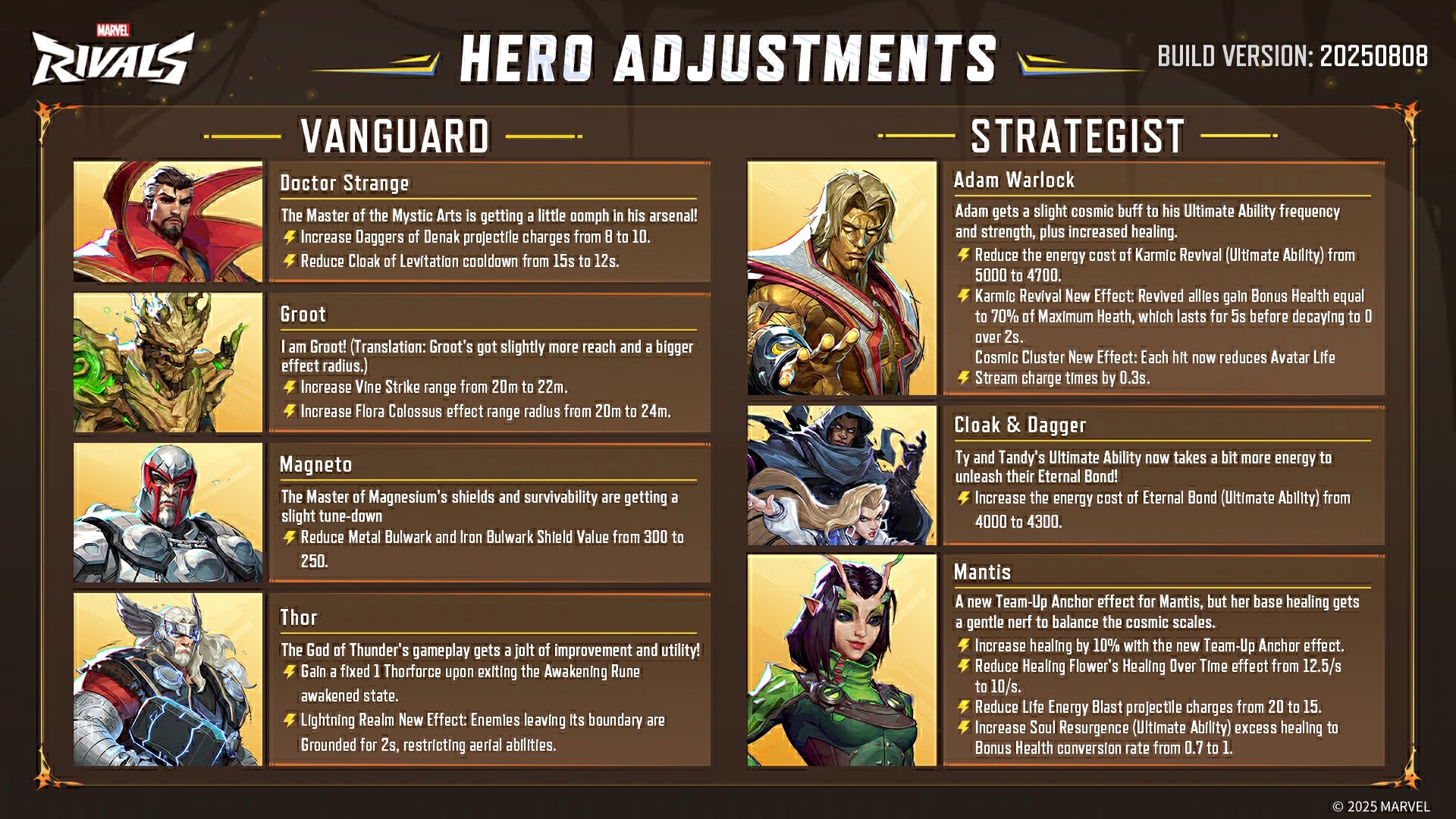
Marvel Rivals Buffs and Nerfs are balance adjustments made by developers to modify hero performance, abilities, statistics, cooldowns, damage values, or gameplay mechanics. Buffs increase a hero’s effectiveness by improving certain aspects of their kit, while nerfs reduce excessive power to create better counterplay and a healthier competitive environment.
Understanding Marvel Rivals Buffs and Nerfs
How Hero Balance Changes Work
In a live-service competitive game, balance updates are necessary to maintain variety and prevent the same heroes from dominating every match. Developers analyze gameplay statistics, community feedback, and competitive results to identify characters that need adjustments.
A buff usually targets heroes that have lower pick rates, weaker performance, or limited usefulness in team compositions. These changes can include:
- Increased damage output or survivability.
- Improved ability range or effectiveness.
- Reduced cooldown times.
- Better synergy with team strategies.
On the other hand, nerfs are designed for heroes that create unhealthy gameplay patterns. When a character becomes too powerful, players may feel forced to choose that hero or build specific counters, reducing strategic diversity.
Common nerf adjustments include:
- Reduced damage scaling.
- Longer cooldown periods.
- Lower defensive capabilities.
- Reduced mobility or burst potential.
Therefore, understanding Marvel Rivals Buffs and Nerfs allows players to predict meta changes and adjust their strategies before entering competitive matches.
Why Balance Updates Matter for Competitive Players
Every patch changes the relationship between heroes. A character that was considered average can suddenly become a top-tier choice after receiving improvements, while a dominant hero may require more precision after receiving reductions.
Competitive players benefit from analyzing these updates because they can identify opportunities before the majority of the player base adapts. Early knowledge of balance changes can help players:
- Discover stronger team compositions.
- Practice newly improved heroes.
- Create better counter strategies.
- Avoid relying on outdated tactics.
The competitive landscape of Marvel Rivals depends heavily on adaptation. Players who understand patch changes usually have a significant advantage over those who continue using previous strategies.
Pre-Season Balance Changes Before Major Updates
Scarlet Witch Buffs and Increased Ultimate Impact
Before the arrival of major seasonal updates, Scarlet Witch received a significant adjustment focused on improving her ultimate ability. The Reality Erasure ultimate damage was increased from 800 to 9,999 during a dedicated balance hotfix.
This adjustment aimed to improve her burst potential and make her more impactful in high-skill situations. As a Mystic hero, Scarlet Witch already had strong area control, but the change allowed skilled players to create more threatening offensive opportunities.
The adjustment demonstrated how developers were experimenting with hero identities rather than simply increasing overall power. Instead of changing her entire kit, the update focused on improving a specific ability that defines her gameplay style.
Luna Snow Adjustments Before Season Changes
Luna Snow also received early balance tuning before the official seasonal update. Her Frozen Embrace ultimate duration was slightly reduced to moderate her strong lane control and influence during fights.
Because Luna Snow combines damage, control, and supportive capabilities, small adjustments were necessary to maintain balance between offensive pressure and defensive utility.
These early modifications prepared the game for a more balanced environment before additional hero changes arrived.
Marvel Rivals Season 7 and the Future of Balance Evolution
The ongoing development of Marvel Rivals shows how seasonal updates continue shaping the competitive experience. While specific future changes may vary, every season introduces new opportunities for heroes to rise or fall within the meta.
The discussion around Marvel Rivals season 7 reflects the community’s interest in future balance directions, possible hero adjustments, and upcoming competitive trends. Seasonal updates often influence not only individual heroes but also the overall structure of team compositions.
Future balancing decisions will likely continue focusing on:
- Improving underused heroes.
- Reducing excessive burst damage.
- Creating stronger team synergy.
- Encouraging strategic variety.
As the game expands, players should expect the balance system to remain one of the most important factors influencing competitive matches.
Marvel Rivals Season 4.5 Official Balance Update
Confirmed Hero Buffs
The Season 4.5 balance update introduced several targeted improvements designed to strengthen specific heroes and create more diversity among competitive choices.
The main confirmed buffs affected Angela, Venom, and Blade.
Angela: Stronger Vanguard Presence
Angela received improvements to her Divine Judgement ability, increasing bonus health gained per enemy hit by 10%.
This change improved her ability to survive extended fights while reinforcing her identity as a frontline Vanguard. Before the adjustment, Angela struggled to compete with other defensive options in some situations.
After the update, her increased durability allowed teams to build more aggressive strategies around sustained combat.
Venom: Improved Utility Through Healing Reduction
Venom received one of the most impactful changes in the patch. His Feast of the Abyss ability gained a 30% Healing Reduction effect against enemies hit for five seconds.
This addition increased his value against teams that depended heavily on recovery abilities. Instead of only absorbing damage, Venom became a more strategic threat capable of disrupting enemy sustain.
The adjustment helped position Venom as a more complete Bruiser option in competitive matches.
Blade: Better Mobility and Melee Pressure
Blade received important improvements focused on consistency during close-range fights.
The Daywalker Dash secondary attack range increased from 4.5 meters to 6.5 meters, allowing him to engage enemies more reliably.
Additionally, completing all four hits of Whirlwind Slash now grants one Slash Speed stack, with a maximum of three stacks.
These improvements rewarded accurate timing and aggressive melee gameplay, helping Blade become a stronger option in ranked environments.
Confirmed Nerfs and Competitive Impact
Psylocke: Reduced Burst Potential
Psylocke was adjusted to reduce excessive burst effectiveness while maintaining her mobility and assassin identity.
The Dance of the Butterfly self-slow effect was reduced, creating more opportunities for opponents to react. Additional tuning to her damage scaling reduced her ability to eliminate enemies too quickly during duels.
The goal was not to remove her importance but to create healthier counterplay situations.
Luna Snow: Additional Cooldown Adjustments
Luna Snow received further tuning related to her Frozen Embrace ultimate cooldown and effectiveness.
These changes focused on balancing her control capabilities without removing her usefulness as a Mystic hero.
The adjustments demonstrate the developers’ approach of carefully reducing excessive advantages while preserving each character’s unique gameplay identity.
Role-Based Summary of Verified Balance Changes
| Role | Buffed Heroes | Nerfed Heroes | Main Design Goal |
| Duelists | Blade | None | Improve close-range diversity and precision gameplay |
| Vanguards | Angela | None | Increase frontline durability |
| Bruisers | Venom | None | Add more utility through anti-healing mechanics |
| Assassins | None | Psylocke | Reduce excessive burst potential |
| Mystics | Scarlet Witch | Luna Snow | Balance damage, control, and cooldown management |
These changes demonstrate how the current balance philosophy focuses on creating more competitive diversity instead of simply increasing or decreasing character strength.
Meta Evolution After Season 4.5 and Competitive Impact
The latest Marvel Rivals Buffs and Nerfs updates created a noticeable shift in how teams approach competitive matches. Instead of focusing exclusively on high burst damage and individual hero carry potential, the current environment rewards coordination, positioning, and stronger combinations between different roles.
Season 4.5 introduced targeted changes rather than complete gameplay overhauls. These adjustments improved underused heroes while reducing situations where specific characters could dominate fights without sufficient counterplay.
As a result, the Marvel Rivals competitive scene moved toward longer engagements where sustain, mobility, and tactical decision-making became more important.
How Marvel Rivals Buffs and Nerfs Changed the Current Meta
Bruisers Become More Valuable in Extended Fights
One of the biggest consequences of the latest balance changes was the increased relevance of Bruisers.
Venom’s new healing reduction effect transformed him from a simple frontline disruptor into a strategic option against teams that rely heavily on recovery abilities. This improvement allows players to pressure opponents while limiting their ability to reset during battles.
Blade also benefited from these changes. His increased attack range and Slash Speed mechanics improved his consistency, allowing skilled players to maintain pressure during close-range encounters.
The result is a meta where sustained combat becomes more rewarding. Heroes that can survive longer while creating pressure are gaining more attention in ranked matches.
Reduced Burst Damage Creates More Counterplay
Another important direction from recent Marvel Rivals Buffs and Nerfs is the reduction of extreme burst strategies.
Psylocke’s adjustments represent this approach. While she remains a dangerous Assassin, opponents now have more opportunities to react before being eliminated.
Similarly, previous Luna Snow adjustments reduced some of her strongest control advantages, creating a better balance between utility and power.
These changes encourage players to focus on teamwork rather than depending on one hero to instantly decide fights.
Team-Up Adjustments and Strategic Composition
Team-Up mechanics remain an important part of Marvel Rivals gameplay. Changes to specific combinations show that developers are interested in rewarding coordinated strategies instead of allowing isolated heroes to dominate.
Strong team compositions now depend on:
- Combining frontline durability with damage output.
- Protecting high-impact heroes during fights.
- Creating balanced offensive and defensive options.
- Understanding enemy counters before selecting heroes.
This evolution makes team communication increasingly important, especially in competitive modes.
Community-Based Tier List After Balance Updates
The following evaluation reflects community discussions, competitive trends, and post-update observations. It is not an official developer ranking.
| Tier | Heroes | Competitive Reasoning |
| S | Blade, Scarlet Witch, Angela | Strong impact, flexible strategies, reliable performance |
| A | Venom, Iron Man, Loki, Thor | Balanced abilities and strong team synergy |
| B | Psylocke, Luna Snow, Captain America | Still viable but require more coordination |
| C | Squirrel Girl, Punisher, Mantis | Need improvements to compete consistently |
S Tier Heroes and Their Competitive Strength
Blade, Scarlet Witch, and Angela currently represent some of the strongest examples of successful balance adjustments.
Blade benefits from improved consistency, Scarlet Witch maintains powerful area damage potential, and Angela offers stronger frontline presence.
These heroes demonstrate how effective buffs can elevate characters without making them unhealthy for the game.
A Tier Heroes and Balanced Performance
Heroes such as Venom, Iron Man, Loki, and Thor remain valuable because they provide reliable options across different team strategies.
Venom’s anti-healing effect gives him a unique purpose, while Iron Man and Loki continue offering strong offensive and utility options.
Their strength comes from flexibility rather than overwhelming power.
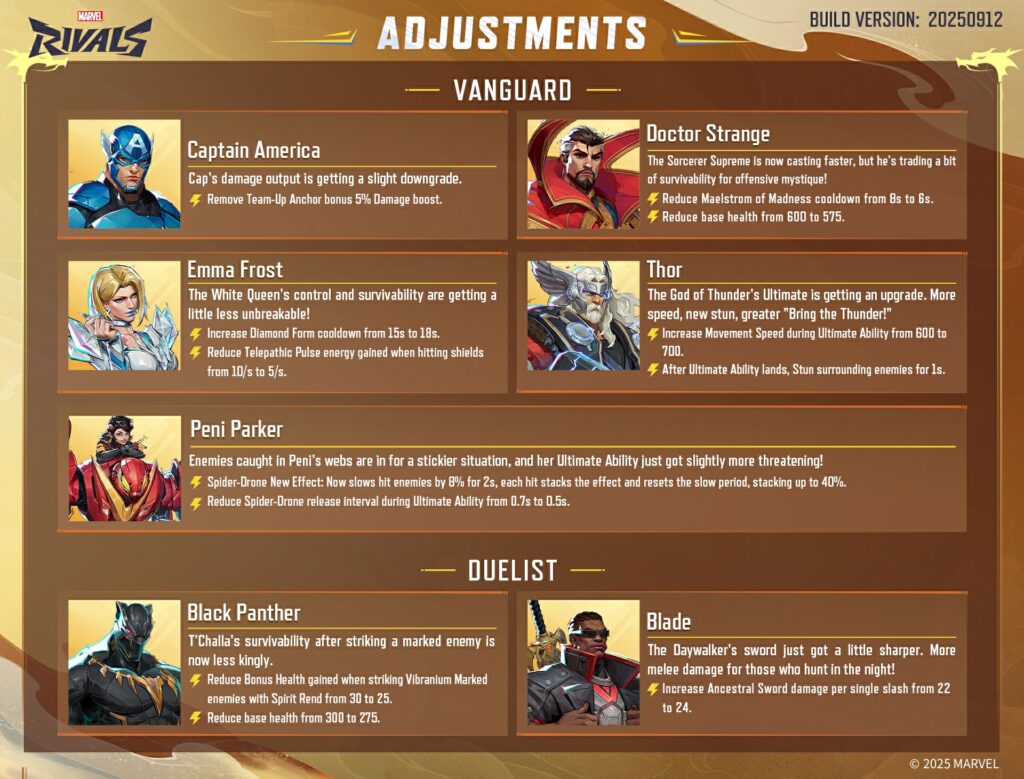
Developer Direction and Future Balance Philosophy
Data-Driven Balance Adjustments
Although future changes are not officially confirmed, the current balance approach suggests that developers are monitoring several important factors.
Possible evaluation points include:
- Hero pick rates.
- Win rates across competitive modes.
- Player feedback.
- Community discussions.
- Professional match results.
This approach allows adjustments to target specific problems instead of creating unnecessary changes.
Smaller Updates Could Improve Competitive Stability
Community discussions often suggest that more frequent balance adjustments could help maintain variety.
Smaller changes may allow developers to quickly address:
- Overperforming heroes.
- Weak character roles.
- Unbalanced abilities.
- Problematic team combinations.
However, these ideas remain community expectations rather than confirmed plans.
Community Reaction to Recent Balance Changes
The response to recent Marvel Rivals Buffs and Nerfs has generally been positive, especially among players who wanted greater hero diversity.
Many community members highlighted that Blade became more enjoyable because his improvements increased effectiveness without making him impossible to counter.
Venom’s healing reduction mechanic also received attention because it created a stronger answer against defensive compositions.
However, some heroes continue to receive requests for improvements, particularly characters that struggle to compete against stronger picks.
Community discussions frequently mention potential adjustments for:
- Captain America.
- Star-Lord.
- Squirrel Girl.
- Mantis.
These conversations demonstrate how balance updates continue to shape player expectations.
Competitive Connection Performance During Patch Updates
Balance changes often arrive alongside major updates, which can increase server activity. Large numbers of players downloading patches or testing new changes may create unstable network conditions.
For competitive players, connection quality remains an important factor when adapting to a new meta.
ExitLag can support players during these periods by optimizing connection stability and reducing common network problems.
Key benefits include:
- More consistent routing between player and game servers.
- Reduced impact from latency spikes.
- Smoother input response during fights.
- Better stability during high-traffic update periods.
While network optimization cannot change game balance itself, a stable connection helps players experience hero changes more accurately.
Future Predictions for Marvel Rivals Balance Updates
Possible Buff Candidates
Future adjustments may focus on heroes that currently have lower competitive presence.
Community discussions frequently mention possible improvements for:
- Captain America: Potential consistency improvements for shield mechanics.
- Iron Man: Possible cooldown or resource adjustments.
- Star-Lord: Potential improvements for ranged effectiveness.
These possibilities remain speculative until official patch information becomes available.
Possible Nerf Candidates
Some stronger heroes may receive additional tuning depending on future performance data.
Potential discussion points include:
- Scarlet Witch damage scaling adjustments.
- Blade Slash Speed mechanic evaluation.
- Additional changes to high-mobility assassins.
These predictions should be treated as community expectations rather than confirmed updates.
Long-Term Meta Trends
The future direction of Marvel Rivals will likely continue moving toward balanced team compositions instead of single-hero dominance.
Based on recent Marvel Rivals Buffs and Nerfs, several trends could define upcoming competitive seasons.
Sustain-Focused Team Strategies
Heroes with durability, healing reduction, and defensive utility may become increasingly important.
Angela and Venom represent this direction by creating frontline pressure while supporting longer fights.
More Dynamic Frontline Battles
Blade’s improvements show that melee-focused heroes can remain competitive when they receive tools that reward precision and timing.
Future updates may continue improving heroes that struggle to reach targets effectively.
Reduced Dependence on Burst Eliminations
The developers’ recent approach suggests a preference for fights where players have opportunities to respond.
This creates more strategic battles where positioning and teamwork matter as much as individual mechanics.
Conclusion About Marvel Rivals Buffs and Nerfs
For players who want to experience these changes without connection issues affecting performance, ExitLag helps optimize network stability during intense Marvel Rivals Buffs and Nerfs matches. By reducing latency spikes and improving route consistency, players can react faster and experience gameplay closer to the developers’ intended balance.
FAQ
Marvel Rivals Buffs and Nerfs are balance changes that modify hero abilities, statistics, cooldowns, damage values, or mechanics. Buffs improve heroes, while nerfs reduce excessive power to create better competitive balance.
Recent updates improved heroes including Blade, Angela, Venom, and Scarlet Witch. These changes focused on improving consistency, survivability, and strategic value.
Yes. Psylocke received adjustments designed to reduce excessive burst potential while keeping her mobility and Assassin role effective.
Marvel Rivals season 7 discussions focus on future balance possibilities, but official details depend on developer announcements and confirmed patch notes.
Yes. High latency and unstable connections can impact reaction time and gameplay consistency. Network optimization tools like ExitLag can help create a smoother competitive experience.