Minecraft End Poem is one of the most unusual endings in gaming. After hours spent mining, crafting, building, surviving, exploring dimensions, and eventually confronting the Ender Dragon, Minecraft suddenly slows down and presents the player with something completely different: a philosophical conversation.
The Minecraft End Poem does not celebrate victory with a traditional cinematic or explain what happens next. Instead, it speaks directly about the player, dreams, creation, identity, the universe, and the experience of playing Minecraft itself.
So, what is the Minecraft End Poem? It is a long piece written by Irish author Julian Gough that appears after the player defeats the Ender Dragon and enters the exit portal. The text unfolds as a conversation between two unidentified voices before the Minecraft credits begin.
In this guide, we will explore when the poem appears, who wrote it, what it means, its major themes, its relationship with Minecraft's ending, and why it continues to inspire players years after they first encounter it.
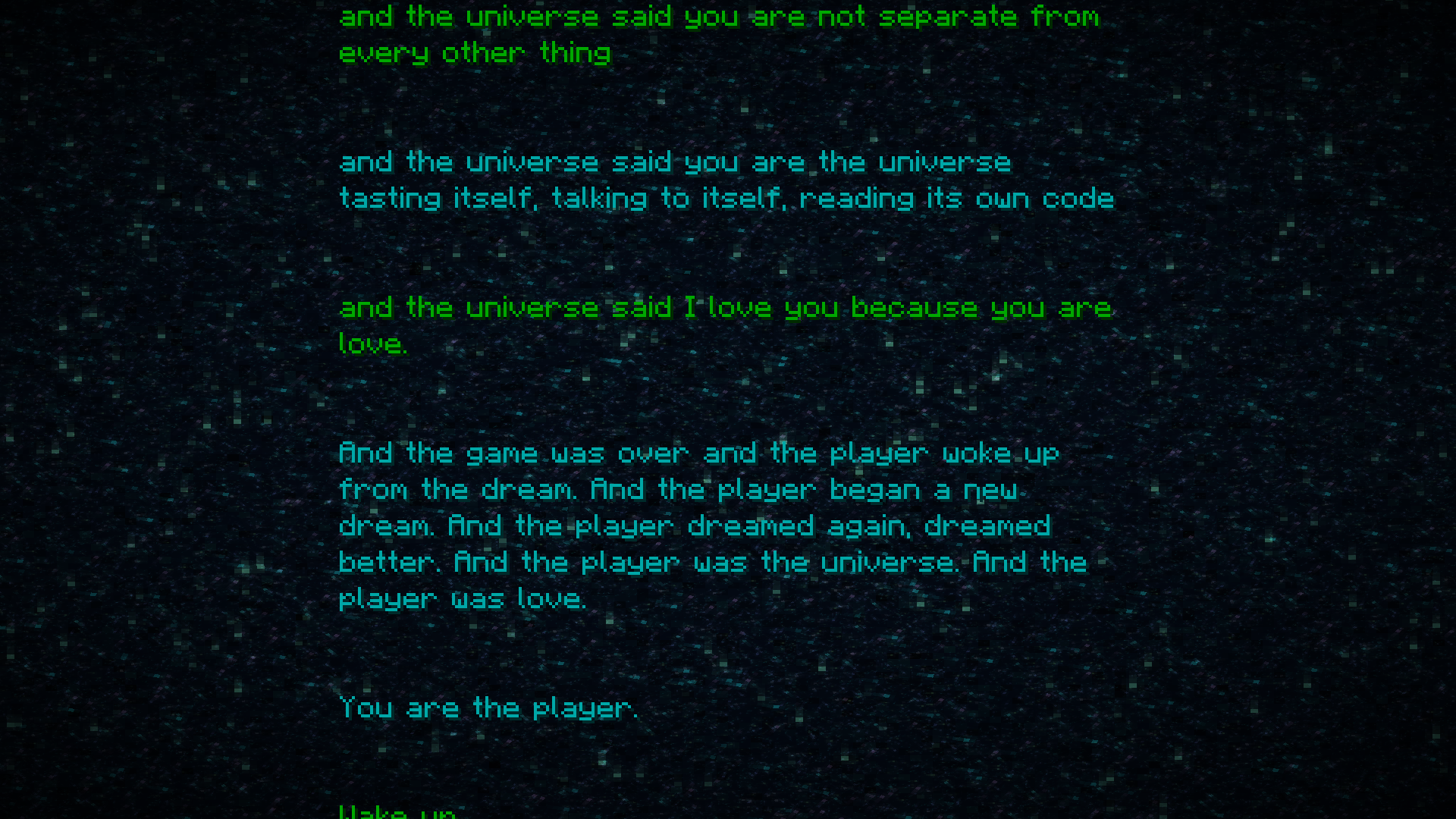
Minecraft End Poem: What Happens at the End of the Game?
The Minecraft End Poem appears at the conclusion of what players commonly consider Minecraft's main progression path.
Minecraft itself is an open-world sandbox without a true permanent ending. Mojang even notes that players commonly say they have “beaten” Minecraft after defeating the Ender Dragon, but the game can continue indefinitely afterward.
Defeating the Ender Dragon
To reach the End poem of Minecraft, players first travel to the End dimension and defeat the Ender Dragon.
Once the dragon is defeated, several things happen:
- Experience orbs are dropped;
- The dragon egg becomes available;
- End gateways open access to outer islands;
- The exit portal activates;
- Players can return to the Overworld.
Entering that exit portal for the first time triggers the poem and credits.
Importantly, defeating the Ender Dragon does not lock or delete your world.
You can continue exploring, building, collecting resources, visiting the outer End islands, and even summon the dragon again.
Minecraft end credits poem sequence
The Minecraft end credits poem appears before the standard credits sequence.
Instead of immediately listing developers and contributors, the game first presents a scrolling conversation between two voices.
These voices discuss the player indirectly before increasingly addressing the player themselves.
The result is deliberately very different from a conventional video game ending.
Rather than saying, “You won,” the text asks the player to think about what the journey meant.
Minecraft's End Poem: What does it Actually Mean? - YouTube
Who Wrote the Minecraft Ending Poem?
The Minecraft ending poem was written by Irish novelist and poet Julian Gough.
Mojang continues to identify Gough as the author in official Minecraft material about defeating the Ender Dragon.
Julian Gough and Minecraft
Gough was invited to create an ending for Minecraft around the time the game was reaching its official 1.0 release.
The challenge was unusual. Minecraft had no traditional linear narrative, named protagonist, or fixed story campaign.
Therefore, the Minecraft poem end could not simply resolve a conventional plot.
Instead, Gough created a piece that addresses the player and the relationship between imagination, games, dreams, and reality.
This approach fits Minecraft particularly well because every player's world and story are different.
The poem's unusual publication history
Years later, Gough publicly discussed the business arrangements surrounding the poem.
He stated that he never signed the proposed agreement transferring ownership of the work, although Mojang paid him €20,000 and continued using the poem in Minecraft.
In 2022, Gough announced that he was releasing his text under the CC0 public-domain dedication. The legal history has received considerable coverage, although Microsoft's interpretation of ownership has not been publicly litigated to a final judgment.
For players, however, the essential point remains simpler: Gough wrote the Minecraft the End poem, and his name appears in the game's credits.
What Does the Minecraft End Poem Mean?
There is no single official interpretation of the Minecraft End Poem. Its language is intentionally abstract, philosophical, and dreamlike. That openness is part of the reason players continue discussing it.
The player as both character and person
One of the central ideas in the end Minecraft poem is the relationship between the player inside Minecraft and the person sitting outside the game.
The poem gradually moves beyond Steve, Alex, blocks, monsters, or the world itself.
Instead, it appears to address the human being controlling the game.
That shift creates an unusual moment. For many hours, you have treated Minecraft as a world.
Suddenly, the game appears to recognize that another world exists beyond the screen.
This creates one of the poem's most memorable themes: the distinction between experiencing a game and experiencing reality.
Minecraft as a dream
Dreams are another major theme.
The poem repeatedly frames Minecraft as something like a dream within a larger existence.
This does not mean the game is suggesting that nothing matters because it is fictional.
The opposite interpretation is equally possible.
A dream can still create emotion, memory, creativity, friendship, fear, and accomplishment.
In this sense, the Minecraft end game poem asks a powerful question: if an experience feels meaningful to you, does its virtual nature make that meaning less real?
Major Themes in the End Poem of Minecraft
The End poem Minecraft players encounter after the dragon fight covers several ideas at once.
This is why different players can read exactly the same text and leave with very different interpretations.
Creativity and creation
Minecraft revolves around creation.
Even Survival Mode eventually becomes an opportunity to reshape the world.
Players build:
- Houses;
- Farms;
- Cities;
- Machines;
- Castles;
- Redstone systems;
- Entire fictional worlds.
The poem connects that creative behavior with imagination itself.
You are not simply completing objectives designed by the developers.
You are creating personal meaning inside an open system.
This makes the ending especially appropriate for Minecraft.
There is no fixed story to summarize because much of the story was created by you.
Identity and perspective
The Minecraft ending poem also explores who the “player” actually is.
Inside the game, you control a character.
Outside the game, you are a person watching that character.
The poem repeatedly moves between these perspectives.
That creates a broader question about identity.
People occupy different roles throughout life just as players occupy identities inside games.
Minecraft uses its ending to blur the boundaries between those layers rather than neatly separating them.
Minecraft End Game Poem vs. a Traditional Game Ending
The Minecraft end game poem stands out because Minecraft does not really end.
After the credits, you return to your world.
There is still more to explore
Defeating the Ender Dragon actually opens additional possibilities.
The End gateways provide access to outer End islands, where players can search for End Cities, End Ships, Elytra, Shulker Shells, and other resources.
You can also return to the Nether, improve your base, complete advancements, build massive projects, or simply begin another adventure.
Mojang explicitly describes the dragon fight and credits as the game's official “End,” while emphasizing that players can continue afterward.
That makes the Minecraft end credits poem less like a final goodbye and more like a transition.
Why the ending fits Minecraft
Consider the difference:
| Traditional game ending | Minecraft ending |
| Story reaches a final conclusion | World remains playable |
| Character arc is resolved | Player creates their own story |
| Credits signal completion | Credits mark a milestone |
| Developer controls the narrative | Player controls much of the experience |
| Usually little remains afterward | Exploration can continue indefinitely |
The poem works because Minecraft itself resists finality.
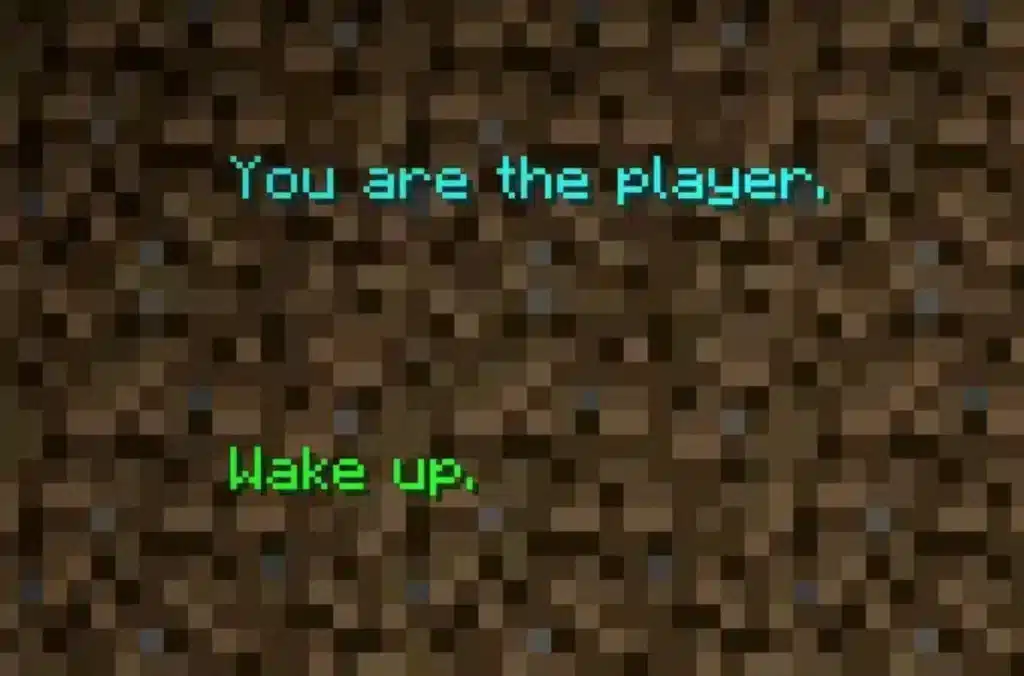
You finished something important, but you did not finish everything.
The Two Voices in Minecraft the End Poem
The identities of the two speakers in Minecraft the End poem are never definitively explained.
They are typically represented through differently colored text.
Who are the speakers?
Players have proposed many theories.
Some interpret the speakers as:
- Cosmic beings;
- Gods;
- Parts of the universe;
- Developers;
- Different aspects of consciousness;
- Narrative devices rather than literal characters.
The game does not provide a definitive answer.
Therefore, claims that the voices are specific established Minecraft characters should be treated as interpretation rather than canon.
Why ambiguity works
Giving the speakers names would actually make the poem less universal.
Because the voices remain undefined, they can represent ideas larger than individual characters.
This allows the End poem of Minecraft to move from observations about the player to broader ideas about existence and consciousness.
The mystery is intentional to the experience.
Players are invited to interpret rather than simply receive an explanation.
Why Is the Minecraft End Poem So Memorable?
Minecraft prepares players for a boss battle, not a philosophical reflection.
That contrast is a major reason the Minecraft End Poem is remembered so strongly.
A sudden change in tone
Immediately before the poem, you are fighting a giant dragon in a hostile dimension.
Then everything becomes quiet.
Instead of another enemy or reward screen, words begin slowly appearing.
The shift encourages players to stop and reflect.
For younger players especially, the poem may even be one of their first encounters with philosophical ideas presented inside a game.
The player becomes the subject
Most game endings discuss characters.
Minecraft's ending discusses you.
That makes the experience unusually personal.
The Minecraft poem end does not know who you are personally, of course.
However, the writing uses the universal experience of playing, learning, creating, failing, rebuilding, and continuing.
The result can feel surprisingly intimate despite being identical for millions of players.
Minecraft End Poem Tattoo Ideas and Meaning
Searches for Minecraft end poem tattoo ideas show how strongly parts of the ending resonate with some players.
Rather than simply representing a game, a tattoo inspired by the poem can represent creativity, growing up, imagination, friendship, or memories associated with Minecraft.
Choosing an idea rather than copying the poem
You do not need a long passage of text to represent the poem.
Tattoo concepts could use:
- The End portal;
- Two colored lines representing the speakers;
- An End crystal;
- The dragon egg;
- Stars or galaxies;
- A Minecraft landscape;
- A symbolic phrase inspired by its themes.
A minimalist design can connect Minecraft imagery with the poem's ideas about dreams and creation.
Why the poem inspires tattoos
Minecraft has existed long enough that many players who discovered it as children are now adults.
For them, the Minecraft end poem tattoo may represent an entire period of their lives.
That gives the ending meaning beyond completing the game.
It can become connected to old servers, friends, siblings, childhood builds, or the first world a player ever created.
Can You Skip the Minecraft End Credits Poem?
Yes. The Minecraft end credits poem does not need to be watched completely every time. Players can skip the sequence and return to the game.
Skipping does not affect progression
Skipping the Minecraft End Poem does not remove the rewards you earned from defeating the Ender Dragon.
Your world remains available. You can continue exploring exactly as you would after watching the full sequence.
Therefore, there is no gameplay disadvantage if you do not want to read it.
Is it worth reading once?
For most players, yes. The poem is part of one of Minecraft's most distinctive moments.
Even players who normally skip game credits may find it interesting because it functions as part of the experience rather than simply listing production staff.
It also provides a striking contrast to Minecraft's otherwise minimal explicit narrative.
FAQ
Who wrote the Minecraft End Poem?
The Minecraft End Poem was written by Irish writer Julian Gough for Minecraft's ending. Mojang continues to credit him as its author in official material.
When does the Minecraft End Poem appear?
The poem appears after the player defeats the Ender Dragon and enters the activated exit portal back to the Overworld, before the main credits sequence.
What does the Minecraft ending poem mean?
The Minecraft ending poem explores themes such as dreams, identity, creativity, consciousness, reality, and the relationship between the player and the virtual world, but it intentionally leaves room for personal interpretation.
Who are the two voices in the End poem Minecraft?
Minecraft never definitively identifies the two speakers. Interpretations range from cosmic beings to representations of consciousness, but none of these theories is officially confirmed.
Can you skip the Minecraft end game poem?
Yes. Players can skip the Minecraft end game poem and credits without losing their world or preventing further gameplay.
Does Minecraft actually end after the poem?
No. Minecraft remains fully playable after the credits, and players can continue exploring the Overworld, Nether, and End. Mojang describes Minecraft as a sandbox without a true permanent endpoint.
Is the Minecraft End Poem public domain?
Julian Gough announced in 2022 that he was dedicating his text to the public domain through CC0. He also stated that he had never signed the proposed copyright-transfer agreement with Mojang; the underlying ownership history has not been resolved through a publicly reported court judgment.
Minecraft End Poem: Keep Exploring With ExitLag
The Minecraft End Poem turns the game's biggest victory into a moment about creativity, dreams, identity, and everything the player created along the way.
The credits may mark an ending, but Minecraft always gives you another world to explore, and when connection instability affects your multiplayer adventures, try ExitLag to optimize your network route and keep building your next Minecraft story.