Monster Hunter Wilds launched with one of the largest and most diverse creature rosters in the franchise’s history, featuring 51 monsters across both large and small categories at release. The roster has since expanded through free Title Updates, with additional monsters arriving throughout the game’s post-launch content cycle.
Monster Hunter Wilds Monsters span an enormous range of ecosystems, elemental affinities, and combat mechanics. From fire-breathing wyverns and powerful Elder Dragons to agile leaping predators and multi-limbed invertebrates, the roster demands that you understand each creature’s weaknesses, behaviors, and attack patterns before engaging.
Understanding the Monster Hunter Wilds Monster List is the foundation of efficient hunting. Knowing which element to bring, when a monster is weak enough to capture, and how to exploit opening windows during combat distinguishes a prepared hunter from one who relies purely on defense and timing.
Monster Hunter Wilds: All Monsters at a Glance
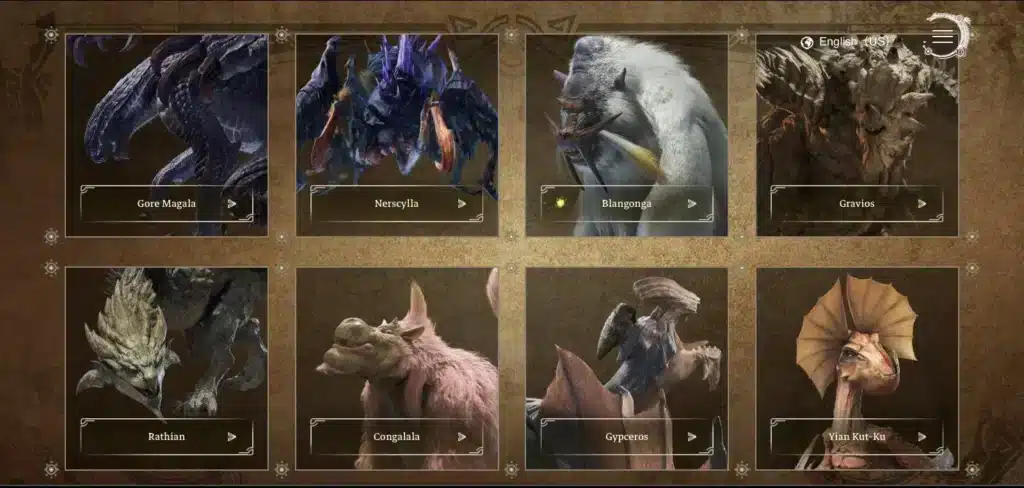
The All Monsters In Monster Hunter Wilds roster at launch included 33 Large Monsters and 18 Small Monsters for a total of 51. Title Updates have added additional creatures since launch, with the roster continuing to grow through post-release content patches.
Large Monsters in Monster Hunter Wilds
The large monster roster includes both new creatures exclusive to Wilds and returning fan favorites from across the franchise:
New Monsters (exclusive to Monster Hunter Wilds):
– Arkveld (and variants: Chained Arkveld, Guardian Arkveld)
– Chatacabra
– Doshaguma (and Guardian Doshaguma)
– Hirabami
– Jin Dahaad
– Lala Barina
– Nu Udra
– Omega Planetes
– Quematrice
– Rey Dau
– Rompopolo
– Uth Duna
– Xu Wu
– Zoh Shia
Returning Monsters from Previous Titles:
– Ajarakan
– Balahara
– Blangonga
– Congalala
– Gogmazios
– Gore Magala
– Gravios
– Gypceros
– Kushala Daora
– Lagiacrus (added via Title Update 2)
– Lao-Shan Lung
– Mizutsune
– Nerscylla
– Rathalos (and Guardian Rathalos)
– Rathian
– Seregios (added via Title Update 2)
– The Black Flame
– Yian Kut-Ku
How Many Monsters Are in Monster Hunter Wilds?
The launch roster included 51 monsters total. With the addition of Title Update 2 (which added Lagiacrus and Seregios), the roster has expanded further. Capcom has confirmed ongoing additions through the Title Update roadmap, making the total count a living number that grows with each major patch.
| Monster Category | Launch Count | Post-TU2 Count |
|---|---|---|
| Large Monsters | 33 | 35+ |
| Small Monsters | 18 | 18+ |
| Total | 51 | 53+ |
Monster Hunter Wilds New Monsters: What Makes the Roster Unique
The Monster Hunter Wilds New Monsters introduced for this entry represent some of the most mechanically complex designs in the franchise.
Arkveld: The Flagship New Monster
Arkveld is the flagship monster for Monster Hunter Wilds and one of the most visually and mechanically distinctive creatures in the roster. It exists in multiple forms (standard, Chained, and Guardian variants), each with different attack patterns and elemental properties.
Arkveld’s signature mechanic involves absorbing energy during combat and transitioning between aggressive and defensive states based on its accumulated power level. Learning to interrupt its absorption windows is essential for consistent damage output against it.
Zoh Shia: The Major Story Boss
Zoh Shia serves as a major narrative milestone and is one of the most challenging fights in the base game’s story campaign. It features multiple phases with dramatic environmental changes and escalating attack variety that requires adapting your approach mid-fight rather than settling into a repeating pattern.
Guardian Variants
Several monsters in Wilds appear in Guardian form, a designation that indicates enhanced combat ability and different elemental resistances compared to the standard version. Guardian variants are typically more aggressive and require higher preparation in terms of equipment tier and buff management.
How to Capture Monsters in Monster Hunter Wilds
How to Capture Monsters In Monster Hunter Wilds is one of the most important skills to master, both for material farming and for completing specific Hunt targets that specifically request live captures.
Step-by-Step Capture Guide
Follow these steps every time you attempt to capture a Large Monster:
- Hunt the monster normally until it enters its weakened state. The monster will begin limping noticeably and attempt to retreat to its sleeping location.
- Watch for the skull icon on your minimap next to the monster’s indicator. This icon confirms the monster is weak enough to capture.
- Set a Shock Trap or Pitfall Trap near the monster’s current or expected location. Shock Traps work on most monsters. Pitfall Traps do not affect flying wyverns.
- Lure or herd the monster into the trap by attacking or using environmental tools to direct its movement toward the trap position.
- Once the monster is immobilized in the trap, throw two Tranq Bombs at it while standing close enough for them to land. Two successful hits with Tranq Bombs completes the capture.

Why Capture Instead of Kill?
Capturing monsters rewards different material drops than killing them, often including parts that are harder or impossible to obtain through a kill. Additionally, captures provide bonus reward slots that can yield rare materials more frequently than standard end-quest rewards.
For consistent rare part farming, alternating between capture and kill runs is more efficient than exclusively doing one or the other.
Capture Tips
- Always carry Shock Traps and Tranq Bombs before entering any hunt where capture is possible or required
- Do not set the trap too early: If the monster is not yet weakened, it will escape the trap immediately without triggering capture eligibility
- Use environmental traps when available: Some areas contain built-in trap opportunities that do not consume your crafted trap items
- Coordinate with co-op partners: In multiplayer, one player can set the trap while another herds the monster into position, making the process faster and more reliable
Monster Hunter Wilds Mounting Monsters: How It Works
Monster Hunter Wilds Mounting Monsters is a combat mechanic that allows hunters to climb onto large monsters and deal sustained damage while controlling their movement.
How to Mount a Monster
Mounting requires hitting a monster repeatedly with aerial attacks until a mounting meter fills. Once mounted:
- Your hunter climbs onto the monster’s body
- You must balance and deal damage by attacking while maintaining grip
- The monster attempts to throw you off through shaking and collisions
- A successful mount ends with the monster being slammed into the ground, dealing bonus damage and opening a window for follow-up attacks from your party
Mounting is particularly effective when team members attack from the ground simultaneously, dealing additional wound damage while the monster is distracted by the rider.
Monster Hunter Wilds Monsters: Weakness Reference
Understanding which elements and damage types each monster is vulnerable to is the difference between an efficient hunt and an unnecessarily prolonged one.
General Weakness Patterns by Monster Type
| Monster Type | Common Weakness | Resistant To |
|---|---|---|
| Fire wyverns (Rathalos, Quematrice) | Water, Dragon | Fire |
| Ice/Water types (Lagiacrus, Mizutsune) | Thunder | Water, Ice |
| Earth/Rock types (Blangonga, Gravios) | Water, Thunder | Fire, Dragon |
| Elder Dragons (general) | Dragon, varies | Varies widely |
| Insect-type (Lala Barina) | Fire | Water |
Always check specific monster weakness data before a hunt, as individual monsters have nuanced elemental profiles that deviate from general category patterns.
Pro Tips for Monster Hunter Wilds Monster List Mastery
Pro Tips: Monster Hunter Wilds Monsters
- Learn each monster’s limping behavior early: Every monster has a distinct animation when it enters capture-eligible state. Recognizing this animation saves time during hunts because you can immediately prepare your trap and Tranq Bombs rather than waiting for the skull icon to appear on the minimap.
- Use Shock Traps as your default capture tool: Pitfall Traps are ineffective against flying wyverns and Elder Dragons. Shock Traps work on the widest variety of monster types, making them the safer default to carry before knowing which variant you will encounter.
- Target wound locations for maximum damage: Monster Hunter Wilds features an enhanced wound system where focusing attacks on specific body parts creates wound states that significantly increase damage output in that area. Prioritize breaking these locations during the hunt for both bonus rewards and combat advantages.
- Bring elemental variety in multiplayer squads: In a four-player group, having different element weapons covers a wider range of match-ups and prevents situations where the entire team struggles against a single monster’s specific resistance profile.
- Review mounting opportunities early in each new fight: Some monster behaviors create natural aerial attack windows at specific moments in their attack animations. Identifying these windows in the first few minutes of a new fight pays dividends in every subsequent hunt against that monster.
Common Mistakes Monster Hunter Wilds Players Make
- Setting capture traps before the skull icon appears: Players excited to capture often place a trap while the monster still has too much HP, causing it to escape immediately. Fix: Wait for the visible limp animation and the minimap skull icon before placing any trap.
- Ignoring small monsters during priority hunts: Small monsters often drop materials needed for crafting bait, trap components, and consumables that directly enable capturing large monsters. Fix: Clear small monster clusters efficiently when they appear in the hunt zone rather than ignoring them entirely.
- Using the same element against every monster: Some players stick to their favorite weapon without swapping elements between hunts. Fix: Maintain at least two weapons with different element types in your loadout box and switch based on the monster’s confirmed weakness before starting each mission.
Reduce Lag in Monster Hunter Wilds With ExitLag
Monster Hunter Wilds features robust online co-op that lets up to four hunters tackle the roster together. However, high ping and packet loss turn co-op hunts into frustrating sessions where traps miss, mounting fails to register, and combos lose their rhythm.
Why Connection Quality Matters in Monster Hunter Wilds Multiplayer
In co-op hunts, all player actions synchronize through the session’s network. High latency causes trap placements to appear in different positions for different players, Tranq Bomb throws to register late, and mounting inputs to fail at the moment they should connect.
Additionally, pack loss during intense multi-player combats against large monsters can cause animation desync, making it harder to read attack telegraphs from the monster’s actual behavior versus what appears on your screen.
How ExitLag Helps Monster Hunter Wilds Players
ExitLag is a game connection optimizer that routes your game traffic through the fastest, most stable network paths to the game’s servers in real time. It is not a VPN and does not interact with game files or affect non-game applications.
ExitLag’s Multipath Technology routes your packets simultaneously through multiple network paths. If one route encounters congestion during a hunt, the others maintain your connection without any interruption. The result is consistently lower ping, reliable trap registration, and synchronized combat actions across all players in the session.
Download ExitLag for PC and make every Monster Hunter Wilds co-op hunt as smooth and synchronized as a solo run.
Monster Hunter Wilds Monster List: Full Summary
Monster Hunter Wilds Monsters cover an enormous range of combat challenges, from familiar franchise favorites to entirely new creatures with unique mechanical hooks. The roster launched with 51 monsters and continues to expand through free Title Updates.
Monster List Summary
- Total at Launch: 51 (33 large, 18 small)
- Post-Title Update 2: 53+ with Lagiacrus and Seregios added
- Flagship Monster: Arkveld (multiple variants)
- Major Story Boss: Zoh Shia
- Capture Requirement: Skull icon on minimap, Shock/Pitfall Trap plus 2 Tranq Bombs
- Mounting: Aerial attacks fill mounting meter, monster slam on success
Mastering the Monster Hunter Wilds Monster List means learning each creature’s unique behavior, weakness profile, and capture timing. With the right preparation, every monster on the roster becomes a manageable hunt rather than an unpredictable challenge.
All game images used in this blog post belong to Capcom. They are used for informational and educational purposes only and do not imply endorsement or affiliation with the rights holders.
Got questions or want to connect with other players? Join the conversation at the ExitLag Forum!