

Path of Exile is one of the most complex ARPGs ever created. Its progression systems go far beyond simply leveling up and equipping stronger gear. Among the most powerful mechanics is the Ascendancy system, which allows each base class to specialize into unique subclasses called ascendancies.
If you’re troubleshooting gameplay issues, check this guide to fixing Path of Exile sound being buggy — performance and audio glitches can affect your Labyrinth or boss runs.
Choosing the right ascendancy can completely transform your character. Whether you want to play a critical-strike Slayer, a tanky Juggernaut, or a minion-based Necromancer, ascendancies define the core identity of your build.
But with Path of Exile 2 (PoE 2) coming soon, many players are asking: what are ascendancies, how do they work in PoE 1 vs PoE 2, and how do you unlock them? This guide will walk you through everything you need to know — from the fundamentals of ascendancies to the updated mechanics in PoE 2.
What Are Ascendancies in Path of Exile?

In Path of Exile, ascendancies are specialized subclasses that you unlock after completing the Labyrinth (in PoE 1) or through class progression (in PoE 2).
They allow you to tailor your character’s abilities toward specific strengths. Each base class (Witch, Duelist, Ranger, Templar, Shadow, Marauder, and Scion) has multiple ascendancies to choose from, offering drastically different playstyles.
For example:
- A Duelist can choose between Slayer, Gladiator, or Champion, each focusing on different combat mechanics.
- A Witch can become a Necromancer to command minions, an Elementalist to harness elemental damage, or an Occultist for curses and chaos magic.
ExitLag tip: Optimizing your ascendancy choice is just as important as reducing latency. With ExitLag, you can eliminate lag spikes and connection instability, ensuring your build performs at peak efficiency in every Labyrinth run or endgame map.
If you’re comparing future archetypes and campaign paths, this quick overview of Path of Exile 2 classes explains how PoE 2’s subclassing expands build variety.
How Do Ascendancies Work in PoE 1 vs PoE 2?
Ascendancies have always been a cornerstone of PoE’s build diversity. However, PoE 2 redesigns this system to expand player choice and integrate ascendancy progression into the campaign itself.
Here’s a breakdown comparing PoE 1 vs PoE 2 ascendancy mechanics:
| Element | Path of Exile 1 (PoE 1) | Path of Exile 2 (PoE 2) |
| Unlock Method | Complete the Labyrinth of Azmeri | Progression tied to class campaign quests |
| Trials Required | Six Trials of Ascendancy scattered in Acts | No trials confirmed (story-based progression) |
| Number of Points | 8 total (2 from each Lab difficulty) | Varies with progression, not finalized yet |
| Respec Options | Can respec with Orbs of Regret + redoing Lab | Still uncertain, likely limited respec options |
| Design Style | Small focused ascendancy trees | Broader, more versatile trees per ascendancy |
Unlocking in PoE 1
In PoE 1, players must complete six Trials of Ascendancy to gain access to the Labyrinth. Beating the Labyrinth’s traps and the boss Izaro unlocks ascendancies and grants ascendancy points to allocate on the ascendancy skill tree.
Unlocking in PoE 2
In PoE 2, ascendancies are earned during campaign progression. Each class will have new ascendancy subclasses, and you will unlock ascendancy points as part of your journey instead of running the Labyrinth multiple times.
This means that PoE 2 ascendancies will be more integrated into leveling, making subclass choices impactful earlier in the game.
Keyword integration: If you’re wondering how to change ascendancy PoE, in PoE 1 you can reset it by refunding ascendancy points with Orbs of Regret and rerunning the Lab. In PoE 2, this process is not yet fully revealed, but current developer notes suggest that free ascendancy swapping will not be possible, keeping your subclass choice meaningful.
Complete List of Ascendancies (Updated for 2025)

To fully understand how poe ascendancies shape builds, here’s the updated list of ascendancy subclasses in both PoE 1 and PoE 2.
Path of Exile 1 Ascendancies
- Witch → Elementalist, Occultist, Necromancer
- Duelist → Slayer, Gladiator, Champion
- Ranger → Deadeye, Pathfinder, Raider
- Templar → Inquisitor, Hierophant, Guardian
- Shadow → Assassin, Saboteur, Trickster
- Marauder → Juggernaut, Berserker, Chieftain
- Scion → Ascendant
Each of these subclasses specializes in unique mechanics that define how you approach combat.
Path of Exile 2 Ascendancies (Preview)
PoE 2 introduces redesigned ascendancy classes for each base character. While not all have been officially revealed, trailers and gameplay previews confirm expanded trees and deeper customization.
Some highlights so far:
- Each class will feature multiple new ascendancies tied to its campaign.
- Ascendancy points in PoE 2 are earned gradually instead of being tied to separate Labyrinth completions.
- The poe 2 ascendancy points system encourages more experimentation with passive allocations during leveling.
Developers have emphasized that PoE 2 ascendancies will not simply mirror PoE 1 — they will be broader, more modular, and integrated into the new endgame systems.
How Do You Unlock and Gain Ascendancy Points?

One of the most common questions players ask is how to get ascendancy points PoE 2. The process differs between PoE 1 and PoE 2, so let’s break it down.
Unlocking Ascendancy Points in PoE 1
In the original Path of Exile, ascendancy points are earned through the Labyrinth of Azmeri. The steps are:
- Complete the six Trials of Ascendancy found across the campaign.
- Access the Labyrinth and defeat its traps and boss, Izaro.
- Earn 2 ascendancy points each time you complete a Labyrinth difficulty: Normal, Cruel, Merciless, and Eternal (Uber Lab).
That’s a total of 8 ascendancy points per character.
Unlocking Ascendancy Points in PoE 2
In Path of Exile 2, ascendancy points are no longer tied to Labyrinth completions. Instead, they are tied to campaign progression. Each class will unlock ascendancy points as they advance through their personal story arcs.
This makes ascendancies feel more integrated into leveling, rather than a separate challenge. While the exact maximum number of points in PoE 2 is still being balanced, early previews suggest a progression similar to PoE 1 — but spread across story milestones.
For monetization context, cosmetics, and stash upgrades that indirectly affect planning, review the Path of Exile store guide to understand how microtransactions fit into progression.
Can You Change Your Ascendancy?
Another common question is whether players can change ascendancy PoE 2 after making their choice.
Changing Ascendancy in PoE 1
In PoE 1, you can reset your ascendancy class, but it requires effort:
- Refund all ascendancy points with Orbs of Regret.
- Re-run the Labyrinth to reassign points to a different ascendancy subclass.
This makes respec possible, but not free or instant.
Changing Ascendancy in PoE 2
In PoE 2, the system is less flexible. Current developer notes suggest that ascendancy choices will be tied to your class progression. While a late-game respec option may exist, it will likely be restricted and costly.
So, the answer to can you change ascendancy PoE 2 is: not freely. Choosing your subclass during the campaign will be a permanent decision, reinforcing its impact on your build identity.
For theorycrafting discussions and Q&A, check the official Path of Exile forum where ascendancy builds and mechanics are debated daily.
Build Tips: How to Choose the Right Ascendancy
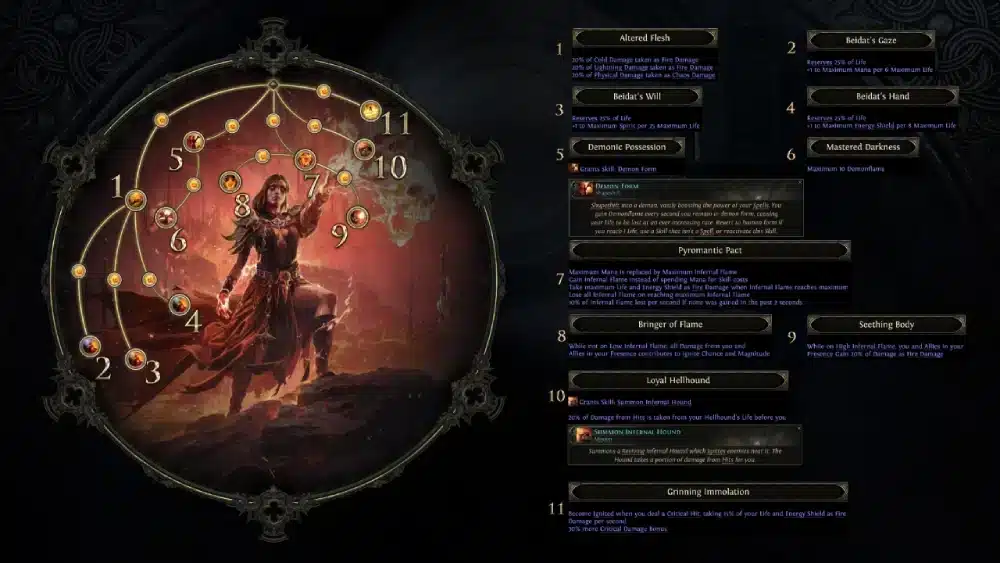
Choosing the right ascendancy is one of the most important decisions you’ll make in PoE. Your subclass determines your build’s strengths, weaknesses, and synergies.
Here are some guidelines to help you decide:
Offensive Playstyles
- Slayer (Duelist): Focuses on critical strikes, life leech, and massive melee DPS.
- Deadeye (Ranger): Enhances ranged projectiles and attack speed.
- Assassin (Shadow): Perfect for crit-focused spellcasters and dagger builds.
Defensive Playstyles
- Juggernaut (Marauder): Grants endurance charges, armor, and stun immunity.
- Guardian (Templar): Provides exceptional defensive auras and block chance.
- Champion (Duelist): Tanky support for melee builds.
Summoner and Utility Playstyles
- Necromancer (Witch): Buffs minions for summoner builds.
- Occultist (Witch): Specializes in curses, chaos damage, and energy shield.
- Saboteur (Shadow): Traps and mines for tactical gameplay.
Tip: Always choose an ascendancy that matches your core skill choice. A spellcaster running minions will thrive as a Necromancer, while a melee damage dealer will be far stronger as a Slayer or Juggernaut.
Recommended Tools for Planning Ascendancies

To master ascendancy mechanics, players often rely on external tools and community resources. Here are the most helpful ones:
- PoE Labs: Helps plan Labyrinth runs by showing daily layouts and trap configurations.
- Path of Building (PoB): A powerful tool to simulate builds, compare ascendancy choices, and calculate DPS/defense values.
- PoE Wiki: The most up-to-date database for ascendancies, skills, and game mechanics.
These tools are essential for maximizing your efficiency in both PoE 1 and PoE 2.
And if you want to stay aligned with league launches, skill reveals, and patch notes, keep an eye on the Path of Exile official site for updates.
FAQ: Path of Exile Ascendancies
Ascendancy points in PoE 2 are unlocked through campaign progression instead of Labyrinth completions.
No free swaps are available. Ascendancy choices in PoE 2 are tied to your class story and are expected to be permanent, with limited respec options.
The exact number is not finalized, but similar to PoE 1, expect multiple points spread across campaign milestones.
You ascend by progressing through your class’s campaign and unlocking ascendancy points along the way.
Ascendancy points are awarded at specific points in the campaign, making subclass progression part of the leveling journey.
Conclusion: Why Mastering Ascendancies Matters
Ascendancies are at the heart of build diversity in Path of Exile. They allow every class to branch into specialized roles, shaping your character’s playstyle, strengths, and weaknesses.
With PoE 2 ascendancies redesigning the system, the choices you make during the campaign will matter more than ever. Unlocking and maximizing ascendancy points is crucial for build optimization, and selecting the right subclass can determine your success in endgame content.
And just like mastering ascendancies improves your build, optimizing your connection with ExitLag ensures your gameplay is smooth and competitive. By reducing latency and preventing lag spikes, ExitLag helps you push through the Labyrinth, conquer bosses, and dominate the endgame with zero interruptions.
Got questions or want to connect with other players? Join the conversation at the ExitLag Forum!