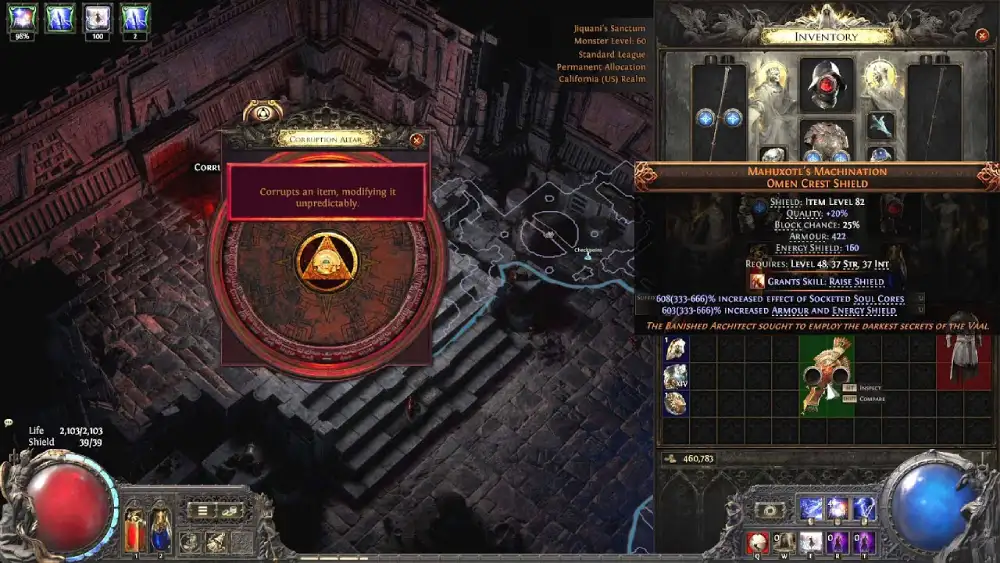
How Corruption Works
Corruption permanently applies a random modification to an item. The four possible outcomes when corrupting most items are:
- Nothing happens: No modification occurs. The item is still corrupted and cannot be modified again.
- Implicit modifier added: The item gains a special corruption-only implicit modifier unavailable through any other crafting method.
- Explicit affix modification: Existing modifiers on the item are randomized or their values are altered.
- Extra socket added: Ignores normal socket limits. For caster weapons, quality is modified instead.
Furthermore, corrupted items display a red background and the text "Corrupted" in their tooltip. This status prevents all further crafting modifications. No currency item can change a corrupted item's properties.

Corruption Methods: Vaal Orb vs Altar
| Method | Location | Additional Notes |
| Vaal Orb | Drops anywhere, more common in Act 3+ | Can be used on any corruptable item anywhere |
| Altar of Corruption | Act 2 Vaal Ruins, Act 3 specific zones | Found in specific locations, same outcomes as Vaal Orb |
| Locus of Corruption | Temple of Atzoatl (Incursion mechanic) | Double-corrupts items for two simultaneous outcomes |
Where To Find Corruption Altars In Path Of Exile 2
Altar Locations By Act
Act 2: Vaal Ruins The Vaal Ruins in Act 2 contain the earliest accessible Altars of Corruption in Path of Exile 2. These altars are excellent for experimenting with corruption on lower-value items during the campaign without spending Vaal Orbs.
Act 3: Jiquani's Sanctum The Jiquani's Sanctum contains Paquate's Mechanism, an Altar of Corruption that players encounter during Act 3 progression. This altar is part of the main story path and the first corruption altar most players encounter.
Act 3: Temple of Atzoatl (Incursion Mechanic) The Temple of Atzoatl, accessed through the Incursion endgame mechanic, contains the Locus of Corruption room when upgraded to Tier 3. The Locus applies double corruption to items, applying two simultaneous corruption outcomes. This is the most powerful corruption opportunity in the game.
Path Of Exile Corruption Altar: Possible Outcomes
Item Corruption Outcomes (25% Each)
Each corruption outcome has approximately equal probability on most item types:
- No change (modified by Omen of Corruption): The item is corrupted but unchanged. An Omen of Corruption can prevent this outcome from occurring.
- Corruption implicit added: The item gains a special implicit modifier from a pool specific to its item class. Gloves can gain corrupted implicits for attack speed or elemental damage. Boots can gain movement speed or resistances. Rings and amulets have their own implicit pools.
- Modifier reroll: All explicit modifiers on the item are randomly rerolled, as if the item was reforged with Alchemy. The item retains its rarity but gets entirely new stats.
- Extra socket: Physical weapons and armour can gain an additional socket beyond their normal maximum. Caster weapons have quality modified instead.
Corruption Outcomes For Specific Item Types
| Item Type | Special Corruption Outcomes |
| Weapons | Extra socket (physical) or quality modification (caster) |
| Armour | Extra socket ignoring limits |
| Skill Gems | +1 Gem Level, -1 Gem Level, or Quality changes |
| Waystones | More dangerous modifiers, better rewards, or both |
| Essences | Upgraded to Greater Essences or transformed into Corrupted Essences |
Path Of Exile Vaal Ruins Corruption Altar: Strategy Guide
When To Corrupt Your Items
Corruption is most valuable in specific scenarios:
Always worth corrupting:
- Skill Gems at Level 20: A 20% chance to become Level 21. A Level 21 gem provides more damage than almost any other single upgrade in the game.
- Items with near-perfect explicit rolls already achieved: If an item is as good as it can get through normal crafting, corruption is the only remaining improvement avenue.
- Items specifically targeted for a valuable corruption implicit: For example, gloves corrupted for a specific elemental damage implicit add a modifier tier that was otherwise impossible to achieve.
Generally not worth corrupting:
- Items you are currently using that cannot be easily replaced
- Items with valuable modifiers that could be ruined by a modifier reroll outcome
- Items below your gear benchmark where replacements are available on the trade site
The Locus Of Corruption: Double Corruption Strategy
The Temple of Atzoatl's Locus of Corruption (Tier 3 Corruption Chamber) applies two simultaneous corruption outcomes to a single item. This creates the possibility of two positive outcomes on the same item, which can produce items significantly more valuable than any single-corruption result.
Double corruption strategy for endgame value:
- Craft an item to the highest possible quality through standard methods
- Identify the two most valuable corruption implicits for that item type
- Only double-corrupt items where two positive outcomes would create a BiS (Best-in-Slot) item
- The risk is significant: two negative outcomes can occur simultaneously
Path of Exile Vaal Ruins: Exploring The Area
What To Expect In The Vaal Ruins
The Vaal Ruins in Act 2 are an optional exploration zone connected to the main Act 2 story path. They contain:
- Multiple Altars of Corruption for experimenting with corruption mechanics
- Dense packs of Vaal-themed enemies including constructs, spectres, and warriors
- Occasional Vaal skill gem drops, which are exclusive versions of standard gems
- Lore items related to the history of Wraeclast's ancient Vaal civilization
The Vaal were an ancient civilization that created powerful magic through ritual sacrifice. Their ruins appear throughout Path of Exile 1 and 2, and the corruption mechanic draws from this lore: the Vaal harnessed corruption energy for immense power, always at great cost.
Pro Tips: Path of Exile Corruption Altar
- Use Omens of Corruption to prevent the "nothing happens" outcome. These items remove the blank outcome from the corruption table, effectively giving you a one-in-three chance of each remaining outcome rather than one-in-four. This significantly improves expected value on high-quality items.
- Corrupt skill gems last in your crafting process, not first. A gem that has not yet reached Level 20 and 20% quality gains less expected value from corruption than a fully developed gem. Always level and quality gems to their caps before attempting corruption.
- Test on cheap items of the same type before corrupting valuable gear. If you want to understand the practical outcomes of corrupting a specific item type, spend a few Vaal Orbs on identical cheap versions first. Seeing the outcomes firsthand removes the uncertainty about what to expect.
- Value the corruption implicit over the socket outcome for most items. While an extra socket sounds appealing, the specific corrupted implicit available to your item type often provides a larger effective power increase when it rolls the ideal value.
- Never corrupt the only copy of a build-enabling item. If losing that item would force a complete build change, the risk is not worth the potential gain.
Common Corruption Mistakes
- Corrupting an item expecting a specific outcome. Every outcome is random. Players who corrupt a near-perfect item expecting to add a specific implicit are just as likely to receive a reroll that removes all their previous crafting investment. Fix: only corrupt items where you would be satisfied with any outcome or where the downside is recoverable.
- Using Vaal Orbs early in the game on rare items. Campaign items are replaced so quickly that corruption outcomes are largely irrelevant. Vaal Orbs have much higher value in the endgame where item replacements are expensive. Fix: save Vaal Orbs until you reach endgame maps.
- Not using the Locus of Corruption for endgame BiS crafting. Many players corrupt items in the open world via Vaal Orbs when the Locus of Corruption in the Temple of Atzoatl would provide two simultaneous outcomes. Fix: whenever the Locus is available in your current Temple layout, prioritize using it for high-value item corruption rather than standard Vaal Orbs.
How ExitLag Keeps Your Connection Stable During High-Value Corruption
Path of Exile Vaal ruins corruption altar sessions involve high-stakes decisions on expensive gear. A disconnect during a Locus of Corruption double-corruption session, before you see the outcome, is one of the most frustrating experiences in the game. Although the server processes the result regardless, connection instability can prevent you from seeing what happened immediately.
ExitLag is not a VPN. It is a game connection optimizer that maintains a stable connection to Path of Exile's servers throughout your play session. For crafting sessions where outcomes matter and every second of visibility counts, a reliable connection removes one variable from an already-risky process.
Download ExitLag atexitlag.com/download and stay connected during your most important crafting moments.

Path of Exile Vaal ruins corruption altar is one of the most exciting and most punishing systems in the game. The potential to create items beyond what standard crafting can achieve is real, and the risk of destroying existing value is equally real. Use Omens of Corruption on high-value items, save your Vaal Orbs for the endgame, and use the Path of Exile corruption altar at the Temple of Atzoatl's Locus for double-corruption opportunities on your best gear.
All game images used in this blog post belong to Grinding Gear Games. They are used for informational and educational purposes only and do not imply endorsement or affiliation with the rights holders.