
If you’ve ever wondered can you uncorrupt an item poe 2, you’re probably dealing with a piece of equipment that changed unexpectedly after using a Vaal Orb. Corruption is one of the riskiest crafting mechanics in Path of Exile 2, offering opportunities to improve powerful gear while introducing permanent restrictions. Understanding how this system works is essential before experimenting with valuable weapons, armor, or accessories.
The question can you uncorrupt an item poe 2 becomes especially important when a rare item loses useful modifiers or receives an unfavorable corruption outcome. Unlike ordinary crafting, corruption is designed as a high-risk decision that cannot simply be reversed with another currency item. Therefore, players must carefully consider their equipment’s value, current modifiers, and potential upgrades before applying a Vaal Orb.
So, can you uncorrupt an item poe 2 after using a Vaal Orb? No. Path of Exile 2 does not provide a standard method to remove the Corrupted status from equipment. Once an item becomes corrupted, it remains corrupted, and most conventional crafting options become unavailable. However, understanding the remaining possibilities can help you decide whether to keep, trade, or replace the affected item.
Can You Uncorrupt an Item PoE 2? Explained
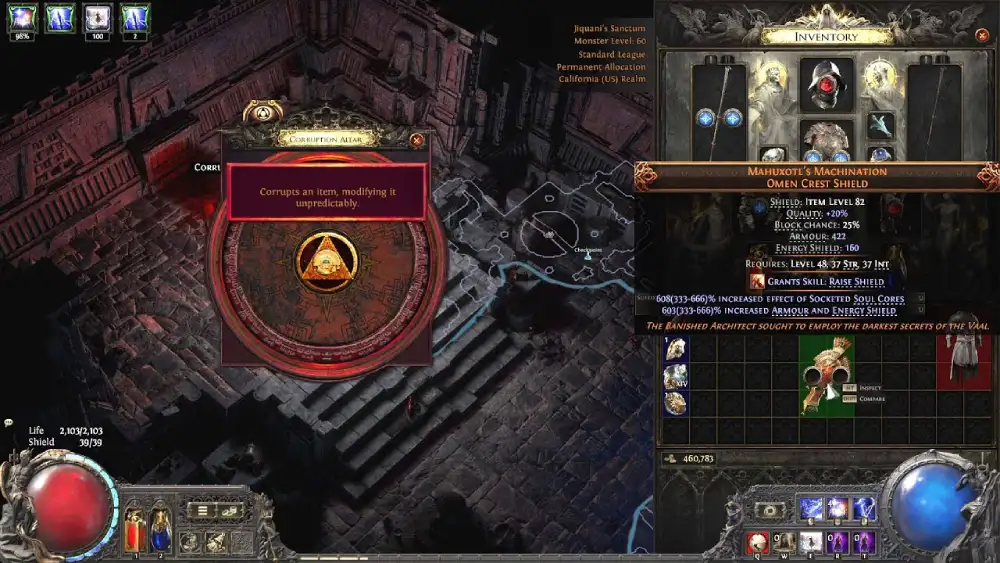
Corruption is a special item modification mechanic in Path of Exile 2 that introduces additional risks and potential rewards.
Unlike ordinary crafting currency, Vaal Orbs can produce unpredictable outcomes while permanently changing an item’s crafting status.
This makes corruption particularly important for players optimizing endgame equipment.
Is Corruption Permanent in Path of Exile 2?
Yes. Corruption is generally a permanent property of an item.
When you apply a Vaal Orb to eligible equipment, the item becomes corrupted regardless of whether the resulting modification improves its usefulness.
Once this happens, ordinary crafting methods cannot remove the Corrupted status.
For players searching poe 2 can you uncorrupt items, this distinction is essential because corruption works differently from standard modifier changes.
For example, ordinary crafting may allow players to replace, add, or remove certain modifiers using appropriate currency.
Corrupted items, however, become restricted from most of these interactions.
Consequently, you cannot simply use another crafting orb to return the equipment to its previous condition.
This limitation applies even when the corruption outcome makes the item less desirable.
Therefore, players should treat corruption as a potentially permanent investment rather than a normal crafting step.
Why Corrupted Items Cannot Be Restored
Path of Exile 2 uses corruption to create meaningful decisions around equipment progression.
Players must balance the possibility of obtaining stronger gear against the risk of losing valuable crafting opportunities.
If corruption could be removed freely, many of these risks would disappear.
For example, players could repeatedly attempt favorable outcomes without committing to the consequences.
Instead, the system encourages careful preparation.
Before corrupting an item, players should evaluate:
- Current modifiers: Does the equipment already provide valuable bonuses?
- Item rarity: Is the item difficult or expensive to replace?
- Build compatibility: Does the equipment support your character’s main abilities?
- Crafting progress: Have you completed the important upgrades?
- Potential rewards: Would a successful corruption meaningfully improve your build?
These considerations become especially important for rare and unique equipment.
A powerful item with excellent modifiers may already perform well without additional changes.
Corrupting it introduces uncertainty that could reduce its usefulness.
As a result, experienced players often wait until they have finished ordinary crafting before attempting corruption.
What Happens When an Item Becomes Corrupted?
Corruption can affect equipment in different ways depending on the item category and the applicable Vaal Orb mechanics.
Some outcomes may improve an item’s properties, while others provide little benefit or create an undesirable result.
However, the most consistent consequence is the item’s Corrupted status.
This status restricts most conventional crafting interactions.
For example, players may discover that they can no longer apply certain currency items or complete previously planned upgrades.
The exact outcome depends on the equipment being modified.
Therefore, corruption should never be treated as a guaranteed improvement.
A successful result may create a valuable piece of equipment, while an unfavorable outcome can leave you searching for a replacement.
Understanding these possibilities is the foundation of responsible crafting in Path of Exile 2.
How Do Vaal Orbs Work in Path of Exile 2?
Vaal Orbs are currency items used to corrupt eligible equipment.
Their purpose is to introduce unpredictable modifications that can potentially improve an item beyond what ordinary crafting provides.
However, using a Vaal Orb is fundamentally different from applying standard crafting currency.
The result cannot be freely adjusted afterward, making preparation especially important.
Possible Vaal Orb Outcomes and Risks
When applying a Vaal Orb, players may encounter different outcomes depending on the item type and current game mechanics.
Some results can improve equipment, while others may negatively affect its usefulness.
Possible effects include changes to an item’s modifiers or other eligible properties.
However, not every item can receive every type of corruption outcome.
The potential results depend on the item’s category and the rules governing that equipment.
For example, weapons, armor, and accessories have different properties.
Consequently, corruption outcomes that matter for one item category may not apply to another.
Players should also remember that a corruption attempt can leave an item with no meaningful improvement.
Even when the equipment’s visible properties remain useful, the Corrupted status still limits future crafting.
This means the opportunity cost can be significant.
Corrupted Equipment Versus Uncorrupted Equipment
Understanding the difference between corrupted and uncorrupted items is essential for planning equipment upgrades.
Uncorrupted equipment generally offers greater crafting flexibility.
Players can use compatible currency items to improve modifiers, adjust quality, or complete other available upgrades.
Corrupted equipment sacrifices much of this flexibility.
The following table highlights the main differences.
| Feature | Uncorrupted equipment | Corrupted equipment |
| Standard crafting currency | Generally available when compatible | Generally restricted |
| Modifier adjustments | Possible through supported crafting methods | Usually unavailable |
| Quality improvements | Available through compatible quality currency | Generally restricted |
| Socket modifications | Subject to item and currency rules | Restricted by corruption |
| Equipping the item | Allowed | Allowed |
| Trading the item | Allowed | Allowed when tradeable |
| Removing corruption | Not applicable | No standard removal method |
| Potential corruption bonuses | Not yet applied | Possible depending on outcome |
These restrictions explain why players should complete important upgrades before corrupting equipment.
For example, an item that still needs additional quality or modifier improvements may not be ready for a Vaal Orb.
Corrupting too early can prevent you from completing those upgrades later.
When Should You Use a Vaal Orb?
Choosing the right moment to corrupt equipment is one of the most important crafting decisions in Path of Exile 2.
In general, corruption becomes more attractive when an item is already close to its intended final state.
This means its important modifiers, quality improvements, and other available upgrades have been completed.
Before using a Vaal Orb, follow these steps:
- Evaluate the item’s current value: Determine whether the equipment is worth risking.
- Complete standard crafting: Apply the upgrades your build requires.
- Check replacement availability: Consider whether you could obtain another suitable item.
- Review potential corruption outcomes: Understand what could happen to that item category.
- Compare risks and rewards: Decide whether the potential improvement justifies the uncertainty.
- Apply the Vaal Orb: Proceed only when you’re comfortable accepting the result.
This approach helps reduce unnecessary losses.
For example, corrupting an inexpensive backup weapon may be reasonable if you’re experimenting with different builds.
However, applying a Vaal Orb to your only high-value weapon can be considerably riskier.
Ultimately, the right decision depends on your available resources and progression goals.
PoE 2 Can You Uncorrupt Items or Modify Them?
The question poe 2 can you uncorrupt items often appears when players discover that their equipment can no longer be modified through familiar crafting methods.
Although removing corruption is not normally possible, corrupted equipment does not automatically become unusable.
Instead, the Corrupted status limits which modifications can be performed.
Understanding these restrictions helps players avoid wasting currency or planning upgrades that cannot be completed.
Crafting Restrictions on Corrupted Items
Most conventional crafting currency cannot modify corrupted equipment.
This includes many currency items normally used to improve modifiers or adjust equipment properties.
For example, players may be unable to apply ordinary crafting orbs that would otherwise modify an item’s affixes.
Similarly, quality improvements generally need to be completed before corruption.
These restrictions make the order of crafting operations extremely important.
If you’re preparing valuable equipment, consider completing the following tasks first:
- Improve the item’s quality using compatible currency.
- Establish the desired modifiers.
- Complete applicable socket-related upgrades.
- Apply other supported enhancements needed for your build.
- Confirm that the equipment meets your intended requirements.
Once these steps are complete, corruption becomes a potential final upgrade attempt.
However, specific interactions can vary between item categories and game updates.
Therefore, always verify that a planned crafting action is compatible with your equipment before committing valuable resources.
Sockets, Quality, and Enchantment Limitations
Sockets and quality are important components of equipment progression in Path of Exile 2.
However, their mechanics differ from those found in the original Path of Exile.
For example, PoE 2 uses a distinct skill gem system, meaning equipment sockets do not function exactly like the linked skill gem sockets found in PoE 1.
Equipment may instead interact with rune sockets and other item-specific systems.
Corruption can restrict the ability to modify these properties through ordinary crafting methods.
Consequently, players should complete relevant socket preparation before applying a Vaal Orb.
Quality follows a similar principle.
Improving weapon or armor quality before corruption helps ensure that important upgrades are not left unfinished.
The same caution applies to enchantments or other specialized item modifications.
Their availability depends on the item category and current game mechanics.
Therefore, the safest approach is to finish all intended compatible modifications before corruption.
Differences Between Path of Exile 1 and Path of Exile 2
Players familiar with the original Path of Exile may expect certain corrupted-item crafting options to work in its sequel.
However, the two games have different equipment systems and crafting mechanics.
Path of Exile 1 includes specialized interactions involving corrupted items, including certain crafting bench options and currency mechanics.
These systems should not automatically be assumed to exist in Path of Exile 2.
For example, the original game uses linked equipment sockets for skill gems.
Path of Exile 2 separates much of this functionality into its skill gem system.
As a result, socket-related crafting operates differently.
The same principle applies to corrupted-item modification.
A technique available in the original game may not work in the sequel.
Players should therefore consult information specifically related to Path of Exile 2 rather than following older crafting guides without verification.
This is especially important when experimenting with expensive equipment.
Ultimately, understanding can you uncorrupt an item poe 2 means recognizing that corruption is intended as a permanent crafting commitment. While Vaal Orbs can create valuable opportunities for equipment optimization, they also introduce restrictions that cannot be removed through ordinary currency. By completing your crafting preparations, evaluating potential outcomes, and choosing suitable items, you can approach corruption more strategically and avoid unnecessary risks during your Path of Exile 2 progression.
What to Do After Corrupting an Item in PoE 2
If you’re still wondering can you uncorrupt an item poe 2, the most important thing to understand is that corruption does not automatically make equipment worthless. Although the Corrupted status cannot normally be removed, an item may remain useful depending on its modifiers, stats, and compatibility with your build.
Instead of immediately discarding corrupted equipment, evaluate whether it still supports your character’s progression. Some corruption outcomes can even improve an item, making it more valuable than its original version.
Knowing how to assess corrupted gear can help you recover value from unsuccessful crafting attempts and make better decisions in future upgrades.
Can You Still Use Corrupted Equipment?
Yes. Corrupted equipment can still be equipped and used normally, provided your character meets its requirements.
The Corrupted status primarily affects crafting flexibility rather than preventing you from using the item.
For example, a corrupted weapon can still provide damage bonuses, attack modifiers, and other useful properties.
Likewise, corrupted armor can continue offering defensive stats and relevant bonuses.
This means an item with an unfavorable corruption outcome may still be suitable for your current build.
Before replacing corrupted equipment, examine several factors:
- Damage or defense: Does the item still provide competitive offensive or defensive stats?
- Important modifiers: Are its most valuable affixes still present?
- Build compatibility: Does the equipment support your skills and passive tree?
- Replacement cost: Would another item provide enough improvement to justify its price?
- Remaining usefulness: Can the item support your character while you farm better equipment?
These questions are especially important during campaign progression.
A corrupted item may not be ideal for endgame crafting, but it can still perform effectively while you search for upgrades.
Therefore, corruption should be evaluated based on practical performance rather than the item’s status alone.
Trading or Replacing a Corrupted Item
Corrupted equipment can still be traded when it meets the game’s normal trading requirements.
However, its value depends heavily on the corruption outcome and the item’s remaining usefulness.
A powerful corruption result may increase demand among players using compatible builds.
Conversely, an item that lost valuable properties or cannot receive necessary upgrades may become less attractive.
For players researching poe 2 can you uncorrupt items, trading often provides a more practical solution than searching for a nonexistent reversal method.
If corruption significantly reduces an item’s effectiveness, consider replacing it with an uncorrupted version.
You can obtain replacement equipment through regular gameplay, item drops, crafting, or trading.
When comparing replacements, prioritize the stats your build actually needs.
For example, a weapon with stronger damage modifiers may be more valuable than one with an impressive but irrelevant corruption bonus.
Similarly, armor with appropriate resistances and defensive properties may provide better overall performance.
Avoid focusing exclusively on item rarity or theoretical maximum value.
An affordable replacement that improves your build can be more useful than an expensive corrupted item with poor synergy.
When a Corrupted Item Is Worth Keeping
Not every corrupted item needs to be replaced.
In some situations, corruption can produce desirable improvements that make equipment especially valuable.
Even when the outcome is not ideal, the item may remain strong enough for continued use.
A corrupted item is generally worth keeping when:
- Its important modifiers remain useful.
- The corruption provides a meaningful improvement.
- The item still supports your main skills.
- Replacing it would require substantial currency.
- Its remaining stats are competitive for your progression stage.
For example, a weapon with excellent existing modifiers may remain effective despite an unhelpful corruption outcome.
Likewise, a unique item with an important build-defining effect may continue serving its intended purpose.
However, keeping an item simply because it was expensive can be a mistake.
Instead, compare its current performance against realistic alternatives.
This approach helps you make objective equipment decisions without becoming overly attached to previous crafting investments.
How to Avoid Bad Corruption Results in Path of Exile 2
Although corruption outcomes involve uncertainty, players can reduce unnecessary risks through careful preparation.
The key is understanding that can you uncorrupt an item poe 2 has a negative answer under normal crafting rules.
Once you accept that corruption cannot simply be reversed, it becomes easier to approach Vaal Orbs strategically.
Preparation does not guarantee a favorable outcome, but it can prevent avoidable mistakes.
Prepare Your Equipment Before Corruption
Before applying a Vaal Orb, complete the ordinary crafting steps your item requires.
This helps ensure that a successful corruption result does not leave you with unfinished equipment.
For example, if your weapon needs additional quality, address that requirement before corrupting it.
Similarly, complete compatible socket modifications and important modifier adjustments.
A practical preparation checklist includes:
- Check the item’s base: Confirm that the equipment type supports your intended build.
- Review its modifiers: Make sure the most important offensive or defensive bonuses are present.
- Improve quality: Apply compatible quality currency before corruption.
- Complete socket preparation: Finish relevant socket-related upgrades where applicable.
- Evaluate its value: Consider how difficult the item would be to replace.
- Review possible outcomes: Understand the corruption mechanics affecting that item category.
- Accept the risk: Use a Vaal Orb only when you can tolerate an unfavorable result.
Following this sequence makes corruption a deliberate final crafting decision.
It also reduces the likelihood of discovering that an important upgrade is no longer available.
Choose the Right Items for Vaal Orbs
Not every piece of equipment is an ideal corruption target.
The best candidates are often items that already perform well and have little need for additional conventional crafting.
However, replacement cost also matters.
A valuable item with excellent modifiers may offer exciting potential rewards, but losing its usefulness could significantly delay your progression.
For this reason, players should consider experimenting with lower-cost equipment first.
For example, an inexpensive duplicate of a useful unique item may provide an opportunity to explore corruption outcomes without risking your only copy.
Similarly, a completed rare item that you can afford to replace may be a reasonable candidate.
The following table compares common corruption strategies.
| Item type | Potential benefit | Main risk | Suggested approach |
| Inexpensive rare equipment | Possible upgrade | Limited resale value | Suitable for experimentation |
| Completed high-value rare | Significant potential improvement | Expensive replacement | Corrupt cautiously |
| Duplicate unique item | Potentially valuable outcome | Losing a useful duplicate | Consider when affordable |
| Main equipped weapon | Possible damage improvement | Disrupting build performance | Prepare a replacement first |
| Unfinished equipment | Uncertain benefit | Losing crafting flexibility | Complete crafting before corruption |
These recommendations are general guidelines rather than guarantees.
Ultimately, your currency reserves, build requirements, and progression goals should determine how much risk you accept.
Common Corruption Mistakes to Avoid
Many corruption mistakes happen because players misunderstand the permanence of the mechanic.
For example, some players assume another Vaal Orb can undo an unfavorable result.
Others expect standard crafting currency to remain available afterward.
Avoid these common mistakes:
- Corrupting equipment before finishing important upgrades.
- Using valuable items without considering replacement costs.
- Assuming corruption always improves an item.
- Confusing Path of Exile 1 mechanics with Path of Exile 2.
- Following outdated crafting information.
- Ignoring whether a corruption outcome benefits your build.
- Spending too much currency trying to compensate for an irreversible result.
Another common problem involves overestimating the value of potential rewards.
A corruption outcome may appear impressive without providing a meaningful improvement to your character.
For example, an offensive bonus that does not interact with your primary skill may offer little practical benefit.
Therefore, always evaluate corruption results in the context of your actual build.
Is Corrupting Items Worth It in PoE 2?

Corruption can be worthwhile when the potential reward justifies the risk.
However, the answer depends on your equipment, progression stage, and available resources.
Players asking poe 2 can you uncorrupt items should understand that corruption is not a routine upgrade process.
It is a permanent gamble that can improve equipment or reduce its usefulness.
Potential Rewards of Corruption
The main attraction of corruption is the possibility of obtaining equipment improvements beyond ordinary crafting.
Depending on the item category and applicable mechanics, a Vaal Orb may create a desirable outcome.
This can make already powerful equipment more attractive.
For example, an item that supports a specific build may become more valuable if corruption improves a relevant property.
However, not every outcome provides a meaningful advantage.
Some results may leave the item with little practical improvement.
Others may negatively affect its effectiveness.
Consequently, players should consider both the probability of a useful outcome and the consequences of failure.
The potential reward is most attractive when the item is already complete and additional conventional crafting offers limited improvement.
Risks for Rare and Unique Equipment
Rare and unique items introduce different considerations.
Rare equipment often derives much of its value from a specific combination of modifiers.
If corruption changes important properties, the item may become less effective.
Unique equipment, meanwhile, frequently provides special mechanics that support particular builds.
A corruption outcome that preserves those mechanics may still leave the item useful.
However, losing desirable properties can significantly reduce its value.
When deciding whether to corrupt valuable equipment, ask:
- Does the item already perform its intended function?
- Would a successful outcome noticeably improve my build?
- Could I afford another copy?
- Is the item essential to my current character?
- Would selling it uncorrupted provide better value?
These questions help establish whether the potential reward is worth pursuing.
Importantly, expensive equipment is not automatically the best corruption target.
Sometimes, experimenting with affordable items provides a better balance between risk and reward.
Corruption Strategies for Different Budgets
Players with limited currency should approach corruption differently from those with substantial resources.
During early progression, maintaining reliable equipment is usually more important than pursuing uncertain upgrades.
Therefore, budget-conscious players may prefer to avoid corrupting essential gear.
Instead, they can experiment with inexpensive duplicates or items they no longer need.
Mid-budget players may have enough resources to replace certain equipment pieces.
This creates opportunities to pursue corruption bonuses without jeopardizing their entire build.
Meanwhile, experienced players with substantial currency reserves may choose to corrupt valuable completed items in pursuit of exceptional results.
However, even expensive strategies carry risks.
The following approaches can help:
- Low budget: Prioritize reliable equipment and avoid risking essential upgrades.
- Moderate budget: Experiment with affordable completed items or duplicates.
- High budget: Consider corruption on valuable equipment when replacement costs are manageable.
Regardless of your budget, the most important principle remains the same.
Never corrupt an item unless you’re prepared to accept the outcome.
Can You Uncorrupt an Item PoE 2? Frequently Asked Questions
Players searching can you uncorrupt an item poe 2 often have additional questions about crafting restrictions, Vaal Orbs, and equipment recovery.
The following answers clarify some of the most common concerns.
Can You Remove Corruption With a Currency Orb?
No. Path of Exile 2 does not provide a standard currency orb that removes the Corrupted status from equipment.
Once an eligible item becomes corrupted, ordinary crafting currency cannot restore its original uncorrupted condition.
This means you cannot use common crafting orbs to reverse a Vaal Orb’s effects.
If the corruption outcome makes your equipment unsuitable, replacing the item is generally the practical solution.
Can You Use a Vaal Orb Twice?
Normally, no.
A Vaal Orb is used on eligible uncorrupted items, and equipment that has already become corrupted cannot simply be corrupted again through the same standard process.
Therefore, applying additional Vaal Orbs is not a method for rerolling an unfavorable outcome.
Players should treat each corruption attempt as a significant decision.
Can Corrupted Items Still Be Equipped and Traded?
Yes.
Corrupted equipment can still be equipped as long as your character meets its normal requirements.
The Corrupted status does not automatically prevent an item from functioning.
Likewise, corrupted equipment can generally be traded when it is otherwise eligible for trading.
However, its market value depends on its modifiers, corruption outcome, and demand among other players.
Can You Add Sockets to Corrupted Gear?
Ordinary socket modification methods are generally restricted once equipment becomes corrupted.
Therefore, players should complete important socket-related upgrades before using a Vaal Orb.
However, Path of Exile 2 has its own socket systems, and specific crafting interactions may change through updates.
Always verify the current mechanics for your equipment type before attempting specialized modifications.
Is There a Way to Recover a Valuable Item After a Bad Corruption?
There is no standard method for restoring an item to its exact pre-corruption state.
However, that does not mean the item has no remaining value.
You may still be able to equip it, trade it, or use it temporarily while searching for a replacement.
If the corruption outcome significantly reduces its effectiveness, obtaining another copy is usually the most reliable option.
For players wondering poe 2 can you uncorrupt items, the safest strategy is to prevent unnecessary risks before corruption rather than expecting a recovery method afterward.
Improve Your Path of Exile 2 Performance With ExitLag
Understanding can you uncorrupt an item poe 2 helps you make smarter crafting decisions, but equipment optimization is only one part of enjoying Path of Exile 2. As an online action RPG, the game also depends on a stable connection during demanding encounters, boss fights, and endgame activities. ExitLag helps optimize network routes through technologies such as Real-Time Optimization and Multipath Connection, potentially reducing lag, minimizing packet loss, and improving connection stability when network conditions allow. Available for PC and Mobile, ExitLag offers automatic optimization and customizable settings designed for different gaming needs. Whether you’re farming currency, preparing valuable equipment, or facing challenging enemies, a more reliable connection can help you focus on your build and gameplay.
All game images used in this blog belong to Grinding Gear Games. They are used for informational/educational purposes only and do not imply endorsement or affiliation with the rights holders.
Got questions or want to connect with other players? Join the conversation at the ExitLag Forum!