
Hitboxes are one of the main mechanics in the gaming world. In more competitive games, they have an even bigger importance, as is the case with Rocket League. So, to understand Rocket League hitboxes, we will explore several important points.
We will learn what a hitbox means, how it works in Rocket League, and the different types available. You will also discover that there are 6 types of hitboxes, each one with their respective cars.
Understand how Fennec and Octane share the same hitbox, even being so different. Besides that, we will check the specific characteristics of each Rocket League hitbox. This way, you can better understand how to play with each one and which strategies work best.
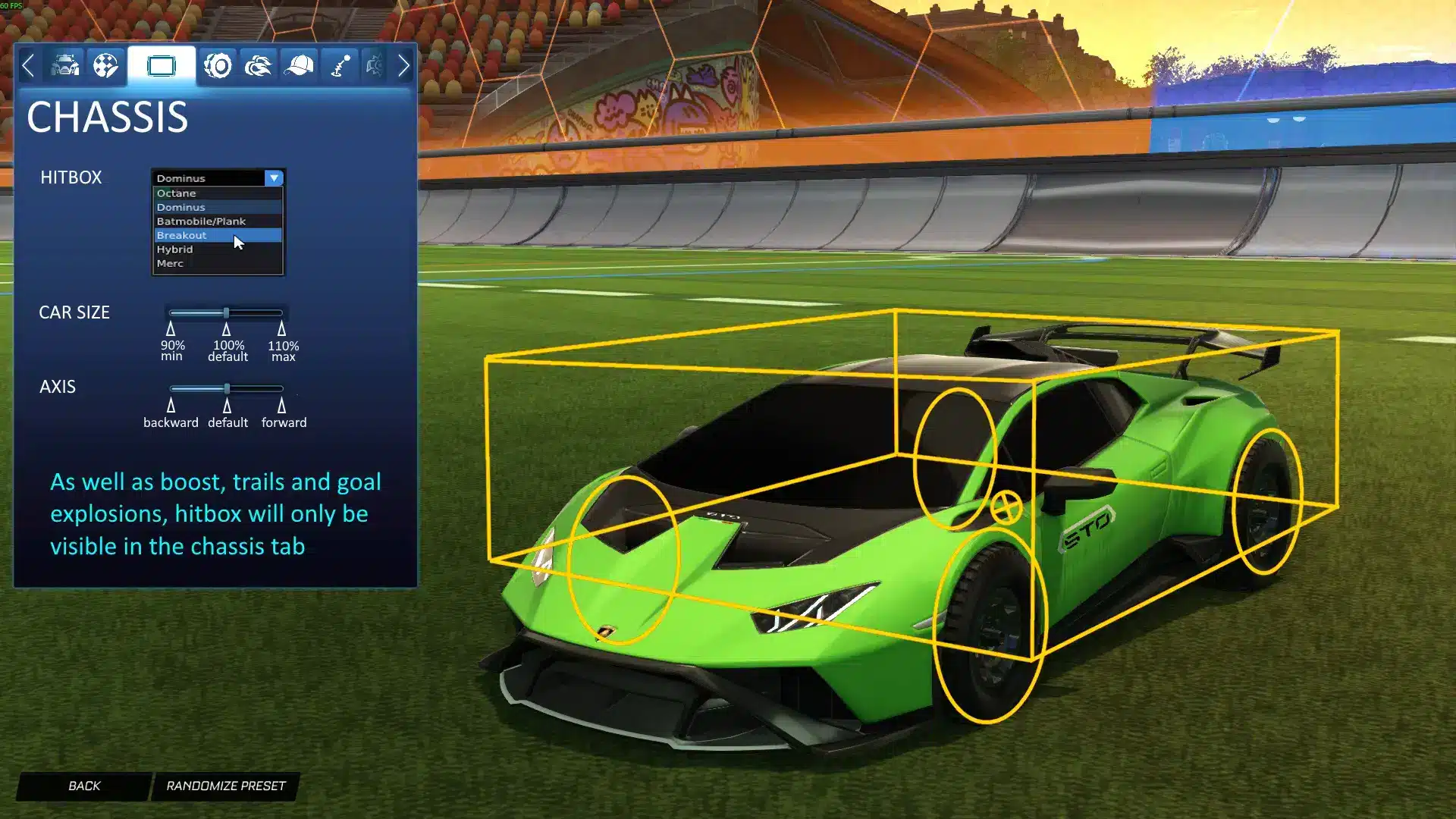 Before explaining what Rocket League hitboxes are, we need to take a step back and understand the concept of a hitbox. In short, a hitbox is a collision box of a specific object. It allows the game's programming to register when something has been hit. This way, the game understands that a certain action needs to happen.
For example, imagine a box inside a game. When the character's hitbox touches the box's hitbox, an action is executed. This can generate different effects, but the basic concept is exactly this.
Now, talking about Rocket League hitboxes, each car type has its own collision box. They are based on a standard model, with variations depending on the type. With these hitboxes, the game identifies when a car interacts with the ball or even with an opponent's car. This also includes collisions with the field and other objects.
To check all vehicles from each of the 6 hitboxes, visit the complete list on the Epic Games website!
With this information, we can start building a better understanding of the particular characteristics of each type. However, to learn more deeply about them, check the details of the 6 Rocket League hitbox types.
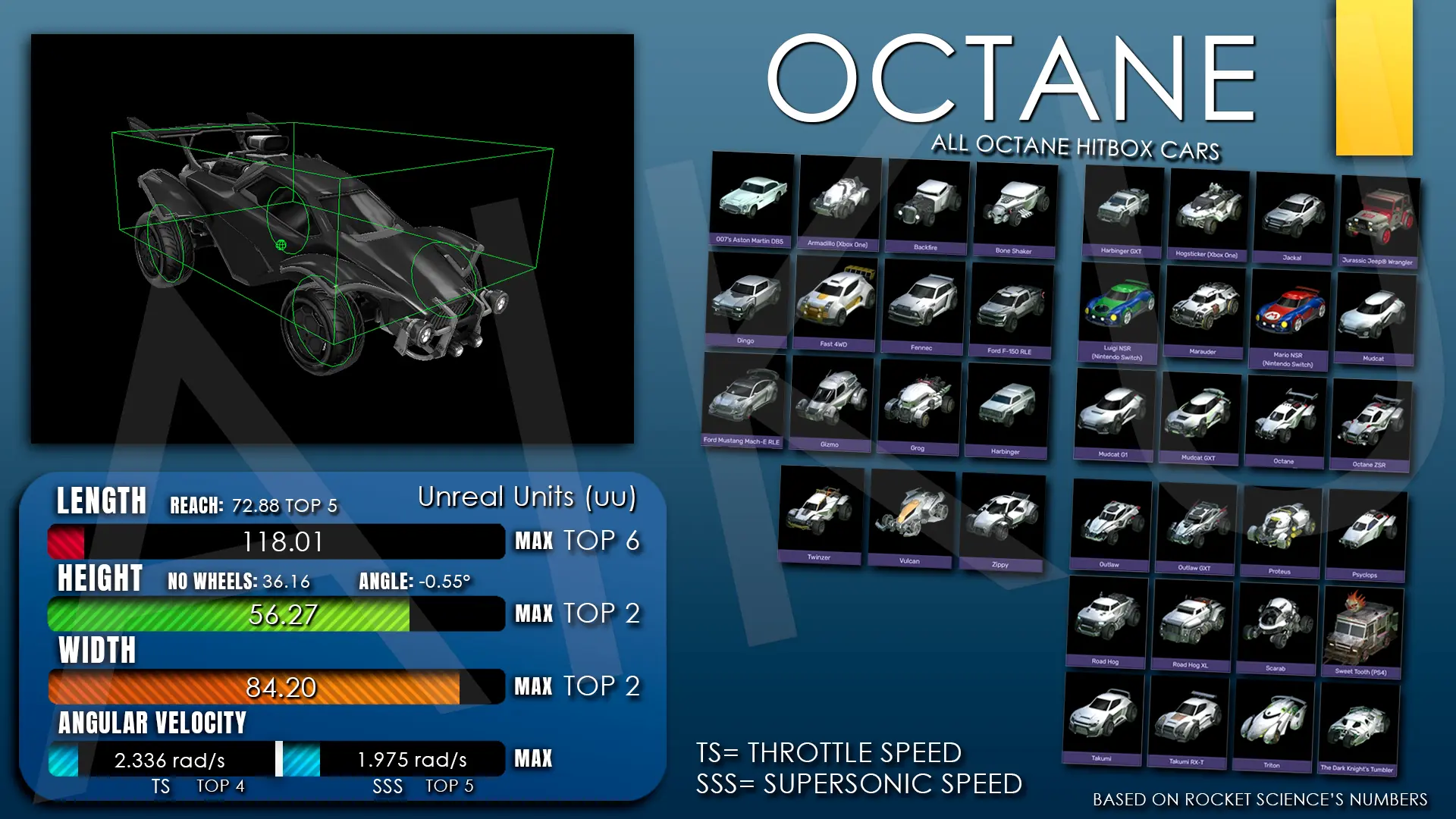 The Octane hitbox is one of the most well-known in the Rocket League universe. It includes some of the most popular cars, such as Octane, Fennec, and Dingo. Besides that, it has a structure that is closer to a standard format.
With its relatively high profile, combined with balanced length and width, we have one of the biggest visual references in the game. In fact, the car used in the Rocket League logo is an Octane.
This category is mostly chosen by players looking for something more versatile. It is also an interesting choice for beginners among the different Rocket League hitboxes.
Main characteristics of the Octane:
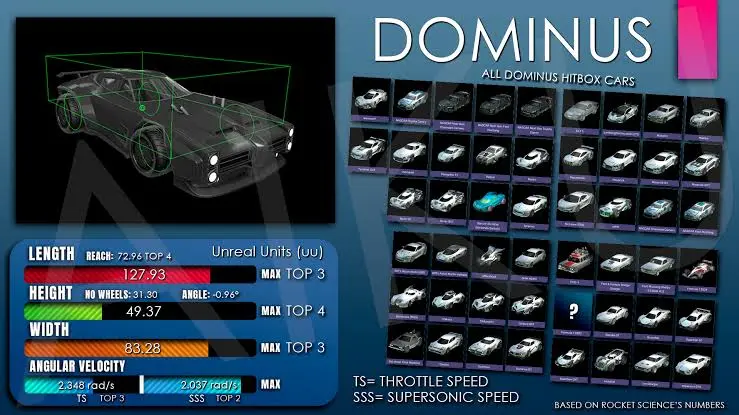 The Dominus is one of the Rocket League hitboxes that most differs from the usual standard (Octane). It has a lower and much more elongated shape. Because of this, it is usually chosen by players looking for specific mechanics.
For example, many players prefer this hitbox when they need movements involving direct contact with the ball. It is also a popular option for gameplay that depends more on flicks and shots. Remembering that executing these mechanics has a much more direct connection with the player's skills.
If a player is already used to the Octane and wants to move to the Dominus, they may face an adaptation period. Especially during situations where positioning the car correctly is necessary to control the ball.
Main characteristics of the Dominus:
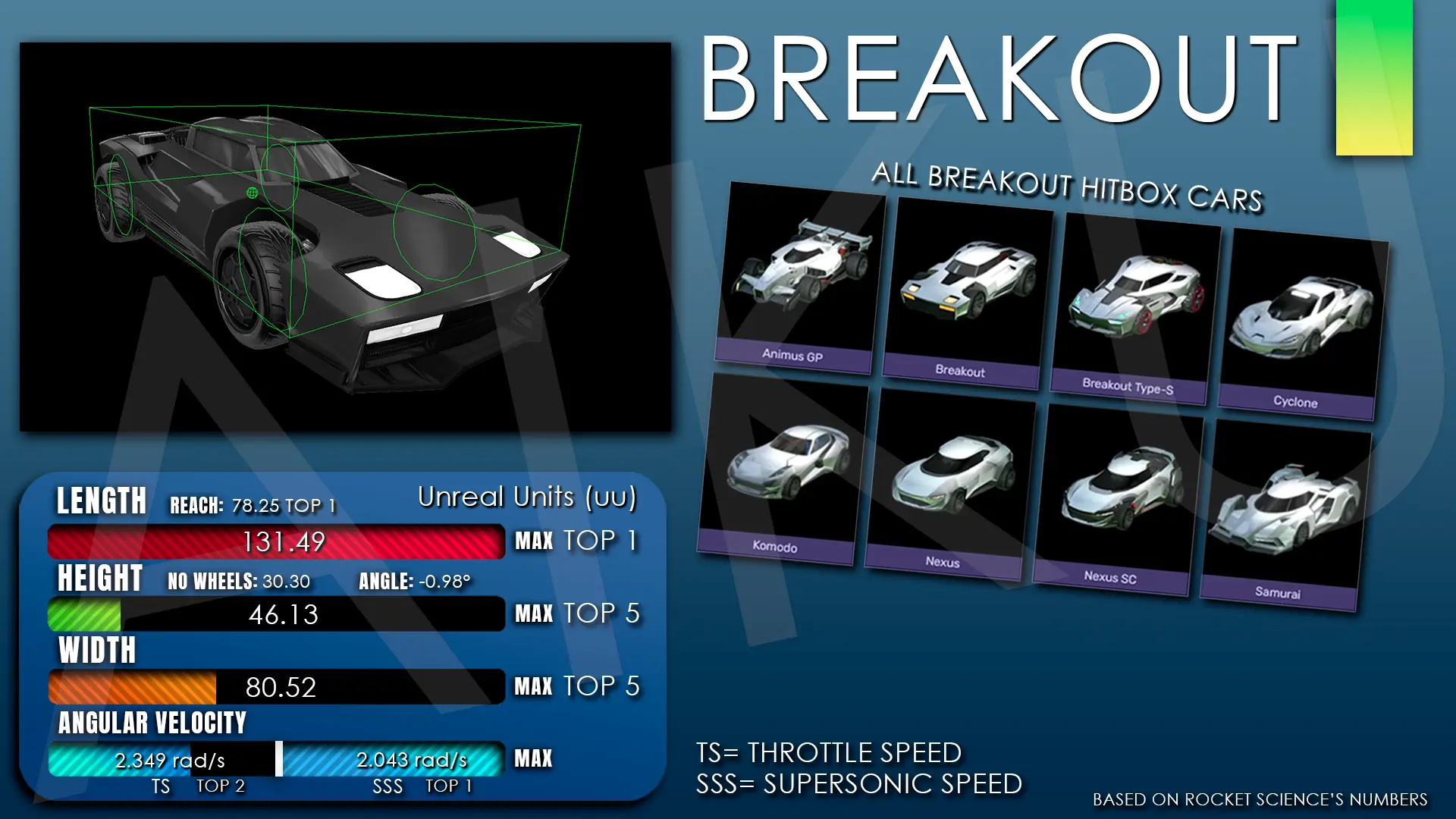 The Breakout is one of the hitboxes that most resembles the Dominus. Both have a lower and elongated profile. However, their proportions are different, creating their own particular characteristics.
Its structure is visually more comfortable, especially when trying to align the car with the ball. This can bring a visual advantage for certain players.
Main characteristics of the Breakout:
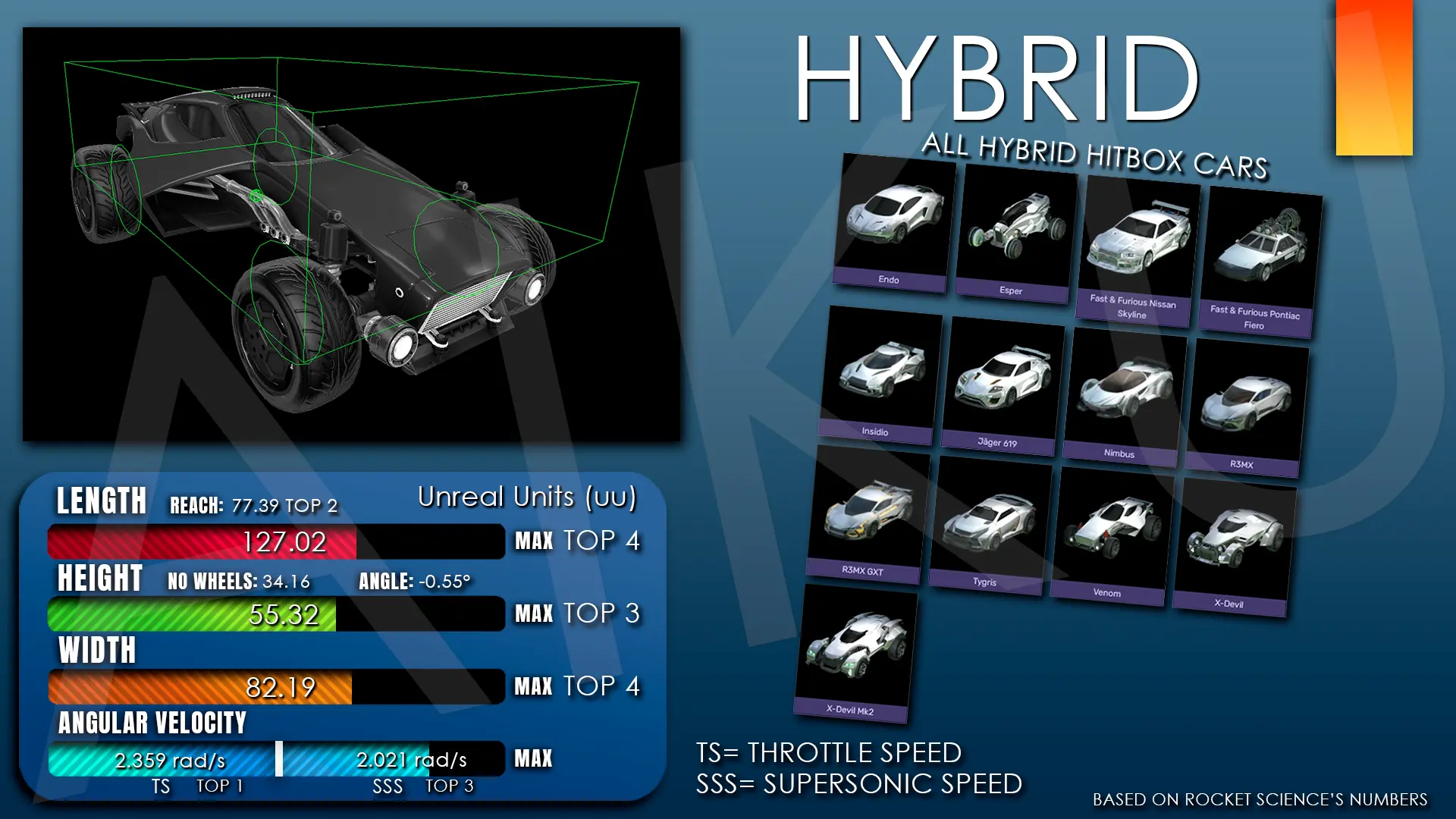 As the name already suggests, the Hybrid hitbox is the model with the most intermediate proportions in the game. When compared to the other Rocket League hitboxes, Hybrid has a more balanced shape.
Because of this, its structure becomes a good alternative for players who want to change their gameplay style. Whether they are coming from an Octane or Dominus.
The Hybrid model does not offer any speed or control advantage. Its main strength comes from its dimensions and the vehicles that use it.
Main characteristics of the Hybrid:
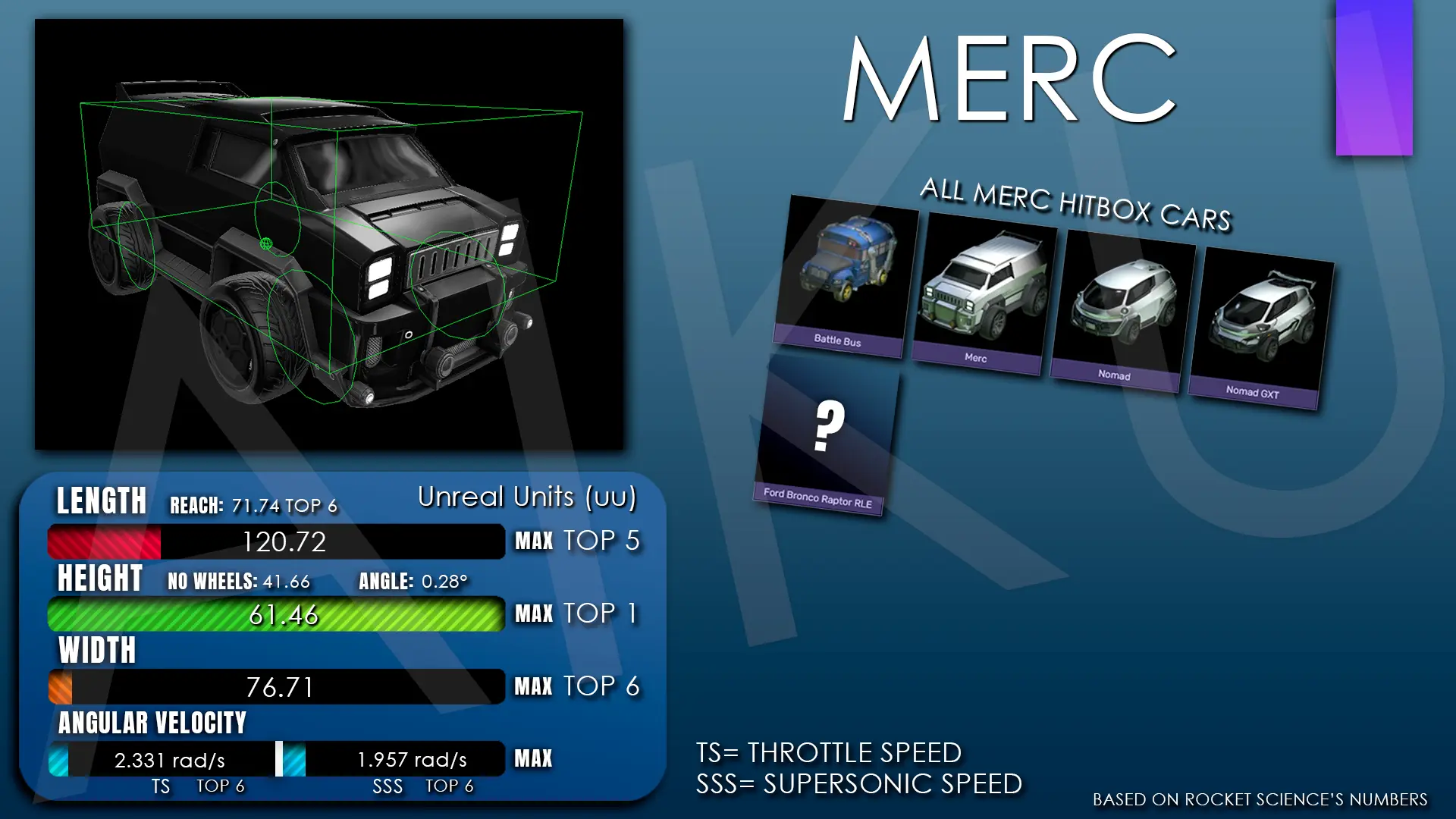 The Merc hitbox is known for its robust appearance and volume. Its vehicles have a taller and longer structure, together with a smaller width. It became very popular because of the Battle Bus, coming directly from Fortnite.
However, even though it gives the impression of being a stronger car, it does not have more power than other vehicles. Because of this, many players can end up having a feeling of weakness when using it.
Besides that, because of its unique shape, adapting to this hitbox can be more complicated. The visual references used by the player change. This way, it becomes necessary to calculate the contact with the ball differently.
Main characteristics of the Merc:
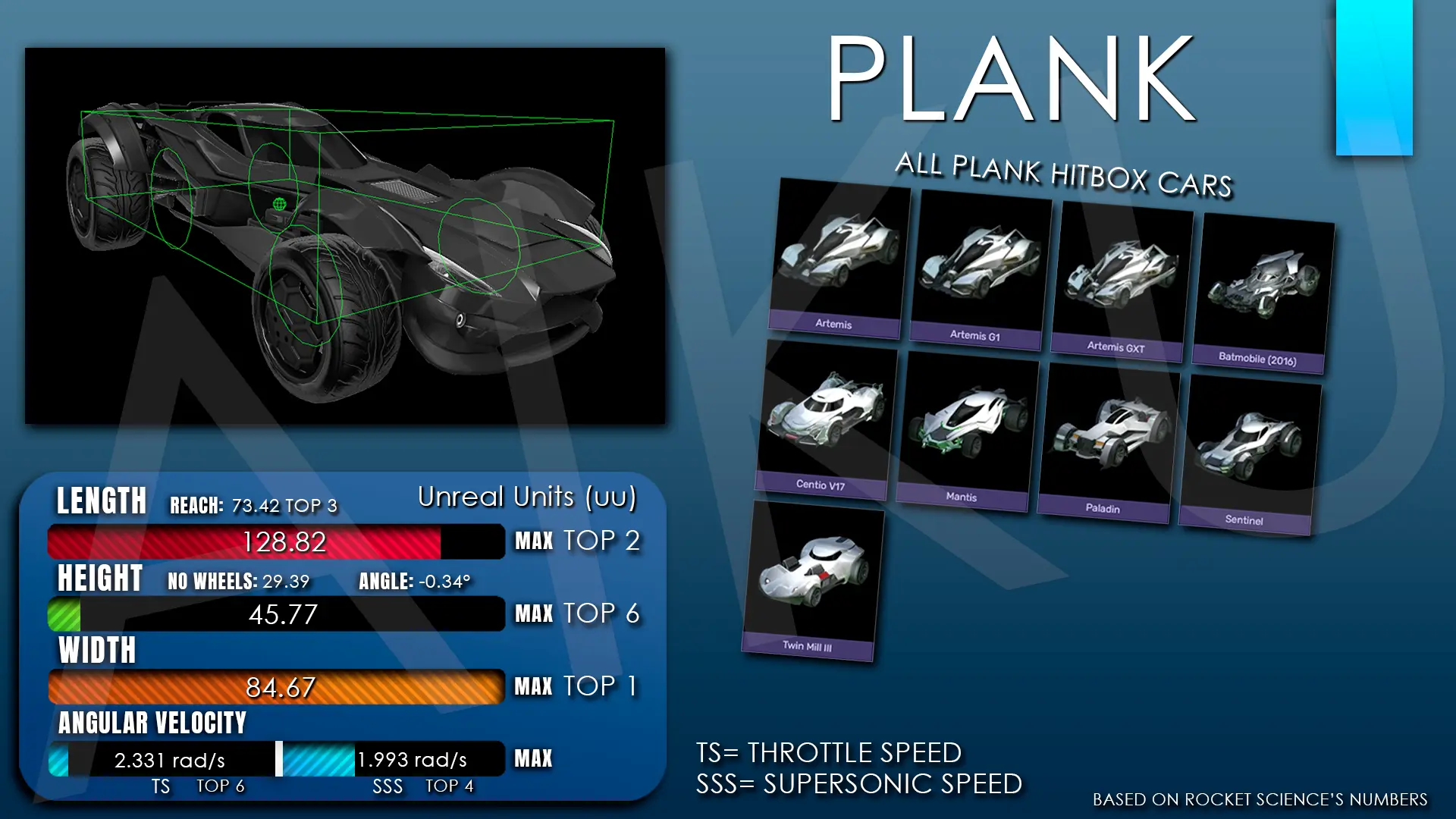 Finally, one of the most particular Rocket League hitboxes, the Plank. Its structure is the lowest and widest among the different types. This can create the perception that contact with the ball may happen earlier.
Because of this, adapting to it requires more from the player's perception. After all, they need to calculate a new contact timing. Especially when this change happens after many hours of gameplay using other hitboxes.
Main characteristics of the Plank:
 First of all, there is no hitbox that is better than another in Rocket League. Each one has its own unique characteristics, requiring players to become familiar with them. This includes the shape, car model, and even the feeling of control.
Even with Octane, Dominus, and Fennec being more popular, it does not mean they are better. The differences between each hitbox become only a small detail when compared to the player's skills.
These characteristics do not represent an absolute performance ranking. Because, as mentioned before, the biggest difference comes from the player's skills.
For example, a player who is used to Dominus may execute certain mechanics with more consistency than when using Octane. Even if another person has the opposite experience.
 In the end, the best way to choose between the different Rocket League hitboxes is through testing. Players need to try each car type, looking to understand their particular characteristics and how they fit their playstyle.
By entering Free Play mode, you will be able to better feel each detail and each difference. Besides that, you can do this in an environment where mistakes can be corrected quickly.
During your tests, try to evaluate the following points:
How do Rocket League hitboxes work?
Before explaining what Rocket League hitboxes are, we need to take a step back and understand the concept of a hitbox. In short, a hitbox is a collision box of a specific object. It allows the game's programming to register when something has been hit. This way, the game understands that a certain action needs to happen.
For example, imagine a box inside a game. When the character's hitbox touches the box's hitbox, an action is executed. This can generate different effects, but the basic concept is exactly this.
Now, talking about Rocket League hitboxes, each car type has its own collision box. They are based on a standard model, with variations depending on the type. With these hitboxes, the game identifies when a car interacts with the ball or even with an opponent's car. This also includes collisions with the field and other objects.
How hitboxes work in Rocket League
Rocket League hitboxes, especially for cars, consider some important information. They use height, length, and width, based on the 6 different chassis types. For example, the Whiplash and McLaren Senna use the Breakout hitbox. Meanwhile, the Fennec and Octane belong to the Octane hitbox group. In the end, each one has its own particular characteristics. These differences can directly impact the gameplay of each player. Each height, length, and width will influence the timing to reach the ball, perform aerial plays, dribbles, and challenges. These differences can be noticed in the following situations:- Dribbling: how you control the ball on top of the car, including small direction adjustments.
- Shooting: how you position the car to hit the ball using different parts of the vehicle.
- Flicks: when launching the ball using a combination of jumps and movements with boost.
- Aerial plays: how you control the car while making contact with the ball during long jumps and movements using boost in the air.
- Challenges: when making contact with opponents, trying to get an advantage during the ball dispute.
What are the 6 different Rocket League hitbox types?
As mentioned before, Rocket League uses 6 chassis structures for its cars. Each one has its own proportions, even when their visual appearances are different. You can check each one, including their characteristics and car examples, below:| Hitbox type | General characteristics | Car examples |
| Octane | Relatively tall and balanced profile | Octane, Fennec, and Dingo |
| Dominus | Low and elongated profile | Dominus, Diestro, and Dominus GT |
| Breakout | Low and elongated profile, with different proportions from Dominus | Animus GP, Whiplash, and Samurai |
| Hybrid | More intermediate profile, with a standard shape | Endo, Jäger 619, and Nimbus |
| Merc | Taller profile with more volume | Merc, Battle Bus, and Nomad |
| Plank | Very low and wider profile | Mantis, Paladin, and Formula 1 (2021 and 2022) |
Octane Hitbox
The Octane hitbox is one of the most well-known in the Rocket League universe. It includes some of the most popular cars, such as Octane, Fennec, and Dingo. Besides that, it has a structure that is closer to a standard format.
With its relatively high profile, combined with balanced length and width, we have one of the biggest visual references in the game. In fact, the car used in the Rocket League logo is an Octane.
This category is mostly chosen by players looking for something more versatile. It is also an interesting choice for beginners among the different Rocket League hitboxes.
Main characteristics of the Octane:
- Balanced shape: it has a relatively tall and compact structure, with proportions that are different from the more elongated categories.
- Versatility: it can be used for different mechanics, including dribbles, flicks, shots, and aerial plays.
- Popularity: it is one of the most recognized categories in the community and a common reference for both beginner and experienced players.
- Main cars: Octane, Fennec, Dingo, Octane ZSR, and Honda Civic Type R.
Dominus Hitbox
The Dominus is one of the Rocket League hitboxes that most differs from the usual standard (Octane). It has a lower and much more elongated shape. Because of this, it is usually chosen by players looking for specific mechanics.
For example, many players prefer this hitbox when they need movements involving direct contact with the ball. It is also a popular option for gameplay that depends more on flicks and shots. Remembering that executing these mechanics has a much more direct connection with the player's skills.
If a player is already used to the Octane and wants to move to the Dominus, they may face an adaptation period. Especially during situations where positioning the car correctly is necessary to control the ball.
Main characteristics of the Dominus:
- Low and elongated profile: it has a longer length and lower height when compared to Octane.
- Front contacts: its shape provides a different reference when aligning the front of the vehicle with the ball.
- Flicks and shots: it is an alternative for players who prefer to execute these mechanics using lower-profile cars.
- Main cars: Dominus, Dominus GT, Diestro, Imperator DT5, and Batmobile (1989).
Breakout Hitbox
The Breakout is one of the hitboxes that most resembles the Dominus. Both have a lower and elongated profile. However, their proportions are different, creating their own particular characteristics.
Its structure is visually more comfortable, especially when trying to align the car with the ball. This can bring a visual advantage for certain players.
Main characteristics of the Breakout:
- Elongated structure: it is among the longest hitbox categories, featuring a low and relatively narrow profile.
- Specific proportions: although it looks similar to Dominus, it has its own dimensions that change the boundaries of the collision area.
- Positioning accuracy: it can be interesting for players who prefer using an elongated visual reference to align their contacts with the ball.
- Main cars: Breakout, Breakout Type-S, Animus GP, Cyclone, and Samurai.
Hybrid Hitbox
As the name already suggests, the Hybrid hitbox is the model with the most intermediate proportions in the game. When compared to the other Rocket League hitboxes, Hybrid has a more balanced shape.
Because of this, its structure becomes a good alternative for players who want to change their gameplay style. Whether they are coming from an Octane or Dominus.
The Hybrid model does not offer any speed or control advantage. Its main strength comes from its dimensions and the vehicles that use it.
Main characteristics of the Hybrid:
- Intermediate dimensions: it has a length close to Dominus, but with a taller structure.
- Versatile shape: it offers an alternative between Octane's compact proportions and the lower, more elongated formats.
- Adaptation to mechanics: it can be used for dribbles, shots, and aerial plays, requiring familiarity with its dimensions.
- Main cars: Endo, Jäger 619, Nimbus, Insidio, and Nissan Skyline GT-R.
Merc Hitbox
The Merc hitbox is known for its robust appearance and volume. Its vehicles have a taller and longer structure, together with a smaller width. It became very popular because of the Battle Bus, coming directly from Fortnite.
However, even though it gives the impression of being a stronger car, it does not have more power than other vehicles. Because of this, many players can end up having a feeling of weakness when using it.
Besides that, because of its unique shape, adapting to this hitbox can be more complicated. The visual references used by the player change. This way, it becomes necessary to calculate the contact with the ball differently.
Main characteristics of the Merc:
- Greater height: it has the tallest structure among the six traditional hitbox categories.
- Narrow shape: despite being tall, it has a smaller width compared to the other categories.
- Ball contacts: its proportions provide different references for challenges and movements involving the upper part of the vehicle.
- Main cars: Merc, Nomad, Battle Bus, and Behemoth.
Plank Hitbox
Finally, one of the most particular Rocket League hitboxes, the Plank. Its structure is the lowest and widest among the different types. This can create the perception that contact with the ball may happen earlier.
Because of this, adapting to it requires more from the player's perception. After all, they need to calculate a new contact timing. Especially when this change happens after many hours of gameplay using other hitboxes.
Main characteristics of the Plank:
- Extremely low profile: it has the lowest height among the six traditional categories.
- Wide and elongated structure: it combines a long length with one of the greatest widths among the hitbox types.
- Control references: its shape may require adaptation during dribbles, shots, and aerial plays, especially for players who are used to taller vehicles.
- Main cars: Batmobile (2016), Mantis, Paladin, Centio, and Artemis.
What is the best Rocket League hitbox?
First of all, there is no hitbox that is better than another in Rocket League. Each one has its own unique characteristics, requiring players to become familiar with them. This includes the shape, car model, and even the feeling of control.
Even with Octane, Dominus, and Fennec being more popular, it does not mean they are better. The differences between each hitbox become only a small detail when compared to the player's skills.
The popularity battle: Octane or Dominus?
Octane and Dominus are the most popular Rocket League hitboxes. However, both have different shapes, which can influence the preferences of each player. Normally, their differences are the following:| Criteria | Octane | Dominus |
| Shape | Relatively tall and balanced | Low and elongated |
| Ball control | Popular visual reference for dribbling | Requires adaptation to the lower profile |
| Flicks | Allows different techniques | Shape appreciated by some players for this movement |
| Aerial plays | Versatile for different playstyles | Offers other visual references for ball contacts |
| Recommended profile | Players looking for familiarity and versatility | Players who prefer low and elongated cars |
Do Octane and Fennec have the same hitbox?
Even though they are cars with completely different structures, both vehicles belong to the same hitbox category. In other words, this means that both share the same collision box. This happens because the most noticeable difference is in their visual models. On one side, the Octane has a design with curves and more irregular shapes. On the other side, we have the Fennec with a more squared body. Because of this, it creates some confusion that they belong to different categories. Besides that, for this reason, some players consider that Fennec's appearance makes visualization easier. Especially when calculating certain collision boundaries. However, this is a matter of perception. The Fennec body does not provide an advantage over Octane. In other words, changing from Octane to Fennec does not actually change anything, even if the player's perception says otherwise.How to choose between the different Rocket League hitboxes?
In the end, the best way to choose between the different Rocket League hitboxes is through testing. Players need to try each car type, looking to understand their particular characteristics and how they fit their playstyle.
By entering Free Play mode, you will be able to better feel each detail and each difference. Besides that, you can do this in an environment where mistakes can be corrected quickly.
During your tests, try to evaluate the following points:
- Dribbling: which car allows you to keep the ball under control for a longer time?
- Flicks: with which car did you feel more comfortable performing launches and rotation movements?
- Shooting: how does the accuracy of front and side contacts with the ball compare between each hitbox?
- Aerials: when were you able to perform better aerial plays and redirects?
- Consistency: with which hitbox could you repeat the same movements more easily?