

The Rocket League player count remains a useful way to understand how active the game is in 2026, but finding one reliable global number is more complicated than it may seem. Psyonix’s vehicular soccer game is available across several platforms, while most public websites track only part of that audience.
Interest in the Rocket League player count also tends to rise around new seasons, competitive events, and cosmetic releases. Returning players who want to see what has changed can also check the latest Rocket League item shop information before heading back onto the field, since live-service updates remain an important part of the wider Rocket League ecosystem.
A useful Rocket League player count therefore needs context. Steam provides measurable concurrent-player data, the game itself once again displays population information, and third-party tools such as an RL tracker or Rocket League tracker can provide additional statistics, but these sources are not measuring exactly the same thing.
As of August 24, 2026, Steam alone continues to show tens of thousands of concurrent players during busy periods. However, those figures should never be presented as the complete Rocket League population because new PC players have used the Epic Games Store rather than Steam since the game became free-to-play in 2020.
How many people are playing Rocket League right now?
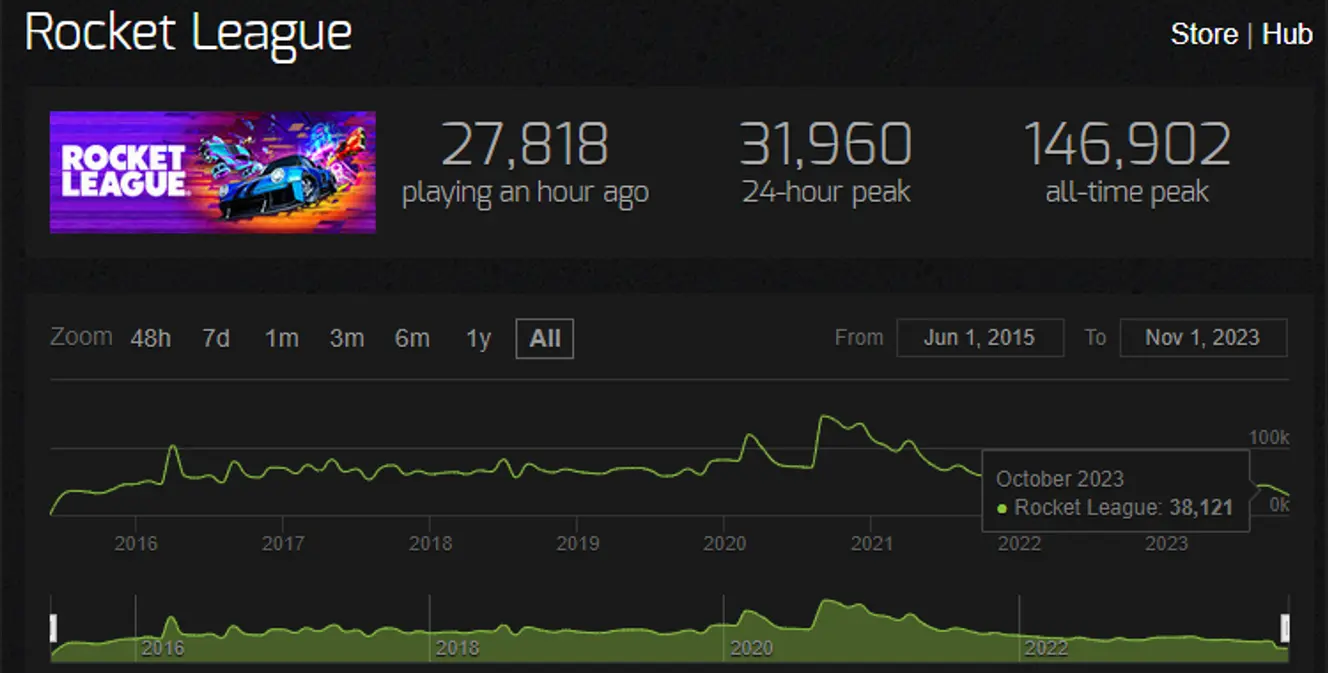
There is no single permanent number that answers this question because the Rocket League player count changes constantly throughout the day. Time zone, region, day of the week, new content, competitive events, and playlist popularity can all affect how many people are online.
More importantly, different counters represent different slices of the community. A Steam counter provides precise Steam concurrency, while population information inside Rocket League can give players a broader picture of activity.
Current Rocket League Steam player count
On August 24, 2026, Steam tracking data showed approximately:
| Metric | Steam activity |
| Concurrent players at the time of the snapshot | About 19,800 |
| 24-hour peak | About 27,600 |
| Average concurrent players over the last 30 days | About 16,100 |
| 30-day peak | About 28,400 |
| Historical Steam peak | About 146,900 |
These figures demonstrate that a substantial legacy Steam audience still plays the game. Nevertheless, they should not be interpreted as the entire Rocket League player count.
Rocket League stopped being available to new Steam users when it transitioned to free-to-play in September 2020. Players who already owned the Steam version can still use it and receive updates, but newer PC users enter through the Epic Games Store.
That distinction matters whenever you use an RL tracker based on Steam data. A counter can be accurate for the platform it measures while still significantly underrepresenting the total Rocket League community.
Why Steam numbers do not show the complete player base
Rocket League supports cross-platform play across PC and consoles. Consequently, a Steam-only figure excludes players accessing the game through the Epic Games Store, PlayStation, Xbox, and Nintendo platforms.
There is no public Steam-style historical chart that combines every one of those ecosystems into one universally accessible dataset. Therefore, claims such as “X million people play Rocket League every day” should be treated carefully unless Psyonix or Epic Games provides a clear methodology and reporting period.
This is also why comparing your rank with the raw population requires more than counting online users. Competitive distribution depends on mode, region, rank, and matchmaking conditions. Players interested in that side of the game can use this guide to Rocket League MMR and rankings to understand how rating works alongside population size.
A Rocket League tracker is especially useful for individual profiles, ratings, match history, and competitive trends. However, no third-party tool should automatically be treated as an official global census.
How can you check the Rocket League player count?
The best method depends on what you actually want to measure. Someone looking for current matchmaking activity needs different information from a player researching historical Steam trends or personal competitive statistics.
In 2026, Rocket League offers more useful population visibility than it did during several previous seasons because Psyonix restored population numbers to the Play Menu.
Check the population directly inside Rocket League
In March 2026, Psyonix restored playlist population numbers. Players can once again view the total Rocket League player population from the Play Menu and see playlist-specific population when highlighting individual modes.
For someone who is already in the game, this is one of the most useful ways to check the current Rocket League player count because it comes directly from the game rather than from an external estimate.
Playlist-level information is particularly valuable when deciding what to queue. A healthy overall population does not necessarily mean every playlist, rank, or region has the same number of available opponents.
For example, Standard or Doubles may have much more activity than a less popular Extra Mode at a particular hour. A high global population can therefore coexist with longer matchmaking times in specific queues.
Use Steam data for historical trends
Steam statistics remain valuable because they provide a consistent historical dataset. You can compare average concurrent players, monthly peaks, and long-term changes instead of relying on one isolated snapshot.
This makes Steam useful for answering questions such as:
- Is the legacy Steam audience increasing or decreasing?
- Did a particular month produce a noticeable player spike?
- Are weekend peaks significantly higher?
- How does current activity compare with previous years?
The limitation is still important: Steam represents only one part of the Rocket League audience.
Use an RL tracker for competitive information
An RL tracker usually becomes more useful when the goal shifts from population to individual performance. Depending on the service, players may be able to inspect ranks, rating changes, leaderboard positions, match data, or profile history.
A Rocket League tracker can therefore complement population statistics. It helps explain who is playing and how competitive progression is developing rather than simply reporting the number of users online.
Some search queries even contain repeated terms such as Rocket League Rocket League Rocket League, especially when users are trying to quickly locate the game, a tracker, or a familiar statistics page. Regardless of the search wording, it is important to identify whether the displayed number represents Steam concurrency, tracked profiles, estimated active users, or the broader in-game population.
Is Rocket League still popular in 2026?
Yes. Available evidence indicates that Rocket League still maintains an active player base in 2026. Steam alone regularly records thousands of simultaneous players even though the platform has not accepted new Rocket League owners since 2020.
That makes Steam activity particularly interesting. Its remaining users are largely part of a legacy installed base, while many newer PC players enter through Epic Games Store instead.
Steam activity remains substantial
The average Steam concurrency recorded during the 30 days leading into late August 2026 was around 16,000 players. Peak activity during that period approached 30,000 simultaneous Steam users.
Monthly averages naturally fluctuate. Updates, school holidays, major esports events, seasonal launches, and other games competing for players’ attention can all influence the Rocket League player count.
A lower month also does not automatically mean the game is “dying.” Multiplayer populations rarely move in a straight line. What matters more is whether players can consistently find matches and whether the ecosystem continues receiving new content and competitive support.
The tournament system also gives players recurring reasons to log in beyond standard ranked queues. If you plan your sessions around these events, the Rocket League tournament times guide explains how scheduled tournaments work and when they are available.
Cross-platform play broadens the available community
One of Rocket League’s biggest advantages is cross-platform play. Players are not restricted to finding opponents who use the same hardware.
That connectivity makes the global Rocket League player count more relevant than the population of any single platform when evaluating matchmaking health.
A Steam chart can tell you that thousands of Steam users are online, but it cannot show every Epic Games Store or console player who may enter the same cross-platform matchmaking ecosystem.
This is another reason not to rely on dramatic third-party headlines claiming an exact worldwide total without explaining the underlying methodology.
What affects the Rocket League player count?
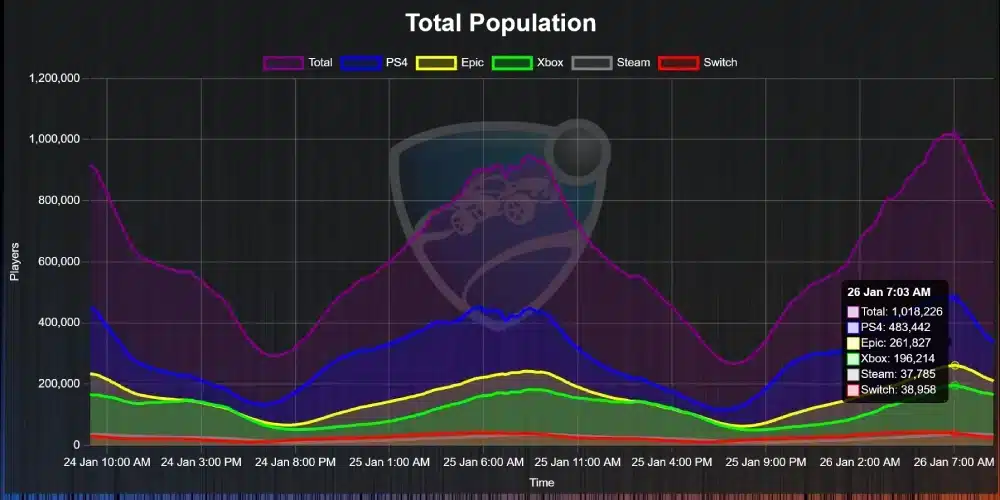
Population naturally changes over time. Rocket League operates as an ongoing competitive game rather than a static release, so updates and events repeatedly give both active and former players reasons to return.
Not every increase lasts indefinitely, but recurring activity can maintain a healthy matchmaking environment even many years after launch.
Seasons, updates, and collaborations
Season launches are among the clearest opportunities for population changes. A new Rocket Pass, gameplay update, arena, competitive reset, or themed event can bring players back to explore what is new.
Rocket League entered its modern free-to-play era in September 2020. That transition removed the purchase barrier and introduced the Epic Games Store version on PC, significantly changing how the game’s audience should be measured.
The game remains actively supported in 2026. Players can follow official Rocket League news and updates for current seasonal information instead of depending on outdated articles that may still describe old seasons as if they were active.
This matters for player-count articles in particular. Population numbers age quickly, while seasonal information can become obsolete within months.
Esports and competitive events
Rocket League esports also contributes to long-term visibility. Major tournaments can attract existing players, returning fans, and viewers who decide to play after watching professional competition.
The relationship is not necessarily one-to-one. A large esports audience does not mean every viewer launches the game, and a spike in players cannot automatically be attributed to one event.
Still, competitive infrastructure is an important indicator of ongoing community activity. The Rocket League ecosystem continues to support organized competition, community tournaments, ranked play, and professional events.
How does player count affect matchmaking?
A larger available population generally gives matchmaking systems more options. However, the total Rocket League player count is only one variable affecting how quickly you find a match.
Your region, playlist, skill rating, time of day, and party composition can matter just as much.
Popular playlists usually have more matchmaking options
High-traffic modes have a larger pool of potential teammates and opponents. That can make it easier for matchmaking to find players near the appropriate competitive level.
Less popular playlists may behave differently. Even with thousands of people playing globally, a specific combination of region, mode, and rank can have a much smaller matchmaking pool.
This explains why two players can have very different queue experiences at the same moment.
Player count does not determine connection quality
Population and network quality are separate issues. A large number of active players does not automatically cause high ping, and a small population does not automatically produce a better connection.
Latency is influenced by factors such as:
- Distance between you and the game server;
- ISP routing;
- Network congestion;
- Wi-Fi conditions;
- Packet loss;
- The server region selected;
- Problems elsewhere along the route.
Similarly, matchmaking availability and connectivity should not be confused. An RL tracker can help you understand rating and statistics, but it cannot diagnose every network route between your device and a game server.
Why the Rocket League player count is difficult to compare historically
Historical comparisons often combine numbers that were measured in completely different ways. One article may report monthly active accounts, another may use peak simultaneous users, and another may display Steam players only.
Those metrics should never be placed side by side as though they describe the same thing.
Concurrent players and active users are different metrics
Concurrent players represent people online at the same time. Monthly active users, by contrast, represent unique or qualifying users across a much longer period.
A game could have a large monthly audience while maintaining a much smaller average concurrency because players enter and leave throughout the month.
Therefore, a claim that millions of accounts were active during a month cannot be directly compared with a Steam chart showing 20,000 players online at one moment.
Platform coverage also changes the result
Historical Rocket League statistics are particularly complicated because the game’s distribution model changed.
Before free-to-play, Steam was an important storefront for new PC purchases. After September 2020, new PC users shifted to Epic Games Store while existing Steam owners retained access.
As a result, Steam trends after that transition describe the behavior of a specific legacy cohort rather than the entire PC audience.
The best interpretation combines platform context, the in-game population display, and a Rocket League tracker when individual competitive information is relevant.
What keeps Rocket League active after more than a decade?
Rocket League first launched in 2015, yet its core concept remains unusually easy to understand and difficult to master. Cars, a ball, two goals, and physics-based mechanics create an accessible starting point with an extremely high competitive skill ceiling.
That structure helps explain why the Rocket League player count can remain meaningful years after release.
Competitive depth encourages long-term play
Mechanical improvement can take hundreds or thousands of hours. Positioning, rotations, aerial control, boost management, recoveries, shooting, dribbling, and team communication create a progression loop that does not depend entirely on new content.
Players can always find another mechanic to improve or another competitive rank to pursue.
An RL tracker or Rocket League tracker can make that progression more visible by allowing players to follow changes over time.
Esports provides an aspirational layer
Professional play demonstrates what is possible at the highest level. RLCS events regularly showcase mechanics and coordination that are far beyond ordinary ranked matches, giving competitive players new strategies and techniques to study.
Players interested in the professional side can use the official Rocket League competitive hub to follow schedules, events, competitive news, and other esports information.
This competitive ecosystem does not provide an exact Rocket League player count on its own, but it helps show why the game continues attracting an engaged audience.
How can ExitLag help Rocket League players?
Player population tells you how many opponents may be available, but your own online experience also depends on how traffic travels between your network and the game servers. ExitLag focuses on this connection layer.
It cannot increase the Rocket League player count, change matchmaking rules, improve hardware-limited FPS, or resolve a global server outage. Instead, it is designed to optimize network routes when routing conditions are contributing to instability.
Route optimization for online matches
Internet traffic does not always take the most efficient path between a player’s connection and a game server. Depending on the ISP, region, and current network conditions, routes can include unnecessary or unstable hops.
ExitLag can help optimize these routes and may reduce latency or improve connection stability when inefficient routing is part of the problem. Results vary according to the player’s connection, region, destination server, and available routes.
That distinction is important. No networking application can guarantee a specific ping in every environment.
A more consistent connection for competitive sessions
Consistency matters in Rocket League because even brief latency changes can affect challenges, aerial touches, saves, and precise mechanical inputs.
ExitLag’s routing features are designed to seek more stable paths for supported online games. Depending on network conditions, this may help reduce routing-related instability during ranked sessions, tournaments, or casual play.
If you regularly play competitive matches and want to evaluate whether routing optimization makes a difference on your connection, try ExitLag and compare your experience across several sessions rather than relying on a single match.
Frequently asked questions
The Rocket League player count is easiest to understand when each source is interpreted according to what it actually measures. These answers summarize the most important points for players looking for current activity information.
There is no permanent worldwide number because activity changes continuously. On August 24, 2026, Steam alone was showing roughly 19,800 simultaneous users at the time of the snapshot, with a 24-hour peak of around 27,600.
Steam does not include new Epic Games Store users or the complete console population.
Yes. Steam maintains thousands of concurrent players despite being closed to new Rocket League users since 2020, while the broader cross-platform ecosystem includes Epic Games Store and console players.
The game also continues receiving seasonal content and competitive support.
One of the best options is the population information available directly inside the Play Menu. In 2026, Psyonix restored both overall and playlist-specific population numbers.
Steam statistics can also help with historical PC trends, while an RL tracker or Rocket League tracker is more useful for individual competitive information.
No. Steam Charts measures the Steam version only.
Because new PC users have accessed Rocket League through Epic Games Store since the free-to-play transition, Steam statistics represent only part of the game’s PC population and exclude consoles entirely.
They may be measuring different platforms, time periods, or metrics. One service might report concurrent Steam players while another estimates monthly activity or counts tracked profiles.
Always check the methodology before comparing two numbers.
Not necessarily. Queue time depends on the population available for your specific region, playlist, rank, and time of day.
A mode can have healthy matchmaking even when the overall population is lower than a historical peak.
No. ExitLag does not change game population or matchmaking availability.
It focuses on network routing and may help provide a more stable route to game servers when your connection problems are related to routing conditions.
The most reliable way to understand the Rocket League player count is to combine current in-game population information with platform-specific data and competitive tracking instead of trusting unsupported global estimates. Rocket League remains active in 2026, and if connection routing is affecting your matches, ExitLag can help optimize the path between your network and supported game servers—so try it during your next sessions and compare the results on your own connection.
All game images used in this article belong to their respective owners. They are used for informational and educational purposes only and do not imply endorsement or affiliation with the rights holders.
Got questions or want to connect with other players? Join the conversation at the ExitLag Forum!