
The Stardew Valley greenhouse is one of the most powerful farm upgrades in the entire game, allowing you to grow any crop from any season year-round without weather or season restrictions. Unlocking it and optimizing its layout correctly transforms your farm income from seasonal to permanent and self-sustaining.
The stardew valley greenhouse is unlocked by completing the Pantry bundles in the Community Center, or alternatively purchased through the Joja Community Development Form for 35,000g if you choose the Joja route. Either way, getting it early and setting it up correctly makes a dramatic difference to long-term profitability.
The greenhouse itself is a 10×12 interior planting space surrounded by paths, supporting a maximum of 18 fruit trees around the border and 116 crop tiles in the center. Filling it efficiently with the right crops and the optimal stardew valley greenhouse layout is the core challenge this guide addresses.

Stardew Valley Greenhouse: How to Unlock It
Community Center Route (Recommended)
The Pantry room in the Community Center requires six bundles to complete. Finishing all six triggers the greenhouse to appear on your farm automatically.
Pantry bundles required:
- Spring Crops Bundle: Parsnip, Green Bean, Cauliflower, Potato
- Summer Crops Bundle: Tomato, Hot Pepper, Blueberry, Melon
- Fall Crops Bundle: Corn, Eggplant, Pumpkin, Yam
- Quality Crops Bundle: 5 Gold-quality versions of Parsnip, Melon, Pumpkin, and Corn
- Animal Bundle: Large Milk, Large Egg, Large Goat Milk, Wool, Duck Egg
- Artisan Bundle: Truffle Oil, Cloth, Goat Cheese, Cheese, Honey, Jelly, Apple, Apricot, Orange, Peach, Pomegranate, Cherry
The Quality Crops Bundle is the typical bottleneck for early game players. Gold-quality crops become more consistent with higher Farming Level and the use of fertilizer on crop tiles.
Joja Route
Purchasing the greenhouse through Joja Community Development costs 35,000g and bypasses the bundle requirements entirely. This is the faster route for Joja run playthroughs but costs significantly more gold in the early game.
Stardew Valley Greenhouse Layout: Optimal Setup
The 18 Fruit Trees and 116 Crop Layout
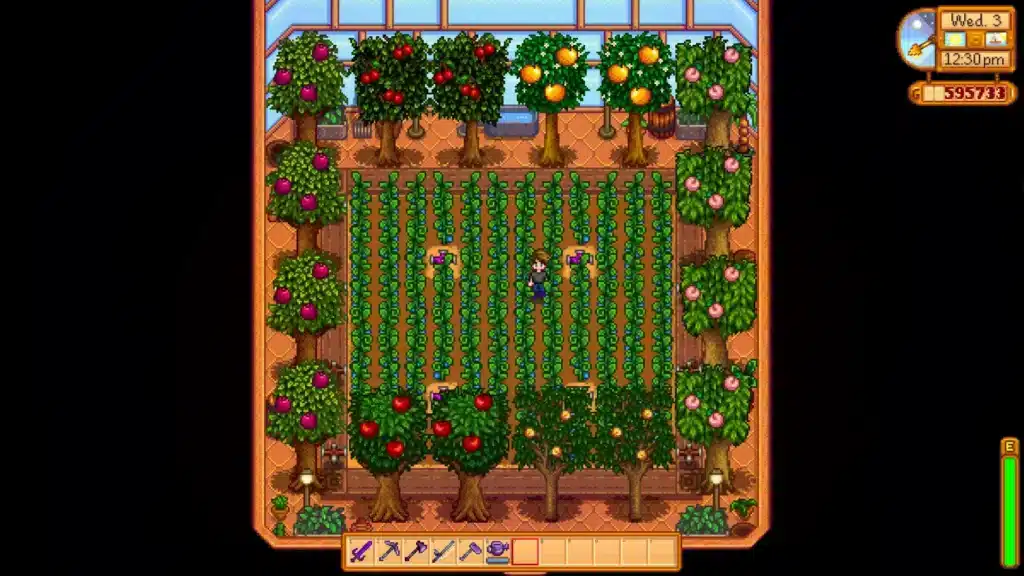
The most widely used greenhouse stardew valley layout supports the maximum number of fruit trees and crop tiles simultaneously, with full irrigation coverage from six Iridium Sprinklers.
Key layout principles:
- 18 fruit trees planted along the border walls with two empty spaces between each tree
- 6 Iridium Sprinklers arranged in a 2-column by 3-row pattern in the center crop area
- 116 crop tiles irrigated completely by the six sprinklers
- Walkable path maintained through the center for harvesting access
- Minimum clearance of one empty tile between any sprinkler and any fruit tree trunk
One critical rule: fruit trees cannot grow if any object is placed in the eight tiles surrounding their trunk. Always leave at least one tile of clearance around every tree, including from sprinklers placed nearby.
Fruit Tree Placement Guide
The border placement for 18 fruit trees follows this pattern:
- Top row: Plant along the top border with two spaces between each tree
- Side rows: Plant along both left and right borders, matching the top spacing
- Bottom row: Two spaces between each tree, leaving the entrance path clear
Plant your stardew valley greenhouse fruit trees as soon as the greenhouse is unlocked. Trees take 28 days to reach maturity and begin producing fruit. Every day you delay planting is a day of lost income during the early greenhouse phase.
Sprinkler Setup for Complete Coverage
Stardew valley greenhouse sprinkler layout with six Iridium Sprinklers covers all 116 planting tiles with zero gaps when placed correctly.
Placement pattern:
- Column A (left): Rows 2, 5, and 8 from the top of the crop area
- Column B (right): Rows 2, 5, and 8 from the top of the crop area
This 2×3 grid pattern provides complete coverage across the entire center section. Verify coverage by checking that every crop tile shows a watering indicator when the sprinklers activate.
Best Greenhouse Crops: Ancient Fruit vs Starfruit
The Core Debate
The stardew valley greenhouse setup crop choice comes down to two primary options: Ancient Fruit and Starfruit. Both are top-tier choices, but they serve different playstyles and resource situations.
| Metric | Ancient Fruit | Starfruit |
| Grow Time (first harvest) | 28 days | 13 days |
| Regrow Time | 7 days (no replanting) | Does not regrow |
| Sell Price (raw) | 550g (base) | 750g (base) |
| Wine Value | 2,310g (base) | 3,150g (base) |
| Seed Cost | 0g (self-seeding via Seed Maker) | 400g per seed |
| Maintenance | Minimal (harvest, keg, repeat) | Replanting required each cycle |
Ancient Fruit: The Low-Maintenance King
Ancient Fruit is the optimal choice for the vast majority of greenhouse setups. Its 7-day regrowth cycle means you never need to replant after the initial seeding. Combined with a keg operation, ancient fruit wine sells for 2,310g per bottle with the Artisan profession, making it the most passive high-income crop in the game.
The workflow is simple: harvest every 7 days, load kegs, collect wine, repeat. One greenhouse of Ancient Fruit paired with enough kegs to process every harvest runs itself with minimal daily attention.
To obtain Ancient Fruit seeds, find an Ancient Seed artifact (random drop from artifact spots or monsters), use it to craft the Ancient Seeds planting item, and then use a Seed Maker on the harvested fruit to generate unlimited seeds for free.
Starfruit: Maximum Raw Gold with Active Management
Starfruit generates higher raw gold per batch than Ancient Fruit, particularly when turned into Starfruit Wine (3,150g base, 4,725g with Artisan profession). However, Starfruit does not regrow, requiring replanting every 13 days and purchasing new seeds at 400g each from Sandy in the Desert.
Starfruit is the better choice when:
- You have enough gold reserves that seed costs are negligible
- You have enough kegs to process harvests faster than the Ancient Fruit regrow cycle
- You want maximum short-term profit during a specific time window
For most players, however, stardew valley greenhouse fruit trees paired with Ancient Fruit provides the best balance of income and effort across an entire save file.

Greenhouse Setup for Maximum Profit: The Full Strategy
Year-Round Fruit Tree Income
The 18 fruit trees in the greenhouse produce one fruit per tree per day once mature, regardless of season. Filling the border with high-value trees multiplies the passive income significantly.
Best fruit tree choices for the greenhouse:
- Ancient Fruit trees (if grafted via modded play): Highest value
- Pomegranate: 140g base, harvested in Fall. In the greenhouse, it produces year-round.
- Peach: 140g base, summer tree producing year-round indoors
- Cherry: 80g base, spring tree producing continuously
- Orange: 100g base, reliable year-round producer
Turning tree fruits into wine or preserves using kegs and preserve jars boosts their value significantly. Furthermore, Iridium-quality tree fruit produced by trees at maximum friendship with Robin produces at 300-400% of base sell price.
Combining Kegs and Greenhouses
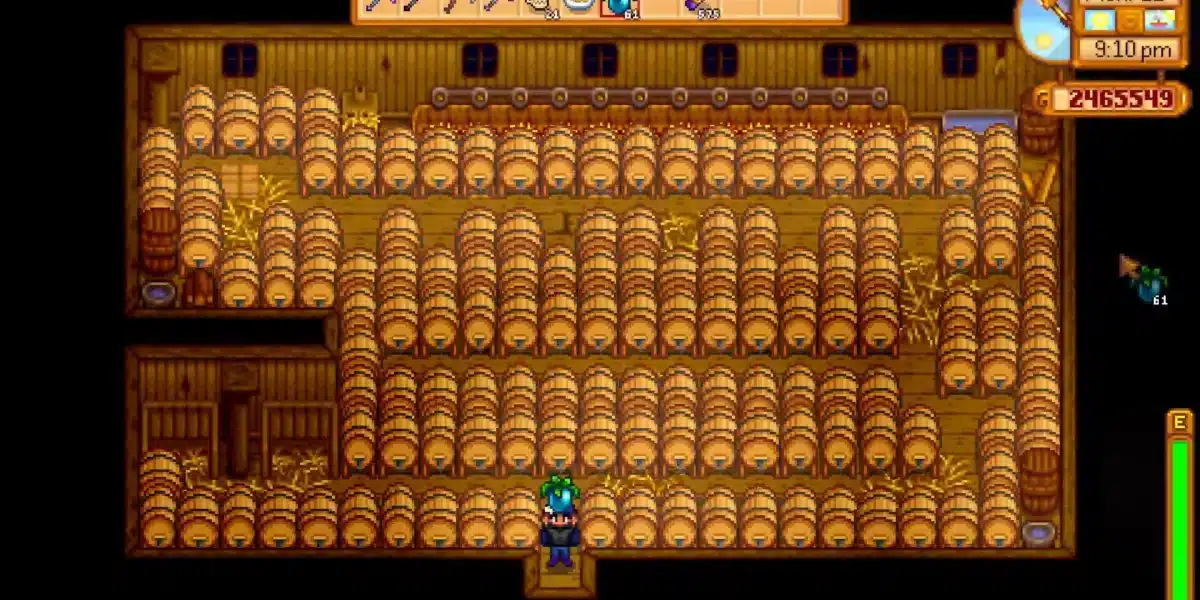
The true endgame power of the greenhouse is the keg operation it enables. With 116 Ancient Fruit plants harvesting every 7 days and enough kegs to process the full batch, the greenhouse becomes a self-sustaining wine factory.
Optimal keg count for a full greenhouse harvest:
- Each keg processes one item every 7 days
- A full 116-plant greenhouse produces up to 116 Ancient Fruits every 7 days
- Therefore, 116 kegs running simultaneously process each full harvest without backlog
This scale of operation generates over 250,000g per week at base prices, significantly more with the Artisan profession applied.
Pro Tips: Stardew Valley Greenhouse
- Plant fruit trees before crops: Trees take 28 days to mature, significantly longer than most crops. Plant them on day one of greenhouse access and fill the crop tiles while you wait for tree maturity.
- Use the Seed Maker on Ancient Fruit immediately: As soon as your first Ancient Fruit harvest comes in, run every fruit through the Seed Maker before planting in the greenhouse. This converts your single Ancient Seed into the dozens needed to fill all 116 crop tiles.
- Upgrade to Iridium Sprinklers before filling the greenhouse: Quality and Iridium Sprinklers are dramatically more efficient than basic sprinklers. Do not fill the greenhouse with Basic Sprinklers and commit to a layout you will need to rearrange later.
- Keep one tile open near the center for Junimo Hut coverage: If you plan to add a Junimo Hut adjacent to the greenhouse for passive harvesting, check that its coverage radius reaches inside before committing to your final layout.
- Add Quality Fertilizer to every tile for better crop quality: Higher crop quality increases sell price directly. Fertilizer in the greenhouse is permanent until the tile is dug up, so investing in it once delivers long-term returns.
Common Mistakes Stardew Valley Greenhouse Players Make
- Planting fruit trees too close together or near sprinklers. Trees need clearance in all eight surrounding tiles to grow properly. Fix: Always leave at least one empty tile between any tree trunk and any placed object, including sprinklers, scarecrows, or path tiles.
- Delaying Ancient Fruit planting while waiting for more seeds. Players often hold off on planting until they have enough seeds for the entire greenhouse, losing weeks of income. Fix: Plant each Ancient Fruit seed as soon as you have it. Each planted fruit generates more seeds through the Seed Maker within 28 days, naturally filling the greenhouse over time.
- Ignoring kegs in favor of direct selling. Selling Ancient Fruit raw leaves the majority of its income potential on the table. Fix: Build kegs as your primary investment after unlocking the greenhouse. Each keg multiplies Ancient Fruit value by 4.2x, making it the highest-return processing investment in the game.
Turn Your Stardew Valley Greenhouse Into a Multiplayer Operation With ExitLag
The stardew valley greenhouse is even more powerful in multiplayer, where two to four players can split farming, keg management, and gifting responsibilities simultaneously. However, co-op sessions require stable connections, and lag turns coordinated farm runs into frustrating desyncs.
ExitLag is a game connection optimizer that selects the fastest, most stable network route in real time. It is not a VPN and does not affect game files or save data.
For Stardew Valley multiplayer greenhouse stardew valley management sessions, ExitLag provides:
- Reduced lag and packet loss during co-op farming sessions
- Multipath Technology that keeps the connection stable even when individual routes fail
- Multi-Internet support for instant connection switching if your primary network drops
Download ExitLag for PC and run your multiplayer greenhouse farm without interruption
All game images used in this blog post belong to ConcernedApe. They are used for informational and educational purposes only and do not imply endorsement or affiliation with the rights holder.
Got questions or want to connect with other players? Join the conversation at the ExitLag Forum!