A sugar cane farm in Minecraft is one of the most important early-game builds for any survival world. Sugar cane may look like a simple plant, but it plays a massive role in progression, especially when players start enchanting gear, crafting maps, or trading with villagers.
Unlike many other crops, sugar cane farming is extremely beginner-friendly. It does not require farmland, seeds, or even specific light levels. As long as you understand the basic placement rules, you can start producing sugar cane almost immediately after spawning into a new world.
In practical terms, sugar cane is a renewable plant resource that grows naturally next to water. Players usually need it early for paper and books, and later in large quantities for bookshelves, enchantment tables, and villager trading. This makes building a reliable sugar cane farm essential for long-term survival.
How Do You Farm Sugar Cane in Minecraft
Understanding how sugar cane grows is the foundation of building an efficient farm. Once you know the rules, scaling production becomes very easy.
Sugar cane growth mechanics explained
Sugar cane follows a few simple but strict mechanics. First, it must be planted on specific blocks such as dirt, grass, sand, mud, or moss. More importantly, the block must be directly adjacent to water. Even one water source block is enough to support growth.
Sugar cane grows vertically and can reach up to three blocks tall naturally. Growth is controlled by random game ticks, meaning it does not grow based on time of day or light level. Because of this, placing torches or building farms underground does not affect growth speed.
Another important rule is that sugar cane does not require farmland or hydration like wheat or carrots. This makes it one of the easiest crops to manage, especially for new players.
Where sugar cane grows naturally
Sugar cane commonly generates near water sources in the Overworld. Players can usually find it early by exploring riverbanks, lakes, swamps, and ocean shores.
Because it spawns naturally in these locations, collecting your first sugar cane plants is usually quick. Once you have at least one piece, you can start expanding your own farm near your base and never worry about finding it again.
How to Farm Sugar Cane in Minecraft (Manual Method)
Manual sugar cane farms are perfect for early survival worlds. They require almost no resources and can be expanded easily.
Simple early-game sugar cane farm
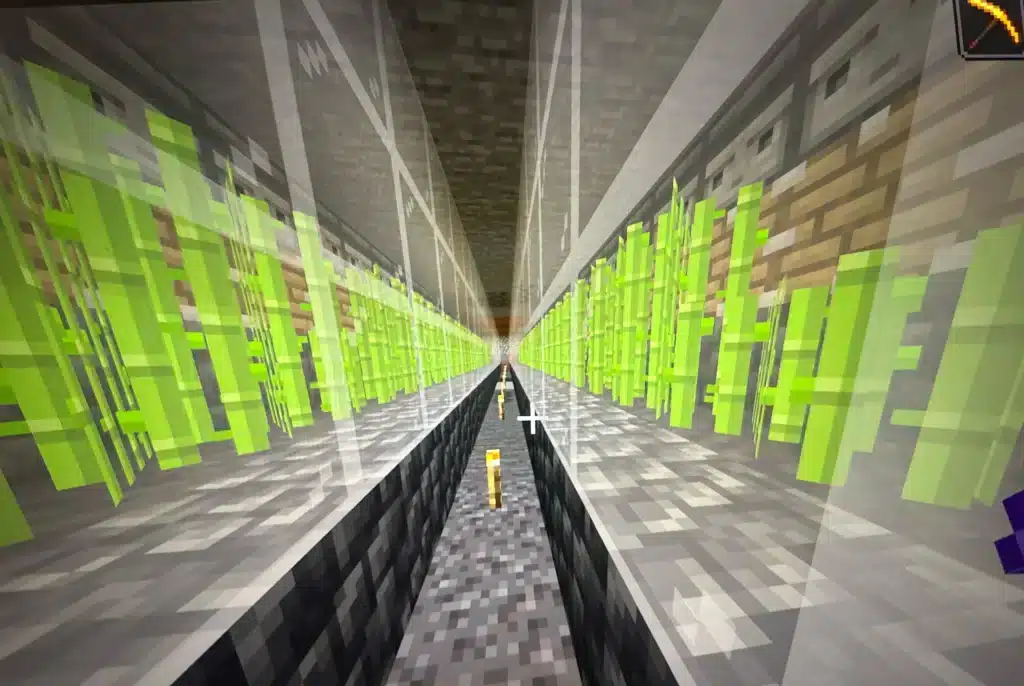
The simplest sugar cane farm uses a single water trench. Dig a one-block-wide channel and fill it with water. On both sides of the water, place dirt, sand, or grass blocks.
Plant sugar cane on every block that touches the water. Over time, each plant will grow upward. When harvesting, break only the top blocks and leave the bottom block intact. This allows the sugar cane to regrow without replanting.
This design is extremely efficient early on and can be built within minutes of starting a new world.
Manual sugar cane farming tips
To get the most out of a manual farm, timing and layout matter. Always harvest sugar cane when it reaches three blocks tall. Breaking it earlier reduces overall efficiency.
Expanding your farm horizontally is better than stacking layers vertically at this stage. Long rows are easier to harvest and manage. Placing chests nearby also helps keep your inventory organized during harvesting sessions.
Minecraft Sugar Cane Farm Layouts
Once you understand the basics, layout optimization becomes the next step.
Horizontal sugar cane farm layouts
Horizontal layouts are the most common and beginner-friendly designs. Long rows of sugar cane next to water provide consistent output and are easy to expand as needed.
These layouts fit well near bases and require minimal materials. They are ideal for players who want reliable production without complicated mechanics.
Best locations to build your farm
Sugar cane only grows in loaded chunks, meaning the area must be active while you are nearby. For this reason, it is best to build your farm close to your base or in an area you frequently visit.
Building the farm near storage rooms or crafting areas improves efficiency and reduces travel time, especially when farming large quantities.
Preparing for an Automatic Sugar Cane Farm
As your world progresses, manual farming may no longer meet your needs. This is where automation comes into play.
What makes sugar cane automation possible
Sugar cane can be automated because the game allows blocks like observers and pistons to detect growth and break only the upper sections of the plant. This makes it possible to harvest sugar cane automatically without destroying the base block.
Item collection systems such as hoppers and water streams can then move the drops into storage chests, creating a fully hands-free farm.
When players should automate sugar cane
Automation becomes useful once players start enchanting heavily, trading paper with librarian villagers, or crafting large numbers of bookshelves. At this stage, sugar cane demand increases significantly.
Building an automatic sugar cane farm saves time and ensures a constant supply, making it a natural upgrade from the manual designs.
Sugar Cane Farm Minecraft Automation Guide
Once a manual farm no longer keeps up with your needs, automation becomes the natural next step. An automatic sugar cane farm minecraft setup allows you to produce large amounts of sugar cane with minimal effort, making it ideal for multiplayer servers, villager trading, and enchanting-heavy gameplay.
Automation does not change how sugar cane grows. Instead, it takes advantage of Minecraft’s redstone mechanics to harvest the crop the moment it reaches full height. This means consistent output without constant manual harvesting.
What makes sugar cane automation possible
Sugar cane is uniquely suited for automation because only its upper blocks need to be broken. When the top section is destroyed, the bottom block remains planted and continues to grow.
Observers can detect when sugar cane grows to a new block height. This update sends a redstone signal, which can activate pistons positioned behind the plant. The piston breaks the upper blocks instantly, allowing the base to regrow without player intervention.
This mechanic makes sugar cane one of the safest and most reliable crops to automate in survival worlds.
Manual vs automatic sugar cane farming
Manual farming works well early on, but it requires frequent player interaction. Every harvest takes time, and production stops when you stop playing.
An automatic sugar cane farm minecraft design solves this issue. Once built, the farm produces sugar cane continuously as long as the chunks remain loaded. This makes automation far more efficient for long-term worlds and multiplayer servers.
Auto Sugar Cane Farm Minecraft (Observer Design)
The most common and reliable automatic sugar cane farm minecraft design uses observers and pistons. This setup balances efficiency, simplicity, and scalability.
Required materials and blocks
While exact quantities depend on farm size, most observer-based farms use:
- Observers
- Pistons
- Redstone dust
- Solid building blocks
- Water source blocks
- Hoppers and chests for collection
These materials are accessible in mid-game survival and do not require rare resources.
How the observer-based farm works
Each sugar cane plant has an observer facing it from behind. When the plant grows to its third block, the observer detects the update and emits a redstone pulse.
That pulse activates a piston placed behind the sugar cane. The piston extends, breaking only the upper sections of the plant. The dropped sugar cane falls into a collection system below, while the base block remains intact and continues growing.
This cycle repeats automatically, creating a steady supply with no manual harvesting required.
Automatic Sugar Cane Farm Minecraft Design Concepts
Before building, it is important to understand how these farms are structured conceptually.
Farm layout explanation
Each sugar cane plant is paired with one observer and one piston. These units can be repeated horizontally to scale production.
Most designs place water in front of the sugar cane and pistons directly behind it. Observers sit behind the pistons, facing the plant. This modular structure makes expansion simple—just repeat the pattern.
Building the farm in a chunk-loaded area is critical. If the chunks are not loaded, the farm will stop producing.
Collection systems for sugar cane
There are two common collection methods:
- Hopper-based systems: Simple and compact, ideal for small to medium farms.
- Water stream systems: Better for large-scale farms, moving items into centralized storage.
Both methods are reliable, and the choice depends on available space and desired output.
Common Problems With Automatic Sugar Cane Farms
Even simple farms can fail if certain rules are overlooked.
Why farms stop working
The most common reasons automatic farms fail include:
- Observers facing the wrong direction
- Pistons placed too close or too far from the sugar cane
- Chunks unloading when players move too far away
- Collection systems filling up and blocking drops
Checking alignment and storage capacity usually solves most issues.
Java vs Bedrock differences
While the core mechanics are similar, Java and Bedrock editions can behave slightly differently. Redstone timing, tick behavior, and observer updates may vary.
Because of this, designs that work perfectly in Java may need small adjustments in Bedrock. Testing farms in creative mode before building in survival is highly recommended.

Is an Automatic Sugar Cane Farm Worth It?
Automation is not mandatory, but it becomes extremely valuable as your world progresses.
When automation becomes necessary
Automatic sugar cane farms are especially useful when:
- Trading paper with librarian villagers for emeralds
- Crafting large numbers of bookshelves
- Mass-producing maps or rockets
- Playing on SMP or long-term survival servers
At this stage, manual farming becomes inefficient compared to automated solutions.
Output comparison
Automatic farms produce sugar cane continuously with little to no player effort. Manual farms can still work, but they require frequent harvesting sessions and active playtime.
For players focused on efficiency and long-term progression, automation is usually worth the initial investment.
Sugar Cane Farm Minecraft – Manual vs Automatic
| Farm Type | Materials Needed | Output | Player Effort | Best Stage |
| Manual | Very Low | Medium | High | Early game |
| Automatic | Medium | High | Low | Mid/Late game |
Improve Your Minecraft Multiplayer Experience With ExitLag
While single-player farms run entirely client-side, multiplayer Minecraft servers rely heavily on stable connections. Lag, packet loss, and high ping can directly affect redstone timing, chunk loading, and overall farm performance.
ExitLag is a PC-only solution that optimizes your network routes in real time, helping reduce latency and connection instability on SMP servers, Realms, and modded environments. With more stable connections, farms load correctly, redstone updates fire consistently, and gameplay feels smoother overall.
If you play Minecraft online and rely on automated farms, using ExitLag can make a noticeable difference in performance and reliability.
All game images used in this blog belong to Mojang Studios. They are used for informational/educational purposes only and do not imply endorsement or affiliation with the rights holders.
Got questions or want to connect with other players? Join the conversation at the ExitLag Forum!