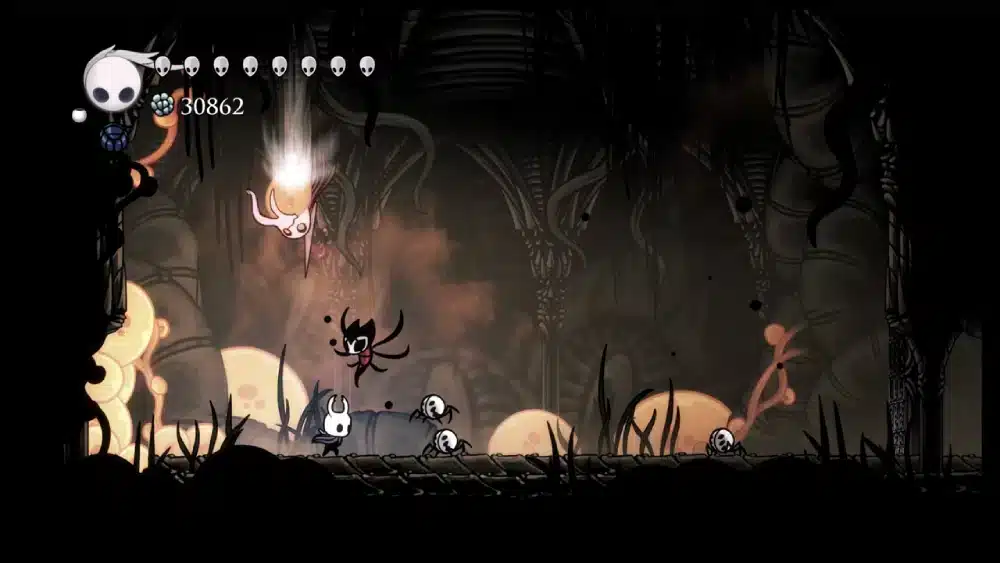
The White Lady Hollow Knight storyline is one of the most important pieces of Hallownest’s history. Hidden beyond the dangerous paths of Queen’s Gardens, this mysterious higher being connects the Knight to the Vessels, Kingsoul, the Abyss, and the ruined royal family that once ruled the kingdom.
Reaching White Lady Hollow Knight also places the player deep into the game’s Dream-related progression. Before following her instructions toward the kingdom’s buried past, it helps to understand how the Dream Nail works and what it reveals about memories, hidden locations, and characters who can no longer speak normally.
Understanding White Lady Hollow Knight is not simply a matter of finding another NPC. Her dialogue reframes the Knight’s identity, exposes the failure of the Vessel plan, and points toward a major late-game transformation that can change which endings become available.
Who is the White Lady in Hollow Knight?
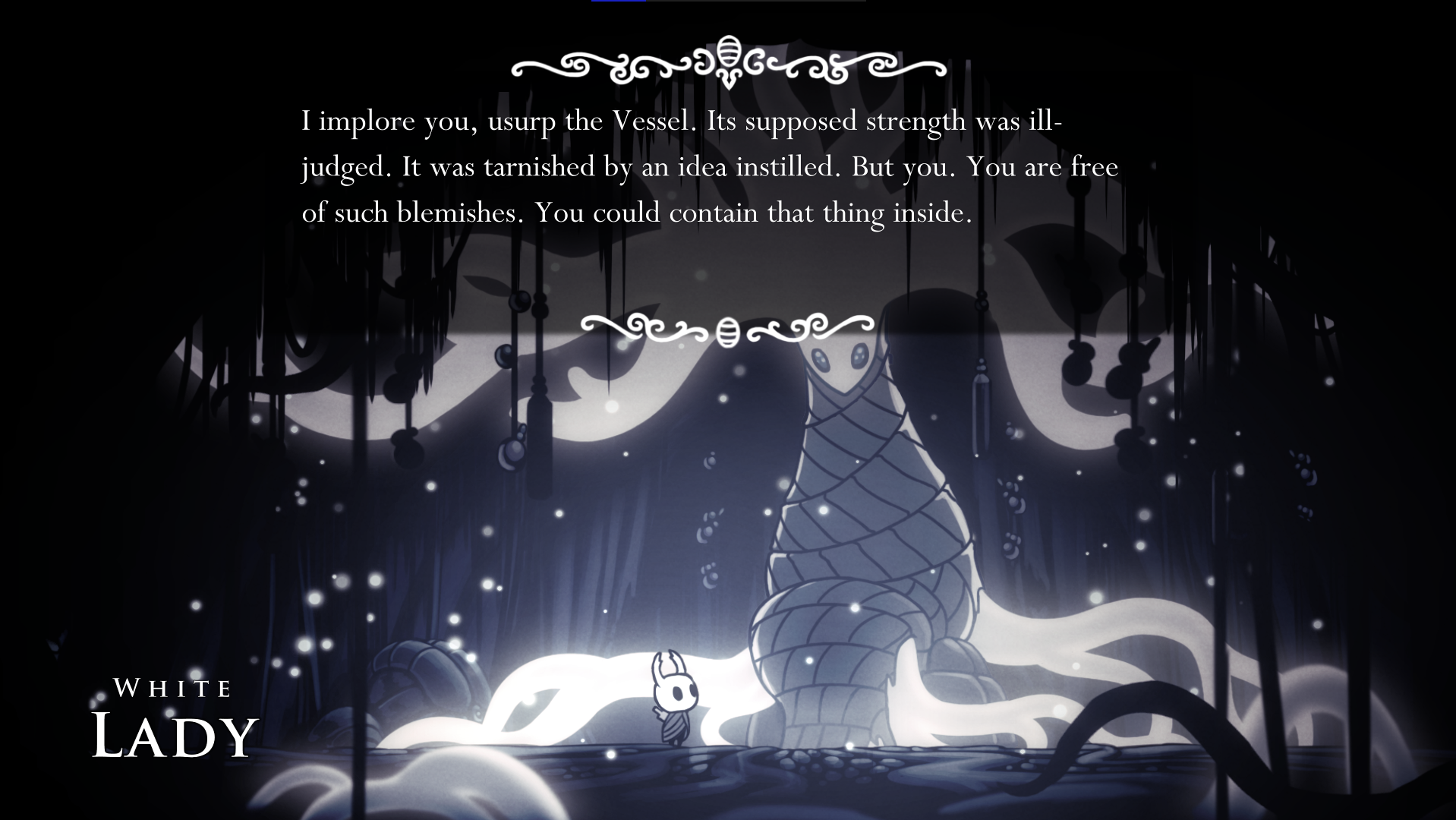
The White Lady Hollow Knight character is a pale root-like higher being who once served as Hallownest’s queen. She was the partner of the Pale King, and their union produced the children later used in the kingdom’s desperate attempt to contain the Radiance.
Unlike many characters in Hollow Knight, she does not attack the Knight or require a traditional quest before speaking. However, reaching her chamber demands significant exploration and a difficult boss victory.
For many players, White Lady Hollow Knight first appears to be a passive figure because of her calm voice and delicate appearance. In reality, her past decisions shaped the entire tragedy of Hallownest.
A former queen and higher being
The White Lady was closely tied to the royal court and the creation of Hallownest. As a higher being associated with roots, growth, and propagation, she contrasts with the transformed Wyrm who became the Pale King.
The game does not explain every detail of their relationship directly. Instead, environmental clues, charm descriptions, and dialogue show that their partnership was both political and supernatural.
The Kingsoul charm describes a union between higher beings. Its two fragments, held separately by the White Lady and the Pale King, make that connection literal through gameplay.
This also explains why discussions about Pale King Hollow Knight lore almost always include the White Lady. Neither character’s role in the Vessel project can be understood completely without the other.
Mother of the Vessels
The White Lady is the mother of the Vessels, including the Hollow Knight and the player-controlled Knight. These offspring were born from the union of the royal pair and cast into the Abyss, where Void was used in an attempt to remove their minds, wills, and voices.
The intended result was a perfectly empty Vessel capable of containing the Radiance without being influenced by her. The chosen Hollow Knight ultimately proved imperfect, allowing the Infection to return.
The White Lady later bound herself in Queen’s Gardens. Her dialogue explains that these bindings were voluntary and connected to shame over her role in the creation of the Vessels. They also prevented her powerful urge to continue spreading seeds and producing more offspring.
| Aspect | What it means |
| Former role | Queen of Hallownest |
| Nature | Pale root-like higher being |
| Partner | Pale King |
| Children | The Vessels, including the Knight |
| Current location | Queen’s Gardens |
| Main reward | One White Fragment |
| Main theme | Motherhood, responsibility, shame, and restraint |
Where is White Lady Hollow Knight located?
Finding White Lady Hollow Knight requires reaching the northwestern section of Queen’s Gardens. Her chamber lies beyond the Traitor Lord arena, so players cannot simply enter the region and walk directly to her.
Queen’s Gardens is filled with thorns, narrow platforms, collapsing surfaces, flying enemies, and routes that loop around locked passages. Preparing for both exploration and combat makes the trip considerably easier.
Requirements before reaching her chamber
Progression can vary because Hollow Knight allows players to approach several areas in different orders. Still, most routes to the White Lady require late-game movement abilities and access to the section guarded by the Traitor Lord.
Useful preparations include:
- Unlocking the Queen’s Gardens Stag Station for faster returns.
- Carrying enough health upgrades to survive platforming mistakes.
- Improving the Nail or preparing a spell-focused build.
- Equipping charms that support healing, mobility, or survivability.
- Opening nearby shortcuts before repeatedly attempting the boss.
- Bringing the Dreamgate, when available, to reduce travel time after a defeat.
The Shade Cloak is especially important for passing through the Shade Gate that blocks the route toward the Traitor Lord. Players should also be comfortable with wall jumps and air movement before entering this part of the map.
Defeating the Traitor Lord
The Traitor Lord is the main obstacle between the Knight and the White Lady. The fight emphasizes close-range timing, shadow dashes, and disciplined positioning.
Because many attacks can deal heavy damage, trying to heal at unsafe moments often causes more harm than waiting for a better opening. Staying near the boss can also make some movements easier to read.
After the battle, continue beyond the arena to reach the White Lady’s cocoon-like chamber. Dryya’s body lies outside, surrounded by the remains of enemies she defeated while defending her queen.
Players preparing for the game’s most demanding royal platforming content may also want to review this Path of Pain Hollow Knight strategy guide. The Path of Pain is optional, but it expands the story surrounding the royal family and tests the same movement precision associated with the White Palace.
What does the White Lady give the Knight?
The White Lady Hollow Knight reward is one White Fragment, given when the Knight speaks to her for the first time. This item cannot be equipped by itself.
The fragment is one half of Kingsoul. The other half must be recovered from the remains of the Pale King after completing the main route through the White Palace.
The White Fragment and Kingsoul
Once both White Fragments are collected, they combine automatically into Kingsoul. No vendor, crafting menu, or additional payment is required.
Kingsoul occupies five charm notches and slowly generates SOUL. Its high cost makes it difficult to fit into a normal combat build, but its most important purpose is not ordinary exploration.
The charm opens the way to the Birthplace at the bottom of the Abyss. It must be equipped for the hidden route to become accessible.
Kingsoul also unlocks additional dialogue with the White Lady. She recognizes the completed charm and encourages the Knight to return to the place where the Vessels began.
Finding the second White Fragment
The second fragment is located at the end of the White Palace Hollow Knight sequence. To enter this dream-like version of the royal palace, players need the Awoken Dream Nail and must use it on the Kingsmould corpse in the Palace Grounds.
Inside, the challenge changes from exploration and combat to precision platforming. Saw blades, spikes, moving mechanisms, and narrow safe areas demand controlled use of the Mantis Claw, Monarch Wings, Crystal Heart, and dashes.
The required route leads to the throne room, where the player finds the body of the Pale King. Taking the fragment from his remains completes Kingsoul if the White Lady’s half is already in the inventory.
The optional Path of Pain is separate from the route required to obtain the fragment. Completing it provides a brief hidden memory, but it is not necessary for Kingsoul, Void Heart, or standard game completion.
How are the White Lady and the Pale King connected?
White Lady Hollow Knight lore places her relationship with the Pale King at the center of Hallownest’s royal history. They ruled together, created the Vessels, and divided the Kingsoul between them.
Their story is told through fragments rather than a single exposition scene. As a result, many details remain open to interpretation, while the main events are supported directly by dialogue and environmental storytelling.
Their union and Hallownest’s royal family
The Pale King was originally a great Wyrm who shed his former body and took a smaller form. He established Hallownest, expanded its civilization, and granted higher thought to many of its inhabitants.
The White Lady became his queen. Together, they represented the “Soul of Wyrm” and “Soul of Root” referenced in the game’s deeper lore.
Their family also included Hornet through the King’s agreement with Herrah the Beast. Hornet is therefore the Knight’s half-sibling rather than a child of the White Lady.
This distinction matters because Hornet was not created as a Vessel. She possesses a voice, identity, emotions, and a clearly defined will.
The wider series later explores Hornet’s journey outside Hallownest. Players comparing both kingdoms can use this Hollow Knight: Silksong map guide to understand how Pharloom’s regions differ from the locations shaped by the White Lady and the royal court.
The failed Vessel plan
When the Radiance’s Infection threatened Hallownest, the royal pair participated in the creation of countless potential Vessels. These children were connected to Void and tested for the emptiness believed necessary to contain the ancient light.
The Hollow Knight was selected and raised by the Pale King. However, the bond formed during that process appears to have introduced an “idea instilled,” undermining the supposed purity of the chosen Vessel.
This failure is one of the most important parts of Pale King Hollow Knight discussions. The plan depended on treating living offspring as replaceable containers, yet the chosen child may have failed precisely because it was not truly emotionless.
The White Lady’s shame does not erase her participation. Instead, it shows that she recognizes at least part of the cost while remaining willing to ask another child to replace the Hollow Knight.
What does the White Lady’s dialogue reveal?
White Lady Hollow Knight dialogue provides direct information about the weakening seal, the Knight’s possible purpose, and the White Lady’s self-imposed isolation. It also reveals how much she can sense despite her deteriorated sight.
Her roots allow her to feel the Hollow Knight weakening. She has therefore waited for a Vessel capable of receiving her fragment and continuing the royal plan.
Her request for replacement
The White Lady initially asks the Knight to defeat the Hollow Knight and take its place. From her perspective, replacing the failing Vessel is preferable to allowing the Infection to consume every mind in Hallownest.
This request leads naturally toward the basic ending in which the Knight becomes the new seal. However, the game gives players opportunities to uncover more information before accepting that role.
After Kingsoul is completed, the White Lady begins to question whether the Knight may be more than a simple Vessel. She then directs the character toward the Abyss and the hidden truth inside the charm.
That shift is crucial. Her first solution repeats the old plan, while her later dialogue points toward a transformation that can break from it.
Special charm and quest interactions
The White Lady has several optional reactions that enrich her characterization:
- Defender’s Crest causes her to mistake the Knight’s scent for Ogrim.
- Kingsoul triggers dialogue about the reunited royal charm.
- Void Heart changes how she perceives the Knight’s transformed emptiness.
- Grimmchild and Carefree Melody prompt comments about the Grimm Troupe.
- The Delicate Flower can be offered, although she refuses to accept it.
- King’s Brand dialogue includes her thoughts about Hornet and Herrah.
These interactions portray her as more than a stationary quest giver. She remembers Hallownest’s knights, understands higher beings, recognizes the royal family, and senses qualities that ordinary NPCs cannot.
How does the White Palace connect to the White Lady?
The White Lady Hollow Knight connection to the White Palace begins with the dream-remnant of the royal home shared by the kingdom’s rulers and court. Its pristine surfaces contrast sharply with the dead and infected kingdom explored in the physical world.
For players researching White Palace Hollow Knight progression, the area serves two purposes. It is a major platforming challenge, and it preserves visual evidence about the royal family’s hidden past.
Entering the White Palace
The entrance is found in the Palace Grounds within Ancient Basin. The visible palace is gone, but a Kingsmould corpse remains.
Using the Awoken Dream Nail on that body transports the Knight into the White Palace. Reaching the Awoken Dream Nail requires collecting 1,800 Essence and returning to the Seer.
The palace contains checkpoints, shortcuts, and benches, but its hazards demand patience. Hiveblood can restore a recently lost Mask after waiting, while Grubsong can provide SOUL when the Knight takes damage.
Deep Focus can make healing more efficient, although its slower Focus time requires a safe platform. Movement charms may help some players, but changing dash distance or speed can also disrupt learned timing.
Required route versus Path of Pain
The standard route through the White Palace is mandatory for obtaining the King’s White Fragment. The Path of Pain is an optional hidden challenge inside the broader area.
Both rely on the same movement toolkit, but the Path of Pain demands far more precise chains of jumps, wall clings, pogo attacks, and dashes. It also ends with a combat encounter, so reaching the final room without a suitable charm setup can be dangerous.
The royal memory at the end is brief. Its importance comes from what it implies about the bond between the Pale King and the young Hollow Knight.
For broader context about Team Cherry’s original game, platforms, world design, and official presentation, visit the official Hollow Knight game website. The site also highlights the interconnected exploration and hand-drawn environments that make areas such as Queen’s Gardens and the palace distinct.
What happens after completing Kingsoul?
Completing Kingsoul is not the end of the White Lady Hollow Knight questline. Instead, it gives the Knight access to the Birthplace, where the truth of the Vessels is revealed more directly.
Players should equip Kingsoul at a bench before descending to the bottom of the Abyss. Simply owning it is not enough to open the hidden path.
Reaching the Birthplace
At the bottom of the Abyss, the equipped charm opens an entrance leading deeper into the Knight’s past. The sequence shows discarded Vessels and culminates in a memory involving the chosen Hollow Knight and the Pale King.
After the memory, Kingsoul transforms permanently into Void Heart. The new charm costs no notches and cannot be unequipped.
Void Heart changes the behavior of Void-related creatures, including Siblings and the player’s Shade. More importantly, it unlocks access to endings that involve confronting the Radiance rather than merely replacing the existing seal.
It is more accurate to describe these as additional endings rather than one officially confirmed “true ending.” Hollow Knight presents several outcomes, and the Void Heart route expands what the Knight can do during the final confrontation.
Why the transformation matters
Kingsoul symbolizes the union of the White Lady and the King. Void Heart reveals what was concealed beneath that royal construction.
The change also marks a shift in the Knight’s relationship with Void. Instead of functioning only as a child shaped by the royal plan, the Knight unifies the force that once surrounded and consumed the discarded Vessels.
This progression changes the meaning of the White Lady Hollow Knight gift. She intends the fragment to help create a replacement, but it can ultimately support a path beyond the solution she first proposed.
How can ExitLag support Hollow Knight gameplay?
Hollow Knight is primarily a single-player game that runs locally, so a routing tool cannot fix platforming timing, hardware-related FPS problems, corrupted files, or internal game bugs. ExitLag should not be presented as a universal performance solution for the base game.
However, network quality can still matter in specific ways. Players may use remote-play services, cloud gaming, online screen sharing, game streaming, or background downloads while playing.
Cloud gaming and remote play
When Hollow Knight is played through a cloud service or a remote connection to another device, every input must travel across a network. Unstable routing, packet loss, or latency variation may create delayed or inconsistent responses.
ExitLag helps optimize routes between the player and supported online services. In compatible network-dependent scenarios, that can help provide a more stable route, although results depend on the connection, service, region, and available paths.
This distinction is especially important in areas that require precise movement. A local game responds according to the device and controller, while cloud or remote play adds network transmission to the input process.
Downloads and connected services
Players may also be downloading the game, installing updates, synchronizing cloud saves, or using connected platform services. Network optimization may assist compatible traffic, but it does not change the content or mechanics of the game.
Before troubleshooting, identify whether the issue is local or network-related:
- Low FPS or stuttering on the device usually points to hardware, drivers, settings, or software conflicts.
- Delayed controls in local play may involve the controller, display, Bluetooth connection, or input settings.
- Delayed controls in cloud gaming may involve latency, packet loss, Wi-Fi instability, or routing.
- Failed downloads may involve the storefront, storage space, account permissions, or connection.
- A global service outage cannot be fixed by changing the route on one device.
Players considering ExitLag should test it only for supported connection-dependent situations and compare the result on their own network.
Why does the White Lady matter to Hollow Knight’s story?
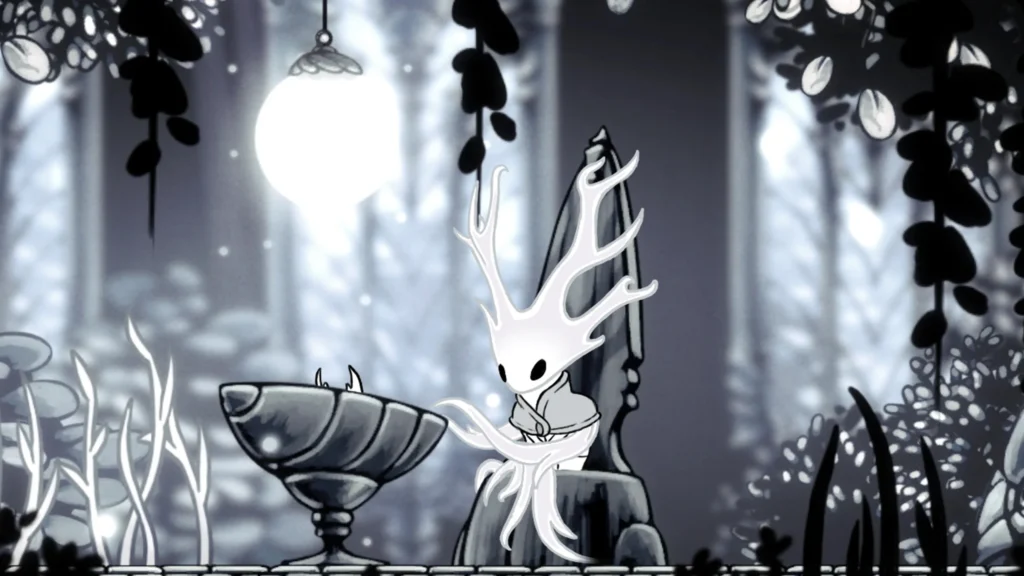
White Lady Hollow Knight lore brings together the game’s central themes: sacrifice, identity, parenthood, duty, and the consequences of pursuing a perfect solution at any cost.
She is not simply innocent, and she is not presented as a straightforward villain. Her complexity comes from the tension between regret and repetition.
Responsibility without complete redemption
The White Lady acknowledges shame and restrains herself, but she still encourages the Knight to replace the failing Hollow Knight. Her response to past harm is therefore incomplete.
This contradiction makes her more interesting. She understands that the creation of the Vessels was terrible, yet she remains focused on preserving Hallownest through another sacrifice.
Her limited sight also works symbolically. She can sense roots, lineage, Void, and familiar scents, but she does not know that Dryya died just outside while protecting her.
The player is left to decide how much sympathy she deserves and whether her isolation represents responsibility, avoidance, or both.
A bridge between the kingdom’s major mysteries
The White Lady connects Queen’s Gardens to the Abyss, the Vessels to Kingsoul, and the Pale King to the final stages of the game.
She also gives practical direction without explaining everything. Players must still explore the White Palace, assemble the charm, revisit the Abyss, and interpret the memory for themselves.
Readers looking for general development, release, and gameplay context can consult this overview of the original Hollow Knight game. Within the game itself, however, the most meaningful answers come from combining dialogue, environments, item descriptions, and optional discoveries.
Frequently asked questions
Is the White Lady the Knight’s mother?
Yes. The White Lady is the mother of the Vessels created with the King, including the player-controlled Knight and the Hollow Knight.
Where can I find White Lady Hollow Knight?
She is located in the northwestern part of Queen’s Gardens, beyond the Traitor Lord arena. Players must defeat the boss before entering her chamber.
What does the White Lady give you?
She gives the left White Fragment, one half of Kingsoul. The other half is found on the King’s remains after completing the required route through the White Palace.
Is Hornet the White Lady’s daughter?
No. Hornet is the daughter of Herrah the Beast and the Pale King. The White Lady expresses affection for Hornet, but she is not her biological mother.
Do I need to complete the Path of Pain?
No. The Path of Pain is optional. You only need to complete the standard White Palace Hollow Knight route to obtain the second White Fragment.
What does Kingsoul do?
Kingsoul slowly generates SOUL and opens the Birthplace at the bottom of the Abyss when equipped. It later transforms permanently into Void Heart.
Is the White Lady trapped?
Her bindings are self-imposed. She explains that she chose them because of shame over her role in the Vessel project and to stop herself from producing more offspring.
Does the White Lady appear in Hollow Knight: Silksong?
Yes. The White Lady appears in memory-related content involving Hornet. This White Lady Hollow Knight guide focuses mainly on the original game and avoids explaining the sequel’s major revelations.
Can ExitLag improve Hollow Knight?
It may help in supported network-dependent situations such as cloud gaming or remote play. It does not improve local FPS, solve internal bugs, or guarantee better input response in a locally running single-player game.
The White Lady Hollow Knight questline is essential for understanding the royal family, completing Kingsoul, entering the Birthplace, and unlocking the Void Heart path. Explore Queen’s Gardens carefully, prepare for the White Palace, and test ExitLag only when your Hollow Knight setup genuinely depends on an online route, cloud service, or remote connection.
All game images used in this article belong to their respective owners. They are used for informational and educational purposes only and do not imply endorsement or affiliation with the rights holders.