The gaming world has reached an impressive technological level, and recent numbers from Valve prove this evolution. According to the new annual report, Steam players downloaded 100 exabytes of data in 2025, establishing a historic milestone for the industry.
What is the data volume where Steam players downloaded 100 exabytes? It is a mark representing the total traffic from game downloads, updates, and additional content performed by platform users over a year, totaling approximately 274 petabytes transferred every day. Therefore, this figure reflects not only the growth of Steam but also the increase in the file sizes of modern games.
Furthermore, the fact that Steam players downloaded 100 exabytes shows how global internet infrastructure is being tested. Consequently, the demand for faster and more stable connections is becoming a priority for consumers and network providers alike.
The historic record where Steam players downloaded 100 exabytes
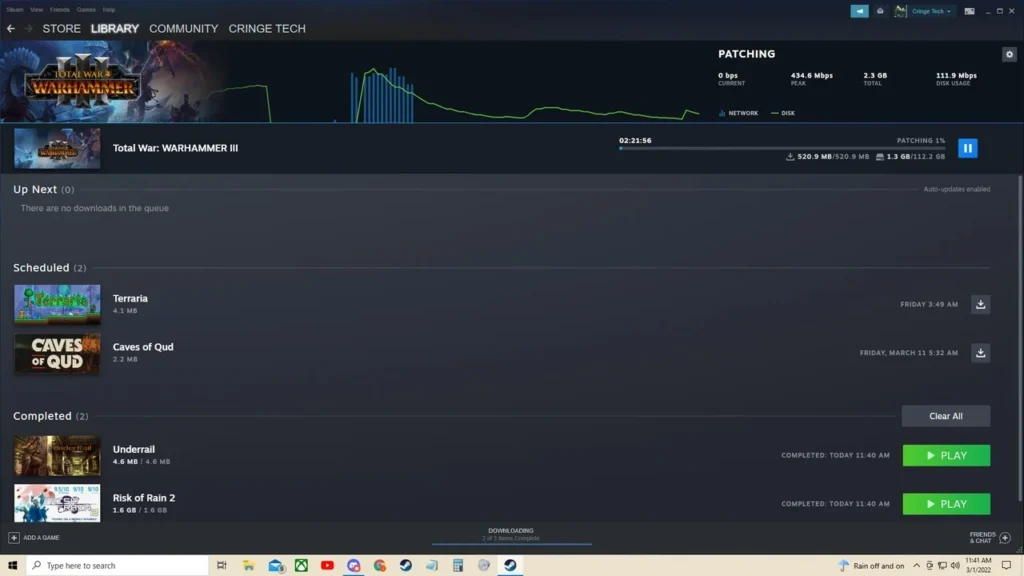
The milestone reached in 2025 represents a massive leap compared to the platform’s previous years. However, to understand this scale, one only needs to look at the data from 2024, when the recorded consumption was 80 total exabytes.
In this way, the increase surpassed a 20% annual growth rate, something that surprised even the most optimistic analysts. Additionally, the volume of 190,000 gigabytes transferred per minute requires absurd technical capacity from Valve’s servers.
Valve’s growth and the active user base
Steam’s growth is the primary engine behind these astronomical data transfer numbers. Currently, the platform adds millions of new users every year, aggressively expanding its global reach.
Therefore, the historic peak of 42 million people connected simultaneously explains why Steam players downloaded 100 exabytes. As such, the company needed to optimize its desktop application to ensure that navigation and downloading remained fluid for everyone.
Reasons for the increase in global Steam traffic

Several technical factors explain why Steam traffic reached such high levels in the last fiscal year. Primarily, high-budget titles—known as Triple-A—now easily exceed the 100 GB mark per installation.
Additionally, the popularization of ultra-high-resolution textures and Ray Tracing technologies has increased file sizes. Consequently, every new release demands more disk space and more download time from users.
Check out the main reasons for this increase:
- Launch of more than 20,000 new titles in the store in a single year.
- Frequent updates for “games as a service” that require weekly downloads.
- Massive adoption of 4K videos for trailers and broadcasts on the platform.
- Expansion of the PC market in emerging regions with better broadband access.
Triple-A games and the weight of constant updates
However, it is not just new releases that weigh on global Steam traffic. On the other hand, established legacy and classic games sustain a major portion of this uninterrupted bandwidth consumption.
According to the official retrospective, titles over eight years old still dominate about 40% of gaming sessions. In this way, keeping this software updated generates a constant flow across global routers, contributing to the record.
Valve’s infrastructure to support the demand

To ensure that Steam players downloaded 100 exabytes without service outages, Valve invested heavily in its Content Delivery Network (CDN). During peak moments, the company’s logistical mesh served up to 146 Terabits per second.
Additionally, the company had to deal with external challenges, such as the component shortage that affected hardware production. However, the focus on software and digital distribution allowed revenue to continue breaking records.
To understand the platform’s evolution, see this timeline:
- Expansion of servers in data centers across Asia and Latin America.
- Reduction of the revenue share charged to studios to retain major franchises.
- Implementation of new file compression technologies for downloads.
- Launch of enhanced search tools to facilitate game discovery.
Hardware challenges and retention of partner studios
As such, Valve’s strategy was to keep major products anchored to its storefront through smart financial maneuvers. For example, the revenue share retained by the platform dropped to 24% in cases of major commercial successes.
Consequently, this prevented the flight of studios to competing stores, ensuring that the catalog remained incredibly rich. Therefore, Steam’s growth was sustained by a protected library highly desired by the public.
Global comparison after Steam players downloaded 100 exabytes
The impact of these downloads goes far beyond the niche of e-sports or casual entertainment. Currently, the total flow of internet on the planet is immense, but the slice occupied by Steam traffic is significant.
For comparison, Steam’s data volume surpassed the entire backbone of major internet exchange points in Europe. Additionally, this shows that the gaming ecosystem has taken the lead in domestic data consumption.
The future of the internet in the Zettabyte era

Unquestionably, predictions indicate that we are only at the beginning of the so-called Zettabyte Era. As virtual files grow, fiber optic infrastructure needs to expand to support the demand of metropolises.
In this way, Valve’s report serves as a map for the structural evolution of the global network over the next decade. On the other hand, developers continue to seek ways to deliver denser experiences without overloading users.
In short, the fact that Steam players downloaded 100 exabytes in 2025 proves the unbeatable strength of PC Gaming. Therefore, the trend is for these numbers to continue rising as technology advances and more people join the global community.