

Apex Legends Ranks are the foundation of the game’s competitive mode, giving players a structured way to measure progression against increasingly challenging opponents. Instead of simply playing matches for wins, Ranked rewards consistent performance, eliminations, placement, teamwork, and smart decisions.
Understanding Apex Legends Ranks becomes even more important as you climb because entry costs, matchmaking, opponents, and the consequences of early eliminations change throughout the ladder. Knowing how Ranked Points work can help you make better decisions instead of treating every match like a public lobby.
So, what are Apex Legends Ranks? They are competitive tiers earned by accumulating Ranked Points, commonly called RP. Players progress through divisions and ranks by performing well in Ranked Battle Royale, while losing RP can slow or reverse that progression at higher levels.
In this guide, you will learn how Apex Ranked works, every major rank tier, RP progression, matchmaking, resets, rank distribution, leaderboards, cheating concerns, and strategies that can help you climb more consistently.

Apex Legends Ranks: How Does the Ranking System Work?
The Apex Legends ranking system is designed to create a more competitive environment than standard public matches.
Players earn or lose Ranked Points based on their performance, and those points determine their current position in the ladder.
Ranked Points and progression
Apex Legends ranked progression revolves around RP. Each main rank from Bronze through Diamond contains four divisions. For example, players progress from Bronze IV to Bronze III, Bronze II, and Bronze I before moving into the next tier.
Your performance during matches determines whether you gain enough RP to advance.
Factors such as placement and combat performance matter, which means surviving without contributing to fights is not always the most efficient approach.
As your Apex Legends rank increases, the competition becomes tougher and poor matches become more costly.
How Ranked matchmaking works
Current Ranked matchmaking uses your Ranked Points as a major matchmaking value.
For players entering Ranked for the first time, EA also uses a hidden skill value from Unranked Trios to help determine their starting rank and RP. Returning Ranked players are placed using their current hidden Ranked skill value.
Before matches, Apex can show information about the distribution of player ranks in the lobby.
This helps players understand the level of competition they are about to face.
Apex Legends Ranking: All Rank Tiers Explained
The Apex Legends ranking ladder gradually increases in difficulty.
Although systems surrounding progression can change between seasons, the familiar rank structure remains the easiest way to understand your overall competitive position.
From Rookie to Diamond
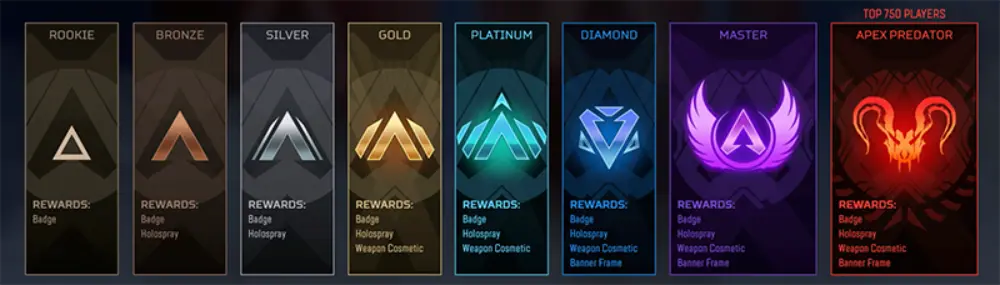
For most players, progression begins in the lower and middle tiers. The main progression path includes:
- Rookie;
- Bronze;
- Silver;
- Gold;
- Platinum;
- Diamond;
- Master;
- Apex Predator.
Most ranks include four divisions, with Division IV being the entry point and Division I being the highest division before promotion.
A player in Gold II, for example, is closer to Platinum than someone in Gold IV.
Master and Apex Predator
Master represents one of the highest competitive tiers in Apex.
Above Master sits Apex Predator, which is reserved for the most highly ranked players rather than functioning like a normal four-division tier.
This makes Predator especially competitive because maintaining that position depends on continuing to accumulate RP relative to other top players.
| Rank | Divisions | General competitive level |
| Rookie | IV-I | Introductory Ranked progression |
| Bronze | IV-I | Early competitive ladder |
| Silver | IV-I | Developing Ranked players |
| Gold | IV-I | Intermediate competition |
| Platinum | IV-I | Stronger coordination required |
| Diamond | IV-I | Highly competitive matches |
| Master | No standard four-division climb | Elite Ranked players |
| Apex Predator | Leaderboard-based | Highest Ranked positions |
The table shows why Apex Legends rankings become increasingly demanding: climbing is not simply about playing more matches, but performing consistently against stronger opponents.
Apex Legends Ranked: How to Earn More RP
Climbing through Apex Legends Ranks requires more than mechanical skill.
Good positioning, squad coordination, decision-making, and combat efficiency all influence long-term progression.
Balance eliminations and placement
Aggressive players sometimes focus entirely on eliminations. Meanwhile, passive squads may avoid combat until the final rings. Neither extreme is always ideal.
A stronger Ranked strategy balances:
- Early survival;
- Smart fights;
- Eliminations;
- Assists;
- Good rotations;
- Strong final-ring positioning.
A fight that offers very little strategic value can cost your squad the entire match. Before engaging, consider whether winning that fight actually improves your position.
Know when to disengage
One of the biggest differences between public matches and Apex Legends ranked is the importance of surviving bad situations.
You do not need to finish every fight you start.
If another squad arrives, resources are running low, or your position becomes dangerous, disengaging can preserve the match.
Good Ranked players recognize when a fight has shifted from opportunity to unnecessary risk.
Apex Legends Rank Distribution and Lobby Difficulty
Apex Legends rank distribution can help explain where most players sit within the competitive ecosystem.
However, distribution percentages should always be treated as time-sensitive because player populations change throughout seasons and splits.
Why rank distribution changes
The percentage of players in each tier can shift because of:
- Ranked rule changes;
- RP adjustments;
- Seasonal resets;
- Matchmaking updates;
- Player activity;
- New seasons;
- Split progression.
For that reason, an Apex Legends rank distribution chart from an older season should not automatically be treated as representative of the current one.
EA has also continued experimenting with matchmaking and Ranked lobby structure during 2026.
Rank does not tell the entire story
Two players with the same rank may have different strengths.
One may excel mechanically while another performs better through positioning, rotations, and communication.
Therefore, use rank as a competitive progression measurement rather than a perfect definition of individual skill.
The current matchmaking system considers RP for Ranked matchmaking while also using skill information when establishing starting positions for new seasons or first-time Ranked players.
Apex Legends Ranked Leaderboard and Apex Predator
The Apex Legends ranked leaderboard becomes especially relevant for players approaching Master and Predator. At that point, competition is not only about reaching a fixed rank threshold.
How Apex Predator works
Apex Predator represents the highest competitive status in the Apex Legends ranking ladder.
Unlike Bronze, Silver, Gold, and other divisional tiers, Predator depends on leaderboard positioning among top players.
This creates a constantly changing competitive environment.
Reaching a high RP total does not necessarily mean you can stop playing and permanently retain the same position.
Other players can continue accumulating RP and move ahead.
Ranked Ladders in Season 31
Season 31, Marked, is also introducing Ranked Ladders during Split 2. According to the September 14, 2026 midseason patch notes, six ladder periods are scheduled between September 22 and November 1, 2026.
These ladders add another competitive layer for players interested in measuring performance during specific windows.
Because Ranked systems continue evolving, always check current patch notes before assuming rules from an older season still apply.
Apex Legends Rank Resets and Seasonal Progression
Your Apex Legends rank is not permanently locked once you reach it.
Ranked progression includes partial resets designed to keep players competing throughout the season.
When Ranked resets happen
EA currently states that rank partially resets:
- At the beginning of a season;
- Around the middle of the season.
Players then continue climbing from their adjusted position. This structure creates multiple opportunities to progress and keeps Ranked from becoming static.
It also means players returning after a break may find themselves below the rank they previously achieved.
Ranked rewards
Ranked also provides seasonal rewards tied to competitive participation and achievement.
Your performance throughout a season can therefore provide more than a visible Apex Legends ranking.
For players focused on climbing, seasonal resets are useful checkpoints. Instead of viewing a reset only as lost progress, treat it as another opportunity to measure improvement.
Apex Legends Ranked S26 Cheating and Competitive Integrity
Searches for Apex Legends ranked s26 cheating increased alongside ongoing concerns about competitive integrity.
Cheating affects legitimate players because unfair advantages can influence RP, matchmaking, and high-level Ranked competition.
EA’s anti-cheat efforts
EA continues updating its anti-cheat systems. In July 2026, the Apex anti-cheat team reported nearly 6,000 hardware bans since the end of April and stated that hardware enforcement was being expanded, including on consoles.
The September 2026 midseason update also introduced new detection systems targeting unauthorized controller hardware and software across PC, PlayStation, Xbox, and Nintendo Switch 2. EA states that detected prohibited behavior may result in enforcement and bans after review.
These measures are particularly important in Apex Legends ranked, where unfair behavior directly affects competitive progression.
Protecting competitive integrity
Players should avoid cheats, unauthorized hardware, scripts, exploits, or other prohibited tools.
Besides risking account penalties, cheating damages the Ranked environment for legitimate competitors.
Improving aim, rotations, communication, Legend knowledge, and decision-making is the sustainable way to progress through Apex Legends Ranks.

Apex Legends Characters Ranking vs. Player Rank
The phrase Apex Legends characters ranking refers to something completely different from player Ranked progression.
Character rankings usually describe community or editorial tier lists based on how strong or useful Legends are within the current meta.
Legend tiers change with balance updates
An Apex Legends characters ranking can change after buffs, nerfs, ability reworks, map rotations, or broader meta changes.
Season 31, for example, introduced a major Bloodhound rework alongside changes to Loba and Rampart.
Therefore, a Legend considered powerful in one season may move significantly after an update.
Tier lists should always be checked against the current patch.
Your best Legend may depend on your squad
The theoretically strongest character is not automatically the best choice for every player. Consider:
- Your mechanical strengths;
- Preferred role;
- Team composition;
- Map;
- Communication;
- Current Ranked meta.
A coordinated squad using Legends they understand well can often outperform a poorly coordinated team built only from a tier list.
How to Climb Apex Legends Ranks More Consistently
Climbing Apex Legends Ranks becomes easier when you focus on repeatable decisions rather than trying to force spectacular matches.
Consistency is more valuable than occasionally earning a huge RP game followed by several early eliminations.
Build a repeatable Ranked routine
Before entering Ranked, make sure you understand your Legends, weapons, map rotations, and squad roles. Then focus on a simple process:
- Choose a reliable landing area;
- Loot efficiently;
- Avoid unnecessary early fights;
- Track the next ring;
- Rotate before dangerous choke points become crowded;
- Take fights with a clear advantage;
- Prioritize strong late-game positioning.
This creates a more predictable path toward positive RP.
Communication matters
Information wins fights. Even basic communication about enemy positions, resources, rotations, and retreat decisions can dramatically improve squad performance.
You do not need constant conversation. Short, useful calls are often enough.
A squad that moves together has a much better chance of surviving difficult Ranked situations than three strong individual players making separate decisions.
Connection Quality and Apex Legends Ranked
Competitive games can make connection problems especially noticeable.
When every fight matters for your Apex Legends Ranks progression, unstable ping or packet loss can interfere with movement, aiming, and reactions.
Ping, packet loss, and jitter
Network problems are different from low FPS. Common connection symptoms include:
- Rubberbanding;
- Delayed actions;
- Sudden movement corrections;
- Packet loss;
- Ping spikes;
- Inconsistent responsiveness.
If these problems appear regularly, investigate your network before assuming the issue comes from Apex itself.
Wired connections, reducing network congestion, and checking routing can all help diagnose the problem.
Where ExitLag fits
ExitLag is a route optimization solution for supported PC and mobile games.
It analyzes different network routes and can use multiple paths to help game traffic reach servers through a faster and more stable route when conditions allow it.
ExitLag does not change Apex Legends rankings, give additional RP, alter matchmaking, or provide any prohibited gameplay advantage. Its role is connection optimization.
FAQ
What are the Apex Legends Ranks in order?
The main Apex Legends Ranks progress through Rookie, Bronze, Silver, Gold, Platinum, Diamond, Master, and Apex Predator, with most tiers divided into four divisions.
How does Apex Legends ranked work?
Apex Legends ranked uses Ranked Points to determine progression and matchmaking. Players gain or lose RP according to match performance and climb through divisions as their RP increases.
What is Apex Legends rank distribution?
Apex Legends rank distribution shows how the Ranked player population is spread across different tiers. The percentages change throughout seasons and splits, so current data should always be prioritized over older charts.
How does the Apex Legends ranked leaderboard work?
The Apex Legends ranked leaderboard tracks high-level competitive standings, with Apex Predator representing the highest leaderboard-based position in Ranked play.
Does Apex Legends rank reset?
Yes. EA currently states that Ranked receives a partial reset at the beginning and approximately halfway through each season.
Is cheating punishable in Apex Legends Ranked?
Yes. EA actively enforces anti-cheat rules and can ban accounts or hardware associated with prohibited behavior. New detection measures were added again during 2026.
Does ExitLag increase Apex Legends RP?
No. ExitLag does not modify Apex Legends Ranks, RP, matchmaking, damage, or gameplay mechanics. It focuses on optimizing network routes for supported connections.
Apex Legends Ranks: Climb With a More Stable Connection Using ExitLag
Improving your Apex Legends Ranks comes from better decisions, teamwork, positioning, combat skills, and consistent Ranked performance.
When unstable routing, ping spikes, jitter, or packet loss interfere with your matches, try ExitLag to optimize your connection and stay focused on climbing the Ranked ladder.
Got questions or want to connect with other players? Join the conversation at the ExitLag Forum!
