Doug Brawl Stars is a Mythic Support Brawler who combines close-range area damage, team healing, and one of the most unusual revival mechanics in the game. His short attack range makes him vulnerable in open spaces, but his health, healing, and Second Serving Super can completely reverse an objective fight.
Before mastering Doug Brawl Stars, it helps to understand how his role compares with the rest of the roster. The complete alphabetical list of Brawl Stars Brawlers provides a broader view of Tanks, Supports, Assassins, Controllers, and Damage Dealers that may appear alongside or against Doug. This context makes it easier to identify which teammates benefit most from his healing and revival effect.
Doug Brawl Stars performs best when he can approach through walls, fight inside a confined area, and keep teammates within the radius of Snack Attack. He is much less reliable on open maps where Marksmen can maintain distance and avoid every attempt to engage.
Who is Doug in Brawl Stars?

Doug is a Mythic Support Brawler with a hot dog vendor theme. His main attack damages all enemies around him while simultaneously healing nearby teammates, and his Super places a temporary revival effect on Doug or an ally.
Unlike traditional healers, Brawl Stars Doug must stay relatively close to the action. His limited range prevents him from healing safely from the back of the map, so he often plays between the frontline and the rest of the team.
How does Snack Attack work?
Snack Attack creates a circular effect around Doug. Enemies inside the radius take damage, while allies inside the same area receive healing.
The attack does not travel as a projectile. Instead, it activates around Doug immediately after he attacks, making positioning more important than long-range aiming.
At maximum Power Level, Doug has a large health pool, deals substantial close-range damage, and heals allies for part of that amount. The exact numbers can change through balance updates, but the basic interaction remains consistent:
- Stand close to enemies to deal damage;
- Stand close to allies to heal them;
- Position between both groups to do both at once;
- Use walls to reduce the risk of approaching;
- Avoid crossing open lanes without support.
The attack affects the entire radius, so Doug can damage several enemies and heal several allies with one use. This makes Doug from Brawl Stars particularly effective when teams are grouped around an objective.
However, grouped teammates may also become vulnerable to enemy area damage. Doug players should not force everyone to stand in the same location merely to receive healing.
His reload speed allows him to maintain pressure, but spending every attack on healing can leave him unable to defend himself. Preserve ammunition when an Assassin or Tank may enter your range.
How does Second Serving revive Brawlers?
Second Serving launches a hot dog toward Doug or a teammate. The effect remains active for a limited time, and the marked Brawler returns with full health after a short delay if defeated before the effect expires.
The Super has strong homing toward teammates, making it easier to place on an ally during a chaotic fight. If Doug does not target a teammate, he can use the effect on himself.
The revival happens where the Brawler was defeated. This detail is critical because returning in a dangerous position may cause an immediate second defeat.
Second Serving is valuable for:
- Protecting a Gem carrier;
- Giving a Brawl Ball carrier another life;
- Keeping a teammate inside a Hot Zone;
- Reversing a close Knockout round;
- Supporting a Tank during an aggressive push;
- Protecting the team’s most important damage dealer;
- Allowing Doug to contest an objective more aggressively.
The revive effect should usually be applied shortly before a dangerous engagement. Using it too early gives opponents time to retreat until the effect expires.
Holding the Super for too long can also waste its value. A revival that changes an ordinary team fight may be more useful than waiting for a perfect moment that never appears.
What is the best Doug build in Brawl Stars?
The best general build uses Extra Mustard, Self Service, Damage Gear, and either Shield or Gadget Cooldown Gear. This setup strengthens Doug’s individual fighting ability while helping him survive long enough to charge and use Second Serving.
The best Doug build changes when the team needs a dedicated healer rather than an aggressive frontline Support. Double Sausage and Fast Food can provide more team-focused value in an organized composition.
Best aggressive Doug build
A reliable aggressive setup is:
| Build slot | Recommended choice | Main benefit |
| Gadget | Extra Mustard | Doubles the next attack’s damage |
| Star Power | Self Service | Heals Doug when Snack Attack is used |
| Gear 1 | Damage | Increases pressure at lower health |
| Gear 2 | Shield or Gadget Cooldown | Adds durability or more Gadget access |
| Hypercharge | Free Toppings | Mirrors Doug’s attack from the revived ally |
Extra Mustard changes Doug’s next Snack Attack so it only damages enemies but deals twice the normal amount. It does not heal allies during that attack.
This creates strong close-range burst potential. Doug can wait behind a wall, activate the Gadget, and move into range when an opponent has already spent ammunition.
Do not activate Extra Mustard long before the fight. The enhanced attack can be wasted on an enemy who retreats or on an accidental attack that hits nothing.
Self Service improves Doug’s independence by healing him whenever Snack Attack is used. This allows the best Doug build Brawl Stars players use for aggressive matches to remain active without depending entirely on another healer.
Damage Gear works well because Doug frequently takes damage while approaching. The additional pressure may help him finish an enemy before they escape his short range.
Shield is the safer second Gear for Knockout or maps where surviving the opening exchange matters. Gadget Cooldown is more valuable when repeated Extra Mustard attacks can decide several engagements.
Players trying to evaluate whether the setup is improving their results can use a Brawl Stars tracker to review gameplay. Match history, mode performance, map choices, and repeated matchup problems can reveal whether the build is working or merely hiding positioning mistakes.
Best support-focused Doug build
A more supportive setup uses:
- Double Sausage;
- Fast Food;
- Health or Shield Gear;
- Gadget Cooldown Gear;
- Free Toppings Hypercharge.
Double Sausage causes the next Snack Attack to heal allies for twice the normal amount while dealing no damage. It is strongest when Doug has one or two durable teammates who can remain inside his healing radius.
This version of Brawl Stars Doug is more dependent on coordination. Random teammates may move away before the healing lands, while an organized Tank can remain near Doug and use the additional health to maintain pressure.
Fast Food rewards Doug for using Second Serving on an ally. When that teammate is successfully revived, Doug also returns to maximum health.
This creates a powerful team-fight reset. Doug can remain near the frontline, take damage while supporting the marked teammate, and recover when the revival activates.
However, Fast Food provides no benefit when Doug repeatedly places Second Serving on himself. Players who use the Super primarily for self-revival generally receive more consistent value from Self Service.
Which Gadget should Doug use?
Extra Mustard is usually the safer choice for solo queue because it gives Doug a direct way to threaten opponents. The doubled attack can punish Tanks, Assassins, or enemies trapped near a wall.
Choose Extra Mustard when:
- Doug needs more finishing damage;
- The enemy team must approach the objective;
- Teammates already provide enough healing;
- You expect frequent close-range duels;
- Your team lacks burst damage.
Choose Double Sausage when:
- Your team includes durable frontliners;
- Teammates remain close enough to receive healing;
- Sustaining an objective matters more than eliminations;
- The composition already has high damage;
- You are playing with coordinated teammates.
The best Frank build principle does not apply here: Doug is a Support with a different health-management system, even though both Brawlers prefer enclosed maps. Build decisions should follow Doug’s healing and revival mechanics rather than copying another short-range character.
Which Star Power is better?
Self Service is the more flexible Star Power. It helps Doug survive every time he attacks, regardless of whether Second Serving successfully revives a teammate.
Fast Food has a higher potential impact in coordinated matches. A successful ally revival restores Doug to full health, allowing both players to continue fighting.
Use Self Service when:
- Playing alone;
- Using Extra Mustard;
- Applying Second Serving to yourself frequently;
- Facing sustained damage;
- Fighting around walls without a separate healer.
Use Fast Food when:
- Playing with a coordinated team;
- Marking Tanks or objective carriers;
- Using Double Sausage;
- Planning extended team fights;
- Expecting Second Serving to activate consistently.
The correct best Doug build depends on whether Doug is functioning as a durable close-range fighter or a dedicated Support. Neither option is automatically superior on every map.
How do you use Doug’s Hypercharge?
Doug’s Hypercharge is called Free Toppings. While it is active, a teammate carrying the Second Serving revival effect mirrors Doug’s Snack Attack whenever Doug attacks.
The copied attack appears around the marked ally. This can damage enemies and heal teammates near that player, creating pressure in two locations from one Doug attack.
How Free Toppings changes team fights
Free Toppings is especially powerful when placed on a teammate who can reach the enemy quickly. Tanks and Assassins can carry the mirrored attack directly into the opposing team while Doug remains behind cover.
A practical sequence is:
- Charge Second Serving and Hypercharge.
- Move close enough to target the intended teammate.
- Apply the revival effect.
- Activate Hypercharge before the main engagement.
- Attack repeatedly while the teammate pressures enemies.
- Continue healing and damaging from both positions.
- Prepare for the possible revival.
The marked teammate does not need to be defeated for Free Toppings to generate value. The copied Snack Attacks can already influence the fight before the revival becomes necessary.
The effect works particularly well with Brawlers who can enter close range quickly. A mobile teammate can place the mirrored attack on top of enemies that Doug could not reach himself.
The guide to Kit in Brawl Stars and his abilities provides an example of another Support whose value changes depending on the teammate he targets. Doug and Kit use different mechanics, but both reward players who identify the most important ally before a fight begins.
Common Hypercharge mistakes
The most common mistake is placing Second Serving on a teammate who immediately retreats. Free Toppings cannot generate meaningful pressure when the marked player remains far from both teams.
Other mistakes include:
- Activating Hypercharge before Second Serving is ready;
- Marking a low-impact teammate instead of the win condition;
- Attacking when the mirrored area cannot reach anyone;
- Using every attack before the real engagement begins;
- Standing too far from allies to provide normal healing;
- Assuming the revival makes the marked teammate invulnerable;
- Forgetting that the effect can expire before defeat.
Communicate before using the combination. A teammate who knows they are marked can play aggressively enough to benefit from the copied attacks without throwing their life away.
Free Toppings does not remove Doug’s short-range weakness. The best Doug build Brawl Stars players use with Hypercharge still requires cover, timing, and a teammate capable of converting the effect into pressure.
How do you play Doug effectively?
Doug should move between cover and objective areas instead of chasing enemies across open ground. His healing, damage, and revival all become more effective when teammates and opponents must enter the same confined space.
A strong Doug player creates a safe area for teammates while threatening anyone who approaches. He does not need to secure every elimination personally.
Use walls to approach enemies
Doug’s range is one of his clearest weaknesses. Marksmen can damage him repeatedly before Snack Attack becomes relevant.
Approach through:
- Walls;
- Bushes;
- Narrow lanes;
- Teleporters;
- Objective cover;
- Teammate pressure.
Wait until enemies spend ammunition before leaving cover. A Piper, Bea, Colt, or Belle with full ammo can punish Doug immediately, while the same opponent becomes much more vulnerable after firing several attacks.
Do not walk directly behind a teammate who is already under fire. This may allow piercing or area attacks to damage both players.
Instead, use a nearby angle that keeps the ally inside healing range without placing both characters on the same line.
The Doug from Brawl Stars playstyle is built around controlled proximity. Stay close enough to affect the fight but not so close that every enemy attack hits the entire team.
Balance healing and damage
Snack Attack can heal and damage simultaneously, but the ideal position is not always available. Doug must decide whether an attack should support a teammate or pressure an opponent.
Prioritize healing when:
- The teammate carries many Gems;
- An ally is holding the ball near the goal;
- The team needs more Hot Zone time;
- A teammate has an active Second Serving effect;
- Preserving a strong position matters more than a kill.
Prioritize damage when:
- An enemy enters Doug’s full range;
- Extra Mustard is active;
- One elimination opens the objective;
- An Assassin threatens the backline;
- The enemy cannot escape without passing Doug.
Avoid spending all three attacks on an ally who is already near full health. Preserve ammunition for an opponent attempting to take advantage of the healing animation.
Time Second Serving before danger
Second Serving should protect a meaningful commitment. Apply it before a teammate enters a dangerous area, not after the player has already been eliminated.
Good targets include:
- A Gem carrier during the countdown;
- A Tank pushing into the enemy team;
- A Brawl Ball carrier preparing to score;
- A high-damage teammate defending a Hot Zone;
- Doug himself when he must contest alone.
The effect may also discourage enemies from committing resources. Eliminating the marked player can feel less valuable because that character will return with full health.
However, opponents can wait for the effect to expire. Continue pressuring the objective so they cannot simply disengage without giving up something important.
The best Doug build becomes ineffective when the Super is used without a clear purpose. Build choices support good timing; they do not replace it.
What are Doug’s best modes and maps?
Doug performs best in modes that concentrate players around a fixed objective. Walls and bushes improve his ability to approach, while narrow areas increase the value of circular healing and damage.
Open maps with several long lanes are usually poor choices, regardless of the selected build.
Hot Zone and Brawl Ball
Hot Zone is one of Doug’s most natural modes because both teams must contest a defined area. Snack Attack can heal allies standing in the zone while damaging enemies entering it.
The Hot Zone mode overview explains the objective structure and why maintaining presence matters. Doug can turn that requirement into an advantage by forcing enemies to fight within his limited range.
Use walls near the zone to avoid taking unnecessary damage. Once positioned safely, Doug can:
- Heal teammates inside the zone;
- Punish enemies who step onto it;
- Use Double Sausage for emergency recovery;
- Apply Second Serving before a coordinated contest;
- Activate Free Toppings around a frontline ally.
Brawl Ball also rewards Doug’s durability and revival. A marked ball carrier can continue a scoring attempt after being defeated, although the ball itself may be dropped during the elimination.
Doug can body-block shots, heal a teammate moving toward the goal, and use Extra Mustard against defenders standing in a narrow goal area.
He cannot destroy walls with his base kit, so the team may need another Brawler to open a blocked goal.
Gem Grab and Knockout
In Gem Grab, Doug should usually support the carrier rather than collect every Gem himself. His short range often requires aggressive movement, which is dangerous when holding the team’s main objective.
Place Second Serving on the carrier before the countdown fight. A successful revival can preserve control even after the enemy appears to secure an elimination.
The Brawl Stars Doug role in Gem Grab is to control the route toward the carrier, heal teammates around the mine, and prevent close-range enemies from reaching the backline.
Knockout is more map-dependent. Doug can provide a major numbers advantage through revival, but open Knockout maps make it difficult for him to charge Super or heal teammates safely.
Choose him when the map contains walls and lanes that allow gradual approaches. Avoid using him into several Marksmen with strong escape tools.
When should you avoid Doug?
Avoid Doug on maps where he cannot reach enemies or support teammates without crossing open ground.
He is often weak in:
- Open Bounty maps;
- Long-range Knockout maps;
- Heist maps that reward direct safe damage;
- Compositions with no close-range teammate;
- Drafts with several anti-healing effects;
- Teams with repeated knockbacks or strong area control.
Heist can be particularly awkward. Doug’s revival may preserve a teammate, but his short range and limited safe damage against the enemy Safe can reduce the team’s offensive pressure.
The best Doug build Brawl Stars setup cannot change basic map geometry. Selecting another Brawler is often better than forcing Doug into an unfavorable environment.
Who counters Doug in Brawl Stars?
Doug struggles against long-range Brawlers, anti-healing effects, strong knockbacks, and abilities that prevent his team from grouping safely.
His high health can also help enemies charge their Supers if he absorbs damage without reaching a useful position.
Long-range and control counters
Piper, Belle, Bea, Brock, and other long-range Brawlers can pressure Doug before he enters Snack Attack range. Open terrain makes these matchups particularly difficult.
Controllers can block the routes Doug needs to approach. Slows, stuns, knockbacks, damage zones, and walls may prevent him from reaching an objective before losing most of his health.
Crow is dangerous because poison reduces natural recovery and applies healing reduction. This weakens Doug’s ability to sustain himself and teammates during extended fights.
Colette can punish high-health opponents with damage designed around their health. Doug should not assume his large health pool guarantees a favorable close-range exchange.
How to respond to difficult matchups
Against long-range enemies, wait for teammates to create pressure. Moving alone through the center of the map usually provides the opponent with free Super charge.
Against anti-healing effects, retreat until the debuff expires when possible. Spending Double Sausage or several Snack Attacks during severe healing reduction wastes much of their value.
Against knockbacks, approach from an angle that does not send Doug into an exposed lane. Track enemy Gadgets and Supers before committing Second Serving or Hypercharge.
A best Doug build recommendation must always account for the draft. Extra Mustard may help against enemies that enter close range, while Double Sausage may be ineffective when healing reduction is constantly active.
Why do players search for Doug Weiner Brawl Stars?
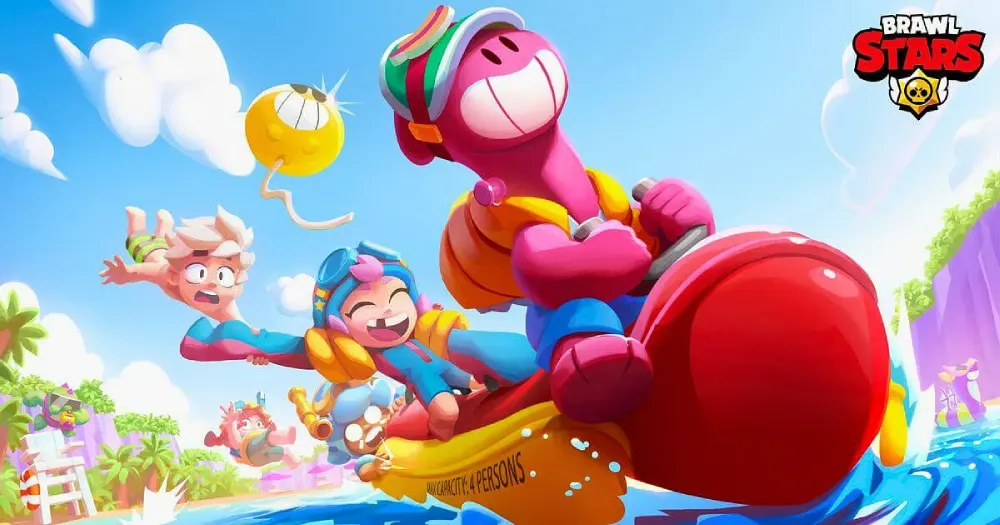
Searches for Doug Weiner Brawl Stars generally refer to Doug’s hot dog theme rather than an official full name. Doug’s official in-game name is simply Doug, and “wiener” is the usual spelling for the hot dog reference.
The phrase became associated with jokes, memes, animations, and descriptions of the character’s design.
Is Doug a hot dog?
Doug appears to be an inflatable dinosaur-like character associated with a hot dog stand. His attacks, Super, descriptions, voice lines, and cosmetic themes repeatedly use food and sausage jokes.
His official description says that his hot dogs extend his friends’ shelf life, directly referencing the revival effect.
The term Doug Weiner Brawl Stars is therefore understandable as a community joke, but it should not be presented as the character’s canonical surname.
The humor also appears in ability names:
- Snack Attack;
- Second Serving;
- Double Sausage;
- Extra Mustard;
- Fast Food;
- Self Service;
- Free Toppings.
These names explain Doug’s mechanics while preserving the food-stand theme.
What skins does Doug have?
Doug has received several cosmetics that reinterpret his food-vendor design. Availability and pricing can change, but known themes include knight, sea warrior, dynasty, and progression-related variations.
Skins change visual effects, animations, models, and sounds. They do not change:
- Snack Attack damage;
- Healing;
- Second Serving duration;
- Revival health;
- Movement speed;
- Matchmaking;
- Super charge;
- Functional attack range.
Players should check the official Brawl Stars game page and the live shop for current releases, updates, and availability. Old skin prices or acquisition methods may no longer reflect the current progression system.
How can ExitLag help Doug players?
ExitLag can help when unstable network routing contributes to delayed movement, inconsistent attacks, or connection interruptions in supported Brawl Stars sessions. It does not improve Doug’s statistics or change how his abilities work.
Doug depends heavily on timing because players must move into a short radius, heal before teammates are defeated, and apply Second Serving before the decisive moment.
Route optimization and connection stability
Online game traffic travels through several network paths between the player and the game infrastructure. Congestion or inefficient routing may contribute to latency variation and packet loss.
ExitLag can analyze supported routes and may help provide a more stable path. Results depend on the device, location, internet provider, mobile carrier, local Wi-Fi, and available route.
Before testing ExitLag:
- Restart the device and router.
- Close background downloads.
- Compare Wi-Fi with mobile data.
- Move closer to the router.
- Check for a broader Brawl Stars outage.
- Test several matches under similar conditions.
- Separate network delay from device slowdowns.
A connection tool cannot correct every gameplay problem. Missing Snack Attack because an enemy remained outside the radius is a positioning issue, not necessarily lag.
What ExitLag cannot change
ExitLag cannot:
- Unlock Doug;
- Provide Coins, Gems, Credits, or Power Points;
- Activate Hypercharge for free;
- Create the best Doug build automatically;
- Increase healing or damage;
- Extend Second Serving;
- Change matchmaking;
- Remove an account penalty;
- Fix every disconnection;
- Guarantee lower latency;
- Improve performance limited by the device;
- Alter Supercell’s servers.
Use ExitLag when routing is the issue being investigated. Results depend on the network and route and should not be treated as guaranteed.
Frequently asked questions
Doug’s combination of healing, close-range damage, and revival creates interactions that are different from most Support Brawlers. The answers below summarize his current role and main build choices.
Doug can be strong on enclosed maps and objective modes where teammates remain close together. Hot Zone, Brawl Ball, and selected Gem Grab maps allow him to use healing and damage at the same time.
He is much weaker against long-range teams on open maps. Draft and map selection matter more than a universal tier placement.
The most flexible setup uses Extra Mustard, Self Service, Damage Gear, and Shield or Gadget Cooldown Gear.
A coordinated support setup can use Double Sausage, Fast Food, Health or Shield Gear, and Gadget Cooldown.
Second Serving revives the marked Brawler with full health when that player is defeated while the effect remains active.
The revival occurs after a short delay and at the place where the Brawler was defeated.
Yes. Doug can apply the revival effect to himself when he does not target a teammate.
Self-revival is useful when Doug must contest an objective, but applying the Super to a high-impact teammate may provide more team value.
Snack Attack normally heals allies, while Self Service allows Doug to recover a portion of the healing value himself.
Without Self Service, Doug does not receive the same standard healing that nearby allies receive from the attack.
Extra Mustard is generally stronger for independent and aggressive play because it creates a high-damage attack.
Double Sausage is better in coordinated teams that can reliably remain inside Doug’s healing radius.
Free Toppings causes the teammate carrying Second Serving to mirror Doug’s Snack Attack whenever Doug attacks.
This creates healing and damage around both Doug and the marked teammate during the Hypercharge.
No. The official character name is Doug.
The phrase Doug Weiner Brawl Stars is an unofficial search term based on his hot dog theme. “Wiener” is also the standard spelling of the food-related word.
Doug works well with Tanks, Assassins, and objective-focused teammates who can carry Free Toppings into close combat.
He also benefits from teammates who provide speed, crowd control, shields, or long-range pressure that helps him approach.
No. ExitLag does not alter Brawler statistics, Gadgets, Star Powers, Gears, or Hypercharges.
It may help optimize supported network routes when routing contributes to connection instability, but results depend on the network and available path.
Mastering Doug Brawl Stars requires disciplined positioning, careful revival timing, and a build adapted to the map. Test Extra Mustard with Self Service for aggressive play, coordinate Double Sausage with durable teammates, and try ExitLag when route-related instability is affecting your matches.
All game images used in this article belong to their respective owners. They are used for informational and educational purposes only and do not imply endorsement or affiliation with the rights holders.
Got questions or want to connect with other players? Join the conversation at the ExitLag Forum!