
Dropper Minecraft mechanics play a fundamental role in automation, item transport, and Redstone engineering. While it may look similar to a dispenser at first glance, the dropper serves a very different purpose and is often the preferred block for efficient item movement. Understanding how droppers work is essential for players who want to move beyond basic survival and start building functional systems.
From farms and sorting systems to elevators and puzzle maps, dropper minecraft designs appear everywhere. The block’s simplicity, combined with Redstone compatibility, makes it one of the most reliable tools for automation. Whether you are a beginner learning Redstone or an experienced builder optimizing efficiency, the dropper is a block you will use constantly.
So what exactly is a dropper in Minecraft, and how do you craft and use one correctly? In this guide, you’ll learn what a dropper does, where it’s used, and how to make a dropper in Minecraft step by step.
What Is a Dropper in Minecraft?
A dropper is a Redstone-powered block that ejects items from its internal inventory when activated. Unlike many interactive blocks, it does not use or activate the item — it simply transfers or drops it. This makes the dropper ideal for automation systems where precision and predictability matter.
Dropper Block Explained
The dropper has:
- A 9-slot inventory, similar to a dispenser
- The ability to face any direction (up, down, or sideways)
- Compatibility with Redstone signals such as buttons, levers, and clocks
When powered, the dropper releases one random item from its inventory per Redstone pulse. This behavior remains consistent across Java and Bedrock editions.
Dropper vs Dispenser
Although droppers and dispensers look nearly identical, their functions are very different:
- Dropper: Only ejects items or transfers them into containers
- Dispenser: Activates items (shoots arrows, places water, equips armor)
Because droppers never activate items, dropper minecraft builds are safer and more predictable for transport systems and storage automation.
How to Make a Dropper in Minecraft
Crafting a dropper is simple and requires early-game materials, making it accessible in survival mode.
Dropper Recipe Minecraft
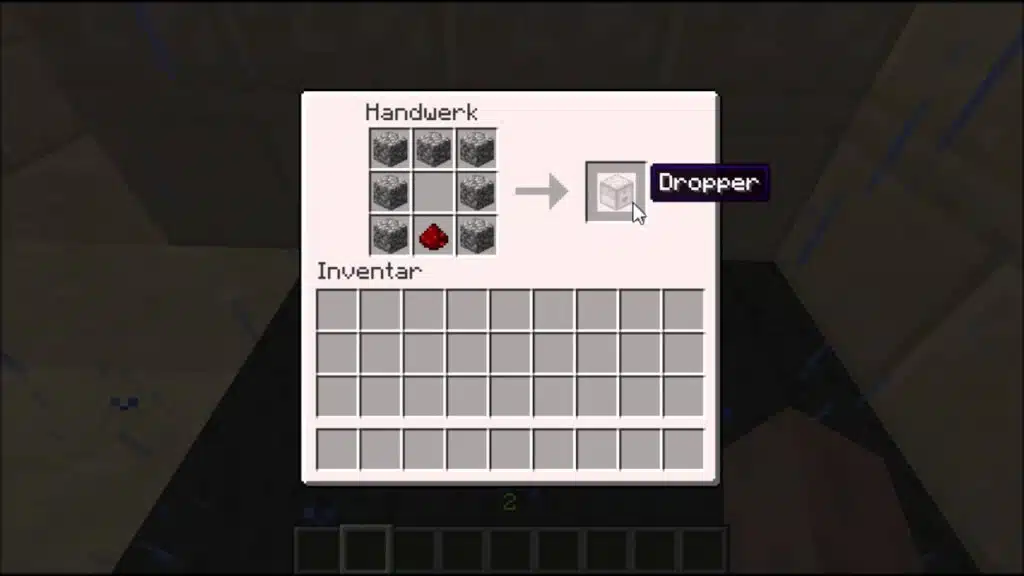
To craft a dropper, you need:
- 7 × Cobblestone
- 1 × Redstone Dust
- 1 × Crafting Table
This recipe works the same way in both Minecraft Java Edition and Bedrock Edition.
How to Craft a Dropper Step by Step
Follow these steps carefully:
- Open the Crafting Table to access the 3×3 grid
- Place 7 cobblestones around the grid, leaving the center empty
- Place 1 Redstone Dust in the bottom-middle slot
- Collect the dropper from the result box
Once crafted, the dropper can be placed facing any direction depending on how you position your character.
How to Use a Dropper in Minecraft
Using a dropper correctly requires Redstone interaction.
Activating a Dropper with Redstone
A dropper activates when it receives a Redstone signal from:
- Buttons
- Levers
- Pressure plates
- Redstone dust or repeaters
Each Redstone pulse ejects exactly one item, making timing control extremely important in automation builds.
Dropper Item Output Behavior
How a dropper behaves depends on what is placed in front of it:
- If facing a container (chest, hopper, another dropper), it transfers the item
- If facing air, it drops the item into the world
This flexibility is why dropper on Minecraft systems are commonly used for item elevators and compact transport lines.
Common Uses for the Dropper in Minecraft
Droppers are a core component in many Redstone systems.
Automation and Item Transport
Common uses include:
- Item elevators (often called droppervators)
- Automatic farms
- Storage and sorting systems
- Puzzle and adventure map mechanics
Beginner Redstone Builds
For new players, droppers are perfect for learning:
- Basic Redstone timing
- Signal control
- Compact automation without complex mechanics
Performance and Multiplayer Considerations
Large Redstone systems built with droppers can impact performance on multiplayer servers if not optimized. Lag, delayed Redstone ticks, and desynchronization can disrupt automation.
ExitLag helps ensure stable connections in multiplayer Minecraft environments by reducing latency and packet loss. While Minecraft droppers function locally, smooth server performance is essential when automation systems run alongside other players and Redstone-heavy builds.
Understanding dropper minecraft mechanics gives you a strong foundation for automation. With crafting, placement, and usage mastered, you’ll be ready to explore advanced Redstone systems and complex dropper chains next.
Advanced Dropper Minecraft Redstone Systems
Once you understand the basics, dropper minecraft mechanics truly shine in advanced Redstone systems. Droppers allow precise, controlled item movement, making them ideal for automation builds where timing and reliability matter. In complex worlds and multiplayer servers, mastering droppers is essential for efficiency.
How Redstone Timing Affects Droppers
A dropper activates only when it receives a Redstone pulse. Each pulse ejects one item, regardless of how long the signal lasts. This means timing is everything. Short pulses generated by buttons, observers, or Redstone clocks ensure controlled item flow, while poorly timed signals can cause delays or inefficiencies.
Repeaters and comparators are commonly used to fine-tune dropper behavior. They help regulate pulse length, synchronize multiple droppers, and prevent accidental double activations.
Dropper Chains and Signal Control
In advanced builds, droppers are often chained together. This allows items to travel across long distances or vertically without manual interaction. Signal control becomes crucial here, as each dropper must activate in sequence.
Well-designed chains prevent item loss, reduce lag, and keep systems compact. This is especially important in survival worlds where resources and space are limited.
Minecraft Dropper Automation Systems
Automation is where the dropper truly excels. With proper Redstone design, droppers can replace bulky transport systems and improve performance.
Item Elevators (Droppervators)
One of the most popular uses of the dropper on minecraft is the item elevator, often called a droppervator. By stacking droppers vertically and powering them in sequence, players can move items upward instantly.
Droppervators are:
- Compact compared to water elevators
- Fully enclosed and mob-safe
- Ideal for farms and underground storage rooms
Because of their efficiency, droppervators are commonly used in Redstone-heavy survival bases.
Auto-Farms and Collection Systems
Droppers are frequently used at the output stage of automatic farms. After crops, mobs, or items are collected, droppers move them into storage systems with precision.
Combining droppers with hoppers allows:
- Controlled item flow
- Reduced overflow
- Better lag management on servers
This makes dropper minecraft automation ideal for large-scale farming operations.
Dropper on Minecraft Multiplayer Servers
Multiplayer servers introduce additional challenges for Redstone systems.
Common Multiplayer Issues
On busy servers, droppers may experience:
- Redstone delay due to server tick lag
- Desynchronization in long dropper chains
- Chunk-loading issues when systems span large areas
These problems are not caused by droppers themselves, but by unstable connections and server performance limits.
Optimizing Dropper Systems for Performance
To keep systems efficient on multiplayer servers:
- Avoid unnecessary Redstone clocks
- Use observers instead of constant signals
- Keep automation within loaded chunks
Optimized systems reduce lag and improve reliability for everyone on the server.

Dropper vs Hopper vs Dispenser
Understanding when to use each block is key to efficient automation.
When to Use Each Block
- Dropper: Best for controlled, Redstone-activated item movement
- Hopper: Best for passive item transfer and collection
- Dispenser: Best when item activation is required
Droppers excel when precision matters and item activation is undesirable.
Combining Droppers and Hoppers
Advanced systems often use both blocks together. Hoppers collect items passively, while droppers move them only when triggered. This hybrid approach maximizes control and minimizes lag.
How to Build Reliable Dropper Systems
Reliability separates good Redstone builds from great ones.
Redstone Clock Types for Droppers
Common clock designs include:
- Repeater clocks for simple timing
- Comparator clocks for adjustable speed
- Observer clocks for compact, modern builds
Choosing the right clock ensures smooth item movement without overload.
Safety and Item Control
To prevent item loss:
- Use single-pulse signals
- Avoid overfilling droppers
- Test systems before scaling them up
These practices keep dropper minecraft builds stable over long play sessions.
Table: Dropper Minecraft Use Cases
| Use Case | Required Blocks | Complexity | Best Mode |
| Item Elevator | Dropper, Redstone, Hopper | Medium | Survival |
| Auto-Farm Output | Dropper, Chest, Comparator | Medium | Survival |
| Puzzle Maps | Dropper, Button, Redstone | Low | Creative |
| Sorting Systems | Dropper, Hopper, Comparator | High | Survival |
ExitLag and Redstone-Heavy Minecraft Builds
In multiplayer environments, even perfectly designed Redstone systems can suffer if the connection is unstable. Lag, packet loss, and delayed ticks can disrupt dropper timing and item flow.
ExitLag helps Minecraft players by:
- Stabilizing connections to multiplayer servers
- Reducing packet loss during Redstone-heavy activity
- Improving consistency when automation systems are running
While droppers function locally, a stable network ensures your automation works exactly as intended, especially on crowded servers.
All game images used in this blog belong to Mojang Studios. They are used for informational/educational purposes only and do not imply endorsement or affiliation with the rights holders.
Got questions or want to connect with other players? Join the conversation at the ExitLag Forum!