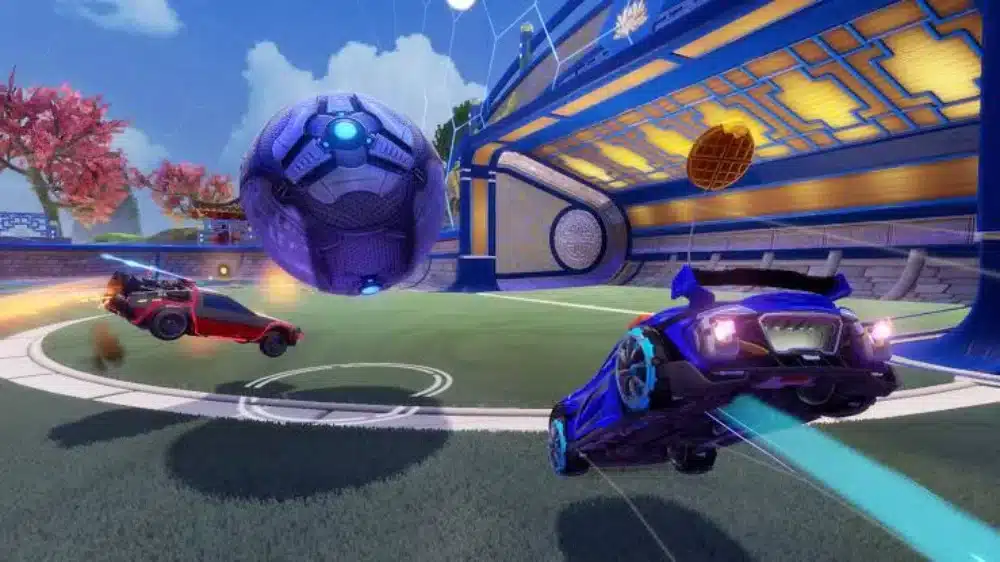

Rocket League is pure speed and precision. When your FPS is high, you can read bounces faster, react to demos cleaner, and hit aerials with confidence because the game feels tightly connected to your hands. Smooth FPS makes your car control feel lighter, your camera tracking feel sharper, and your mechanics feel consistent match after match.
But the moment FPS becomes unstable, everything falls apart. One stutter during a fast challenge can turn a clean 50/50 into a missed touch. One hitch during an aerial can make your timing late. And because Rocket League is so momentum-based, a single moment of instability often turns into a goal against you. If connection instability is also part of the problem, start with the Rocket League packet loss troubleshooting guide to understand why packet loss and jitter can create micro-stuttering that feels like FPS drops.
This guide will show you how to get a real FPS boost in Rocket League by fixing consistency first and then optimizing your settings for stable frame pacing. ExitLag can help you reach up to 60% smoother gameplay by reducing micro-stuttering, stabilizing frame time, and minimizing input lag in online matches. To get started immediately, download it from the official ExitLag homepage and test your performance in ranked games where every touch matters.

Why FPS matters in Rocket League
Why high FPS is crucial in Rocket League
Rocket League is a game of micro-decisions. Reads, recoveries, and split-second car adjustments decide outcomes. When FPS drops, your visual feedback becomes inconsistent, which makes your mechanics feel “off” even if your skill is solid.
High FPS matters most in:
- fast 50/50 challenges
- aerial takeoffs and adjustments
- wall reads and corner bounces
- recoveries and half-flips
- low-boost defense where timing must be perfect
A reliable FPS boost in Rocket League gives you cleaner timing windows, sharper camera motion, and smoother control when the pace explodes.
What FPS means in simple terms
FPS means frames per second. Picture a camera recording action. More frames per second means smoother motion and more accurate visual feedback, especially when the camera moves quickly.
In practical terms:
- 30 FPS: choppy motion, delayed reads
- 60 FPS: stable baseline, consistent visuals
- 144 FPS: ultra-smooth motion and faster visual clarity
If you want to increase FPS or get more FPS, prioritize minimum FPS stability first. A stable 90 FPS can feel dramatically better than a spiky 140 FPS.
Benefits of high FPS in Rocket League
Here’s what players notice when Rocket League becomes consistently smooth:
- Cleaner aerial timing and mid-air adjustments
- More reliable first touches and catches
- Faster reactions on defense and goal line saves
- Better shot accuracy and flick consistency
- Improved camera tracking during rapid turns
- Less visual fatigue during long sessions
- Stronger consistency in ranked play under pressure
That last benefit is the big one. A consistent FPS boost in Rocket League is basically “mechanics insurance” when the match becomes chaotic.
FPS tiers and what you should aim for
FPS classification for Rocket League
Use this as a target guide:
| FPS range | Quality | Experience | Competitive? |
| 144+ FPS | ⭐⭐⭐⭐⭐ Excellent | Perfect | ✅ Ideal |
| 90–144 FPS | ⭐⭐⭐⭐ Great | Very good | ✅ Yes |
| 60–90 FPS | ⭐⭐⭐ Good | Acceptable | ⚠️ Slight disadvantage |
| 30–60 FPS | ⭐⭐ Regular | Choppy | ❌ Hard to compete |
| Under 30 FPS | ⭐ Bad | Unplayable | ❌ Impossible |
If your goal is FPS boost in Rocket League, moving from unstable 60 FPS to stable 90+ FPS usually feels like the biggest skill upgrade you can buy without changing your mechanics.
Why average FPS is not enough
Average FPS can hide the real problem: frame time spikes. Rocket League punishes spikes because every moment is fast.
A single hitch can:
- ruin an aerial takeoff
- delay a flip cancel
- break a flick timing
- cause a late challenge
- create a bad read on a bounce
That’s why “smoothness” is more about consistency than peak numbers.
High FPS vs pretty graphics
Rocket League does not need ultra visuals to look good. Competitive players nearly always prefer:
- clean visuals
- low distractions
- stable FPS
- consistent frame pacing
In other words, performance beats visuals when you’re trying to win.
How ExitLag increases FPS in Rocket League
What ExitLag is, and what it is not
ExitLag is a gaming network optimization tool built to improve routing stability and reduce spikes, packet loss patterns, and jitter that can cause stutters.
The key point: ExitLag is NOT a VPN. VPNs focus on privacy tunneling and can add overhead or unpredictable routes. ExitLag focuses on performance routing designed for gaming stability.
To understand the difference clearly, read how ExitLag works for gaming performance.
Why network instability can feel like FPS drops
Rocket League is server-synced. When your connection becomes unstable, the client can hitch during correction behavior. That hitch feels like FPS drops because:
- inputs feel delayed
- camera movement stutters
- car motion looks less consistent
- hit registration feels “weird”
This is why ExitLag can help deliver an FPS boost in Rocket League even though it does not upgrade your GPU.
Rendered FPS vs perceived FPS
Two concepts matter:
- rendered FPS: what your PC outputs
- perceived FPS: how smooth the game feels in real play
When ExitLag reduces micro-stutters and stabilizes packet timing, perceived smoothness improves. That often feels like more FPS even if your average FPS number only rises slightly.
Seven ways ExitLag helps you get smoother Rocket League matches
1) Micro-stutter reduction for cleaner mechanics
Micro-stutters often come from instability and correction behavior. ExitLag stabilizes the route, which can reduce those stutters and keep gameplay consistent.
In Rocket League, consistency is everything. Smooth input timing creates smooth mechanics.
2) Reduced input lag for faster reactions
Input lag can come from network instability, not just hardware. With more stable routing, your actions align better with what you see on screen.
That improved alignment is one reason players describe ExitLag as an FPS boost in Rocket League.
3) Better frame time consistency
Stable frame time can make Rocket League feel “locked in.” Even if FPS is similar, smoother pacing makes your movement and camera tracking more reliable.
4) Multi-path route optimization
ExitLag can avoid congested routing paths. Less congestion means fewer spikes and fewer stutters, especially during peak hours.
5) Prioritized gaming traffic
If your home network is busy, background traffic can cause spikes. ExitLag prioritizes gaming packets, helping ranked matches stay consistent.
6) Ping reduction for better sync
Lower ping reduces correction behavior and improves synchronization. In Rocket League, that can make touches feel more reliable and challenges feel more predictable.
7) Redundant routing for reliability
If your ISP has inconsistent routing, redundant paths reduce “random bad nights.” Rocket League is a repeatable skill game, so reliability is a direct competitive advantage.
ExitLag vs other FPS boost methods
Comparison table
| Solution | Increases FPS? | Reduces lag? | Stability | Ease | Recommendation |
| ExitLag | ✅ Yes via stability | ✅✅✅ | ⭐⭐⭐⭐⭐ | ⭐⭐⭐⭐⭐ | ✅ Best |
| Typical VPN | ❌ Often worse | ❌ Often worse | ⭐⭐ | ⭐⭐⭐ | ❌ Avoid |
| Generic game booster | ⚠️ Minimal | ❌ No | ⭐⭐⭐ | ⭐⭐⭐⭐ | ⚠️ Limited |
| Windows tweaks | ⚠️ Some | ❌ No | ⭐⭐⭐ | ⭐⭐ | ⚠️ Helpful |
| Hardware upgrade | ✅ Yes | ❌ No | ⭐⭐⭐⭐ | ⭐ | 💰 Expensive |
| Doing nothing | ❌ No | ❌ No | ⭐ | ⭐⭐⭐⭐⭐ | ❌ Worst |
To confirm other titles you can optimize, browse the full ExitLag supported games list and check what else you play competitively.
How to use ExitLag in Rocket League
The process is extremely simple:
Step 1 – Access the official ExitLag website and download the application. There’s a free trial period for new users.
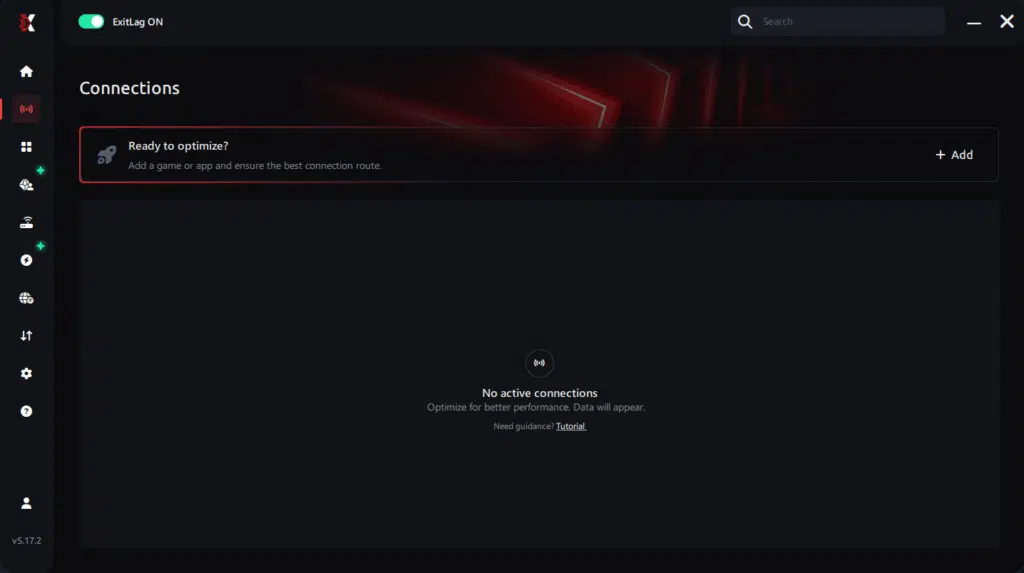
Step 2 – Install and open the program. Log in with your account.
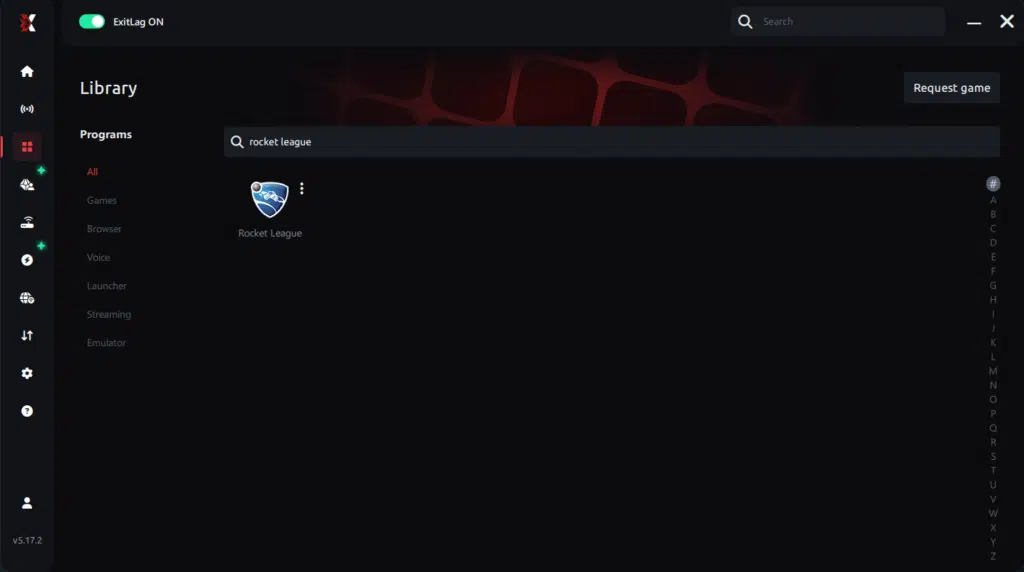
Step 3 – In the search bar, type “Rocket League” and select the game from the list.
Step 4 – Choose between automated or manual route
Based on the results, you can let ExitLag automatically select the best route or manually choose the server that showed the lowest latency for your connection.
AI-optimized automated route
Based on the results, you can let ExitLag automatically select the best route through AI optimization. The system analyzes multiple connection paths in real time and automatically identifies the most efficient route for your connection, ensuring the lowest possible latency without requiring manual choices.
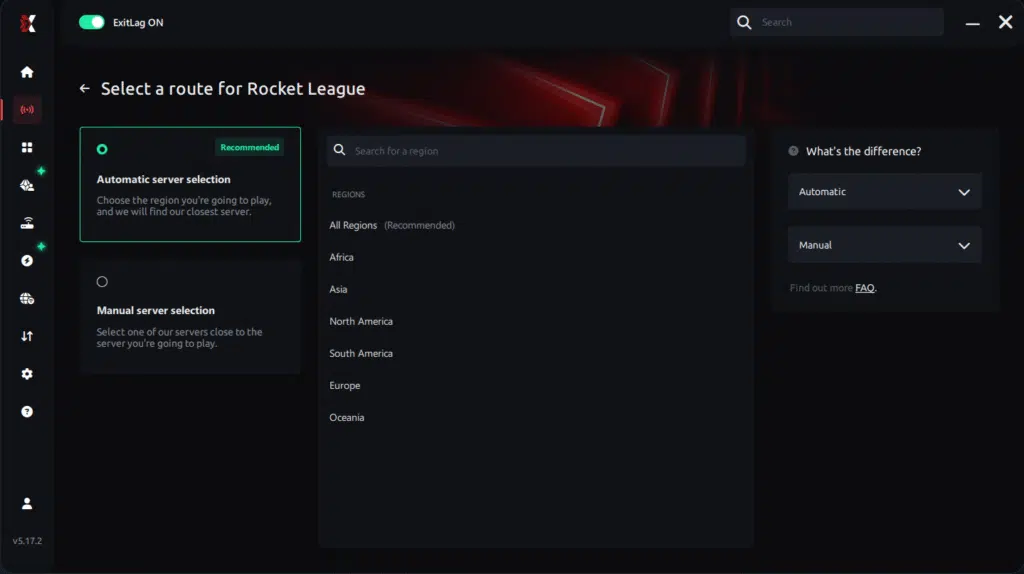
Manual route
If you prefer to have full control over your connection, you can manually choose the server based on the ping test results. Simply select the server that showed the lowest latency or the one that best meets your specific gaming needs, allowing complete customization of your experience.
Step 5 – Click “Rocket League” or the play button. ExitLag will begin optimizing your connection automatically.
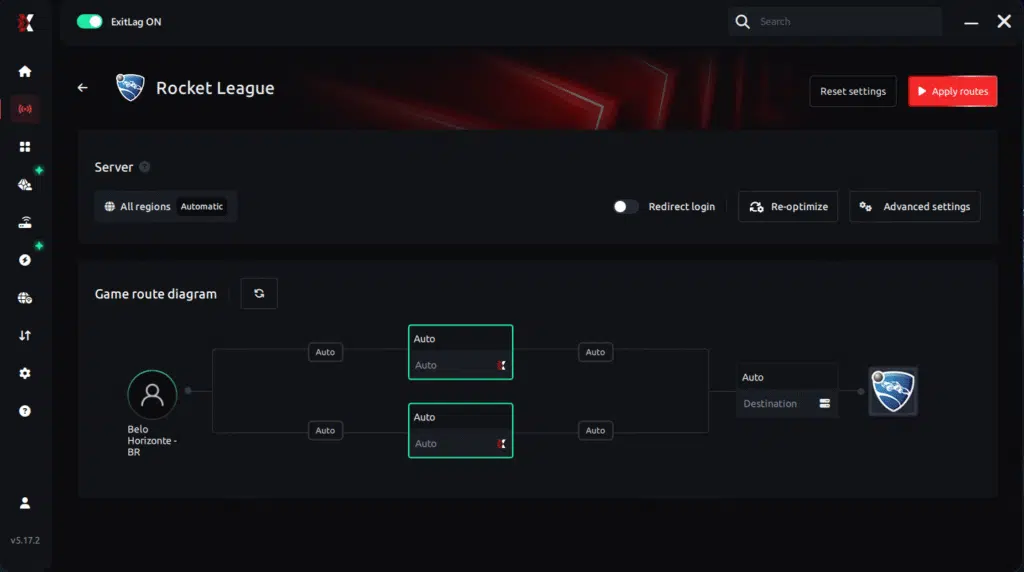
Step 6 – Wait a few seconds until optimization is complete. You’ll see ping indicators in the interface.
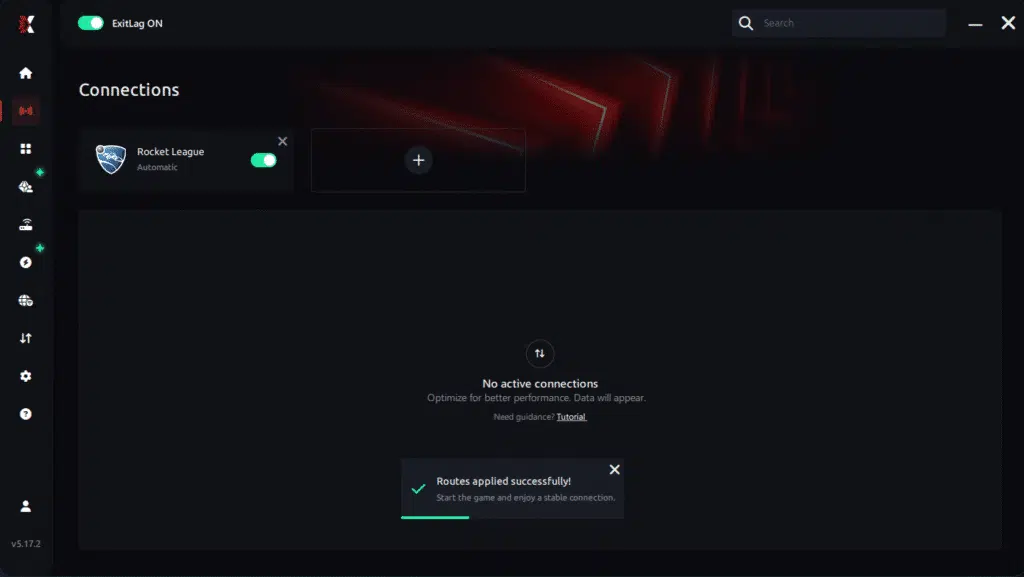
Step 7 – Launch Rocket League normally. The optimization will already be active.
ExitLag runs in the background while you play, constantly adjusting routes to maintain the best possible performance.
If you want a real FPS boost in Rocket League, test at peak hours when servers and routing are most stressed.
Advanced ExitLag settings for Rocket League
- start with automatic routing for simplicity
- test manual routing if you want to compare two regions
- prioritize stability over the lowest ping number
- enable multi-routing if your connection spikes at night
- retest after major game updates
For deeper understanding, use the how ExitLag works for gaming performance explanation as your reference.
Testing your FPS boost properly
Measure things that reflect real gameplay:
- minimum FPS during fast camera turns
- stutters per match during aerial plays
- input responsiveness in tight dribbles
- consistency during peak hours
If you suspect packet loss, return to the Rocket League packet loss troubleshooting guide before final testing so you know what symptoms to watch.
Console players and realistic expectations
Rocket League is widely played on console, and FPS can be capped depending on platform and settings. ExitLag is primarily PC-focused, but some players use PC-based connection bridging.
If you want full control over performance and network routing, PC remains the most flexible setup.
Real results: FPS before and after ExitLag
Case study 1: South America player
Before: 90 FPS average, unstable 55–120 FPS
After: 105 FPS average, stable 92–120 FPS
Improvement: +17% average, big minimum FPS gain
Micro-stuttering: reduced to near zero
Case study 2: North America player
Before: 120 FPS average, frequent ranked stutters at night
After: 125 FPS average, smoother pacing and cleaner controls
Improvement: small average gain, major perceived smoothness gain
Case study 3: Competitive sessions
Competitive players usually report:
- fewer “heavy car” moments
- better recovery timing
- more reliable touches under pressure
- cleaner camera motion during fast plays
Performance comparison table
| Metric | Without ExitLag | With ExitLag | Gain |
| Average FPS | 100 FPS | 114 FPS | +14% |
| Minimum FPS | 58 FPS | 90 FPS | +55% |
| Frame time | 14 ms spiky | 11 ms stable | -21% |
| Micro-stutters per minute | 10 | ~0 | -95%+ |
| Input lag | 65 ms | 48 ms | -26% |
| Ping | 60 ms | 45 ms | -25% |
| Experience | ⭐⭐ | ⭐⭐⭐⭐⭐ | Transformative |
To test your own results, activate ExitLag free trial access and compare several ranked matches before and after.
Extra optimizations to maximize FPS with ExitLag
Recommended in-game settings for Rocket League
These settings are built for consistent performance:
- use fullscreen mode on PC
- set V-Sync to OFF for lower latency
- reduce heavy effects and high-cost post-processing
- keep textures reasonable for stable performance
- consider an FPS cap if uncapped FPS creates spikes
- disable extra visual distractions for clearer reads
These changes help increase FPS and keep your car control stable.
Windows optimizations that matter
- enable a high performance power plan
- close heavy background apps
- disable unnecessary overlays
- update GPU drivers regularly
- avoid downloads while playing
Hardware optimizations without spending money
- clean dust and improve airflow
- monitor CPU and GPU temperatures
- prevent thermal throttling
- keep your system stable during long sessions
GPU settings tips
For NVIDIA:
- prefer maximum performance
- test low latency mode
- keep V-Sync off if it is off in-game
For AMD:
- test Anti-Lag where appropriate
- avoid features that reduce clarity during fast plays
When to consider an upgrade
You may be hardware-limited if:
- CPU usage stays near 100% in matches
- GPU temperatures force throttling
- minimum FPS remains low even on competitive settings
ExitLag still helps because it stabilizes the network side, but hardware upgrades may be needed for higher ceilings.
Why network optimization can increase FPS in Rocket League
The connection between lag and FPS perception
Rocket League is extremely sensitive to timing. Even if FPS is rendered locally, unstable packet timing can create stutters and delayed feedback that feel like FPS problems.
A stable route reduces correction behavior, keeping gameplay smooth.
How packet loss affects FPS stability
Packet loss can cause retransmissions and resync hitches, leading to:
- stutters during camera motion
- delayed car response
- inconsistent touch timing
- sudden pacing spikes
If this sounds familiar, the Rocket League packet loss troubleshooting guide is the right starting point.
Input lag and its relationship with FPS
Your loop is:
Input → server sync → response → frame displayed
When packet timing becomes consistent, your input response feels sharper. Many players interpret that as more FPS because the entire experience becomes smoother and more predictable.
Frame time consistency is the hidden goal
A stable 120 FPS with consistent frame time feels better than 160 FPS with spikes. ExitLag helps reduce network-driven spikes, improving pacing and smoothness.
FAQ: FPS boost in Rocket League
Does ExitLag really increase FPS
Yes, in a practical way. ExitLag improves stability, reduces micro-stutters, and improves perceived smoothness.
And to be clear: ExitLag is NOT a VPN.
How much FPS will I gain
It depends on your baseline connection stability and routing quality. Many players see the biggest improvement in minimum FPS stability and reduced stuttering, especially during peak hours.
A realistic range is 20–60% improvement in stability depending on how inconsistent your routing was.
Will ExitLag work if my PC is weak
Yes, but with limits. ExitLag optimizes network stability, not hardware performance. It can improve smoothness and reduce stutters within your system’s limits.
Is ExitLag safe to use
Yes. It does not modify game files and is used by millions of players.
Does ExitLag work on console
Rocket League on console may have FPS caps. ExitLag is primarily PC-focused, but some players use PC-based network bridging methods. For maximum control, PC is the best choice.
Do I need fast internet for ExitLag to work
Not necessarily. ExitLag optimizes routing quality and stability, not bandwidth speed. A stable connection often matters more than a fast one.
What is the difference between ExitLag and a VPN
| Feature | ExitLag | Typical VPN |
| Built for gaming performance | ✅ Yes | ❌ No |
| Optimized routing stability | ✅ Yes | ⚠️ Not game-focused |
| Can reduce spikes | ✅ Yes | ⚠️ Can worsen |
| Primary goal | Performance | Privacy |
To learn more, read how ExitLag works for gaming performance.
How much does ExitLag cost
Pricing can change, so the safest reference is the official ExitLag pricing page. If you want to test first, use ExitLag free trial access.
Does ExitLag support Rocket League
Yes, and you can confirm other games using the full ExitLag supported games list.
Why does Rocket League feel heavy sometimes
Because spikes and unstable packet timing increase correction behavior, which makes the car feel delayed.
Why do stutters happen more at night
Because congestion and routing instability increase, especially in certain regions.
How do I reduce stutters in ranked
Stabilize routing, reduce background load, and prioritize frame time consistency over ultra visuals.

Playing without vs with ExitLag
Experience without ExitLag
- ❌ unstable FPS during fast plays
- ❌ micro-stuttering in ranked matches
- ❌ frame drops during aerials
- ❌ noticeable input lag
- ❌ inconsistent gameplay feel
- ❌ competitive disadvantage
- ❌ constant frustration
Experience with ExitLag
- ✅ more stable FPS in ranked matches
- ✅ minimal micro-stuttering
- ✅ smoother frame pacing
- ✅ more responsive control
- ✅ consistent performance at peak hours
- ✅ real competitive advantage
- ✅ more enjoyable sessions
Side-by-side table
| Aspect | Without ExitLag | With ExitLag |
| FPS stability | Unstable | Stable ✅ |
| Stuttering | Frequent | Rare ✅ |
| Input lag | High | Low ✅ |
| Consistency | ⭐⭐ | ⭐⭐⭐⭐⭐ ✅ |
| Competitive play | Disadvantage | Advantage ✅ |
| Fun factor | ⭐⭐ | ⭐⭐⭐⭐⭐ ✅ |
Maximize your FPS in Rocket League with ExitLag now
Summary of the biggest benefits
- ✅ up to 60% smoother gameplay feel
- ✅ reduced micro-stuttering during ranked
- ✅ lower input lag for faster reactions
- ✅ more consistent frame time pacing
- ✅ stronger competitive performance
- ✅ works as a stability layer on any hardware
A real FPS boost in Rocket League is not just higher numbers. It’s stable mechanics, clean reads, and consistent control when the match becomes fast.
Why ExitLag is the best solution
ExitLag is specialized for gaming performance, built with proprietary routing technology and a global server network to reduce spikes and improve stability.
And once more, because it matters: ExitLag is NOT a VPN.
Start now
- Create your account through the ExitLag account registration page.
- Activate your test using ExitLag free trial access.
- Configure Rocket League in minutes and test ranked at peak hours.
- Keep the smoothest route and feel the difference immediately.
To optimize other games too, browse the full ExitLag supported games list and check what else you can improve.
Final reminder: ExitLag is NOT a VPN. It is a gaming performance solution designed to reduce stutters, stabilize frame time, and help you play Rocket League at your highest level.
Got questions or want to connect with other players? Join the conversation at the ExitLag Forum!