Someone, somewhere, just paid more for a pixelated rifle skin than most people pay for a used car — and it happens every single day. The CS2 skin market is a real economy with its own rules, its own crashes, and yes, its own millionaires. If you’re new, the whole thing probably looks confusing: same-name skins at wildly different prices, weird decimals called floats, and colors that apparently mean rarity. This guide breaks down CS2 skins for beginners in plain English — what skins are, what makes them valuable, where people trade them, and how not to lose money on day one.
What CS2 Skins Actually Are (and Why They Have Real Value)
A skin is a purely cosmetic finish for a weapon — it changes how your gun looks, never how it shoots. No damage boosts, no accuracy perks, nothing. And that’s exactly what makes the system work: Valve kept skins gameplay-neutral, so owning an expensive one is a flex, not an advantage.
The value comes from scarcity plus demand, the same engine that drives sneaker or trading card markets. Every skin enters the world through a fixed set of doors — case openings, weekly drops, or collections — and many of those doors close forever when cases get discontinued. Limited supply meets a player base of millions, and prices happen.
Here’s the simplest way to understand how CS2 skins work: each skin is a unique digital item in your Steam inventory with its own rarity, float, and sometimes a pattern or kill counter. Because it lives in your inventory, you can sell it, trade it, or hold it — it’s property, not a rental. That ownership layer is why the market exists at all.
New supply enters through a few faucets: weekly care-package drops for Prime players, case openings with paid keys, and event or Armory collections. When a case leaves the active drop pool, its skins stop multiplying — and that slow supply freeze is the single biggest long-term price driver in the whole economy.
So where does “rare” actually come from? Colors.
The Rarity System – How Color Tiers Work
Every weapon skin sits on a rarity ladder, and the CS2 skin rarity tiers are color-coded so you can read them at a glance:
- Consumer (white) and Industrial Grade (light blue) — the bottom of the ladder, mostly collection drops worth cents.
- Mil-Spec (blue) — the most common case drop, at roughly 80% odds.
- Restricted (purple) — about a 16% case chance.
- Classified (pink) — around 3.2%.
- Covert (red) — roughly 0.64%, the headline skin of most cases.
- Rare Special Items (gold) — knives and gloves, about 0.26%, or 1 in 385 cases.
- Contraband — a tier of exactly one skin, the M4A4 Howl, removed from drops over a copyright dispute years ago.
Two things to internalize here. First, rarity is set at the case level: the same skin always has the same tier. Second, rarity alone doesn’t set the price — a boring red can cost less than a hyped pink. Tier is the starting point, not the answer.
There’s also a bridge between tiers: Trade-Up Contracts. Burn ten skins of one rarity and you get a random skin from the tier above, drawn from the same collection. And since the October 2025 update, five Covert skins can trade straight up to a knife or gloves — a mechanic so powerful it crashed the entire gold market in a day (more on that below).
Because two copies of the exact same skin can still differ a lot. That’s where float comes in.
Float Value and Wear – Why Identical Skins Cost Differently
Every skin gets a CS2 float value the moment it’s created — a decimal between 0.00 and 1.00 that decides how scratched the finish looks. It’s permanent and never changes, no matter how much you play with the skin. The CS2 skin wear conditions map onto that decimal like this:
| Wear | Float range | What it looks like |
|---|---|---|
| Factory New | 0.00–0.07 | Clean, crisp, premium price |
| Minimal Wear | 0.07–0.15 | Tiny scratches, best value tier |
| Field-Tested | 0.15–0.38 | Visible wear, the budget sweet spot |
| Well-Worn | 0.38–0.45 | Heavy scratches |
| Battle-Scarred | 0.45–1.00 | Faded and rough |
The price gaps are not subtle. A Factory New version of a popular rifle skin can cost five to ten times more than its Battle-Scarred twin. Some finishes are also float-capped — they only exist in a narrow range — which creates its own micro-markets. Always check the float before buying, not just the wear label: two Field-Tested skins at 0.16 and 0.37 look and price very differently.
Float explains condition. But it doesn’t explain why one AWP costs $5.00 and another costs $10,000.
What Else Drives Price Beyond Rarity and Float
The full list of CS2 skin price factors goes well beyond the two fundamentals:
- StatTrak — an orange kill counter baked into the skin; StatTrak versions drop at roughly 1 in 10 odds and usually cost a premium.
- Pattern seeds — some finishes (like Case Hardened) roll 1,000 different layouts, and a famous pattern can multiply value by 100x.
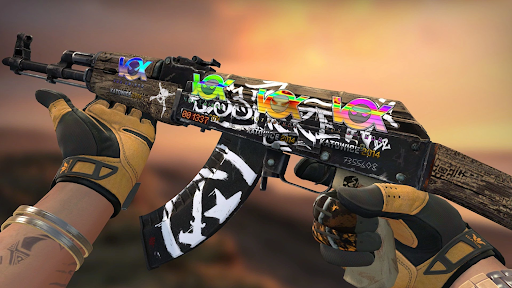
- Stickers — old tournament stickers, especially Katowice 2014 holos, can be worth more than the gun they’re stuck on; the best ones have sold for over $100,000 each.
- Supply status — skins from discontinued cases or removed collections have a permanently shrinking pool.
- Hype and visibility — pro players, streamers, and new-game metas move demand overnight.
- Liquidity — popular mid-price skins sell in minutes, while a $50,000 pattern might wait months for a buyer.
The takeaway for a beginner: price is a stack of multipliers, not a single number. Rarity sets the floor, float adjusts it, and everything above adds or subtracts from there.
Now, where does all this buying and selling actually happen?
Where CS2 Skins Are Bought, Sold, and Traded
Three main venues, each with a different deal:
- Steam Community Market — Valve’s own marketplace: instant, safe, and simple, but it takes roughly 15% in combined fees, and everything you earn stays locked in Steam Wallet forever.
- Third-party marketplaces — licensed platforms with much lower fees (some around 2.5–5%) and real-money cash-outs, at the cost of trusting a company outside Valve.
- P2P trading — direct player-to-player swaps with no fees at all, and also zero protection if something goes wrong.
The fee difference is bigger than it sounds. Sell a $100.00 skin on Steam and you keep about $85.00 in store credit you can never withdraw; sell it on a low-fee marketplace and you keep around $95.00 of actual money. Steam’s convenience is real, but you’re paying for it twice — once in fees, once in lock-in.
Whichever venue you pick, learn the scam basics first. Resources like Avoid scams walk through the current tricks — fake login pages, API key hijacks, impersonated “admins” — in plain language.
How Prices Actually Move
Skin prices aren’t random — they follow supply shocks and demand waves you can actually watch. New case releases flood the market with fresh supply and push prices down. Discontinued cases do the opposite, slowly grinding their contents upward as the pool shrinks. Major tournaments, big updates, and streamer hype all create demand spikes within hours.
And then there are earthquakes. On October 22, 2025, Valve let players trade five Covert skins up to a knife or gloves — and the market cap fell from a record $6 billion to about $4.1 billion almost overnight, with knives and gloves dropping 20–50% while cheap red skins surged 10x as trade-up fuel. Valve’s July 2025 safety changes moved prices too — the Trade protection update shows how even security features ripple into valuations.
Zoom out and the long-term trend is demand growth: Counter-Strike keeps breaking its own player-count records, and every new player is a potential skin buyer. Which brings us to the traps waiting for new players.
Common Beginner Mistakes in the Skin Market
Almost everyone loses a little money learning how CS2 skins work in practice. You can skip most of the tuition by avoiding these:
- Overpaying on Steam Market without comparing third-party prices first — the convenience tax is real.
- Ignoring float and buying a “cheap” skin that’s actually a high-float version of a good wear tier.
- Buying into hype at the peak, especially right after an update or a viral clip — prices almost always cool off.
- Treating skins as a guaranteed investment; October 2025 proved a single patch can halve a category overnight.
- Rushing trades with strangers — urgency, middlemen, and “verification” requests are scam scripts, not opportunities.
- Panic-selling during dips, which locks in losses right before the recoveries this market is famous for.
Notice the pattern: every mistake is either impatience or missing information. Both are fixable with a five-minute routine.
A Simple First Steps Checklist for New Traders
Your starter routine for CS2 skins for beginners — run it before your first real purchase and keep running it after:
- Set a hard budget you’re fine losing entirely, because no skin purchase is an investment with a guarantee.
- Compare the same skin across Steam and at least one third-party marketplace before buying anything.
- Check the float, pattern, and StatTrak status of the exact listing — never buy on the name alone.
- Learn the five or six active scam scripts before your first trade, not after it.
- Start with liquid mid-price skins ($5.00–$50.00) that you can resell in minutes if you change your mind.
- Keep Steam Guard’s mobile authenticator active so your growing inventory stays yours.
- Screenshot or save a price chart habit — sites tracking the CS2 skin market daily will teach you more in a month than any guide.
To Sum Up
The CS2 skin market looks chaotic from the outside, but it runs on simple machinery: rarity tiers set the floor, float and extras stack the price, and supply shocks move everything at once. Learn those three ideas, respect the scams, and start small with liquid skins — the rest comes from watching the market do its thing.
FAQ
Do CS2 skins affect gameplay in any way?
No — skins are 100% cosmetic. A $5.00 rifle and a $5,000 rifle shoot exactly the same. Their value comes from scarcity and demand, not performance.
Why do two skins with the same name have completely different prices?
Because the name is only the starting point. Float value, StatTrak, pattern seed, and stickers all multiply or divide the price of the same-named skin. Always inspect the exact listing, not just the skin’s title.
What is float value and why does it matter?
Float is a permanent decimal from 0.00 to 1.00 that controls how worn a skin looks. Lower floats look cleaner and cost more — sometimes five to ten times more within the same skin. Two listings with the same wear label can still differ hugely, so check the number itself.
Is the Steam Community Market the cheapest place to sell skins?
Usually not. Steam takes roughly 15% in combined fees and pays you in locked Steam Wallet credit. Third-party marketplaces with 2.5–5% fees and real cash-outs typically leave you with noticeably more money.
Can CS2 skins actually lose value over time?
Absolutely. New case releases, game updates, and rule changes like the October 2025 trade-up update have all crashed categories overnight. Skins can gain value too, but anyone promising guaranteed growth is selling you something.
What’s the difference between StatTrak and regular skins?
StatTrak versions include an orange counter that tracks your kills with that weapon. They drop at roughly 1 in 10 odds from cases, which makes them rarer and usually pricier. The counter resets if the skin gets a new owner through a market listing.
Is it worth buying skins as an investment?
Only with money you can afford to lose. The market has delivered incredible returns for some items and 50% overnight crashes for others. Buy skins you enjoy owning first — treat any profit as a bonus, never a plan.
Got questions or want to connect with other players? Join the conversation at the ExitLag Forum!