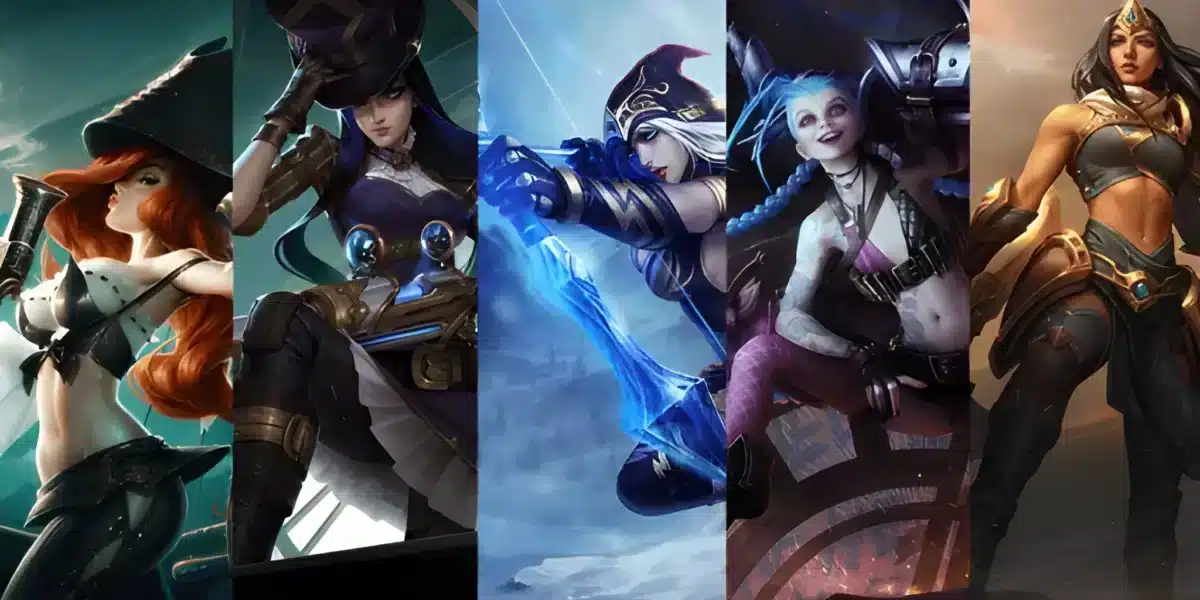

League of Legends battle royale questions pop up frequently among players who are newer to the game or who discovered LoL through Arcane and want to understand what genre the actual game is. The short answers are clear: League of Legends is not a battle royale, has never had a battle royale mode, and Riot has explicitly stated that a battle royale mode probably cannot work within the existing game.
League of Legends is also not an RTS. It belongs to a specific genre called MOBA (Multiplayer Online Battle Arena), which originated from RTS games but evolved into something distinctly different. Understanding what makes a MOBA different from both battle royale games and real-time strategy games explains a lot about why LoL plays the way it does.
This guide explains what genre League of Legends is, why battle royale and LoL are fundamentally different, what game modes actually exist in League in 2026, and what “League of Legends BR” actually refers to in certain contexts.

What Genre Is League of Legends?
League of Legends is a MOBA, which stands for Multiplayer Online Battle Arena. In each match, two teams of five players compete on a map with three lanes. Each player controls a single champion with unique abilities. The goal is to push through the enemy’s defenses and destroy their base structure, called the Nexus.
The fastest description: five people versus five people, three lanes, unique characters with abilities, destroy the enemy base to win.
Is LoL a Battle Royale Game?
No. League of Legends is not a battle royale game. The two genres are fundamentally different:
| Feature | Battle Royale | League of Legends (MOBA) |
| Players | Solo or small squads among 60 to 150 total | Two teams of exactly five |
| Objective | Be the last one standing | Destroy the enemy Nexus |
| Map | Shrinking play zone | Fixed three-lane map with jungle |
| Lives | Usually one life per game | One life per round, but rounds repeat |
| Resources | Looted from the environment | Purchased from a shop with in-game gold |
| Match format | Everyone against everyone | Team vs team |
| Match length | 20 to 30 minutes | 25 to 40 minutes |
The defining element of a battle royale is a shrinking play zone that forces all players toward each other, combined with a last-survivor objective. League of Legends has none of these elements.
Is LoL an RTS Game?
Not exactly. LoL is MOBA, a genre that emerged from RTS, but the two are different:
RTS games (Real-Time Strategy) require managing multiple units and resources simultaneously. In StarCraft, you control an entire army. In Age of Empires, you build bases, gather resources, and command dozens of units at once. Strategy operates at the macro scale of an entire civilization or army.
In League of Legends, you control exactly one champion. That is the entire unit under your control. There are no troops to manage, no base to construct (only defend), and no worker units gathering resources. The strategic elements exist but operate at a completely different scale from traditional RTS design.
The MOBA genre grew directly from modded versions of Warcraft III, which is an RTS game. Modders created maps where players each controlled a single powerful Hero unit, which became the concept that evolved into DotA and then into League of Legends. This shared history explains why MOBAs and RTS games share visual elements like an isometric camera angle and resource management concepts, while playing very differently.
Why Riot Said Battle Royale “Probably Can’t” Be in League
Riot’s design director Ghostcrawler officially addressed the battle royale question in an Ask Riot response:
Riot concluded that the demands of a battle royale mode were beyond what League of Legends’ existing architecture could handle. Adding 100 or more champions to a single game instance would require extensive engineering work that Riot said they had trouble even achieving with a six-person “Hexakill” mode. The game’s architecture was not built for the scale that battle royale requires.
Riot did express appreciation for some battle royale ideas. Ghostcrawler mentioned wanting “a game mode where you’re there to do crazy things and see how far you can get, versus just crush the enemy team.” That philosophy influenced later rotating modes like Arena, which borrows the escalating pressure concept from battle royale without the full 100-player implementation.
What Is League of Legends BR? All Uses of the Term
“League of Legends BR” (or “LoL BR”) is used in multiple different contexts that cause confusion.
LoL BR as a Regional Identifier: Brazil
The most common legitimate use of “LoL BR” refers to the Brazilian regional server of League of Legends. Brazil is one of League’s largest and most passionate regional communities, with its own server, its own regional league (CBLOL), and its own language (Portuguese) for in-game and community content.
When a League player says “LoL BR,” they are most likely referring to the Brazilian regional experience, the Brazilian ranked server, or CBLOL matches.
Is Battle Royale League Online or Offline?
“Battle Royale League” sometimes appears as a search query from players looking for information about whether specific battle royale competitive leagues run their events online or at live events.
This has no connection to League of Legends. Competitive organizations that run battle royale tournaments (for games like Fortnite or PUBG) use a mix of online and offline formats depending on the event tier and prize pool.
All League of Legends Game Modes in 2026
Since LoL does not have battle royale, here is what it actually has. As of 2026, League of Legends has six permanent modes, two long-running modes, five or more rotating modes that cycle in and out, and three practice modes.
Permanent Modes
- Ranked Solo/Duo: The main competitive queue. Results affect your visible rank and matchmaking rating. This is the mode used by players climbing the ladder.
- Ranked Flex: A separate competitive queue for premade groups of any size.
- Swiftplay: A faster version of the standard game with level 3 starts, accelerated gold, and a 25-minute Sudden Death timer. Replaced Quickplay in 2025.
- Normal Draft: Standard five-on-five with champion pick-and-ban phase but no rank impact.
- ARAM (All Random All Mid): All ten players are assigned a random champion and fight in a single lane on the Howling Abyss map. Pure combat, no jungle, shorter sessions averaging 20 minutes.
- ARAM: Mayhem: A modifier version of ARAM with additional chaos elements.
Long-Running Modes (Available Through at Least Mid-2026)
- Arena: A 2v2v2v2 mode where four teams of two compete in small arenas with a shrinking Ring of Fire between rounds. Players choose permanent augments between rounds. The closest thing to battle royale pressure in LoL, though the format is entirely different.
- Clash: An organized monthly tournament bracket for premade teams of five. Uses pick-and-ban and awards cosmetic rewards based on performance.
Rotating Modes (Cycle In and Out)
- URF (Ultra Rapid Fire): All champions get near-zero cooldowns, free abilities, and massive speed boosts. Fast and chaotic. Returns roughly once or twice a year.
- ARURF: Random champion assignment applied to URF format.
- Ultimate Spellbook: One of your summoner spells is replaced by another champion’s ultimate ability, chosen from three randomly offered options.
Practice Modes
- Practice Tool: A sandbox solo environment where you can test champion abilities, practice CSing, and experiment with builds without opponents.
- Co-Op vs AI: Standard game against bot opponents. Used for new player learning and casual warm-up.
- Tutorial: Step-by-step champion and mechanics introduction for new players.
Arena: League’s Closest Approach to Battle Royale Concepts
Arena borrows pressure mechanics from battle royale games without being one. It is the mode that most clearly reflects Riot’s stated goal of a game mode where players “do crazy things and see how far you can get.”
In Arena:
- A shrinking Ring of Fire forces teams into smaller combat zones between rounds
- Augments chosen between rounds permanently upgrade your champion in escalating ways
- Teams are eliminated when they lose enough health across rounds
- The last team standing wins
This captures the escalating stakes and eventual last-survivor conclusion of battle royale at a micro scale (2v2 brackets rather than 100 players). Riot has guaranteed Arena’s availability through at least June 2026 and has not officially made it permanent, though its consistent return suggests community support for ongoing availability.
Pro Tips: Understanding League of Legends Genres and Modes
- Start with ARAM if you are new and want combat without learning the full map: ARAM removes the jungle, objective rotation, and base return mechanics that make Summoner’s Rift overwhelming for first-time MOBA players. It puts you directly into team fights from minute one.
- Use Practice Tool to learn champion abilities before ranked: Testing every ability in Practice Tool before your first ranked game with a new champion eliminates the “I forgot that ability existed” moments that cost rounds.
- Try Arena if you want shorter, more chaotic sessions: Arena matches resolve faster than Summoner’s Rift and the augment system creates unique builds every game. It is the mode closest to the “casual but competitive” feel that some players miss from battle royale games.
- Look for URF during January and spring windows: Riot brings back URF approximately once or twice yearly. The low-cooldown format is a completely different experience from normal League and worth trying during its availability windows.
Common Misconceptions About League of Legends Genre and Modes
- Assuming LoL has a battle royale mode because battle royale is popular: League of Legends has not added a battle royale despite the genre’s cultural dominance. Riot explicitly ruled it out due to technical constraints. Fix: Look for battle royale elements in Arena’s shrinking zone and escalating pressure mechanics rather than expecting a dedicated 100-player mode.
- Confusing LoL with an RTS because the camera looks similar: League’s overhead camera angle is inherited from its RTS roots but the game plays nothing like StarCraft or Age of Empires. Fix: Understand MOBA as a distinct genre that evolved from RTS rather than being an RTS with fewer units.
- Thinking rotating modes are always available: URF, ARURF, and other featured modes appear on a schedule and are removed from the client between runs. Fix: Follow Riot’s official social media and patch notes to know when rotating modes are active rather than looking for them in the client at random times.

Play League of Legends in Any Mode with ExitLag
Whether you are playing Ranked Solo, ARAM, or Arena, your connection quality determines whether your abilities fire on time and your position updates smoothly on the server.
ExitLag is a connection optimizer used by over 30 million players across 4,000+ game titles including League of Legends. It analyzes multiple network routes in real time and selects the fastest, most stable path between your device and Riot’s servers across all game modes.
Features that benefit LoL players in every mode:
- Real-Time Optimization: Selects the lowest-latency route to Riot’s servers, reducing the input delay that affects every ability cast and auto-attack.
- Multipath Technology: Routes game data through multiple simultaneous paths so a single connection failure never drops you from a ranked match or an Arena final round.
- Traffic Shaper: Prioritizes League of Legends traffic over background applications so nothing else on your network disrupts your session.
- Multi-Internet: Supports up to four simultaneous connections, eliminating disconnections at critical moments in any mode.
Download ExitLag and play League of Legends without connection issues.
All game images and trademarks mentioned in this article belong to Riot Games. They are used for informational and educational purposes only and do not imply endorsement or affiliation with the rights holders.
Got questions or want to connect with other players? Join the conversation at the ExitLag Forum!