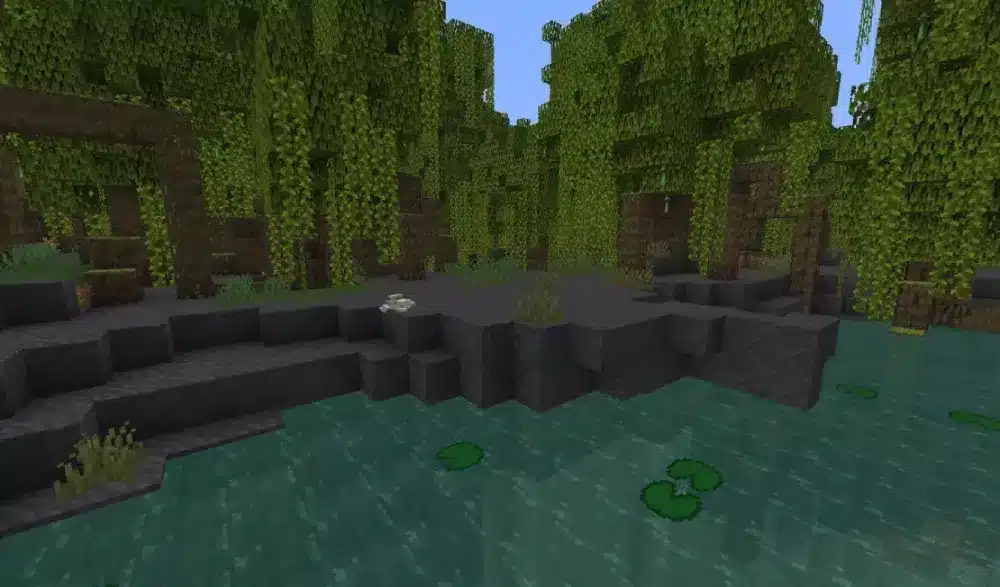
Mangrove Minecraft is one of the most atmospheric biome experiences in the Overworld. With muddy terrain, thick roots, shallow water, frogs, red-toned wood, and dense vegetation, the mangrove swamp gives players a completely different rhythm of exploration and building. It is not just another place to collect logs. It is a biome built around water, mud, vertical roots, and natural design.
Mangrove swamps are part of a much wider network of environments, each offering different terrain, resources, and building opportunities. This guide to exploring Minecraft biomes can help players compare these areas and plan which locations to visit next.
Mangrove Minecraft also brings practical value to survival worlds. You can collect mangrove logs, roots, propagules, mud, packed mud, mud bricks, frogs, tadpoles, and renewable clay opportunities. That makes the biome useful for builders, explorers, decorators, redstone users, and players who want a swamp base with a stronger visual identity.
A good Mangrove Minecraft guide should cover more than where the biome spawns. You need to know how propagules work, how trees grow, how mud blocks can be used, what frogs do, and which building styles fit the environment. Once you understand these systems, the biome becomes a resource hub instead of just a scenic destination.
In this complete guide, you will learn how to find Minecraft Mangrove swamps, collect a Mangrove tree Minecraft propagule, understand how to grow Mangrove trees Minecraft, farm Mangrove trees Minecraft, and use every major block in creative or survival builds. You will also see how ExitLag can help when connection problems affect multiplayer exploration.
Where do you find mangrove swamps in Minecraft?
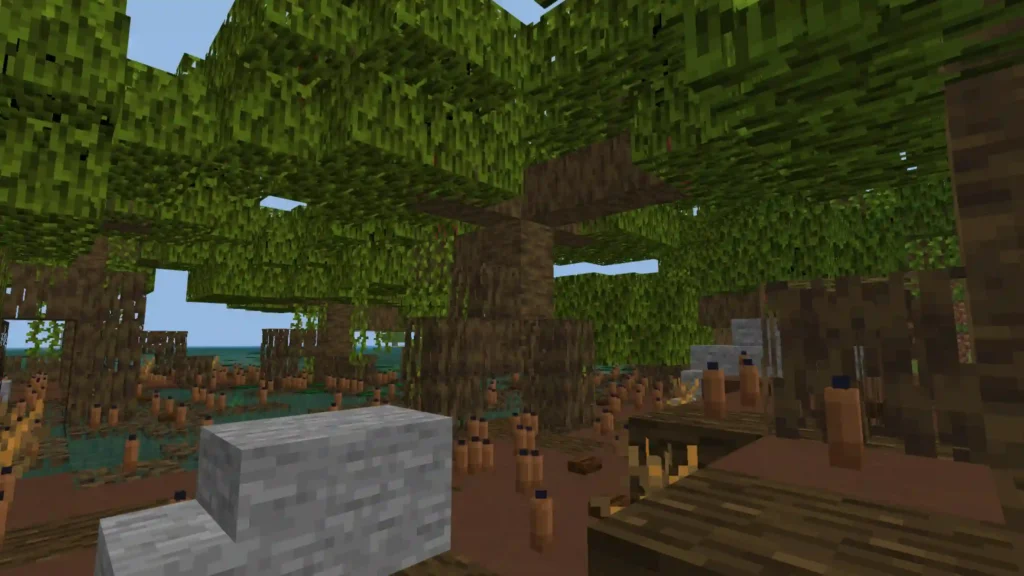
Mangrove swamps generate in warm, humid areas of the Overworld. They are not as common as forests or plains, so finding one can take time if you are exploring naturally. The best approach is to travel through warm regions, check low-lying terrain, and watch for muddy water, tall root systems, and red mangrove wood.
The Mangrove Minecraft biome is easy to recognize once it appears. Unlike a regular swamp, it feels denser and more vertical. Mangrove roots stretch into the mud and water, tree canopies overlap, and movement can be slower because you are constantly navigating around roots and shallow pools.
How to locate a mangrove swamp naturally
If you are playing without commands, explore warm regions first. Mangrove swamps are more likely to appear near warmer climate zones, so traveling near jungles, deserts, savannas, or warm coastlines can help. Boats are useful because the biome often includes shallow water and irregular terrain.
Look for these visual signs:
- Red or vermillion wood tones.
- Large trees with exposed roots.
- Mud blocks covering the ground.
- Shallow water channels.
- Frogs moving through the area.
- Dense leaf canopies and swamp-like vegetation.
Because the biome can be difficult to cross, bring food, a boat, building blocks, and tools before entering. It is easy to get slowed down by roots or lose direction under the canopy. A map or coordinates can also help you return later.
How to use commands to find the biome
If commands are enabled, the fastest way to locate a mangrove swamp is to use the biome locate command. Depending on your game version and edition, the command format may vary slightly, but it usually follows this idea:
/locate biome minecraft:mangrove_swamp
After running the command, the game gives you coordinates for the closest matching biome. You can then travel there or teleport if cheats are enabled.
This method is useful for creative building, testing farms, or starting a project that depends on mangrove materials. However, in survival worlds, finding the biome naturally can be more rewarding because it turns the search into a real exploration objective.
Before leaving, collect enough resources to make the trip worthwhile. A strong first visit should include Mangrove Minecraft logs, Minecraft Mangrove roots, at least one Mangrove tree Minecraft propagule, mud blocks, and enough notes to remember the location for future harvesting.
How do you grow mangrove trees in Minecraft?
Mangrove trees grow from propagules, not regular saplings. A propagule is a small green plant that can hang from mangrove leaves and later be collected by the player. It works like a tree-growing item, but it has unique behavior that makes it more flexible than many traditional saplings.
The biggest advantage is that propagules can be planted on land or underwater. This makes Mangrove Minecraft especially useful for coastal builds, river bases, artificial swamps, and decorative farms. If you enjoy shaping terrain around water, mangroves give you more freedom than most trees.
How to get a mangrove propagule
To get a propagule, first find a mangrove tree. Look under the leaves for green hanging propagules. Mature propagules can be collected and replanted. If you do not see one immediately, use bone meal on mangrove leaves to encourage a propagule to grow underneath.
A simple collection process looks like this:
- Find a healthy mangrove tree.
- Look under the leaf blocks.
- Use bone meal on leaves if needed.
- Wait for the propagule to mature.
- Break the mature propagule.
- Replant it on a valid block.
Propagules are important because they make mangrove wood renewable. Instead of traveling back to the original swamp every time you need logs, you can start your own mangrove farm near your base.
Best blocks and spacing for mangrove growth
Mangrove propagules can grow on several natural blocks, including dirt-like surfaces and mud. They can also be planted underwater, which is one of their most useful traits. However, mangrove trees can become large and irregular, so they need room.
For easier farming, use this setup:
| Farm element | Recommendation |
| Planting block | Mud, dirt, grass block, or similar valid block |
| Water access | Optional, but useful for swamp-style farms |
| Horizontal space | Leave several blocks around each propagule |
| Vertical space | Keep the area clear above the propagule |
| Tool | Axe for logs, shears if collecting leaves |
| Growth boost | Bone meal |
Mangroves can generate roots around the trunk, so do not plant them too close to important paths, machines, or buildings unless you want a wild natural look. For a cleaner wood farm, space propagules apart and leave room to cut the tree from bottom to top.
Understanding how to grow Mangrove trees Minecraft is essential if you want a sustainable wood source. Once you master propagules, Mangrove trees Minecraft become renewable, decorative, and practical for both survival and creative projects.
What resources can you collect in the Mangrove Minecraft biome?
The Mangrove Minecraft biome is valuable because nearly every major block has a use. You can harvest wood for building, roots for detail work, mud for crafting, and frog-related resources for lighting. It is a biome where natural blocks and functional resources overlap.
This makes the biome especially useful for players who want a consistent building palette. Mangrove wood, mud bricks, packed mud, roots, mossy details, vines, and water all work together visually. Instead of collecting materials from five different locations, you can design an entire base around one ecosystem.
Mangrove wood, planks, roots, and leaves
Mangrove wood has a warm red tone that stands out from oak, spruce, birch, jungle, acacia, dark oak, cherry, and bamboo palettes. It is excellent for builds that need strong color contrast without looking too artificial.
You can craft mangrove logs and planks into many standard wood items:
- Planks.
- Stairs.
- Slabs.
- Doors.
- Trapdoors.
- Fences.
- Fence gates.
- Signs.
- Hanging signs.
- Boats.
- Boats with chests.
The Mangrove tree Minecraft block family is especially strong for docks, bridges, swamp houses, fishing huts, watchtowers, and fantasy villages. The red planks pair well with mud bricks, deepslate, stone bricks, copper, moss, and jungle leaves.
The combination of red wood, exposed roots, and shallow water makes this material set particularly suitable for waterfront projects. Players looking for a practical starting point can use this Minecraft dock building guide to develop piers, fishing areas, and raised walkways that fit naturally into the swamp.
Mangrove roots are also valuable. They can be waterlogged and used as natural barriers, supports, underwater details, or decorative wall textures. Muddy mangrove roots add an even more swampy look and can be crafted by combining mud with mangrove roots.
Mud, packed mud, mud bricks, and renewable clay
Mud is one of the defining resources of the biome. You can collect it directly from mangrove swamps or create it by using a water bottle on dirt. This makes it renewable with the right setup.
Mud can be used in several ways:
| Resource | How to get it | Best use |
| Mud | Found in mangrove swamps or made with water bottles on dirt | Terrain, rustic floors, farms |
| Packed Mud | Crafted with mud and wheat | Building block and transition material |
| Mud Bricks | Crafted from packed mud | Walls, houses, paths, villages |
| Clay | Created through mud and dripstone mechanics | Bricks, terracotta, pottery-style builds |
| Muddy Mangrove Roots | Mud plus mangrove roots | Swamp decoration and natural supports |
Mud bricks are especially important for builders. They offer a softer, earthier style than stone bricks and look natural beside mangrove wood. Use them for foundations, chimneys, walls, paths, and village houses.
By combining Mangrove Minecraft materials with Minecraft Mangrove roots, Mangrove tree Minecraft wood, how to grow Mangrove trees Minecraft farms, and Mangrove trees Minecraft propagules, you can create a fully renewable swamp-building system.
What mobs and features make mangrove swamps special?
Mangrove swamps are not only about blocks. They also introduced a stronger sense of life to swamp areas. Frogs and tadpoles are the most important mobs connected to the biome, and they create new gameplay possibilities through breeding, transportation, and froglight farming.
The biome feels alive because water, mud, roots, and wildlife all interact visually. Frogs hop between muddy surfaces. Tadpoles grow in water. Roots shape the terrain. This makes the area ideal for players who like natural builds and environmental storytelling.
Water-based wildlife can add both function and atmosphere to a mangrove settlement. This guide to Minecraft fish and breeding explains how aquatic mobs work and offers additional ideas for ponds, enclosures, and other living features around a swamp base.
Frogs, tadpoles, and froglights
Frogs can spawn in swamp environments and can be bred using slimeballs. When frogs breed, they produce frogspawn in water. Frogspawn later hatches into tadpoles. Tadpoles can be picked up with a bucket and moved to another location.
Frog color depends on the temperature of the biome where the tadpole grows into a frog. This creates three frog variants:
- Temperate frogs.
- Warm frogs.
- Cold frogs.
Frogs are also connected to froglights. When a frog eats a small magma cube, it can produce a froglight. The color of the froglight depends on the frog variant. Froglights are useful because they provide attractive lighting for builds without needing torches everywhere.
For a mangrove base, froglights work beautifully under docks, inside treehouses, along bridges, and near water paths. They fit the natural fantasy of the area better than many modern-looking light blocks.
Frog behavior involves several mechanics that are easy to overlook, including breeding, temperature-based variants, and interactions with magma cubes. The complete Minecraft Wiki page about frogs provides a detailed reference for players planning sanctuaries or froglight farms.
What about fireflies?
Fireflies were discussed during the development period around The Wild Update, but they were not added to the final vanilla game. Because of that, players should not expect to find fireflies naturally in current standard Minecraft worlds.
If you see fireflies in a video, server, or world, they may come from a mod, add-on, datapack, marketplace item, or custom resource pack. Always check the version and platform before assuming a feature exists in vanilla Minecraft.
This correction matters because many older biome guides still mention fireflies as if they are part of the mangrove swamp. A more accurate Mangrove Minecraft guide should focus on features that players can actually use: mud, propagules, mangrove roots, frogs, tadpoles, and froglights.
What can you build with mangrove wood and mud?
Mangrove materials are perfect for organic, rustic, swamp, jungle, coastal, and fantasy builds. The red wood creates a bold base color, while mud blocks and mud bricks add warmth and texture. Roots make buildings feel anchored into the landscape instead of placed on top of it.
The most successful Mangrove Minecraft builds usually work with the biome rather than against it. Instead of flattening everything, use the existing roots, water channels, and tree shapes to guide your design.
Best build ideas for mangrove swamps
Here are some strong project ideas:
| Build idea | Main materials | Why it works |
| Swamp treehouse | Mangrove logs, roots, ladders, trapdoors | Uses vertical tree shapes naturally |
| Fishing dock | Mangrove slabs, fences, barrels, lanterns | Fits shallow water and rivers |
| Mud brick village | Mud bricks, packed mud, mangrove planks | Creates a warm natural settlement |
| Frog sanctuary | Water, mud, roots, froglights, fences | Highlights the biome’s wildlife |
| Witch hut upgrade | Mangrove wood, mud bricks, cauldrons | Improves classic swamp themes |
| Hidden base | Roots, leaves, mud, trapdoors | Blends into dense terrain |
| Clay farm workshop | Mud, dripstone, water systems | Turns biome resources into function |
A mangrove swamp base looks best when pathways are raised above the mud. Use slabs, stairs, fences, and trapdoors to create boardwalks. Then add waterlogged roots, hanging signs, vines, moss carpets, and froglights for atmosphere.
Block palettes that match mangrove materials
Mangrove wood is visually strong, so pairing it with the right blocks matters. Too many saturated colors can make the build look chaotic. Neutral and earthy blocks usually work best.
Good block combinations include:
- Mangrove planks plus mud bricks.
- Mangrove logs plus deepslate.
- Mangrove trapdoors plus packed mud.
- Mud bricks plus mossy stone bricks.
- Mangrove roots plus water and moss.
- Froglights plus leaves and vines.
- Copper plus mangrove planks for warm contrast.
For a cleaner build, use mangrove wood as an accent rather than the entire structure. For example, make the walls from mud bricks and use mangrove planks for roofs, doors, beams, and docks.
This is where Minecraft Mangrove resources become more than decoration. With a renewable Mangrove tree Minecraft farm, a clear plan for how to grow Mangrove trees Minecraft, and a steady supply of Mangrove trees Minecraft, you can support huge builds without stripping the original biome.
Players interested in exploring other Minecraft experiences can also look beyond the standard survival sandbox. The official Minecraft Dungeons information page introduces a more combat-focused adventure built around missions, equipment, and cooperative play.
How can ExitLag help in Mangrove Minecraft multiplayer worlds?
ExitLag does not change Minecraft biomes, increase spawn rates, or make mangrove trees grow faster. However, it can help players who experience routing-related lag, unstable ping, or packet loss while playing on multiplayer servers. That matters when you are exploring, building, fighting mobs, or traveling far from base with valuable resources.
In single-player offline worlds, ExitLag is not necessary because your connection to a server is not part of the experience. In multiplayer, Realms, hosted servers, or modded servers, connection quality can affect how smooth the game feels.
Why connection stability matters in Minecraft
Minecraft is not always as fast as a competitive shooter, but lag can still cause problems. When your connection is unstable, blocks may reappear after being mined, mobs may move unpredictably, boats may rubberband, and inventory actions may feel delayed.
In a mangrove swamp, this can be extra annoying because movement is already slower. Roots, water, mud, and dense terrain require careful navigation. If your connection is unstable, exploring the biome can feel clunky instead of relaxing.
Common multiplayer lag signs include:
- Blocks breaking and then reappearing.
- Delayed chest or inventory actions.
- Boats snapping backward.
- Mobs freezing and then moving suddenly.
- Fall damage applying late.
- Server timeouts.
- Rubberbanding while crossing water or roots.
If these issues happen only on one server, the server itself may be under load. If they happen across several servers, your route or local connection may be part of the problem.
How to use ExitLag for smoother multiplayer exploration
Before using any optimization tool, check your basic setup. Close downloads, pause cloud backups, restart your router if needed, and use a wired connection when possible. Then test your multiplayer server normally and compare it with ExitLag enabled.
A simple process looks like this:
- Open ExitLag before launching Minecraft.
- Select Minecraft or the relevant server/game profile.
- Apply the recommended route.
- Join the multiplayer world.
- Travel, mine, place blocks, and interact with inventories.
- Compare ping stability and rubberbanding.
- Keep the route that feels most consistent.
For Mangrove Minecraft exploration, a smoother connection helps most when you are traveling far, transporting frogs or tadpoles, building with friends, or collecting large amounts of wood and mud. It will not replace good server hosting, but it can improve the path your data takes to the server when routing is the issue.
FAQ: Mangrove Minecraft questions
Mangrove swamps have several mechanics that are easy to misunderstand because they work differently from older trees and biomes. These quick answers cover the most common player questions about propagules, growth, roots, and resources.
Use this section as a fast reference when planning farms, builds, or survival exploration.
To grow mangrove trees, collect a mature propagule from mangrove leaves and plant it on a valid block such as mud, dirt, or grass. You can also plant propagules underwater, which makes them useful for swamp, river, and coastal builds.
Use bone meal if you want faster growth. Leave enough space around the propagule because mangrove trees can grow with large roots and broad canopies.
You find mangrove trees in mangrove swamp biomes. These biomes usually appear in warm, humid Overworld regions and are recognizable by mud blocks, shallow water, exposed roots, frogs, and red mangrove wood.
If commands are enabled, you can use the locate biome command to find the nearest mangrove swamp. Otherwise, explore warm regions and coastlines until you spot the biome’s dense root systems.
Mangrove roots are decorative and functional building blocks. They can be waterlogged, used as natural supports, added to swamp walls, placed under docks, or mixed with mud to create muddy mangrove roots.
Builders often use them to make structures feel more natural. They are excellent for bridges, treehouses, underwater details, custom ponds, and overgrown ruins.
Yes. Mangrove propagules can be planted underwater, which makes mangrove trees unusually flexible compared with many other tree types. This is useful for riverside farms, swamp restoration, decorative ponds, and underwater-root builds.
However, you still need enough space for the tree to generate properly. Clear nearby blocks if growth fails.
No. Fireflies are not part of vanilla Minecraft as a standard mangrove swamp feature. Some mods, add-ons, or custom servers may include them, but they are not a normal resource you can find in an unmodded vanilla world.
Focus instead on frogs, tadpoles, froglights, mud, roots, propagules, and mangrove wood.
Explore, farm, and build with the mangrove swamp
Mangrove Minecraft is one of the best biome experiences for players who enjoy exploration, renewable resources, and natural building. It gives you red-toned wood, dramatic roots, mud blocks, mud bricks, frogs, tadpoles, froglights, and a unique environment that feels different from forests, jungles, and old swamps.
To get the most from the biome, find a mangrove swamp, collect propagules, build your own tree farm, gather mud, experiment with mud bricks, and use roots to make your builds feel alive. Whether you are creating a treehouse village, a frog sanctuary, a clay farm, or a hidden swamp base, the biome gives you everything needed for a memorable project.
Mangrove Minecraft becomes even better when your multiplayer connection is stable. If lag, packet loss, or rubberbanding keeps interrupting your exploration, try ExitLag before your next server session. Optimize your route, join your world, and explore Minecraft Mangrove swamps with smoother movement, steadier block interactions, and fewer connection interruptions. Start building with Mangrove tree Minecraft resources today, master how to grow Mangrove trees Minecraft, farm Mangrove trees Minecraft, and let ExitLag help keep your adventure flowing.
Got questions or want to connect with other players? Join the conversation at the ExitLag Forum!