A Minecraft Skeleton is one of the first ranged threats most players face, and it can punish sloppy movement faster than almost any early-game enemy.
If you keep taking surprise hits at night or in caves, Minecraft Skeleton fights usually feel unfair because arrows force you to react before you are ready.
So, what is Minecraft Skeleton in simple terms? A Minecraft Skeleton is a hostile archer mob that spawns in dark areas, attacks from range with a bow, and drops useful loot that can power up your survival progression.
This guide keeps things practical, and Minecraft Skeleton encounters will feel easier once you know where they spawn, how to block arrows, what loot matters, and how to farm them safely without turning your base into a danger zone.
Minecraft Skeleton basics: where they spawn and why they feel dangerous

Minecraft Skeleton pressure comes from two things: range and timing. You are often taking damage while you are still trying to see where the shots are coming from.
Skeletons also tend to appear in places where you are already busy, like mining tunnels, ravines, and nighttime travel routes, so the threat stacks quickly. That is why learning the Skeleton Minecraft spawn logic saves you resources and prevents risky fights.
To make this more visual, here is a quick checklist of the most common “high risk” places where a Minecraft mob like a skeleton will surprise you:
- Dark cave entrances near your base;
- Long mining tunnels with unlit corners;
- Ravines where mobs shoot from above;
- Dense forests with shadow zones;
- Nighttime paths between home and farms;
- Unlit base edges, especially behind walls or builds.
Spawn rules and the “darkness problem”
A Minecraft Skeleton can spawn in the Overworld at very low light, which is why caves, unlit forests, and unprotected base edges become dangerous so fast.
That means your best defense is not just armor, it is lighting and space control. If you remove dark spawn zones, you remove most surprise fights. This also helps when you are collecting Skeleton drops, because you control where fights happen instead of getting ambushed.
Skeleton variants you might meet
Not all skeletons are identical, and certain biomes can produce variants that behave a bit differently. For example, cold biomes can replace some spawns with strays, and some areas can introduce other skeleton types depending on the world.
You do not need to memorize every variant, but you should expect that some skeleton types can add extra pressure, especially when you are undergeared. That is also why practicing how to fight Skeletons with cover and line of sight is more reliable than trying to out-damage them in open space.
Skeleton Minecraft combat tips: winning fights without perfect gear
Skeleton Minecraft fights are easiest when you stop treating them like a DPS race. Instead, treat them like a timing puzzle: force misses, close the distance safely, then finish.
If you are early game, this is even more important, because your armor and food are limited.
Shield timing, strafing, and line of sight
A shield is one of the cleanest counters to skeleton arrows. Blocking early is usually safer than blocking late, especially when combat feels “off” due to timing or small delays.
Use these habits to make ranged mobs feel manageable:
- Keep your shield up while you reposition;
- Peek from cover instead of walking in a straight line;
- Strafe diagonally, not just left and right, to mess with aim;
- Break line of sight behind blocks, trees, or corners.
If you do this consistently, a single skeleton becomes a controlled fight, not a panic moment.
How to fight Skeletons in tight spaces
Tight tunnels make arrows harder to dodge, so terrain becomes your best tool. Build cover quickly and turn the fight into a corner duel.
A simple approach that works almost everywhere:
- Place a block as a “shield wall” in front of you;
- Peek, bait a shot, then step back;
- Move forward after the shot, then repeat.
Step-by-step plan for how to fight Skeletons safely:
- Put your shield up, then locate the shooter;
- Back into cover, then create a corner if you need one;
- Bait one arrow, then push forward during the reload window;
- Use a quick hit, then return to cover if your health is low;
- Finish the fight when you have space control.
This routine makes how to fight Skeletons feel repeatable, even when you are undergeared.
Skeleton drops and loot: what to keep, what to farm, and why it matters

Skeleton drops are one of the best early survival boosts, because they directly support ranged combat and farming progression.
You do not need to farm them immediately, but you should understand what is valuable so you do not ignore the loot that speeds up your world.
What Skeleton drops usually include
In general, skeletons drop bones and arrows, and they can also drop their bow in some cases.
That loot turns into real progress:
- Bones become bone meal for faster crop growth;
- Arrows let you fight safely at range;
- Bows support exploration, especially against creepers.
These Skeleton drops are why players often build early mob farms, because the materials scale your survival loop.
Quick loot table for new players
Before you look at the table, think of it as a simple priority guide. When you are early game, storage is limited and fights are messy, so you want to keep the loot that speeds up your survival loop the most.
| Loot item | Why it matters | Best early use |
| Bones | Converts into bone meal | Boost crops and trees |
| Arrows | Safe ranged damage | Clear caves, fight creepers |
| Bow (rare) | Early ranged weapon | Enchant later, save durability |
Minecraft mob awareness: how to reduce Skeleton spawns near your base
A Minecraft mob problem is usually a lighting problem. If you keep seeing skeletons near home, your base perimeter is giving them space to spawn.
Spawn-proofing and light control basics
If you want fewer skeletons, remove dark patches. That includes:
- Gaps behind buildings;
- Tree shadows near walls;
- Unlit mine entrances;
- Long grass areas you never check.
You do not need to make everything bright like daytime, but you do need to remove “safe spawn tiles” close to where you walk.
Skeleton spawner strategy: fight it or use it
A skeleton spawner changes the game because it creates a repeatable source of bones and arrows. The danger is that it can also overwhelm you if you fight it wrong.
Two safe options:
- Disable it temporarily with light while you loot the room;
- Turn it into a controlled skeleton farm when you have the gear.
If you are early game, treat spawners with respect. Come back when you have a shield, food, and enough blocks to build cover.
Skeleton farm basics: safe farming without risky gimmicks
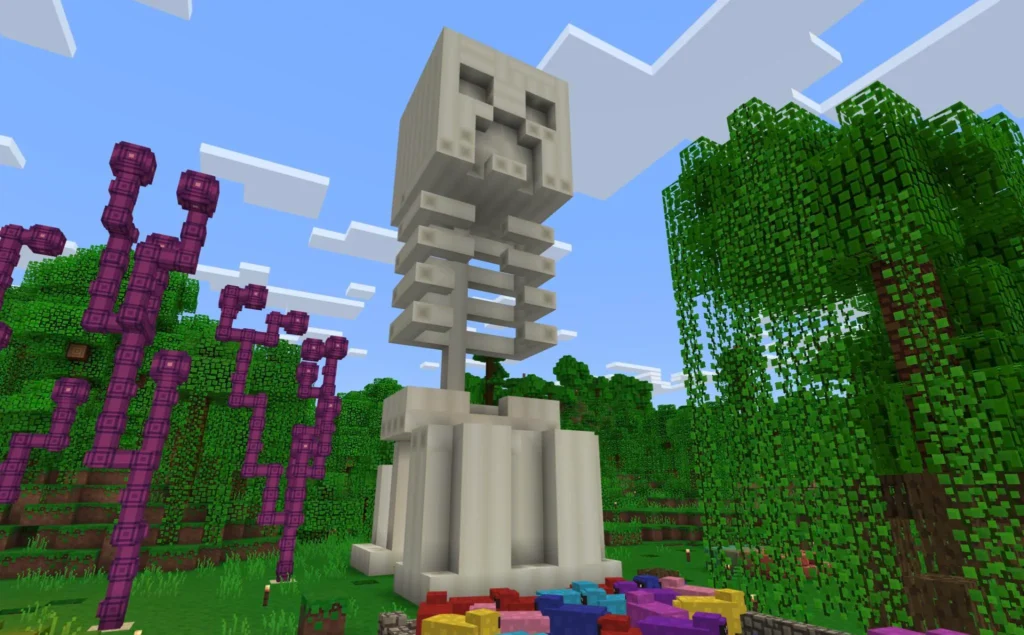
A skeleton farm can be as simple as “controlled spawner kills” or as advanced as full mob grinders. Either way, the goal is predictable loot with minimal danger.
Starter skeleton farm from a dungeon spawner
Beginner-friendly goals:
- Keep the spawner active, but limit where mobs can move;
- Funnel mobs into a single kill zone;
- Add an escape path so you never get trapped.
Common mistakes that make farms fail
Avoid these issues:
- Making the room too cramped to manage safely;
- Forgetting to light nearby caves that steal spawns;
- Building the kill zone too close to where mobs can hit you;
- Not planning storage, so items overflow and despawn.
A good farm feels boring. Boring is good, because boring means safe and consistent.
Minecraft Skeleton and multiplayer performance: smoother fights with ExitLag
Minecraft Skeleton fights in multiplayer can feel worse when your connection is unstable, because tiny delays make arrows harder to react to and blocking feel inconsistent.
What connection issues look like during Skeleton fights
In online play, instability often shows up as:
- Delayed shield blocks or late damage registration;
- “Teleport” movement when you strafe;
- Weird hit timing when you try to close distance;
- Sudden spikes during busy server hours.
How ExitLag helps?
ExitLag is a route optimization tool that uses multiple routes to find a more stable path to game servers, which can reduce issues like lag spikes, jitter, and packet loss.
ExitLag is not a VPN. It is not designed to change your location or hide your IP. Its focus is improving routing quality for online gaming.
FAQ
Use cover and a shield, then push during the reload window. Keep food ready so you can recover if you take a hit.
Skeleton drops like bones and arrows support farming and combat. Bones turn into bone meal, and arrows power ranged fighting.
Skeleton Minecraft enemies attack from range, so they punish straight movement. Zombies are easier to kite, while skeletons force you to manage line of sight.
Light up dark areas, flatten uneven terrain, and remove shadow zones behind walls and trees. Spawn-proofing is the fastest prevention method.
Yes, a skeleton spawner can become a reliable skeleton farm for bones and arrows, especially once you have a shield and basic building blocks.
Ready to survive Minecraft Skeleton fights more consistently with ExitLag?
If you master cover, shield timing, and spawn-proofing, Minecraft Skeleton encounters stop being scary and start becoming useful, because the loot supports your entire survival loop.
If you also play online, a stable connection helps your reactions feel real and your blocks feel reliable, which matters most when arrows are flying.
Try ExitLag if you want steadier sessions, and remember this: Minecraft Skeleton combat is easier when your movement and timing are not fighting your network.
Got questions or want to connect with other players? Join the conversation at the ExitLag Forum!