
Physics games are one of the best ways to turn complex science concepts into something practical, visual, and fun. Instead of only memorizing formulas, players can test motion, force, collisions, and balance directly through gameplay. That makes learning feel more intuitive and much less intimidating.
If you want “learning through play” to stick, it helps to pick a theme that keeps you coming back. Some people learn best with tension and timing, where one small change flips the outcome instantly. This list of physics-friendly horror games to try is a good fit when you want that kind of pressure-driven experimentation.
For beginners and curious learners, physics games can make abstract ideas easier to understand because you see cause and effect immediately. A small change in angle, weight, speed, or timing can completely change the outcome, which is exactly how real-world physics works.
If you want to explore physics games in a smarter way, this guide will help. We will cover what they are, how they work, why they are effective, how to choose the right titles, and which games are worth trying first. Along the way, we will also connect the topic with physics based games, realistic physics, simulation games, gravity games, and physics puzzles so you can build a better learning path.
What are physics games?
Physics games are interactive games that use physics principles as part of the gameplay. Instead of treating science as background theory, these games make mechanics like gravity, momentum, force, friction, and motion part of the challenge itself.
That means the player often needs to think like an experimenter:
- What happens if I change the angle?
- What if I reduce weight?
- What if I add speed?
- How does gravity affect the object?
- Will this structure hold or collapse?
This is why physics games are so effective for learning. They create a hands-on environment where experimentation is rewarded.
Many of the best physics based games combine problem-solving with trial and error. Players learn by testing, failing, adjusting, and trying again. That process helps build intuition, not just textbook knowledge.
How physics games teach through interaction
The biggest advantage of physics games is interactivity. When players must apply concepts to progress, learning becomes active instead of passive.
For example, a player may need to:
- build a stable bridge,
- launch an object with correct force,
- solve a trajectory challenge,
- balance shapes under gravity,
- or use momentum to reach a target.
These mechanics are common in physics puzzles and many simulation games, and they help learners connect scientific ideas to outcomes they can see and control.
Why they work for different ages and skill levels
Another strength of physics games is flexibility. Some are simple and playful, while others are more advanced and sandbox-driven.
This means they can work for:
- kids learning basic motion and balance,
- teens exploring mechanics and problem-solving,
- adults revisiting science in a practical way,
- teachers looking for interactive classroom tools,
- and gamers who enjoy realistic physics systems.
Because there are so many formats, physics games can fit different learning styles and goals.
Why are physics games so effective for learning?
A lot of people struggle with physics because it can feel abstract at first. You read about force, acceleration, and momentum, but the concepts do not always “click” until you see them in action.
That is where physics games help. They turn scientific principles into visible, testable systems. Instead of just reading about gravity, you interact with it. Instead of only solving equations, you observe motion and adjust variables.
This is also why simulation games and physics puzzles are often used as support tools in learning environments.
They make abstract concepts feel concrete
In strong physics based games, cause and effect is immediate. If your design fails, you can usually see why. If your timing is wrong, the object misses the target. If balance is off, the structure collapses.
This makes concepts like:
- gravity,
- momentum,
- friction,
- force,
- and energy transfer
much easier to understand in practice.
Games with realistic physics are especially useful because they simulate motion and interactions in a way that feels believable and repeatable.
They improve problem-solving and experimentation skills
Learning physics is not only about formulas. It is also about reasoning:
- predicting outcomes,
- testing assumptions,
- interpreting results,
- and making adjustments.
The best physics games train these habits naturally.
Players constantly ask:
- Why did that fail?
- What variable changed?
- How can I improve stability?
- What happens if I use less force?
This process is central to both science learning and game-based problem solving.
They increase motivation and engagement
Physics can become much more enjoyable when learning feels like a challenge instead of a lecture. The game format adds:
- goals,
- feedback,
- progression,
- and experimentation freedom.
That is why gravity games, physics puzzles, and creative simulation games often keep learners engaged longer than traditional drills.
Once the basics feel intuitive, adding combat and build choices can make physics concepts show up in a different way—timing, positioning, momentum, and cause-and-effect under stress. That’s where action RPGs can be surprisingly educational, even when they’re entertainment-first. Use this overview of what defines an action RPG to find games where systems and choices stay interactive.
What features make the best physics games?
Not all physics games teach equally well. Some are fun but shallow. Others are educational but not very engaging. The best ones balance both.
If you want to choose better physics based games, look for the features below.
Before the subsections, here is the big idea: strong games let players interact with systems, not just click through content.
Interactive learning and clear cause-and-effect
Great physics games make the relationship between action and result easy to observe.
Look for games that allow you to:
- change variables,
- test solutions,
- fail safely,
- and retry quickly.
This is especially valuable in physics puzzles, where solving the challenge depends on understanding the system rather than guessing.
Realistic or consistent physics behavior
A game does not need perfect real-world simulation to teach well, but it should have consistent rules. If the system behaves unpredictably for no reason, learning becomes frustrating.
That is why realistic physics (or at least stable internal logic) is so important. It helps players form accurate mental models.
Examples of useful consistency:
- gravity always affects mass in predictable ways,
- momentum carries through motion logically,
- collisions behave in repeatable patterns,
- structures fail under load in understandable ways.
This is where many simulation games stand out.
Problem-solving depth and replayability
The best physics games encourage experimentation, not one-click answers. They allow multiple solutions or different approaches to the same challenge.
That improves:
- creativity,
- critical thinking,
- and replay value.
Games that support sandbox building or open-ended design are often excellent for this, especially if you enjoy gravity games and engineering-style physics based games.
Good feedback and low frustration
Learning-focused games work best when they give useful feedback. Players should be able to see what went wrong and improve.
Helpful features include:
- quick resets,
- visual indicators,
- stable controls,
- clear objectives,
- and incremental difficulty.
This keeps physics games fun instead of overwhelming.
What are the best physics games to play for learning?
There are many great options, but the best choice depends on what you want to learn. Some games are better for creativity and sandbox experimentation. Others are better for structured physics puzzles or engineering-style challenges.
The list below organizes your original examples into a cleaner, more practical guide.
Top physics games and what they teach
Here are strong examples of physics games and why they work:
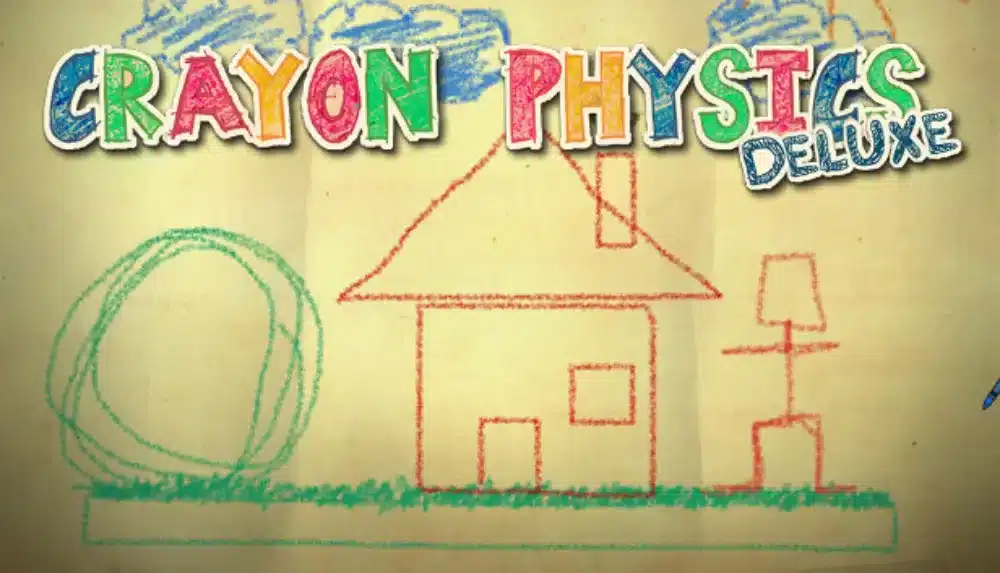
- Crayon Physics Deluxe A creative puzzle game where drawing objects solves challenges. Great for motion, gravity, and momentum intuition.
This is one of the cleanest examples of physics learning through creativity: you sketch a solution, then watch the system respond in real time. It’s great for building intuition around gravity, momentum, and simple machines without needing a tutorial-heavy approach. Here’s the official site for Crayon Physics Deluxe if you want the original source and details.
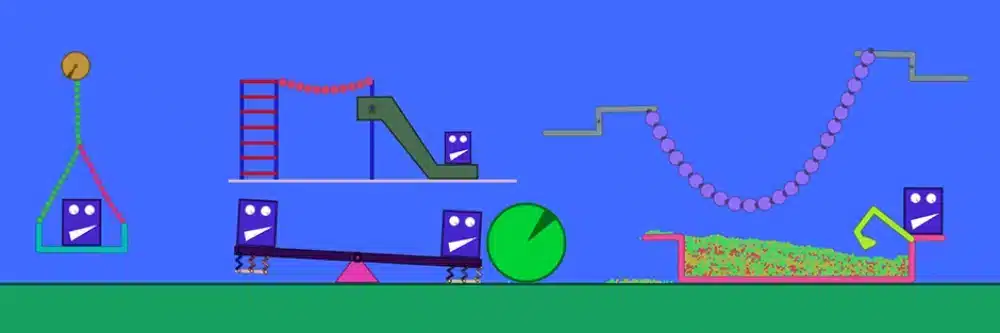
- Algodoo (Phun) One of the most flexible simulation games for experimenting with force, friction, collisions, and mechanics in a sandbox format.
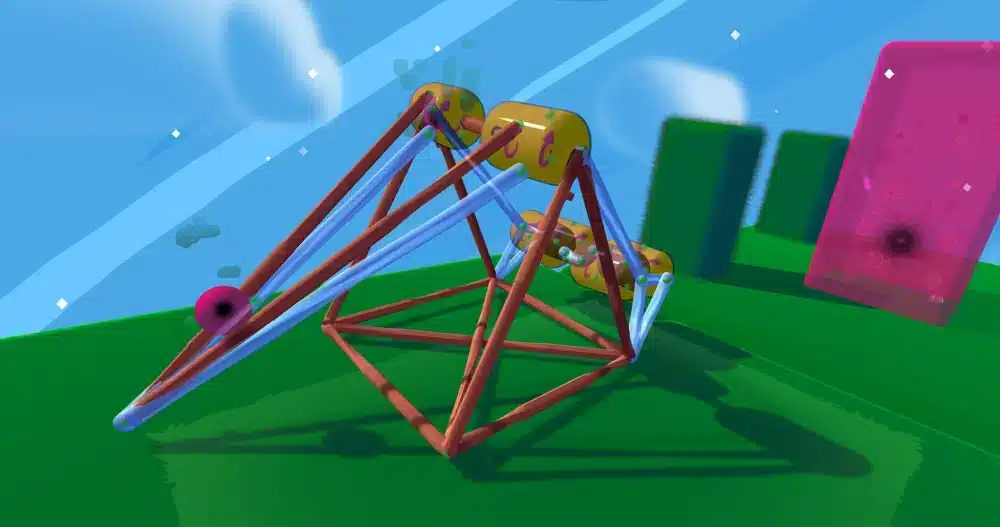
- Fantastic Contraption Build machines to move objects. Strong for engineering thinking, motion planning, and force transfer.
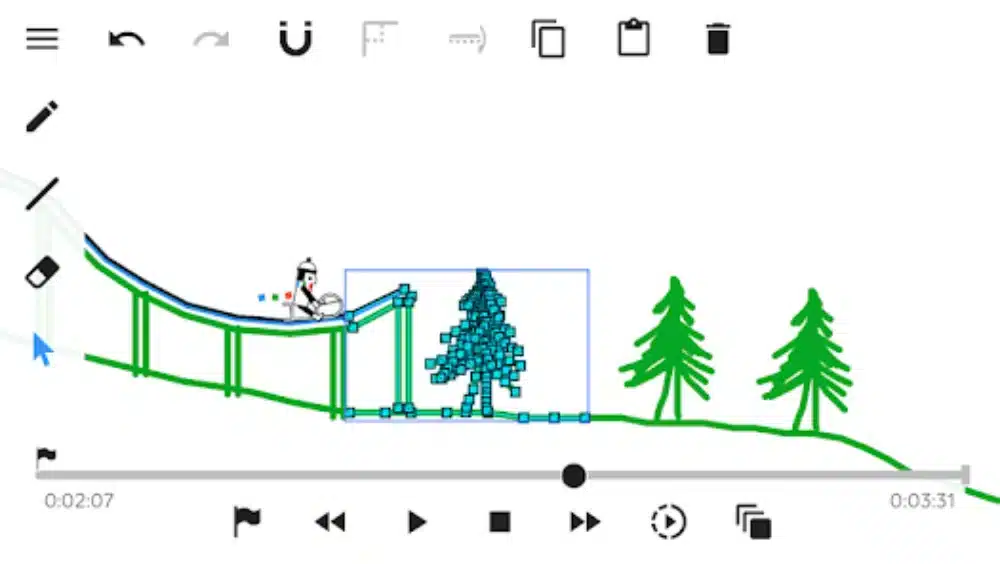
- Line Rider A classic example of playful gravity games, teaching inertia, slope design, momentum, and motion through track creation.
- Happy Wheels More chaotic than educational in tone, but still a clear example of physics based games with ragdoll motion, collision, and force effects.
- Physion A 2D physics simulation tool/game for building scenes and testing interactions. Useful for broad experimentation.
- Gravity Master A puzzle-focused title built around balance and gravity interaction. Great for learners who like direct physics puzzles.
- Cut the Rope Excellent for timing, tension, gravity, and motion planning in short puzzle levels.
Cut the Rope is especially useful because it teaches timing and prediction in short loops—perfect for quick practice sessions. You can replay levels with small variations and immediately see how changes in angle or sequence affect motion. For more info and versions, use the official Cut the Rope site.
- Bridge Builder A strong entry point into structural logic, load distribution, and engineering-style simulation games.
- Portal: The Flash Version A fun way to explore momentum and spatial reasoning through portal mechanics and movement-based problem solving.
Best types by learning goal
| Game | Best for learning | Style | Main concepts |
| Algodoo | Open experimentation | Sandbox / simulation games | Force, friction, collisions |
| Bridge Builder | Engineering basics | Structure puzzle | Load, balance, support |
| Cut the Rope | Beginner-friendly problem solving | Short physics puzzles | Gravity, tension, timing |
| Line Rider | Motion intuition | Creative gravity games | Momentum, inertia, slope |
| Fantastic Contraption | Mechanical thinking | Build-and-test | Force, motion, machine design |
Which one should beginners start with?
If you are new to physics games, a simple path is:
- Start with Cut the Rope or Line Rider for intuitive concepts
- Move to Bridge Builder for structure and force thinking
- Try Algodoo for deeper experimentation
- Explore more advanced or creative physics based games after that
This gives you a progression from accessible physics puzzles to more open simulation games.
How can you learn physics in a fun way with games and activities?
The best way to learn physics is usually a mix of methods. Physics games are powerful, but they work even better when combined with videos, experiments, and guided practice.
If your goal is long-term understanding, think of games as your interactive lab.
Start with physics games and physics puzzles
Begin with physics games that make concepts easy to observe. Focus on one idea at a time:
- gravity,
- motion,
- force,
- balance,
- or momentum.
Short physics puzzles are especially good for this because they isolate a single problem and teach through repetition and feedback.
Add simulation games for deeper experimentation
After building basic intuition, use simulation games or sandbox tools to test ideas more freely.
This helps you:
- compare outcomes,
- manipulate variables,
- and build your own experiments.
Games with realistic physics are very useful here because they reinforce consistent behavior across many scenarios.
If you want a different kind of “sandbox,” try games where learning comes from moving through spaces and discovering how systems behave naturally. Exploration-driven titles are great for building intuition because you’re constantly testing routes, momentum, and environmental interactions without rigid prompts. A good starting list is exploration-focused games worth playing.
Use educational videos and interactive simulations
To reinforce what you learn in physics games, combine them with:
- science explainers,
- classroom-friendly simulations,
- and hands-on examples.
This helps connect gameplay intuition to formal vocabulary and equations.
Try real-world mini experiments
Even simple experiments can improve understanding:
- pendulums,
- ramps,
- toy cars,
- falling objects,
- balance tests.
When you combine these with physics based games, your understanding becomes much stronger because you are learning across both digital and physical contexts.
Practical learning checklist
Use this routine to study with fun and structure:
- Play a short physics game session (15–30 min)
- Identify one concept used in the game
- Write what changed the outcome
- Watch a quick explainer on that concept
- Repeat with a different puzzle or level
- Test one real-world example if possible
This makes physics games part of a real learning process, not just entertainment.
What are the best physics games for kids, students, and casual players?
Different players need different types of physics games. A child who is learning gravity basics does not need the same tool as a student practicing engineering concepts.
Choosing by audience helps a lot.
Best physics games for kids and younger learners
For younger learners, the best options are:
- visual,
- simple,
- quick to restart,
- and easy to understand.
Good choices:
- Cut the Rope
- Line Rider
- simple gravity games
- beginner-friendly physics puzzles
These games teach cause-and-effect and motion without requiring advanced reading or technical knowledge.
Best physics based games for students
Students often benefit from games that combine experimentation and problem-solving.
Good picks include:
- Bridge Builder
- Fantastic Contraption
- Algodoo
- broader simulation games
These support deeper thinking about force, balance, and system behavior while staying engaging.
Best options for casual players who want to learn by playing
Casual players may prefer games that are fun first, educational second. That is totally valid. Many physics games still teach useful principles even when they are playful or chaotic.
Look for:
- strong feedback,
- clear mechanics,
- and consistent physics systems.
Titles with realistic physics and creative systems tend to be especially rewarding over time.
How does ExitLag help in physics games and online simulations?
Physics learning games are often single-player, but many browser tools, cloud-based platforms, and online simulation games still depend on a stable connection. When lag disrupts interaction, it can break focus and make learning less effective.
That is why connection quality matters, even in educational or puzzle-focused physics games.
Why lag hurts learning in interactive physics games
Lag can interrupt:
- timing-based physics puzzles
- object interactions in browser games
- loading and responsiveness in online simulations
- classroom demonstrations using web tools
- collaborative sessions in networked simulation games
When that happens, it becomes harder to tell whether a result came from physics behavior or connection delay.
Where ExitLag can help
ExitLag can help support smoother online experiences in supported scenarios by improving route stability and reducing issues like ping spikes, jitter, and route-related instability.
This may be useful if you play:
- browser-based physics games
- online simulation games
- interactive learning platforms
- multiplayer sandbox tools with physics systems
What ExitLag does not replace
ExitLag does not replace:
- device performance optimization
- browser optimization
- game engine limitations
- local hardware upgrades
Think of it as a connection support layer. If your online physics based games or simulations feel unstable due to routing-related issues, ExitLag may help improve consistency.
Can physics games really help with real-world physics understanding?
Yes, they can—especially for intuition and conceptual understanding. Physics games are not a full replacement for formal study, but they are excellent for building mental models.
They help players answer questions like:
- Why did this move that way?
- Why did the structure fail?
- Why did the object gain speed?
- Why did the angle matter?
That kind of thinking is the foundation of physics learning.
What physics games are best at teaching
Physics games are especially strong at teaching:
- intuition,
- experimentation,
- prediction,
- and cause-and-effect reasoning.
This is why physics puzzles, gravity games, and simulation games are so effective as support tools.
What still requires formal study
To go deeper, learners still need:
- formulas,
- definitions,
- units,
- and structured explanation.
But the advantage is huge: after using good physics based games, the formal material often makes more sense because you have already “felt” the mechanics through play.
FAQ
What are physics games?
Physics games are games that use physics concepts like gravity, motion, force, momentum, and collisions as part of the gameplay. Players learn by interacting with systems and solving challenges.
Are physics games good for learning?
Yes. Physics games can be very effective for building intuition and problem-solving skills because they make abstract concepts visible and interactive.
What is the difference between physics based games and physics puzzles?
Physics based games is a broad category that includes many types of games using physics mechanics. Physics puzzles are a subcategory focused on solving challenges through physics logic, timing, and object interaction.
Do physics games use realistic physics?
Some do, and some simplify things for fun. Games with realistic physics or consistent mechanics are usually better for learning because they help players build accurate mental models.
What are good beginner physics games?
Good beginner-friendly physics games include Cut the Rope, Line Rider, and simple gravity games. They are easy to start and teach core ideas like motion, timing, and momentum.
Can simulation games help me learn physics better than textbooks?
Simulation games can greatly improve intuition and engagement, but they work best as a complement to textbooks or structured lessons. Together, they create a stronger learning experience.
Does ExitLag help physics games?
ExitLag can help in supported online scenarios by improving route stability and reducing latency-related issues in browser-based or online physics games and simulation games.
Final thoughts
Physics games are one of the most effective ways to make science feel practical, visual, and enjoyable. Whether you prefer quick physics puzzles, creative gravity games, or deeper simulation games with realistic physics, the key benefit is the same: you learn by testing, observing, and improving. That process builds intuition, problem-solving skills, and confidence.
If you want to learn physics in a more engaging way, start with beginner-friendly physics games, then move into more advanced physics based games and sandbox tools as your understanding grows. And if you use online platforms or browser-based simulations, try ExitLag to help keep your sessions smoother and more stable while you focus on learning through play with physics games.