Sea of Thieves player count remains one of the most interesting indicators of the game’s long-term success. Years after its original release, Rare’s pirate adventure continues to bring crews together across open waters, where players can explore islands, hunt for treasure, complete stories, battle rival ships, and build their own reputation. However, one question continues to matter for both returning pirates and newcomers: how many people are still playing?
The Sea of Thieves player count can help answer more than whether the game is popular. It can also provide context about matchmaking, community activity, platform distribution, seasonal events, and the game’s ability to keep players returning. Because Sea of Thieves is available across Xbox and PC platforms and supports crossplay, its complete audience is larger than the figures visible on any single storefront.

What is the Sea of Thieves player count?
The Sea of Thieves player count is the estimated number of people actively playing Sea of Thieves across its different platforms and time periods. Because Microsoft and Rare do not provide a single public real-time counter covering every platform, available information must be interpreted using sources such as SteamCharts, platform activity, community reports, and engagement signals. Therefore, individual figures should be treated as estimates rather than an exact representation of everyone currently sailing.
After all, Sea of Thieves is built around shared multiplayer experiences. A crew can include different types of players, from casual explorers and lore enthusiasts to dedicated PvP crews and streamers. For that reason, the size and activity of the community directly influence how easy it is to find other pirates, participate in events, and experience the world as intended.
Why Sea of Thieves Player Count Still Matters
The Sea of Thieves player count is useful because player numbers provide a snapshot of the game’s health. A multiplayer game needs an active audience to maintain quick matchmaking, populated servers, community events, and a steady flow of encounters.
For Sea of Thieves, this becomes particularly important because much of the experience depends on meeting other crews. The game is not simply a collection of isolated missions. Its appeal comes from unpredictable interactions, alliances, naval combat, exploration, and stories that can change depending on what another crew does.
What Does the Sea of Thieves Player Count Tell Us?
Player-count data can reveal several aspects of a multiplayer game’s condition.
First, it can indicate whether there is enough activity for a healthy matchmaking environment. Second, it can show whether updates are attracting attention. Third, it can provide clues about how strongly different platforms contribute to the overall community.
However, a single number should never be interpreted in isolation.
Steam activity, for example, represents only players using the Steam version. It does not include people playing through Xbox consoles, Microsoft Store PC, or other supported ecosystems. Therefore, SteamCharts can be valuable while still representing only one part of the overall picture.
Why Multiplayer Games Need Active Communities
A large community can make a significant difference to the way a game feels.
For Sea of Thieves, an active population can mean:
- More opportunities to encounter other crews during voyages.
- More active participation in seasonal events and community activities.
- Faster and more reliable matchmaking.
- More players discussing strategies, lore, and new content.
- Greater visibility on streaming and video platforms.
At the same time, player count does not automatically determine quality. A smaller community can remain highly dedicated, while a massive audience can still experience matchmaking or server issues.
The important point is that Sea of Thieves has several characteristics that make community activity especially relevant. Its shared world, cross-platform ecosystem, and player-driven encounters all benefit from a steady population.
What Is Sea of Thieves?
Developed by Rare and published by Xbox Game Studios, Sea of Thieves is a multiplayer action-adventure game centered on piracy and exploration.
Players take on the role of pirates and travel through a shared ocean environment. Voyages can involve treasure hunting, trading, exploration, combat, story content, and encounters with other crews.
Since its 2018 launch, the game has expanded considerably. Its identity is no longer based solely on sailing and treasure hunting. Instead, the broader experience includes narrative adventures, seasonal content, cosmetics, community activities, and different approaches to PvE and PvP.
This evolution is one of the reasons the Sea of Thieves current player count remains worth monitoring. The game has repeatedly introduced new reasons for players to return, while its sandbox structure allows experienced crews to create their own objectives.
Sea of Thieves Current Player Count and Community Activity
The Sea of Thieves current player count is difficult to establish with complete precision because there is no single public source combining every supported platform into one real-time figure.
Instead, available data needs to be considered as a collection of signals.
Steam provides the clearest publicly observable concurrent-player information because third-party services can track activity on the platform. Xbox and Microsoft Store activity, however, is not presented in exactly the same way. Consequently, Steam numbers should not be treated as the total Sea of Thieves population.
How Third-Party Tracking Works
Third-party tracking platforms can provide useful information about activity over time.
For PC players using Steam, SteamCharts is particularly useful because it can show historical trends, peaks, averages, and changes in concurrent activity.
That makes it possible to identify patterns around major updates, weekends, seasonal events, and other moments that influence player activity.
However, these figures should be interpreted carefully. A concurrent-player number answers a specific question: how many players are online at approximately the same time on the tracked platform?
It does not necessarily answer how many unique people played during an entire day or month.
Concurrent Players vs. Daily Active Players
These terms are often confused.
Concurrent players represent the number of people playing simultaneously. Daily active players represent unique users who play during a particular day.
For example, if 20,000 people are playing simultaneously at a particular moment, that does not mean only 20,000 people played the game that day.
A player may play for several hours, while another person may log in for thirty minutes. Across an entire day, the total number of unique players can therefore be substantially larger than a single concurrent-player measurement.
This distinction is essential when evaluating the Sea of Thieves live player count.
Where the Estimates Come From
The broader estimates referenced in discussions about Sea of Thieves can come from several sources:
- SteamCharts and other Steam tracking services.
- Xbox ecosystem activity.
- Microsoft Store PC activity.
- Game Pass engagement.
- Twitch viewership.
- YouTube activity.
- Community discussions and player reports.
- Official developer communications.
Each source measures something different.
For that reason, combining several signals can provide a more useful understanding of the community than relying on one number alone.
Sea of Thieves Live Player Count: Understanding Peak Activity
The Sea of Thieves live player count can change significantly depending on the time of day, day of the week, region, and current game content.
Multiplayer games commonly experience higher activity during weekends and evenings because more players have free time. Sea of Thieves follows the same broad pattern.
When Does Sea of Thieves Usually Get Busy?
Peak activity can be influenced by several factors.
Weekends are naturally important because players have more time to form crews and complete longer voyages. Seasonal events can also create temporary increases because returning players want to experience new content or obtain limited rewards.
Major updates can have an even stronger effect.
When a substantial update introduces new mechanics, narrative content, cosmetics, or activities, players who have not logged in recently may return to see what has changed.
Events Can Change Player Activity
Community events and major crossover content can create substantial visibility.
This effect extends beyond the people who immediately start playing. A popular update may also increase Twitch streams, YouTube videos, social media discussions, and community activity.
As a result, player-count trends should be viewed alongside broader engagement signals.
A sudden increase in Steam activity, for example, may coincide with a major content release. A Twitch spike may indicate that streamers are showcasing new mechanics. A rise in community discussions can suggest renewed interest even when a complete cross-platform player count is unavailable.
Why Numbers Can Rise and Fall
Player activity is rarely constant.
Several factors can produce fluctuations:
- A major content update attracts returning players.
- New players discover the game through promotions or subscriptions.
- A seasonal event creates a short-term reason to log in.
- Players complete the available content and temporarily leave.
- Another major game launches and competes for attention.
- Community interest returns when new content arrives.
Therefore, a temporary decline should not automatically be interpreted as a permanent loss of interest.
Sea of Thieves Player Count on Xbox
The Sea of Thieves player count on Xbox is particularly important because Xbox represents a central part of the game’s ecosystem.
As an Xbox Game Studios title, Sea of Thieves has a strong relationship with the Xbox platform. It is also designed around cross-platform multiplayer, allowing the broader player base to interact rather than remaining divided into completely separate communities.
Why Xbox Is Crucial to Sea of Thieves
Xbox contributes to the game’s ecosystem in several ways.
Game Pass can lower the barrier to entry for subscribers who want to try the game without purchasing it separately. This can introduce players who might otherwise never have started a long-running multiplayer title.
Xbox also provides an established social environment for friends who want to form crews and play together.
The result is a platform ecosystem that can continually introduce new pirates while giving returning players reasons to come back.
Xbox One and Xbox Series X|S
Sea of Thieves has been available across generations of Xbox hardware.
Xbox One helped establish the game’s console audience, while Xbox Series X|S provides newer hardware for players who want the experience on current-generation consoles.
The exact distribution between these systems can change over time, and publicly available sources do not provide a complete real-time breakdown of every active Xbox player.
Still, both generations have contributed to the game’s long-term console community.
Why Game Pass Matters
Subscription services can influence multiplayer populations differently from traditional game sales.
A player who already has access through a subscription can try Sea of Thieves with relatively little additional friction. If that player enjoys the experience, they may become a regular member of the community.
This can create a continuous flow of new users.
It also helps explain why storefront-specific statistics may underestimate the overall player base. A player accessing the game through an Xbox subscription is not represented by SteamCharts, even though that person may be actively participating in the same multiplayer ecosystem.
Cross-Platform Sea of Thieves Player Count
When considering the Sea of Thieves player count all platforms, crossplay becomes one of the most important factors.
The game supports a connected ecosystem involving Xbox and PC. PC players can access Sea of Thieves through different storefront environments, including Steam and Microsoft Store.
This means that a player looking only at Steam activity is seeing one segment of a much larger community.
Platforms Supporting Sea of Thieves
The ecosystem includes:
- Xbox One.
- Xbox Series X|S.
- PC through the Microsoft Store.
- PC through Steam.
These platforms contribute to the overall matchmaking environment.
Because players are not completely separated by storefront, activity on one platform can benefit the experience of users on another.
Why Crossplay Matters
Crossplay can help maintain a healthy multiplayer environment.
Its main advantages include:
- A larger shared matchmaking pool.
- More opportunities to encounter different crews.
- Easier multiplayer sessions between friends on different systems.
- More consistent participation in community activities.
- Less dependence on the population of a single platform.
For Sea of Thieves, these benefits are especially relevant because the game’s social design is based on interactions between crews.
Crossplay Makes Player-Count Comparisons Difficult
There is also a downside to analyzing the numbers.
Because different platforms report activity differently, it is difficult to combine their statistics into a single exact number.
Steam may provide concurrent-player measurements. Xbox may provide broader ecosystem engagement signals. Microsoft Store activity is not necessarily exposed in the same way.
Therefore, the most responsible approach is to describe the available figures as estimates and explain what each measurement actually represents.
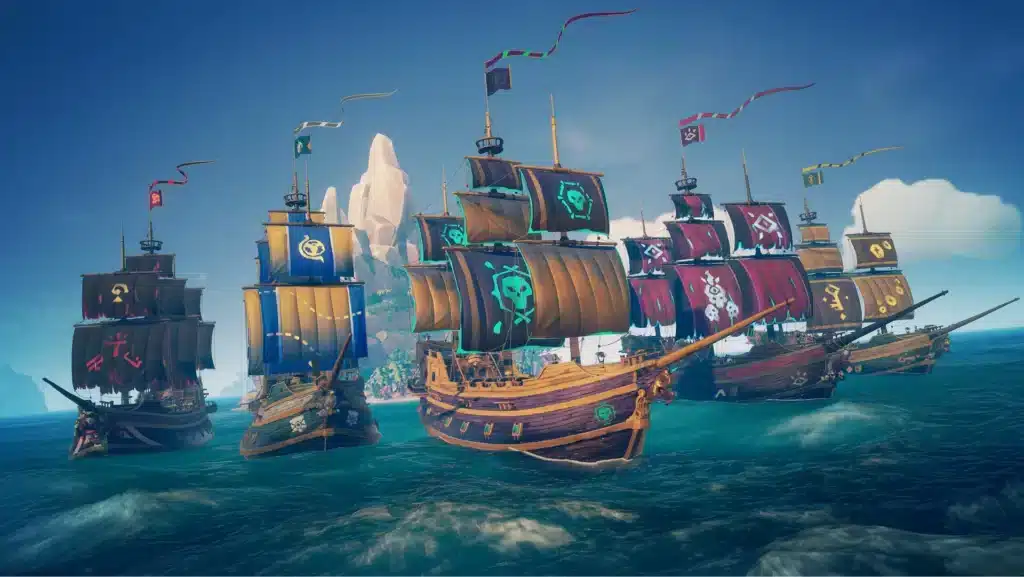
How Sea of Thieves Ships Shape Multiplayer Encounters
Ships are at the center of the Sea of Thieves experience.
They are transportation, mobile bases, combat platforms, and social spaces. More importantly, ships create the physical conditions for many of the encounters that make the game memorable.
A populated server can therefore feel dramatically different from an empty one.
Different Crews Create Different Experiences
One crew may focus entirely on treasure hunting.
Another may actively search for PvP encounters.
A third may be completing a story-driven adventure.
This variety is one of the game’s defining characteristics.
The Sea of Thieves player count matters because every additional active crew increases the potential for unpredictable interactions. A voyage can change instantly when another ship appears on the horizon.
PvE and PvP Depend on Community Activity
Sea of Thieves combines cooperative and competitive elements.
PvE activities allow crews to explore, fight enemies, solve objectives, and complete voyages. PvP adds the possibility of fighting other players for treasure or strategic advantages.
A healthy population supports both styles.
Players looking for combat need other crews to encounter. Players focused on exploration still benefit from a world populated by other pirates because those encounters add uncertainty and tension.
The Community Behind the Numbers
Player statistics only tell part of the story.
The community surrounding Sea of Thieves has remained an important part of the game’s identity. Players create guides, share stories, discuss lore, organize crews, stream voyages, and produce videos around unusual encounters.
Where Players Gather
Community activity can be found across several platforms.
Reddit provides a space for discussions, questions, screenshots, stories, and gameplay advice. Discord communities allow crews to organize sessions and find other players.
Twitch and YouTube are particularly important for visibility.
A streamer can introduce the game to thousands of viewers, while a successful video can encourage returning players to revisit an activity they have not played recently.
Popular Community Activities
Players can participate in activities such as:
- Gold Hoarder voyages.
- Ghost Ship PvE encounters.
- Tall Tale runs.
- PvP battles.
- Community events.
- Lore discussions.
- Speedrunning challenges.
These activities demonstrate why a player-count statistic should not be viewed as a simple popularity score.
Two games with the same number of active users can feel completely different depending on how those users interact with the world.
Steam vs. Xbox: Who Dominates Sea of Thieves?
Since the game’s arrival on Steam, PC players have had another way to access the pirate adventure.
Steam has become a meaningful part of the community, but it represents only one portion of the total audience.
What SteamCharts Can Tell You
SteamCharts is useful for monitoring historical Steam activity.
Players can use it to examine concurrent-player trends and identify periods when activity rises or falls.
It is particularly useful when comparing different periods around updates or events.
However, SteamCharts should not be used to claim that its displayed number represents the complete Sea of Thieves player count.
The Xbox and Microsoft Store populations are outside that Steam-specific measurement.
Steam and Xbox Serve Different Segments
The Steam audience can include dedicated PC players, streamers, returning fans, and players who prefer Valve’s storefront ecosystem.
Xbox includes console users as well as people participating through the broader Xbox and Game Pass environment.
The two groups are not necessarily competing populations because crossplay allows them to participate in the same broader multiplayer ecosystem.
Platform Comparison
| Platform | Role in the Ecosystem | Typical Data Visibility | Main Audience Characteristics |
| Xbox One | Established console platform | Limited public real-time data | Returning and legacy console players |
| Xbox Series X|S | Current-generation console platform | Limited public real-time data | Newer-console players and Game Pass users |
| Steam | PC storefront | Stronger public concurrent data | PC players, streamers, dedicated fans |
| Microsoft Store PC | Xbox-connected PC ecosystem | Limited public real-time data | PC and cross-platform players |
The table highlights an important point: the most visible statistics are not necessarily the most comprehensive.
Steam data can be highly useful because it is publicly trackable. Nevertheless, the broader population extends beyond what SteamCharts can measure.
Long-Term Retention and Sea of Thieves Player Count
Long-term retention is another reason to study player activity.
Most multiplayer games experience an initial launch surge. A large number of people try the game, some stay, and others move on to different experiences.
Sea of Thieves has had multiple opportunities to rebuild or strengthen its audience through ongoing content.
The Launch and Expansion Cycle
The original launch created significant awareness around the concept of a shared pirate sandbox.
Later updates gave returning players new reasons to explore.
The Steam release expanded access to another PC audience. Narrative content and crossover material increased visibility. Seasonal updates established recurring reasons to return.
This cycle is important because retention in a live multiplayer game does not necessarily mean that every original player remains active forever.
Instead, a healthy ecosystem can continuously combine:
- Long-term veterans.
- Returning players.
- New players.
- Casual participants.
- Highly engaged competitive crews.
Why Players Stay
There are several reasons players can remain interested in Sea of Thieves.
The open-ended structure is one.
Unlike a traditional linear campaign, the game can produce different experiences depending on the crew, location, objectives, and encounters.
Narrative content is another factor.
Tall Tales and other story-driven activities provide structured objectives for players who want something beyond free-form exploration.
Cosmetic progression also encourages continued participation without turning the game into a conventional gear-grind experience.
Why Players Leave Temporarily
Even successful multiplayer games have natural drop-off points.
Players may step away after completing available story content. Others may lose interest after repeated PvP sessions.
Some players simply wait for the next update.
This is not necessarily a sign that the community has collapsed.
In a seasonal multiplayer environment, temporary breaks are normal. What matters is whether players return when new content arrives.
What Can Cause Changes in Sea of Thieves Player Count?
Understanding fluctuations is easier when the causes are separated into different categories.
Content Releases
New content can produce immediate interest.
Players who have not logged in for weeks or months may return to investigate new mechanics, stories, rewards, or events.
New players can also discover the game through coverage of the update.
Platform Promotions
Promotions and subscription access can reduce the barrier to entry.
When a player already has access through an existing service, trying Sea of Thieves becomes easier.
This can produce new-player waves that may not appear in Steam-specific statistics.
Community Visibility
Streaming and video content can influence awareness.
A popular creator showcasing an unusual naval battle or entertaining crew encounter can introduce the game to an audience that had not previously considered playing.
Community visibility can therefore indirectly affect the Sea of Thieves current player count.
Competition From Other Games
Player attention is limited.
A major multiplayer launch, seasonal event, or competitive tournament in another game can temporarily reduce activity.
This does not necessarily mean players have permanently abandoned Sea of Thieves.
Many players move between several games depending on what is currently happening.
How to Track Sea of Thieves Player Count
If you want to monitor activity yourself, it is important to use several sources rather than relying on one number.
SteamCharts and Historical Trends
SteamCharts is one of the easiest tools for observing Steam-specific trends.
Instead of looking at only today’s figure, compare different periods.
Look for:
- Average concurrent players.
- Peak concurrent players.
- Monthly changes.
- Activity around updates.
- Weekend increases.
- Long-term trends.
This approach provides much more context than a single snapshot.
Twitch and YouTube Engagement
Streaming platforms can provide another useful signal.
A rise in Sea of Thieves streams may indicate increased interest around a major update or event.
However, viewership is not the same as player count.
Someone can watch a stream without owning the game, while an active player may never watch streaming content.
Therefore, these metrics should complement, not replace, direct player data.
Community Reports
Reddit, Discord, forums, and social media can provide qualitative information.
Players frequently discuss matchmaking times, server activity, event participation, and the types of encounters they are experiencing.
These reports are anecdotal, but they can help explain what the raw numbers mean.
A Practical Way to Read the Data
Use the following process when evaluating the game’s activity:
- Check SteamCharts for Steam-specific concurrent-player trends.
- Compare current activity with previous months instead of using a single day.
- Look for major updates or events that could explain spikes.
- Consider Xbox and Microsoft Store activity separately.
- Check community and streaming activity for additional context.
- Avoid treating one platform’s statistics as the complete player base.
This approach gives you a more realistic picture of the game’s multiplayer ecosystem.
How Connection Quality Affects the Sea of Thieves Experience
Player population is only one part of multiplayer performance.
Even with a healthy community, network conditions can affect how a game feels.
Sea of Thieves includes real-time naval combat, movement, interactions, and communication between players. A poor connection can therefore make otherwise enjoyable encounters frustrating.
Ping and Latency
Latency describes how long it takes information to travel between your device and the game server.
High latency can make actions feel delayed.
In a naval battle, even a small delay can affect the timing of cannon shots, movement, repairs, or other actions.
Packet Loss and Instability
Packet loss is another potential problem.
When packets fail to reach their destination correctly, the game may need to compensate for missing information.
The result can include visual inconsistencies, delayed interactions, or sudden changes in movement.
A stable connection is particularly valuable during PvP encounters, where timing can determine the outcome of a battle.
Why Connection Quality Matters More in Crossplay
Cross-platform multiplayer creates a broader ecosystem, but it also means that players can be connecting from different regions and network environments.
A player may have a fast local connection while still experiencing high latency to a particular server route.
Consequently, understanding the Sea of Thieves player count all platforms is useful for community analysis, while understanding connection quality is useful for individual performance.
Sea of Thieves Player Count and the Future of the Community
A long-running multiplayer game needs more than a successful launch.
It needs reasons for players to return.
Sea of Thieves has maintained its identity by combining exploration, social interaction, combat, and narrative content rather than relying on only one gameplay loop.
The Importance of New Content
New content gives veterans a reason to return.
It also creates opportunities for new players to discover the game.
When an update introduces a new activity, returning players can experience it alongside newcomers. That creates a natural bridge between different generations of the community.
The Community Wishlist
Players have continued to discuss potential improvements and additions, including:
- Expanded PvP options.
- More ship customization.
- Additional guild-focused activities.
- Deeper fishing systems.
- More underwater exploration.
- New story arcs.
- Additional social features.
Not every community request becomes part of the game.
Still, these discussions demonstrate that players remain invested in the game’s future.
Why Sea of Thieves Remains Relevant
The long-term relevance of Sea of Thieves comes from its ability to create stories that are different from one crew to another.
A player may remember a routine treasure voyage because another ship suddenly attacked.
Another crew may remember an unexpected alliance.
Someone else may remember completing a Tall Tale with friends.
These moments are difficult to measure through a conventional player-count statistic.
However, they explain why population still matters.
A larger active audience increases the number of possible encounters and helps preserve the unpredictability that makes the game distinctive.
Player Count Is Only One Part of the Story
The Sea of Thieves player count can tell us whether a multiplayer community remains active, but it cannot fully explain why people stay.
For that, we also need to consider content updates, crossplay, community activity, streaming visibility, narrative expansion, and the social nature of the game.
That broader context is essential when evaluating the game’s long-term position.
Sea of Thieves Player Count: What the Numbers Really Mean
The available information shows why it is difficult to reduce Sea of Thieves to a single number.
SteamCharts provides useful Steam-specific data. Xbox and Microsoft Store activity expands the picture. Game Pass contributes another pathway for players to enter the ecosystem. Twitch, YouTube, Reddit, and Discord provide additional signals about community engagement.
Together, these sources suggest a multiplayer environment that is broader than any individual storefront statistic.
The most important takeaway is that Sea of Thieves player count should always be interpreted according to the metric being discussed. Concurrent players, daily active users, monthly active users, and lifetime players are different measurements, and none should automatically be substituted for another.
For players deciding whether to return, the practical conclusion is equally important. Sea of Thieves is designed around a shared multiplayer world, so community activity directly influences the experience. Crossplay helps connect players across Xbox and PC, while regular content and community events provide reasons to keep returning.
As a result, the game’s population should not be judged solely by a Steam figure or a single peak. Looking at long-term trends, platform distribution, update cycles, and community engagement provides a much clearer understanding of how active the pirate adventure remains.
The sea is still defined by the crews sailing across it, and understanding the Sea of Thieves player count is ultimately a way of understanding how active that shared world continues to be.
The size of a multiplayer community is never just a statistic. In Sea of Thieves, it directly affects the atmosphere of the world, the frequency of encounters, the availability of crews, and the sense that every voyage can turn into an unexpected story. That is why the Sea of Thieves player count remains such a useful topic for both new pirates and longtime players.
A healthy community gives a multiplayer sandbox room to breathe. More players can mean more ships on the horizon, more opportunities for alliances, more unpredictable PvP encounters, and more people participating in seasonal activities. At the same time, a smaller number does not automatically mean a game is failing. The quality and consistency of the active community can matter just as much as its size.
For Sea of Thieves, this distinction is especially important because the game operates across multiple platforms. Xbox, PC through the Microsoft Store, and Steam all contribute to a connected ecosystem. Therefore, no single public tracker can provide a perfect picture of the entire population. SteamCharts, for example, is useful for Steam activity but does not represent Xbox players or every PC player outside Steam.
That makes understanding the Sea of Thieves player count a matter of looking at several pieces of evidence rather than searching for one definitive number. Platform data, concurrent-player measurements, community activity, streaming visibility, update schedules, and long-term engagement can all help explain how active the pirate adventure remains.
How Sea of Thieves Maintains an Active Multiplayer World
Sea of Thieves has an unusual advantage compared with many multiplayer games because its gameplay does not depend entirely on a traditional progression system. Players can return after a break and immediately find something familiar, while still having access to new activities and experiences.
The Sea of Thieves player count therefore matters because the game’s design is built around social unpredictability. Even a routine voyage can become memorable when another crew appears.
The Role of Player Encounters
A large part of Sea of Thieves’ appeal comes from the fact that players do not know exactly what another crew will do.
One ship may pass peacefully.
Another may approach with an offer to form an alliance.
A third may attack without warning.
These possibilities create tension that scripted enemies cannot reproduce in exactly the same way.
A strong Sea of Thieves current player count helps preserve this dynamic. More active crews create more possibilities for encounters, although server design and matchmaking rules also determine how those players are distributed.
Why a Busy Server Feels Different
Imagine sailing for twenty minutes without seeing another ship. The experience can still be enjoyable, particularly when completing a Tall Tale or exploring an island.
However, seeing a distant sail changes the atmosphere immediately.
You may need to decide whether to approach, avoid the ship, prepare for combat, or attempt communication. That uncertainty is part of what makes Sea of Thieves different from a conventional cooperative adventure.
Consequently, player population has a direct relationship with the game’s atmosphere.
The Sea of Thieves live player count is therefore not only about matchmaking speed. It also affects the likelihood of spontaneous interactions that become stories players remember long after the session ends.
Sea of Thieves Player Count Across Different Types of Players
The community is not one homogeneous group.
Different players approach the game for completely different reasons. Some care about treasure and exploration. Others focus on competitive combat. Some prefer narrative content, while others simply want to sail with friends.
This diversity makes the Sea of Thieves player count particularly interesting because a single figure cannot tell us how the population is distributed.
Casual Explorers
Casual players may log in only a few times each month.
They might complete a short voyage, fish, explore an island, customize a ship, or continue a story.
These players may not contribute heavily to peak concurrent figures, yet they still form an important part of the overall audience.
Competitive PvP Crews
At the other end of the spectrum are players who spend long sessions practicing naval combat.
They may participate in faction battles, seek rival crews, or specialize in specific combat strategies.
For these players, an active community is especially valuable because finding opponents is central to the experience.
Lore Hunters and Story Players
Sea of Thieves also attracts players interested in its world and narrative.
Tall Tales and other story-driven content give these users a structured reason to explore.
They may return when new narrative content becomes available and then take a break after completing it.
This behavior can produce fluctuations in the Sea of Thieves player count without indicating that the game has lost its long-term audience.
Streamers and Content Creators
Creators represent another important segment.
A streamer can play for several hours, generate discussion, and introduce the game to viewers who may later become players themselves.
YouTube guides, PvP highlights, funny crew encounters, and lore videos can have a similar effect.
The relationship works in both directions. A larger player population creates more interesting content, while more content can bring attention back to the game.
Why SteamCharts Is Useful but Not the Whole Story
One of the most common mistakes when researching the Sea of Thieves player count is assuming that the most visible public statistic represents everyone.
It does not.
SteamCharts can provide valuable historical information about the Steam version, including concurrent activity and trends over time. However, Steam is only one access point for Sea of Thieves.
What SteamCharts Measures
Steam tracking services are useful because Steam makes certain activity measurements publicly observable.
This allows players and analysts to examine patterns such as:
- Concurrent player peaks.
- Average concurrent activity.
- Monthly changes.
- Effects of major updates.
- Weekend fluctuations.
- Long-term trends.
These measurements can help identify whether the Steam audience is growing, shrinking, or remaining relatively stable.
What SteamCharts Does Not Measure
SteamCharts does not provide a complete count of Xbox players.
It also does not represent every person playing the PC version through another storefront.
Therefore, taking a Steam concurrent figure and calling it the total Sea of Thieves player count would produce an incomplete picture.
The correct interpretation is more specific: the figure represents observable activity for the Steam version.
Why Historical Trends Matter More Than One Number
Suppose Steam activity rises sharply during a major update.
That tells us something useful.
It suggests that the update generated renewed interest among Steam players.
If activity then falls after several weeks, that does not automatically mean the game has become unpopular. Players may have completed the new content and temporarily moved to another game.
Looking at a sequence of measurements is therefore more informative than looking at a single day.
How to Interpret Sea of Thieves Player Count Data Correctly
Player-count terminology can be confusing because several metrics describe different things.
Understanding the difference helps prevent misleading conclusions.
Concurrent Players
Concurrent players represent users playing at approximately the same time.
This is the type of measurement most commonly associated with Steam tracking.
It is useful for understanding how busy a platform is at a particular moment.
Daily Active Players
Daily active players represent unique players who participate during a day.
This figure can be considerably larger than a concurrent-player peak because different people can play at different times.
For example, one player may play during the morning, another during the afternoon, and another at night. They all contribute to daily activity without necessarily appearing together in a concurrent count.
Monthly Active Players
Monthly activity measures unique users across a longer period.
This is useful for understanding the size of an audience that returns at least occasionally.
A player who logs in once during a month still contributes to monthly activity, even if they are not present during the busiest hours.
Lifetime Players
Lifetime-player figures represent the number of people who have played the game over a much longer period.
This measurement can demonstrate reach, but it does not indicate how many people are currently active.
For that reason, lifetime players and the Sea of Thieves current player count should never be treated as interchangeable.
When Is Sea of Thieves Usually Most Active?
The Sea of Thieves player count naturally changes throughout the day and week.
Multiplayer games generally attract more players when people have free time, and Sea of Thieves is no exception.
Weekday Activity
During weekdays, activity can be more concentrated around afternoons and evenings.
Players finishing work or school may log in for shorter sessions.
This can create a gradual increase rather than an immediate peak.
Weekend Activity
Weekends tend to be especially important for crew-based games.
Friends have more opportunities to coordinate sessions, while longer playtime makes larger voyages and extended PvP encounters easier to organize.
As a result, weekend activity can be stronger than weekday activity.
Seasonal Activity
Seasonal updates can produce another kind of spike.
The official Sea of Thieves site continues to document new seasons, updates, and live events, demonstrating that the game is still receiving ongoing content rather than operating as a static release. The official update history currently includes Season 20 and ongoing content releases in 2026.
This continuing content cycle is relevant to the Sea of Thieves player count because every major release creates an opportunity for former players to return.
Why Updates Can Bring Players Back
Live-service games rely heavily on reasons to return.
Sea of Thieves has used seasons, events, narrative content, gameplay additions, and customization features to create those reasons.
New Features Create Curiosity
A returning player may have no immediate reason to replay an old voyage.
However, a new feature changes that calculation.
Players may return simply because they want to understand how the new system works.
That curiosity can generate short-term increases in activity.
New Rewards Encourage Participation
Cosmetics and seasonal progression provide additional goals.
Even when a player has already completed the game’s major narrative content, a new reward track can provide a reason to sail again.
This is one reason the Sea of Thieves player count can respond strongly to seasonal changes.
Community Events Create Shared Moments
Events can have an even greater effect because they encourage players to participate at the same time.
The official Events Hub continues to list live activities and current seasonal features, including Custom Seas and recurring community-focused events.
When many players participate simultaneously, the community becomes more visible both inside and outside the game.
Crossplay and the Size of the Shared Audience
Crossplay is one of the most important factors when discussing the Sea of Thieves player count.
The game is designed to bring players from different supported platforms into the same broader multiplayer ecosystem.
Xbox Players and PC Players
Xbox remains a major part of the game’s identity.
PC players can also participate through Steam or the Microsoft Store ecosystem.
This means that the population is not divided into completely isolated groups.
A player using Steam can potentially interact with someone playing on Xbox, which expands the effective matchmaking pool.
Why Crossplay Helps Matchmaking
Crossplay provides several advantages:
- More potential crews and opponents.
- Greater platform diversity.
- More consistent activity across different regions.
- Easier sessions between friends using different systems.
- A broader community for events and shared activities.
For a game built around encounters between crews, these advantages are substantial.
Crossplay Also Complicates Data Analysis
There is a trade-off.
The more platforms participate in one ecosystem, the harder it becomes for outsiders to calculate the exact total population.
A public Steam number is easy to observe.
Xbox activity is less transparent.
Microsoft Store PC activity is measured differently again.
Therefore, the Sea of Thieves player count all platforms remains an estimate rather than a single universally verified live figure.
The Importance of Server Activity
Player population and server activity are related, but they are not exactly the same thing.
A game can have many players globally while still distributing those players across different regions and server instances.
Regional Distribution
Players are spread across North America, Europe, South America, Asia, and other regions.
This means a global player-count figure does not tell you how busy a particular region will be.
A player in one location may experience frequent encounters, while another may have a quieter session.
Time Zones Change the Experience
The same principle applies to time zones.
When North American players are most active, European activity may be declining.
Later, European evening activity can produce another peak.
As a result, players interested in finding the busiest environment should consider both their local time and the broader regional population.
How Player Count Influences PvP
PvP is one of the areas where population can have the most obvious effect.
If a crew wants frequent naval battles, it needs other crews to encounter.
Finding Rival Ships
A busy world can increase the chance of seeing ships during voyages.
However, encountering another ship does not guarantee combat.
The opposing crew may be focused on PvE content, avoiding confrontation, or simply traveling somewhere else.
This uncertainty is part of the game’s design.
PvP Crews Need Consistent Activity
Competitive players may monitor community activity more closely than casual players.
They want opponents who can provide challenging encounters.
A healthy Sea of Thieves player count can therefore help sustain competitive modes and PvP communities.
At the same time, players should not assume that higher population always means more fights. Server structure, player behavior, and matchmaking rules all influence what happens in an individual session.
How Player Count Influences PvE
PvE players also benefit from a healthy community, even if they rarely seek combat.
Shared-World Atmosphere
Seeing another ship in the distance makes the ocean feel alive.
Even when there is no direct confrontation, another crew contributes to the sense that the world is shared.
Alliances and Cooperation
Some encounters can become cooperative.
Crews can communicate, form temporary alliances, or simply help one another during an unexpected situation.
These interactions are easier to find when the broader community remains active.
Tall Tales and Story Sessions
Players who prefer narrative content can also benefit from a populated world.
The presence of other players creates a contrast between structured story objectives and unpredictable encounters.
That mixture is one of the reasons Sea of Thieves can feel different from a traditional campaign.
Sea of Thieves Player Count and Long-Term Retention
Retention is often more meaningful than a launch-day peak.
A multiplayer game can generate enormous attention at launch and then lose most of its audience within a few months.
Long-term communities work differently.
The Importance of Returning Players
Returning players form a major part of live multiplayer ecosystems.
They may disappear for several months and then come back for a new season.
This means the audience can remain valuable even when individual users are not playing continuously.
Content Cycles Support Retention
A content cycle typically follows a pattern.
New content arrives.
Players return.
Activity increases.
Some players complete the content.
Activity settles.
Another update arrives.
The cycle begins again.
This pattern should not automatically be interpreted as failure.
For many live-service games, periodic fluctuations are normal.
Why Sea of Thieves Has a Strong Retention Structure
The game has several systems that support repeated play.
Players can:
- Continue exploring.
- Complete voyages.
- Work toward cosmetics.
- Progress through seasonal activities.
- Play Tall Tales.
- Participate in events.
- Join guilds and crews.
- Engage in PvP.
- Return for new content.
Because there is no single mandatory path, different players can return for different reasons.
What Makes Sea of Thieves Different From Traditional Multiplayer Games?
The Sea of Thieves player count becomes more meaningful when compared with the game’s design.
Traditional competitive games often revolve around structured matches.
A match begins, players compete, the match ends, and another begins.
Sea of Thieves is more persistent in feel.
Sessions Become Stories
A voyage can start as a simple treasure hunt.
Then a storm appears.
Another ship approaches.
A crew member falls overboard.
An enemy attacks.
The crew escapes with the treasure.
None of these moments necessarily exist as a pre-written sequence.
They emerge from the combination of systems and players.
The Community Creates Content
This is why community size can have an outsized impact.
Players themselves become part of the content.
The more active the ecosystem, the more possible interactions exist.
This helps explain why the Sea of Thieves current player count remains relevant even for people who are not interested in competitive statistics.
The Role of Streaming in Sea of Thieves Popularity
Streaming platforms have played an important role in keeping multiplayer games visible.
Sea of Thieves is particularly suitable for streaming because unpredictable player interactions can create entertaining moments.
Why Sea of Thieves Works Well on Twitch
A streamer can begin a session with a simple objective and end up in a completely different situation.
That unpredictability gives viewers a reason to continue watching.
It also makes the game easy to discover through personality-driven content rather than only through traditional advertisements.
YouTube Expands the Audience
YouTube content can serve a different purpose.
Creators can publish:
- Beginner guides.
- Ship tutorials.
- PvP strategies.
- Lore explanations.
- Funny encounters.
- Challenge videos.
- Update breakdowns.
These videos can continue generating views long after the original session.
That evergreen content can help introduce new players to the game and indirectly support the Sea of Thieves player count.
How to Use Player Count When Deciding Whether to Play
A common reason people search for the Sea of Thieves player count is simple: they want to know whether the game is worth starting.
Player count can help answer that question, but it should not be the only consideration.
Look for an Active Community
A healthy multiplayer game should have enough activity to support its core experiences.
For Sea of Thieves, that means considering whether players are still discussing updates, creating content, participating in events, and forming crews.
Consider Your Preferred Playstyle
If you enjoy PvP, look for evidence of active competitive communities.
If you prefer story content, focus more on available adventures and narrative updates.
If you like social play, investigate guilds, crews, and community groups.
The ideal game is not necessarily the one with the largest population.
It is the one with a population that supports the way you want to play.
Check Current Content
It is also useful to check what is happening in the game now. The official Sea of Thieves update pages provide information about current seasons and releases. As of 2026, the official site documents Season 20 and continued updates, which reinforces the point that the game remains an actively maintained multiplayer title.
For players evaluating the game today, current content is more relevant than relying entirely on historical launch statistics.
Connection Quality and a Better Multiplayer Experience
A strong Sea of Thieves player count does not automatically guarantee a smooth session.
Network quality can influence how enjoyable a multiplayer game feels.
Latency During Naval Combat
Naval battles involve movement, aiming, cannon fire, repairs, boarding, and quick reactions.
High latency can make these interactions feel delayed.
For competitive crews, consistent response times are particularly important.
Packet Loss Can Be Frustrating
Packet loss can cause information to arrive late or not arrive correctly.
In practical terms, this can result in unstable movement, delayed interactions, or unexpected behavior.
A stable network is therefore important when playing in busy encounters.
Routing Matters
The physical distance between a player and a server is not the only factor.
The route taken by network traffic can also affect latency and stability.
Players experiencing inconsistent performance may therefore investigate their local network, ISP routing, server region, and other connection variables before blaming the game’s population.
Is Sea of Thieves Still Worth Playing?
The answer depends on what you want from a multiplayer game.
If you enjoy cooperative exploration, social interactions, naval combat, and unpredictable encounters, Sea of Thieves remains a strong fit.
The ongoing update structure is also relevant.
The official game website continues to publish new content and seasonal updates, including features introduced during Season 20.
For New Players
New players can approach the game gradually.
There is no requirement to master every system immediately.
Learning to sail, manage supplies, steer during combat, and communicate with a crew can take time.
That learning process is part of the appeal.
For Returning Players
Returning players have a different advantage.
They already understand the basic systems and can focus on what has changed since their previous session.
New seasons, events, features, and community activities can provide a reason to return.
What the Sea of Thieves Player Count Ultimately Tells Us
The Sea of Thieves player count is best understood as an indicator rather than a definitive verdict.
A single number cannot tell you whether the game is fun.
It cannot tell you whether your next crew will be friendly.
It cannot predict whether another ship will attack you while you are carrying valuable treasure.
What it can do is provide context.
A strong and sustained multiplayer population supports the shared-world design. Crossplay expands the available community. Seasonal content encourages returning players. Community events create concentrated activity. SteamCharts helps reveal trends on one important platform, while Xbox and Microsoft Store activity broaden the picture.
For this reason, the most useful approach is to combine statistics with the structure of the game itself.
Final Thoughts on Sea of Thieves Player Count
TheSea of Thieves player count is more than a number on a tracking website. It represents the activity behind a shared pirate world where crews explore, fight, cooperate, compete, and create stories together. To improve your experience even further you can count on tools such as ExitLag, which help you reduce lag and optimize your connection.
Frequently Asked Questions
How many players does Sea of Thieves have?
There is no single public real-time figure that combines every platform. The Sea of Thieves player count must be estimated using platform-specific information, including Steam activity and broader Xbox and PC ecosystem signals.
What does SteamCharts show for Sea of Thieves?
SteamCharts shows historical and current Steam activity, including concurrent-player trends. It is useful for monitoring the Steam audience, but it does not represent Xbox or every PC player.
Is Sea of Thieves still popular?
The Sea of Thieves player count remains relevant because the game continues to support an active multiplayer ecosystem, with ongoing seasons, events, updates, and community activity. The official site continues to document new content and live features.
Does Sea of Thieves have crossplay?
Yes. Sea of Thieves supports a connected multiplayer ecosystem across supported Xbox and PC platforms, allowing players from different systems to participate in the broader shared world.
Why does the Sea of Thieves player count change?
Activity changes because of weekends, regional time zones, seasonal updates, events, new content, promotions, competing game releases, and players temporarily taking breaks before returning for new content.
Got questions or want to connect with other players? Join the conversation at the ExitLag Forum!