
Stardew Valley farm layout is one of the most personal and impactful decisions you make at the start of every new save file. The farm type you choose determines how much tillable land you have, what unique advantages you receive, and what playstyle the game naturally encourages. Getting this decision right from the beginning makes every subsequent choice easier and more satisfying.
Stardew valley farm layout planning matters because farm space is finite and rebuilding is expensive. Every building, path, crop field, and decoration you place interacts with the others, and an unplanned farm quickly becomes a cluttered, inefficient mess that is difficult to navigate or optimize without tearing everything down and starting over.
The best farm layout for you depends on whether you prioritize crops, animals, mining, foraging, or a balanced approach. This guide covers every farm type’s strengths and weaknesses, the optimal planning approach for each, and the layout principles that produce the most organized and profitable results regardless of which farm you choose.
Stardew Valley Farm Layout: All Farm Types Compared
Standard Farm
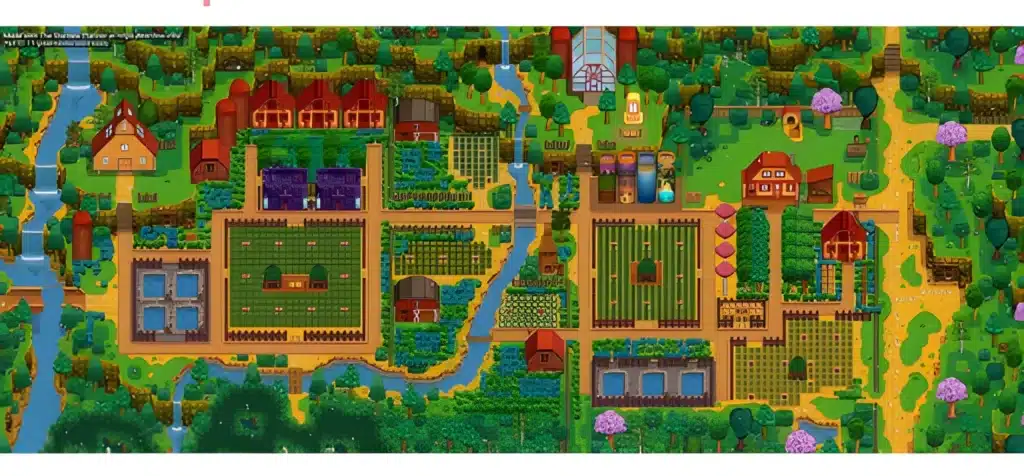
The Standard Farm is the most versatile option and the one recommended for first-time players. It offers the largest amount of tillable land in the game, with 3,427 tillable tiles and an additional 235 buildable but non-tillable tiles.
Standard Farm strengths:
- Maximum crop space for pure farming playthroughs
- Simplest layout to understand and plan around
- No unique gimmicks that require adapting your strategy
Standard Farm weaknesses:
- No unique bonus or starting advantage
- The large open space can feel overwhelming to plan without guidance
The Standard Farm rewards methodical planning with maximum long-term income potential. However, its blank canvas nature means it requires more deliberate layout decisions than the other farm types.
Forest Farm
The stardew valley forest farm layout replaces a large portion of the open field with trees, bushes, and foraging items. It generates unique renewable resources including Large Stumps (which provide Hardwood when cut) and seasonal forage items that respawn each week.
Forest Farm strengths:
- Renewable Hardwood from Large Stumps, eliminating the need to clear Secret Woods repeatedly
- Seasonal forage items spawn on the farm itself
- Aesthetically beautiful, with a natural woodland feel
- Still has sufficient tillable land for all crop needs
Forest Farm weaknesses:
- Less tillable land than Standard Farm
- Some areas feel cramped due to permanent tree placement
- Foraging only becomes very profitable with high Foraging Level
The Forest Farm is ideal for players who want a mix of farming and foraging without traveling far from home for Hardwood. It is also the most visually appealing starting layout for players who value an aesthetic farm design.
Meadowlands Farm
The stardew valley meadowlands farm layout is the newest farm type and is specifically designed around animal husbandry. It starts with a pre-built small Coop containing two starter chickens and features Blue Grass, a unique forage item that speeds up animal friendship growth.
Meadowlands Farm strengths:
- Pre-built Coop with two starter chickens saves early-game gold
- Blue Grass that generates on the farm boosts animal happiness faster than normal grass
- Excellent for players who want to focus on animals from day one
Meadowlands Farm weaknesses:
- Less tillable land than Standard Farm
- Crop farming is secondary to animal farming in this layout
- Blue Grass does not grow in winter
The Meadowlands Farm is one of the best options for beginners despite its reduced crop space. The free starting Coop and chickens provide an immediate income source that offset the reduced farming area significantly.
All Farm Types at a Glance
| Farm Type | Tillable Tiles | Best For | Starting Bonus |
| Standard | 3,427 | Pure crop farming | None |
| Forest | ~1,500 | Foraging + farming mix | Renewable Hardwood |
| Hilltop | ~1,536 | Mining + farming | Quarry on farm |
| Riverland | ~1,578 | Fishing + farming | Multiple water bodies |
| Beach | ~1,767 | Unique aesthetic | No sprinklers on sand |
| Wilderness | ~1,648 | Combat enthusiasts | Monsters spawn at night |
| Four Corners | ~1,648 | Multiplayer co-op | Four distinct zones |
| Meadowlands | ~1,490 | Animal farming | Pre-built coop + chickens |
Stardew Valley Farm Layout Ideas: Planning Principles
The Iridium Sprinkler Grid System
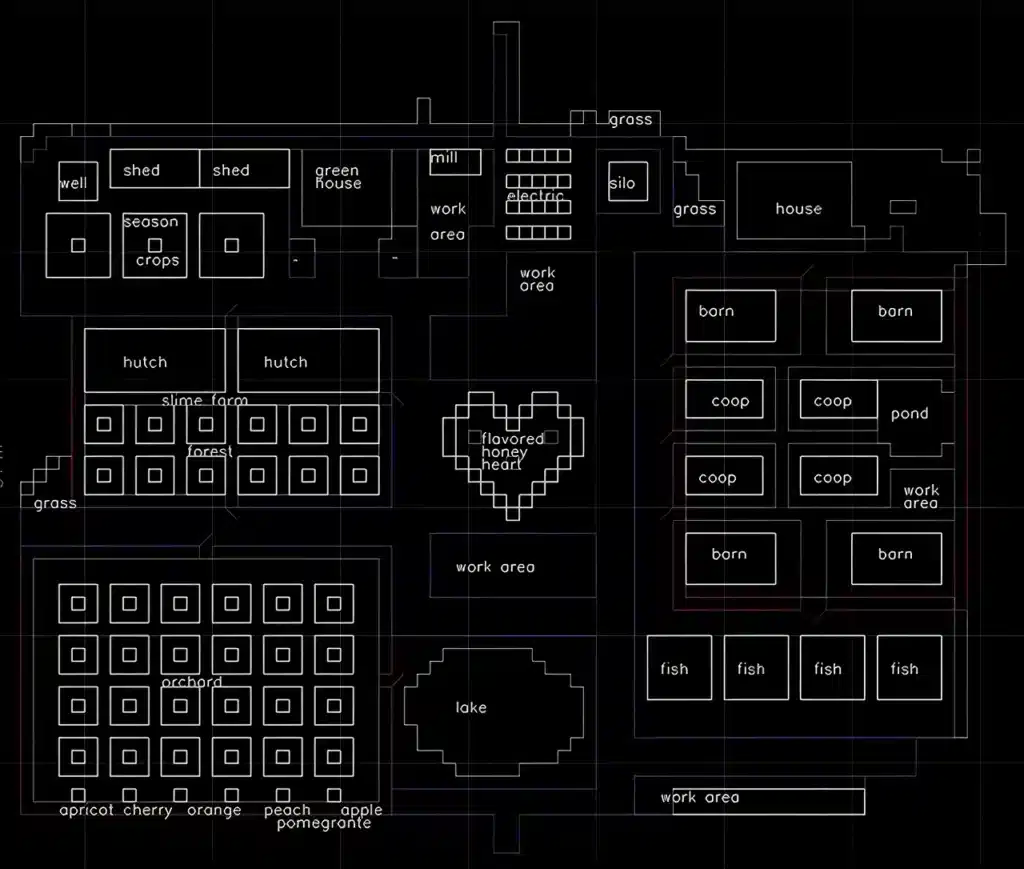
The most efficient crop layout for any stardew valley farming layout uses Iridium Sprinklers as the base unit of organization. Each Iridium Sprinkler waters a 5×5 area (24 tiles around it), making a 6×6 crop block the optimal arrangement: one sprinkler in the center of every 6×6 crop block.
Benefits of the sprinkler grid approach:
- Zero tiles wasted on manual watering
- Crops grow simultaneously across the entire field
- Easy to scale up by adding additional 6×6 blocks
- Walkable paths between blocks maintain harvest accessibility
For a Standard Farm aiming at maximum crop efficiency, plan a grid of 6×6 blocks with 1-2 tile paths between them, oriented to leave room for buildings, storage chests, and seasonal adjustments.
Centralized Storage Hub
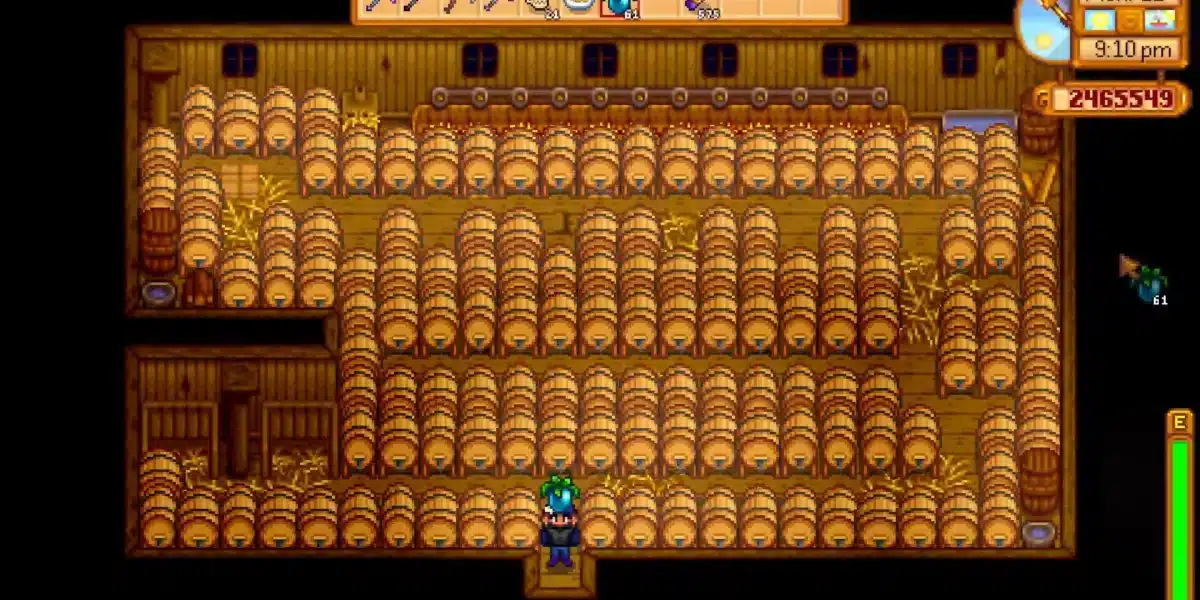
One of the most impactful stardew valley farm layout ideas is creating a central storage and processing hub near your farmhouse. All chests, Kegs, Preserve Jars, and Furnaces placed in one organized area dramatically reduces the time spent running between stations during morning and evening farm routines.
Recommended hub layout:
- Place a row of Kegs near the farmhouse
- Adjacent row of Preserve Jars for overflow fruit and vegetables
- Storage chests labeled by category (crops, minerals, fish, artisan goods)
- Shipping bin within easy reach of the storage hub
Aesthetic Stardew Valley Farm Layout Tips
For players focused on aesthetics as much as efficiency, the aesthetic stardew valley farm layout approach balances visual design with functional productivity.
Aesthetic layout principles:
- Use paths (Wood, Cobblestone, or Crystal) to create clear walkways that also define zones visually
- Alternate different flooring types to create distinct farm districts (crop zone, animal zone, processing zone)
- Leave open decorative spaces with furniture, trees, or flowers between productive areas
- Keep buildings aligned to a consistent grid orientation for visual cleanliness
- Use earth-tone building paints to harmonize your farm’s color palette
Using the Stardew Valley Farm Planner
Planning Before Building
The interactive farm planner at stardew.info lets you design your entire layout before placing a single building or crop tile in-game. This tool is invaluable for preventing costly mistakes that require demolishing and rebuilding structures.
How to use the farm planner effectively:
- Select your farm type at the planner’s start menu
- Place all permanent buildings (Coop, Barn, Shed, Greenhouse) first
- Lay out your Iridium Sprinkler grids around the building placement
- Add path tiles to define walkways between zones
- Identify dead spaces and fill them with trees, bee houses, or decorative items
- Finalize before building in-game
The stardew valley farm layout planner at stardewplanner.com offers an alternative interface with slightly different features, including the ability to overlay crop spacing requirements directly on the map.
Pro Tips: Stardew Valley Farm Layout
- Never build without a plan: The most expensive farm mistake is placing buildings randomly and then needing to pay Robin to move them. Spend 30 minutes planning before placing your first structure.
- Leave expansion space: Your Year 1 farm will look nothing like your Year 3 farm. Always plan for future buildings (Greenhouse, Shed, additional Barns and Coops) when laying out your initial structure grid.
- Prioritize Iridium Sprinkler coverage before filling crop fields: Placing crops before you have Iridium Sprinklers means replanting everything when you upgrade. Wait for Iridium Sprinklers and plant your large crop fields after installing them.
- Use the Forest Farm for Hardwood efficiency: If your planned playthrough involves heavy building and crafting, the Forest Farm’s renewable Hardwood stumps save dozens of daily trips to the Secret Woods across the entire game.
- Put Sheds to work as processing factories: A Shed filled with Kegs or Preserve Jars creates a dedicated artisan goods facility that keeps your main farm area clean and your processing operation organized in one place.
Common Mistakes Stardew Valley Farm Layout Players Make
- Placing the Farmhouse in a bad location by accident. The Farmhouse starts in a fixed position but the space around it determines how much room you have for your central hub and surrounding structures. Fix: Use the farm planner to work backward from the Farmhouse position when designing your layout, ensuring you leave adequate space for the structures you plan to build.
- Using Quality Sprinklers for large crop fields instead of upgrading to Iridium. Quality Sprinklers cover a 3×3 area (8 tiles), requiring many more sprinklers than Iridium, wasting tile space and maintenance time. Fix: Invest in the Iridium Sprinkler as your primary farm infrastructure target. Run smaller crop plots with Quality Sprinklers as a temporary measure until Iridium is available.
- Planting trees too close to buildings or other structures. Trees need space in all four cardinal directions to grow. Trees planted adjacent to fences, buildings, or other trees simply never mature. Fix: Leave two clear tiles in every direction around every tree you plant, and always verify clearance before the planting animation completes.

Build Your Perfect Farm With ExitLag in Multiplayer
Stardew valley farm layout planning and execution is even more fun with friends in co-op mode. Multiplayer lets players divide the farm into personal zones, split building responsibilities, and coordinate large-scale expansion projects that would take much longer solo.
ExitLag is a game connection optimizer that routes your network traffic through the fastest, most stable path in real time. It is not a VPN and does not affect game files.
For Stardew Valley multiplayer stardew valley farm layouts and co-op build sessions, ExitLag provides:
- Reduced lag and packet loss during shared farm planning and building sessions
- Multipath Technology maintaining connection stability throughout long co-op sessions
- Multi-Internet support for instant fallback if your primary network drops
Download ExitLag for PC and build your dream farm layout with friends on a stable connection
All game images used in this blog post belong to ConcernedApe. They are used for informational and educational purposes only and do not imply endorsement or affiliation with the rights holder.
Got questions or want to connect with other players? Join the conversation at the ExitLag Forum!