
Planning your farm layout in Stardew Valley before building it in the game saves hours of wasted days, resources, and effort. A Stardew Valley Planner is an interactive online tool that lets you map out your entire farm, place buildings, plan crop rows, position Junimo Huts, and design paths, all on a grid that mirrors the exact dimensions of each farm type in the game.
Stardew Valley Planner tools have become an essential part of how dedicated players approach the game, especially for players who want to maximize crop tile coverage, optimize Scarecrow and Sprinkler placement, or design aesthetically pleasing farms without spending in-game days rearranging buildings and tiles.
The best Stardew Valley Farm Planner options are free, browser-based, and require no account or download. This guide covers the most popular tools, how to use them, and what to plan for each stage of the game.

Best Stardew Valley Planner Tools
Several farm planning tools are available, each with different features and interfaces. Here are the most widely used and feature-complete options.
1. Stardew info Planner
URL: stardew.info
Stardew.info is the original and most widely used Stardew Valley farm planner. It features a drag-and-drop interface with:
- All 8 farm types accurately mapped
- Every building from the Carpenter Shop available to place
- Crop placement with color-coded grid squares
- Ginger Island farm planning support
- Exportable layouts you can save and share as links
This tool has been maintained and updated to reflect major game updates including version 1.6 content. It is the community standard recommendation for players starting to plan their first serious farm layout.
2. Stardew Planner
URL: stardewplanner.com
StardewPlanner.com offers similar functionality to stardew.info with a modern interface and the following features:
- All 8 standard farm types plus the Meadowlands Farm added in 1.6
- Over 500 placeable items including crops, buildings, paths, and decorations
- Interior layout planning for farmhouse and sheds
- Mobile-friendly interface for planning on a phone or tablet
- Save layouts to browser storage for returning to later
3. Stardew Plan
URL: stardewplan.com
StardewPlan.com is a newer option with a clean interface and real-time feedback that shows you how many tiles each building occupies and highlights adjacency requirements for specific structures. It is particularly useful for planning Sprinkler coverage patterns because it visually shows you the range of each Sprinkler type as you place them.
Comparison Table
| Tool | Farm Types | Sprinkler Range | Scarecrow Range | Ginger Island | Mobile |
|---|---|---|---|---|---|
| Stardew.info | All 8 | Yes | Yes | Yes | Limited |
| StardewPlanner.com | All 8 + Meadowlands | Yes | Yes | Yes | Yes |
| StardewPlan.com | All 8 | Yes | Yes | No | Yes |
How to Use a Stardew Valley Farm Planner
Using a farm planning tool effectively requires knowing which elements to plan for at each stage of the game.
Step 1: Choose Your Farm Type
Before placing anything, select the farm type that matches your current save or the one you plan to use. Each farm type has a different map layout, obstacle placement, and available tile count. The Standard Farm has the most open space (approximately 3,427 tiles), while specialty farms like the Forest Farm or Riverland Farm have more constrained layouts with unique features.
Step 2: Place Major Buildings First
Buildings determine the framework around which everything else is arranged. Place these structures before filling in crop rows or paths:
- Farmhouse (pre-placed, cannot move)
- Barn and Coop (require space + animal access considerations)
- Greenhouse (unlocked through Community Center; 10×12 exterior footprint)
- Stable (must be accessible for horse pathfinding)
- Slime Hutch (requires 120+ tiles of space)
- Shed (optional but valuable for Kegs, Preserve Jars, and Crystalariums)
Step 3: Plan Sprinkler Coverage
Sprinklers are the most space-efficient planning element in the game. Placing them on the planning grid before filling in crop tiles ensures you do not plant crops in positions that will never be watered.
Sprinkler coverage by type:
– Basic Sprinkler: Waters 4 adjacent tiles (N, S, E, W)
– Quality Sprinkler: Waters 8 tiles (all adjacent tiles in 3×3 area around it, excluding itself)
– Iridium Sprinkler: Waters 24 tiles (5×5 area around it, excluding itself)
Iridium Sprinklers are the gold standard for efficient farming. Planning your crop rows around Iridium Sprinkler placement before building anything else maximizes the number of crop tiles per watering unit.
Step 4: Place Scarecrows and Junimo Huts
Scarecrows protect a radius of 8 tiles from crows, but only on crop tiles that the Scarecrow can see. On the planner, use the Scarecrow range overlay to ensure complete coverage of all your crop tiles.
Junimo Huts (unlocked through Community Center completion) auto-harvest crops within a 17×17 tile area centered on the hut. Placing multiple Junimo Huts so their coverage areas overlap perfectly with your crop tile layout eliminates the need for manual harvesting entirely.
Step 5: Plan Paths and Accessibility
Every building needs to be reachable by the player character. Paths can be placed decoratively but should also serve as navigation corridors that let you reach every tile in the farm without walking through crop rows and potentially delaying NPC pathfinding.
What to Plan for Your Stardew Valley Farm
Specific farm goals require specific planning priorities. Here are the most common farm types and what each needs from a layout planning session.
Crop Farm Planning Priorities
- Maximize crop tiles by fitting crops into every available non-building square
- Plan Iridium Sprinkler placement first, then fill in crop tiles around them
- Place Junimo Huts for auto-harvesting (if Community Center is complete)
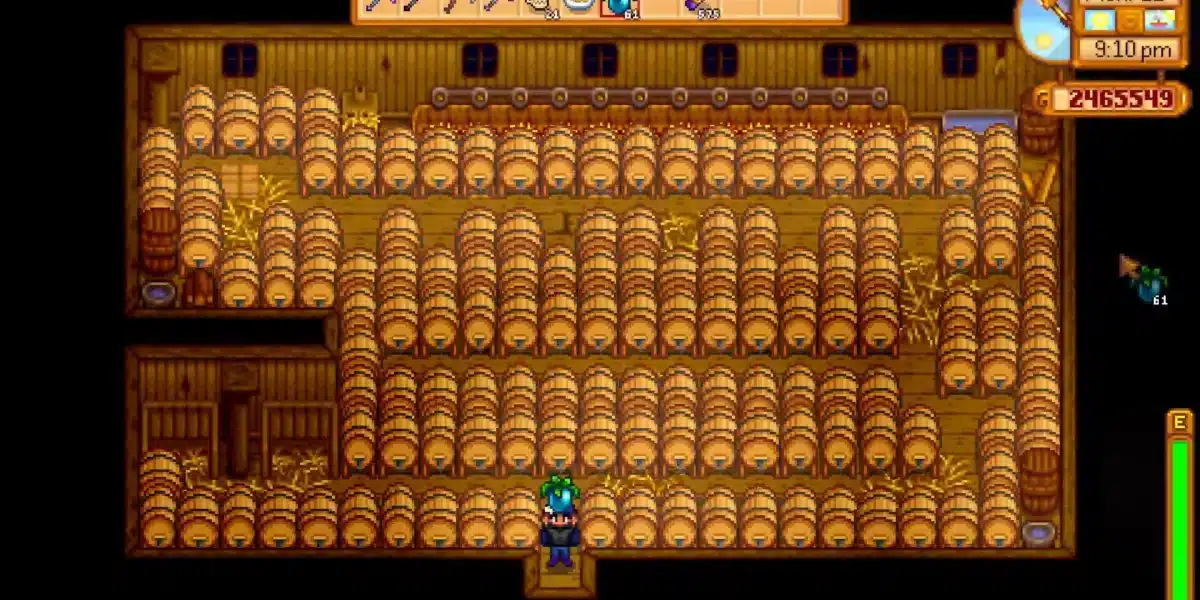
- Include a large Shed for Kegs to process crops into Artisan Goods
Animal Farm Planning Priorities
- Build Barns and Coops in an area with easy grazing access
- Leave space for grass propagation (uncultivated tiles that grow grass for free food)
- Include Silos near animal housing for efficient hay storage
- Position the Stable near the barn area for efficient morning routines
Greenhouse Optimization Planning
The Greenhouse interior has a 10×12 planting grid. Planning the interior on the farm planner helps you decide between:
– Full Ancient Fruit planting (highest Gold value per tile per day)
– Mixed orchard (Fruit Trees in corners, crops in center)
– Seasonal crop rotation within the Greenhouse
Pro Tips for Stardew Valley Farm Planner Use
Pro Tips: Stardew Valley Planner
- Plan your Year 2 farm in Year 1 so you know what to build toward: The final farm layout you want to achieve in Year 2 or 3 requires specific buildings and resources. Planning it early shows you what milestones to prioritize during Year 1, such as saving Gold for the Greenhouse or collecting Stone for a large Shed.
- Use the Scarecrow range display to minimize Scarecrows used: Many players place Scarecrows reactively when crows appear, often placing more than necessary. Planning Scarecrow positions on the planner before planting reduces total Scarecrow count while maintaining complete coverage.
- Plan paths before planting so you always have farm access: Paths placed after dense crop rows are always suboptimal. Planning them first creates clean corridors that remain accessible for watering, harvesting, and reaching buildings.
- Save your layout URL or screenshot it before closing the browser: Most planners save state in the URL or local browser storage. If your browser clears history, you lose your layout. Screenshot the plan or save the URL in a notes app before closing.
- Plan for maximum Iridium Sprinkler coverage from the start of Year 2: Iridium Sprinklers require unlocking the Skull Cavern in Year 1 to source enough Iridium Ore. Planning the exact number of Iridium Sprinklers your layout requires gives you a concrete mining goal during Year 1.
Common Mistakes Players Make Without a Farm Planner
- Building the Barn in a position that blocks optimal crop tile access: Many early-game players place the Barn wherever fits without considering how it affects the available crop area around it. Fix: Use the planner to visualize the Barn footprint and access corridor before ever talking to Robin about construction.
- Underestimating how much space farm buildings require: A full Barn and Coop each require a 7×4 footprint plus space for animals to roam outside. Players who do not plan often find their farms gridlocked after building several structures. Fix: Place all planned buildings on the planner grid first and verify total space usage before ordering any construction.
- Not accounting for Sprinkler placement when planting the first crop rows: Many players plant their first Spring crops in rows that are incompatible with future Sprinkler placement, requiring replanting later. Fix: Even with basic Sprinklers, use the planner to map out which tiles will be covered before your first Spring planting.
Play Stardew Valley Co-op Without Lag
Once your farm layout is planned and built, co-op sessions let you work through it with friends. But connection instability in Stardew Valley multiplayer disrupts synchronized farming, causing tool use to desync and end-of-day saves to lose progress.
How ExitLag Helps Stardew Valley Co-op Players
ExitLag is a game connection optimizer that routes your game traffic through the fastest available paths to the game server in real time. ExitLag’s Multipath Technology maintains a stable connection across multiple simultaneous network routes. If one path encounters congestion, the others keep the session running without interruption.
For co-op farming sessions on layouts you have spent time planning, a stable connection ensures that every action registers correctly and every day-end save preserves the progress of all players in the session.
Download ExitLag for PC and run your perfectly planned farm without connection issues disrupting your co-op sessions.
Stardew Valley Planner: Best Tools Summary
Stardew Valley Planner tools eliminate the trial and error of farm building and let you design the optimal layout before spending a single in-game resource. Whether you are designing a pure crop operation, an animal farm, a mixed Artisan Goods factory, or an aesthetic showcase farm, starting on a planner gives you a complete blueprint to work from.
| Priority | What to Plan |
|---|---|
| First | Major buildings (Barn, Coop, Shed, Greenhouse) |
| Second | Iridium Sprinkler placement and crop tiles |
| Third | Scarecrow coverage and Junimo Hut placement |
| Fourth | Paths, fences, and aesthetic elements |
Use stardew.info, StardewPlanner.com, or StardewPlan.com as your primary planning tool, save your layout, and build with confidence knowing every tile is accounted for.
All game images used in this blog post belong to ConcernedApe. They are used for informational and educational purposes only and do not imply endorsement or affiliation with the rights holders.
Got questions or want to connect with other players? Join the conversation at the ExitLag Forum!