The production of major esports events is no longer just an audiovisual challenge. It has become a complex network engineering and global technology operation. To support the exponential growth of titles such as League of Legends, VALORANT, and TFT, Riot Games had to rethink the way it broadcasts its tournaments.
The result? An infrastructure based on remote bases (dual-hub). Where equipment intelligence is centralized in major global hubs, such as Seattle. While creative operations can happen from anywhere in the world.
To understand the behind-the-scenes of this structure, we spoke with Fernando Svevo, Director of Content Services Americas at Riot Games. He explained how the company uses proprietary technology to optimize resources. Thereby managing to reduce logistical costs and scale its operations.
The Evolution of Broadcast: From Mobile Units to Decentralization
Over a decade ago, Riot Games used the traditional broadcast model.
“It was done in a very traditional way, bringing in a mobile unit or setting up a broadcast center in the studio and doing the transmission, often via satellite,” recalls Svevo.
However, because esports are global operations, Riot identified an important need. The need to maintain a strict quality standard across all regions. This includes everything from switcher (vision mixer) capacity to the number of replay and audio channels.
With the evolution of streaming technologies and data compression, the company found the perfect opportunity to change the game. The major turning point was separating the physical equipment from its operation.
The “Keyboard and Desktop” Logic
To illustrate the remote production model, Svevo uses a simple and direct analogy based on the operation of a video switcher:
“I can centralize broadcast resources (the equipment) and decentralize its production. Think of a computer: the switcher would be the desktop, and the control surface is the keyboard. Our logic is that the keyboard is in one place, but the desktop is in another.”
This decentralization brings a fundamental advantage to Riot Games’ business model: optimizing downtime. If a high-end piece of equipment is not being used for an event in São Paulo today. It can be accessed remotely to process a tournament in Los Angeles tomorrow.
This allowed Riot Games to scale its operation to new games, such as Valorant, Teamfight Tactics (TFT), and Wild Rift. All without the need to exponentially multiply hardware purchases for each region. Even more so in cases like Riot Games, which has a global presence across all its games.
Riot Direct and the Challenge of Latency

An operation where the operator presses a button in Latin America and the camera cut happens on a server in Seattle requires something crucial: ultra-low latency. Any delay or packet loss can compromise the experience of millions of viewers. In addition to negatively impacting the entire synchronization of the technical crew.
To solve this, the company relies on Riot Direct, its own dedicated global infrastructure network.
“Riot benefits enormously from our Riot Direct network, which supports not only the massive transmission of broadcast data, but also that of the games themselves,” explains the director.
The Joint Work of Engineering and Product
Ensuring that latency is low and stable is not the job of a single department. Svevo highlights that Riot has a massive technology group. The Tech, Broadcast Tech, and Network Engineering departments work together.
In addition, they partner with encoder vendors to create lighter data packets, transmitted at record speeds. In this way, new technologies can be created and tested, fostering an ecosystem of constant evolution. As Svevo details:
“It is a massive effort by Riot’s technology group. We have a broadcast technology department with incredible, highly skilled people who understand all these challenges and work on redundancies. We work closely with the companies that manufacture encoders to understand how we can create lighter data packets that we can transmit faster and with low latency.“
The daily practical challenge is enormous, and any millisecond error impacts the final broadcast. The executive illustrates the complexity of this real-time decision-making synchronization:
“Imagine this: a camera operator is on stage. The person speaking in their ear (the director) is in Los Angeles. And the person pressing the button (the cut) is also in Los Angeles, but could be anywhere else in the world. The moment he says ‘I want that shot’ and cuts the camera, it has to happen automatically. So, low latency is fundamental to the operation.“
Additionally, redundancy in the “last mile” (the connection from the event venue to the server) is handled with military-grade rigor. The contingency system encompasses:
- Electrical power redundancy.
- Multiple fiber optic connections.
- Diversity of local providers to ensure seamless failover in the event of outages.
A Vision of the Future (That Started in 2015)
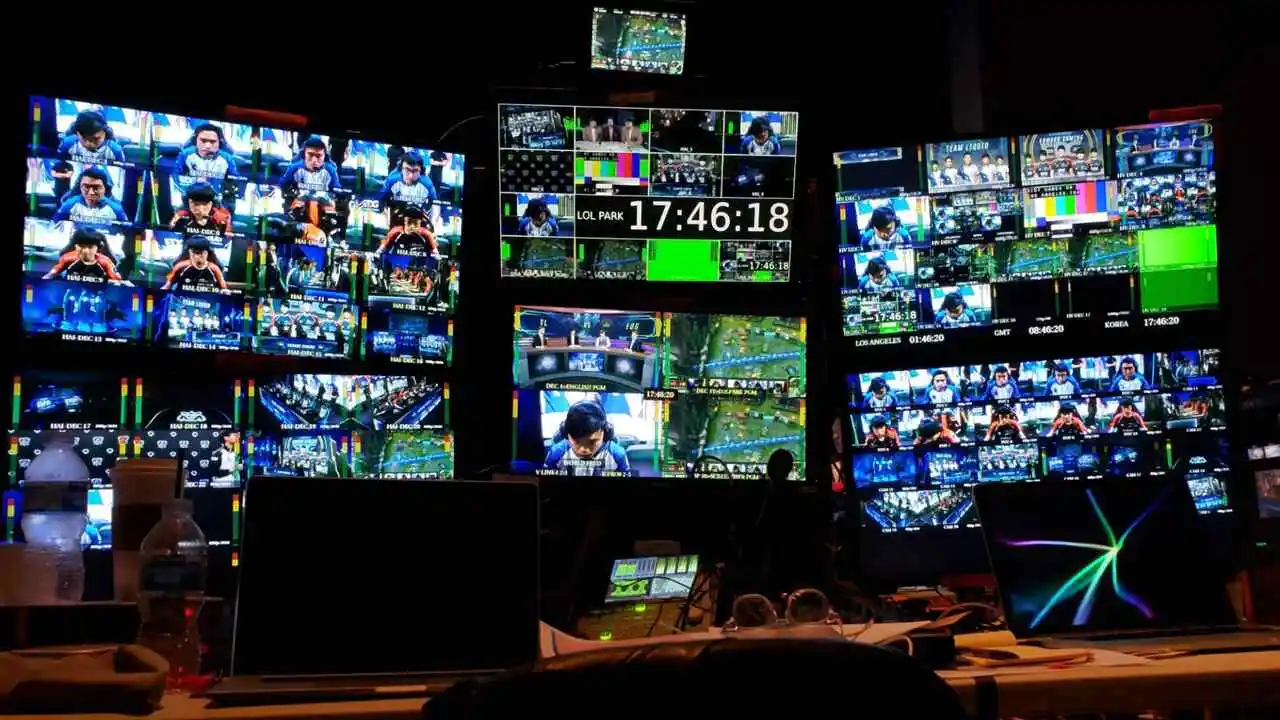
The maturity of this global and decentralized operation was not achieved overnight. According to the Riot Games director, testing with these infrastructures dates back nearly a decade, ironically emerging from the search to reduce dependence on traditional methods.
When asked about the moment the company realized this model would be the future, Svevo recalls:
“Looking back, with different technologies, between 2015 and 2016 we were already starting to look at this. It wasn’t exactly for the current purpose. It started, for example, by questioning the need for satellites: ‘Wait a minute, do I really need to use satellites? Can I do a point-to-point transmission?‘ And then we started exploring protocols like SRT. Right there, we saw that there was something promising, and we kept developing it.“
It took years of adjustments to reach the current infrastructure, proving that technological innovation in sports audiovisual production requires patience and multidisciplinary integration.
“The coolest thing is the collaborative work between product areas, broadcast teams, and the engineering crew. In these projects, you often start with one intention and, halfway through, a new horizon opens up. But I can say that for at least 10 years, we have been exploring and working with point-to-point and remote operations,” Svevo concludes.
Today, Riot Games’ dual-hub model not only ensures the delivery of a top-quality product, but also serves as a true B2B case study in operational efficiency. By integrating centralized hardware, a proprietary network, and human talent across different time zones, the company has paved the way for the future of major live broadcasts.