Blue Axolotl Minecraft is one of the rarest color variants players can obtain, and unlike the four common axolotl colors, you cannot normally find the blue version simply swimming around a cave. In Survival, the rare blue variant is obtained through breeding, making it a challenging collectible for players who want every axolotl color.
Getting a Blue Axolotl Minecraft requires patience because each breeding attempt has only a 1 in 1,200 chance, or approximately 0.083%, of producing the rare blue mutation. Otherwise, the baby normally inherits the color of one of its parents, which means you may need to breed a large number of axolotls before seeing the blue variant.
The key to finding a Blue Axolotl Minecraft is therefore building an efficient breeding setup, collecting plenty of Buckets of Tropical Fish, and understanding how the probability works. This guide explains where normal axolotls spawn, how breeding works, what the 1-in-1,200 chance really means, how to protect your rare blue axolotl, and what changes after you finally obtain one.
What Is the Blue Axolotl in Minecraft?
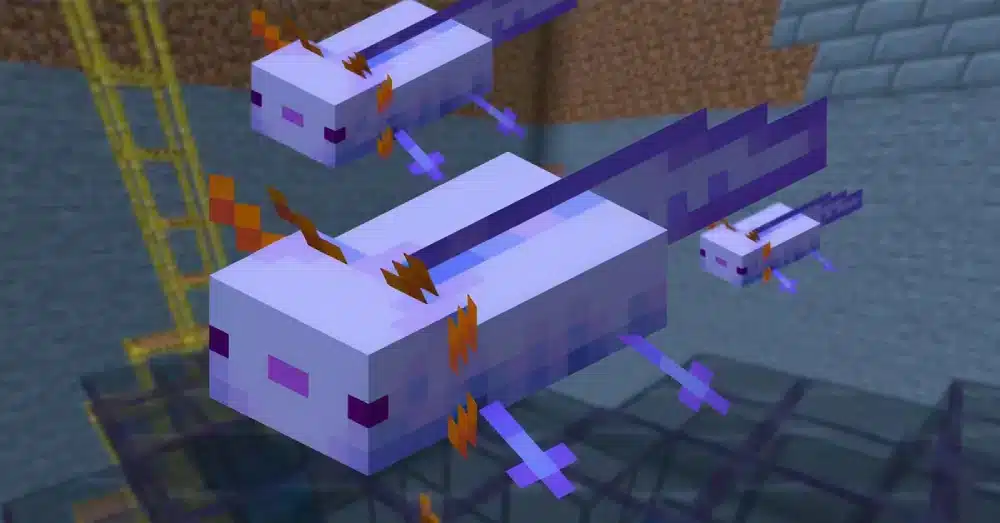
The Blue Axolotl is the rare color variant of Minecraft's aquatic axolotl mob. Axolotls were introduced as part of the Caves & Cliffs update and come in five color variants.
Four are common, while blue is deliberately rare. Mojang describes the blue axolotl as the rare variant and confirms that it can appear as a mutation when breeding two axolotls.
Here are the five variants:
| Axolotl variant | Appearance | Naturally available? | Available through breeding? |
| Leucistic | Pink | Yes | Yes |
| Wild | Brown | Yes | Yes |
| Gold | Yellow | Yes | Yes |
| Cyan | Light cyan | Yes | Yes |
| Blue | Blue/purple-blue | No | Yes, rare mutation |
The blue variant behaves like other axolotls. Its rarity comes from its color and breeding mechanics rather than superior combat abilities or special stats.
That makes owning one primarily a collectible achievement—and a particularly difficult one for Survival players.
How Rare Is a Blue Axolotl in Minecraft?
If you're wondering how rare is a Blue Axolotl in Minecraft, the number to remember is:
1 in 1,200.
Every qualifying breeding attempt has a 1/1,200 probability of producing a blue baby, equivalent to approximately 0.083%. Otherwise, the baby inherits one of its parents' colors.
That makes the Blue Axolotl substantially harder to obtain than simply searching for the four ordinary variants.
But there's an important detail about this number.
A 1-in-1,200 probability does not mean Minecraft guarantees a Blue Axolotl on your 1,200th breeding attempt.
Each breeding event is random.
You could get extremely lucky and receive one after 20 attempts. Another player could breed hundreds or even more than 1,200 babies without seeing blue.
That's why understanding probability is important before starting a large breeding project.
Blue Axolotl Minecraft Chance Explained
The Blue Axolotl Minecraft chance is approximately 0.083% on each breeding attempt.
Another way to understand the probability is:
Blue mutation: 1/1,200
No blue mutation: 1,199/1,200
Each new breeding attempt essentially gives you another independent chance.
Suppose you breed 100 axolotls without getting blue. Your next attempt still has the same basic mutation probability. The game doesn't gradually increase your chance because you've been unlucky.
Similarly, reaching 1,199 unsuccessful attempts does not make attempt 1,200 guaranteed to be blue.
This distinction is particularly important when planning resources. You aren't preparing for exactly 1,200 babies; you're preparing to keep breeding until random chance finally produces the result you want.
Can Blue Axolotls Spawn Naturally?
No, the blue variant is not part of the normal natural axolotl spawn pool in current Survival gameplay.
This is one of the most important things to understand about Blue Axolotl spawn Minecraft searches.
Exploring more caves won't eventually reveal a naturally spawned blue one under normal conditions. You need ordinary axolotls first and then use breeding to obtain the rare blue mutation.
Mojang's documentation describes blue as the exception among the variants, appearing through breeding rather than normal spawning.
This also explains why older Minecraft videos or guides can sometimes create confusion.
Axolotl mechanics changed during their development and early updates. If you're playing a current version, don't spend hours searching Lush Caves specifically for a naturally spawned blue axolotl.
Instead, use those caves to find your initial breeding pair.
Where Do Normal Axolotls Spawn?
Before attempting Minecraft Blue Axolotl breeding, you need at least two ordinary axolotls.
Axolotls naturally spawn underwater in Lush Caves, under the appropriate environmental conditions involving clay.
Lush Caves are distinctive underground biomes containing vegetation such as glow berries, moss, dripleaf, and other lush blocks.
Once you've located axolotls, you don't need to drag them all the way back to your base.
Use a water bucket on an axolotl to collect it.
The resulting Bucket of Axolotl allows you to transport the mob safely to your breeding location. Mojang confirms that axolotls can be picked up and transported in buckets.
For breeding purposes, two axolotls are enough to begin, although maintaining more adults can make repeated breeding much more efficient.
How to Get a Blue Axolotl in Minecraft Survival
The answer to how to get a Blue Axolotl in Minecraft Survival is straightforward, even though completing the process can take a long time. You'll need to:
- Find at least two normal axolotls;
- Capture them using water buckets;
- Build a secure water-based breeding area;
- Collect multiple Buckets of Tropical Fish;
- Feed a Bucket of Tropical Fish to each adult;
- Allow them to breed;
- Check the baby's color;
- Wait for the breeding cooldown;
- Repeat until a blue baby appears.
Axolotls specifically require Buckets of Tropical Fish for breeding. Mojang's current axolotl information also identifies tropical fish carried in buckets as their breeding food.
The mechanics themselves are simple.
The challenge is repetition.
Because the blue mutation is so rare, efficient resource management becomes much more important than complicated breeding techniques.
Minecraft Blue Axolotl Breeding Requirements
You don't need a special biome, enchantment, potion, weather condition, or moon phase to produce a blue baby.
You need adult axolotls and Buckets of Tropical Fish.
Feed one bucket to each adult to place them into love mode. They will breed and produce a baby axolotl.
After breeding, the parents enter a cooldown before they can breed again. The cooldown currently differs between editions: approximately five minutes in Java Edition and one minute in Bedrock Edition.
Babies take approximately 20 minutes to grow naturally into adults. Feeding them additional Buckets of Tropical Fish accelerates their growth.
These mechanics matter when designing your setup.
If you use only two adults, your breeding speed is limited by their cooldown. Keeping multiple adult breeding pairs lets you perform more breeding attempts over the same period.
How to Get Buckets of Tropical Fish
Buckets of Tropical Fish are the main resource bottleneck when trying to breed large numbers of axolotls.
You need a water bucket and a tropical fish.
Instead of killing the fish, interact with it using the water bucket to capture it. You'll then have a Bucket of Tropical Fish that can be used for axolotl breeding.
Because every breeding requires feeding both parents, large-scale breeding can consume a considerable number of tropical fish.
That means preparing resources before beginning is much more efficient than repeatedly stopping after every few breeding attempts.
Bring multiple buckets when collecting fish.
Iron can therefore become an indirect resource requirement for serious Blue Axolotl hunting, particularly when you want enough buckets to collect many tropical fish during a single trip.
Once you have a reliable supply, return to your breeding enclosure and begin working through your axolotl pairs.
How to Build a Blue Axolotl Breeding Setup
You don't need a complicated redstone farm to breed Blue Axolotls.
A practical setup should prioritize three things:
water, containment, and easy access to the adults.
Create a secure pool where the axolotls can't wander away. Make sure you can comfortably reach each adult with your Buckets of Tropical Fish.
Then consider creating additional areas for babies.
Separating babies from the breeding adults makes it easier to count attempts and identify new colors. It also prevents your enclosure from becoming increasingly chaotic as the population grows.
For larger projects, you can create several breeding pools containing multiple adult pairs.
However, don't confuse an efficient breeding setup with fully automated breeding. Feeding axolotls still requires player involvement, so the objective is to streamline your movement and resource handling rather than expect the process to run entirely by itself.
How Many Attempts Does It Take to Get a Blue Axolotl?
There is no fixed number.
The often-mentioned 1,200 attempts comes from the probability of 1 in 1,200 per breeding, not from a guaranteed progression system.
This means different players can have dramatically different experiences.
One player might get a Blue Axolotl almost immediately.
Another could perform hundreds of attempts.
Another could exceed 1,200 attempts.
None of these outcomes contradicts the stated probability.
This is why the best strategy isn't to count down toward a guaranteed attempt. Instead, maximize the number of breeding opportunities you can perform efficiently.
Maintain multiple breeding adults, stockpile Buckets of Tropical Fish, and create enough space to manage babies without constantly rebuilding your enclosure.
Luck determines the final result, but preparation determines how frustrating the process becomes.
Does Breeding More Axolotls Increase the Blue Chance?
Breeding more axolotls gives you more attempts, but it doesn't increase the mutation probability of each individual breeding event.
This distinction is important.
Adding ten breeding pairs doesn't transform the 1-in-1,200 chance into something better for each baby.
Instead, those ten pairs allow you to produce babies more frequently.
Over many attempts, having more breeding pairs therefore improves your practical opportunity to eventually see a blue mutation simply because you're generating more babies.
Think of it as buying more chances rather than improving each chance.
For players committed to finding the rare variant in Survival, increasing breeding capacity is usually much more useful than maintaining only one pair and waiting through every cooldown.
What Happens After You Get a Blue Axolotl?
Once you finally produce a blue baby, secure it immediately.
The easiest approach is to collect it with a water bucket. Axolotls transported in buckets can be moved safely, and this gives you much greater control over where the rare mob is stored.
You may also want to give the axolotl a name for easier identification.
Most importantly, don't treat your first blue variant as just another mob in an overcrowded breeding enclosure.
It represents potentially hundreds of breeding attempts.
Create a protected aquarium or enclosure for it, or use it strategically as part of your next breeding project.
That's because obtaining your first Blue Axolotl changes the genetics of your breeding operation significantly.
Can You Breed Two Blue Axolotls?
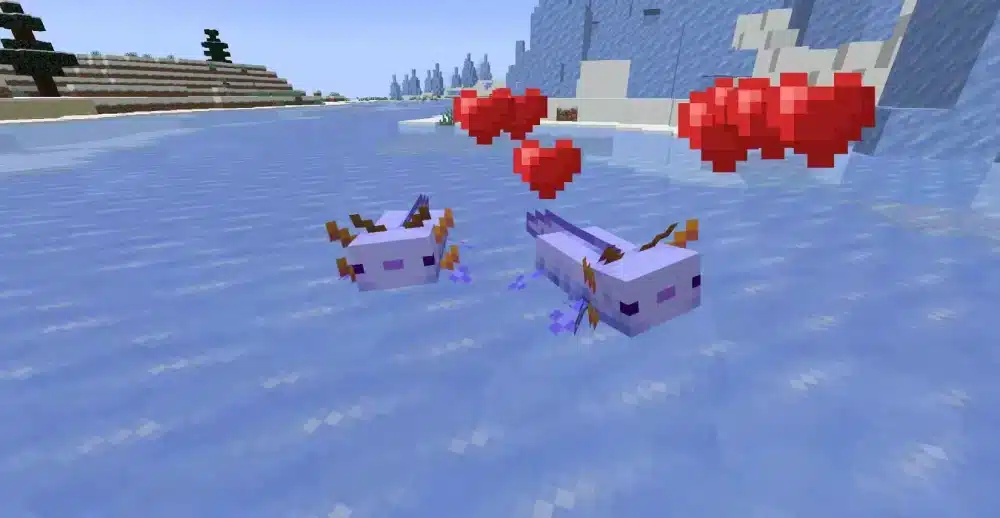
Yes, and this is where things become much easier.
Normally, when an axolotl baby does not receive the rare blue mutation, it inherits the color of one of its parents. If a parent is already blue, that creates a much higher practical opportunity for blue offspring through ordinary color inheritance.
If you have one blue and one non-blue parent, the baby can inherit either parent's color when the rare mutation does not occur.
If both parents are blue, their inherited parental color is blue.
This means the extremely difficult stage is obtaining that first rare blue mutation.
Once you have established blue breeding stock, creating additional Blue Axolotls becomes dramatically easier.
For collectors, this is an excellent reason to protect the first blue variant and use it carefully rather than placing it in dangerous situations immediately.
All Minecraft Axolotl Colors
Minecraft has five axolotl color variants.
Leucistic Axolotl
The leucistic variant has the familiar pink appearance many players associate with real-life captive axolotls.
Wild Axolotl
Wild axolotls have a brown appearance that more closely resembles natural coloration.
Gold Axolotl
The gold variant is bright yellow and particularly easy to identify inside a breeding pool.
Cyan Axolotl
The cyan variant has a pale bluish appearance, but it should not be confused with the genuinely rare blue axolotl.
Blue Axolotl
The blue variant has a darker blue-purple appearance and is the rare breeding mutation.
Mojang describes axolotls as having four common varieties and one rare blue variety.
Collecting all five is therefore a natural challenge for players who enjoy mob collections.
Cyan Axolotl vs. Blue Axolotl
This distinction can confuse newer players.
Cyan axolotls have a light blue or cyan body, which can initially make them look like they should qualify as “blue.”
They don't.
The actual Blue Axolotl is a separate color variant with a much darker blue-purple appearance.
Cyan is one of the four common variants and can appear through normal spawning. Blue is the rare variant associated with breeding.
Therefore, finding a cyan axolotl in a Lush Cave doesn't mean you've somehow found the 1-in-1,200 variant naturally.
If you're building a complete collection, you'll need both cyan and blue.
Can You Get a Blue Axolotl With Commands?
Players using Creative Mode or cheats can bypass the Survival breeding grind through commands.
However, command syntax and entity data can differ between Java Edition and Bedrock Edition, as well as across Minecraft versions.
For that reason, commands should not be confused with the Survival acquisition method.
If your objective is obtaining the rare variant legitimately in Survival, breeding remains the relevant mechanic.
If you're building a Creative world, testing mobs, creating maps, or administering a server, commands can provide direct access to specific axolotl variants where supported.
Before entering a variant-specific summon command, verify the syntax for the exact edition and Minecraft version you're running.
This avoids copying an outdated Java command into Bedrock—or vice versa—and assuming the game mechanic itself is broken.
Java vs. Bedrock Blue Axolotl Breeding
The fundamental rarity mechanic is the same idea across the major editions: blue is the rare breeding variant.
However, there are differences in breeding timing.
Current reference information lists the parental breeding cooldown as approximately:
| Edition | Breeding cooldown |
| Java Edition | 5 minutes |
| Bedrock Edition | 1 minute |
Babies normally mature in about 20 minutes, with Buckets of Tropical Fish capable of accelerating their growth.
That cooldown difference can have a substantial impact when you're performing hundreds of breeding attempts.
Bedrock players using the same pair can begin another breeding cycle sooner, while Java players may benefit more from maintaining multiple adult pairs rather than waiting for a single pair's cooldown repeatedly.
The 1-in-1,200 mutation chance still means patience is required regardless of edition.
How to Keep Your Blue Axolotl Safe
After spending potentially hours breeding for a Blue Axolotl, protecting it should become a priority.
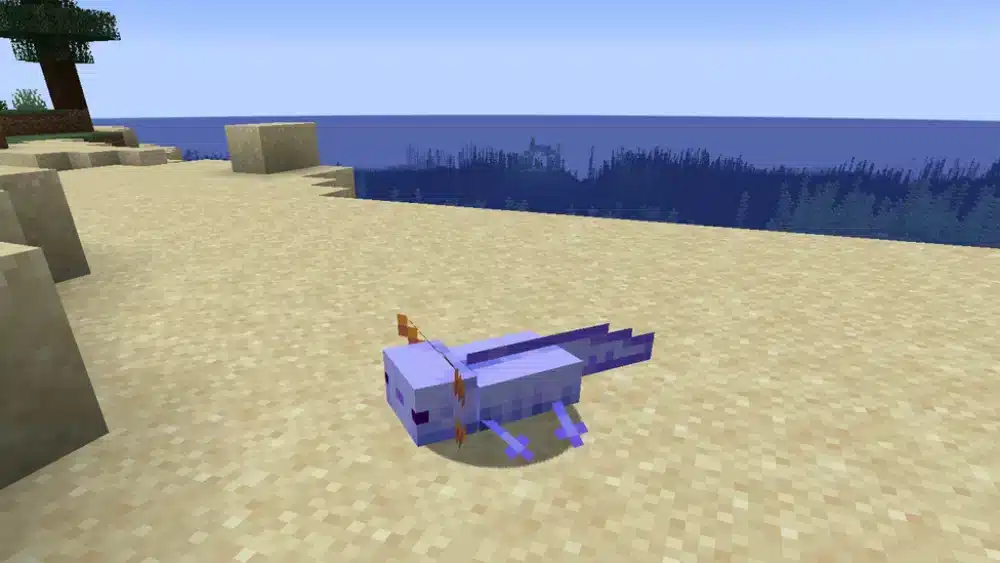
Axolotls are amphibious, but they cannot remain indefinitely out of water.
Mojang states that axolotls begin drying out and taking damage after being out of water for more than five minutes. They don't dry out while they are in water or rain.
The safest option is a secure water enclosure.
Avoid creating an aquarium from which the axolotl can escape onto dry terrain and remain there unnoticed.
Buckets provide another safe transportation method.
If you're moving the Blue Axolotl between bases, transporting it in a bucket is generally much more controlled than trying to lead it through a long journey.
For a valuable mob like this, there's little reason to take unnecessary risks.
Can You Tame a Blue Axolotl?
No. Axolotls cannot be tamed in the same way as wolves or cats.
They can be bred, transported in buckets, tempted with Buckets of Tropical Fish, and kept in player-built enclosures, but there is no standard ownership/taming mechanic that causes them to permanently behave like a traditional Minecraft pet. Mojang explicitly documented axolotls as breedable but not tameable.
That doesn't stop players from keeping them as pets.
You can build an aquarium, collect different colors, name individual axolotls, and transport them around your world.
A Blue Axolotl is particularly suited to this because of the effort required to obtain one.
Just remember that holding the appropriate food to attract an axolotl isn't the same as taming it.
What Do Axolotls Attack?
Axolotls aren't merely decorative mobs.
They interact with several aquatic creatures and can participate in underwater combat.
Mojang documents axolotls attacking targets including fish, squids, Drowned, Guardians, and Elder Guardians. They can also provide a useful benefit to players participating in the same fight.
When a player kills a mob that an axolotl was fighting, the player can receive temporary Regeneration and have Mining Fatigue removed.
That can make axolotls particularly interesting around Ocean Monuments.
However, your rare Blue Axolotl has the same basic gameplay role as other color variants.
Its blue coloration doesn't make it a stronger fighter.
If you've spent hundreds of breeding attempts obtaining one, you may prefer keeping it safely at your base and using common axolotls for dangerous underwater adventures.
Do Blue Axolotls Have Special Abilities?
No. Their special characteristic is rarity, not enhanced abilities.
A Blue Axolotl doesn't deal extra damage, provide stronger Regeneration, swim faster, or possess additional health simply because it is blue.
From a practical gameplay perspective, another axolotl color can perform the same combat-related functions.
This is an important point for players deciding whether the breeding grind is worthwhile.
If you're looking purely for underwater assistance, you don't need the rare variant.
If you're a collector, completionist, breeder, or simply like the blue design, then the challenge itself becomes the reward.
That also makes successfully breeding one feel considerably more meaningful than finding an ordinary variant.
Blue Axolotl Breeding in Minecraft Multiplayer
Breeding Blue Axolotls can be a fun multiplayer project because several players can divide the repetitive work.
One player can search for Lush Caves and collect breeding stock while another gathers iron and prepares buckets. Other players can collect tropical fish, construct breeding pools, or manage the growing axolotl population.
This division of labor can make a potentially lengthy Survival challenge much more manageable.
However, multiplayer introduces another variable: network performance.
If the game itself is running smoothly but multiplayer interactions feel delayed or inconsistent, the problem may be related to latency, jitter, packet loss, or network routing rather than the axolotl mechanics.
Those network issues don't change the 1-in-1,200 breeding probability.
They are separate from the random breeding system and should be diagnosed separately rather than treated as a factor affecting your chances of obtaining the blue mutation.
Improve Your Minecraft Multiplayer Experience With ExitLag
The hardest part of obtaining a Blue Axolotl should be beating the breeding odds—not dealing with an unstable multiplayer connection.
When network routing contributes to latency variation, jitter, packet loss, or connection instability, route optimization can help address the network side of the experience.
ExitLag is designed to optimize network routes for supported online games, searching for more stable paths when routing conditions are affecting connectivity.
It cannot increase the Blue Axolotl Minecraft chance, shorten breeding cooldowns, or guarantee the rare mutation.
However, when network routing is contributing to multiplayer connection problems, ExitLag can help provide a more consistent online experience while you and your friends continue the hunt for Minecraft's rarest axolotl color.
FAQ
Each breeding attempt has a 1 in 1,200 chance, approximately 0.083%, of producing the rare blue mutation.
No. In current Survival gameplay, the rare blue variant is obtained through breeding rather than the normal natural spawn pool.
Breed two adult axolotls using Buckets of Tropical Fish. Each breeding attempt provides another chance of producing the rare blue baby.
There is no guaranteed number. The probability is 1 in 1,200 per breeding attempt, so you could get one very quickly or perform more than 1,200 attempts without receiving one.
Yes. Once you have blue axolotls as breeding parents, their blue color can be inherited by their offspring, making additional blue axolotls much easier to obtain than the first rare mutation.
Get Your Blue Axolotl and Complete Your Minecraft Collection
The Blue Axolotl Minecraft variant is difficult to obtain because you can't simply explore until one naturally appears. In Survival, you need to breed axolotls repeatedly, with each attempt providing only a 1-in-1,200 chance of producing the rare blue mutation.
Prepare multiple breeding adults, collect plenty of Buckets of Tropical Fish, build an efficient enclosure, and remember that 1,200 attempts is not a guarantee. Once you finally obtain your first blue axolotl, protect it carefully and use blue breeding stock if you want to expand your collection.