Even though the keyword still says CSGO live stats, the real ecosystem in 2026 is centered on Counter-Strike 2. Most of the tools players actually use now are built around CS2 match data, CS2 demos, pro match coverage, or platform-specific analysis like FACEIT and Leetify. So the smartest way to approach this topic is to treat “CSGO live stats” as a legacy search term and explain the current CS2 reality clearly.
That shift also makes it important to follow the current state of the game itself, not only third-party dashboards. For players trying to understand what changed between patches, the latest CS2 updates and game changes can give useful context before comparing match data or performance trends.
If you want CSGO live stats today, what you usually mean is one of four things: HLTV live match coverage for pro games, FACEIT live stats or match insights for platform play, personal analysis through a CS2 stats tracker like Leetify or Scope.gg, or a general CSGO match tracker style site that shows scorelines, ratings, ADR, KAST, and timelines. Those categories overlap, but they do not do the same job.
That difference matters because players often expect one tool to do everything. It usually does not. HLTV is excellent for following pro matches and event stats. Leetify is stronger for personal improvement and automated match reports. Scope.gg focuses on player performance breakdowns and growth areas. FACEIT’s new Match Insights and FACEIT Rating are built for platform-specific analysis inside the FACEIT ecosystem.
So this guide explains what CSGO live stats really means now, where to track CS2 live match stats, which tools are best for pro matches versus your own games, what “live” actually means on each platform, and how to use these numbers to improve instead of just staring at dashboards.
What are CSGO live stats now?
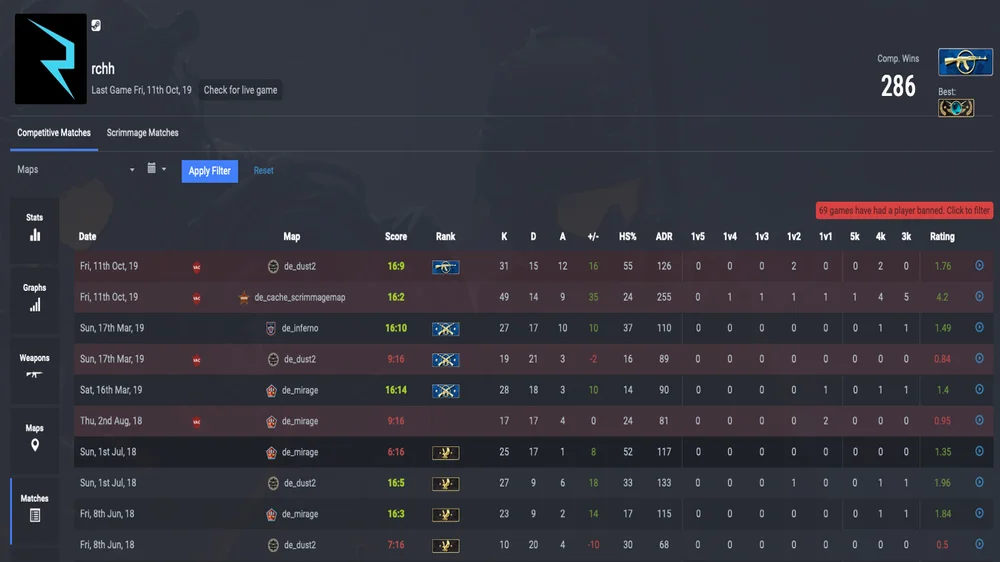
The phrase CSGO live stats mostly survives because players still search for it, not because the live ecosystem is still built around Global Offensive. In practice, the most relevant data products now are tied to CS2. HLTV’s current match and stats pages are explicitly filtered for CS2, Leetify brands itself as “CS2 Stats & Accomplishments,” and FACEIT’s official support center now organizes these features under CS2 matchmaking and CS2 Season 8.
That means a modern definition of CSGO game statistics includes:
- live pro match scorelines and player ratings
- round-by-round radar or timeline analysis
- personal match reports after your games
- utility, ADR, KAST, and duel metrics
- map-by-map and event-by-event performance
- platform-specific performance scoring, especially on FACEIT
Each of those is real. They just come from different tools and update at different speeds.
The competitive scene is a big reason these numbers still matter so much. Counter-Strike became a long-running esport because players and viewers learned to read performance through rounds, roles, economy, and pressure, which is why the history behind Counter-Strike as an esports phenomenon still helps explain today’s obsession with stats.
Which tools are best for CSGO live stats and CS2 live match stats?
The best tool depends on what you want to track. There is no single universal winner. If you follow pro Counter-Strike, HLTV is the default choice. If you want personal growth, Leetify and Scope.gg are much better. If you mainly play FACEIT, then FACEIT’s own Match Insights and FACEIT Rating features are more contextually useful than a generic tracker.
Here is the clearest breakdown:
| Tool | Best use | What it does best |
| HLTV | Pro match following | Live match pages, player stats, team stats, event tracking |
| Leetify | Personal improvement | Automatic match reports, skill trends, performance tracking |
| Scope.gg | Detailed personal analytics | Deeper match breakdowns, mistakes, map performance, clips |
| FACEIT Match Insights | FACEIT match review | Round-by-round radar, kill/death locations, utility review |
| FACEIT Rating | FACEIT performance context | Match impact metric beyond scoreboard stats |
This is the real current landscape for CS2 player stats live and modern CSGO match tracker usage.
HLTV for pro matches
HLTV is still the top source for pro and tournament-focused HLTV live match coverage. Its match listing page explicitly promises livescore, lineups, statistics, and more, while the broader stats database covers players, teams, maps, and events. If your goal is to follow pro Counter-Strike rather than your own ranked grind, HLTV is still the cleanest answer.
What HLTV is best for:
- live professional match pages
- tournament scorelines
- player and team database lookups
- map and event trend analysis
- historical match context
It is much less about coaching your gameplay and much more about helping you follow or analyze the competitive scene.
Leetify for your own matches
Leetify is one of the strongest answers for players asking how to turn CSGO live stats into actual improvement. Its homepage currently describes the platform as a way to track your Counter-Strike performance, compare accomplishments, and review automatic match reports. That makes it much more player-development focused than HLTV.
Leetify is strong for:
- automatic personal match reports
- long-term trend tracking
- player progression
- identifying recurring weaknesses
- post-match review without building your own spreadsheet
So if you want a real CS2 stats tracker for yourself rather than a pro-viewing site, Leetify is one of the best places to start.
Scope.gg for deeper analysis
Scope.gg is another strong personal analytics option. Its current site says it evaluates your skill with stats you will not see inside CS2, tracks progress, analyzes mistakes, and even records clips of your best moments. That makes it useful for players who want more than simple scoreboard data.
Scope.gg is especially useful if you care about:
- performance trends over time
- map-specific strengths and weaknesses
- deeper contextual review
- visual replay-friendly analysis
- identifying improvement areas faster
For many players, Scope.gg feels like a more analysis-heavy alternative to simpler match summary tools.
Players who want that deeper review style can go straight to Scope.gg for Counter-Strike analysis and compare its breakdowns with the simpler summaries they already use. It is especially useful when raw scoreboard numbers are not enough to explain why a match felt difficult.
FACEIT live stats and Match Insights
If you mostly play on FACEIT, the most current official answer to FACEIT live stats is FACEIT’s new Match Insights feature plus the new FACEIT Rating metric. FACEIT’s official Season 8 FAQ says Match Insights launches on April 22, 2026 for Premium players and provides round-by-round radar breakdown directly on the match page, including kill/death locations, utility tracking, and performance over the match.
FACEIT Rating, also launching with Season 8, is described by FACEIT as a new performance metric that measures how much your actions changed the result of the match, rather than just showing what your scoreboard looked like at the end. That is an important shift because it adds context to entries, utility, impact, and round value.
So if you are asking for FACEIT live stats, the most accurate current answer is that FACEIT now has official built-in analysis features that go beyond old-school K/D and Elo discussions.
What is the difference between live stats and post-match analysis?
A lot of players use these terms interchangeably, but they are not the same. Real live stats update during the match or immediately around it. Post-match analysis usually parses data after the game ends and gives you a better breakdown once all round data is available.
HLTV is the clearest example of true live pro coverage. It gives you the active match page, map score, current stats view, and event context while the series is happening. FACEIT Match Insights is very fast, but it is still match-page analysis generated from completed or near-complete match data rather than a literal mid-round in-client coach. Leetify and Scope.gg are even more clearly post-match focused.
That means:
- HLTV live match = best for following pro games as they happen
- FACEIT live stats = better thought of as near-immediate match-page review
- Leetify / Scope.gg = best for post-match development
- generic CSGO match tracker sites = often mix livescore and post-match stats
Understanding that difference helps you choose the right tool without expecting magic from the wrong one.
Official game context still matters alongside trackers because patches, map changes, and system updates can reshape what the numbers mean. The main Counter-Strike website is the safest place to confirm official news before treating a sudden stat shift as purely personal performance.
How should you use CS2 live match stats to improve?
The biggest mistake players make with CSGO live stats is treating stats as entertainment only. The real value is in decision-making and pattern recognition. A scoreboard alone will not tell you why you are losing. But utility patterns, round-by-round radar, map-by-map underperformance, and context-aware performance metrics can get much closer.
A strong improvement loop looks like this:
- Track your match results and not just your highlight clips.
- Review your weak maps, roles, and utility habits.
- Compare impact with results, not just kills.
- Use one tool consistently for at least a few weeks.
- Focus on one or two changes at a time.
This is exactly where Leetify, Scope.gg, and FACEIT Rating become more useful than raw scoreboard obsession.
What stats matter most?
Not every stat deserves equal attention. The most useful metrics are the ones that explain your role and decision-making, not just your raw fragging.
Usually the most helpful CS2 player stats live or near-live categories are:
- ADR
- KAST
- entry success
- utility usage and impact
- death locations
- round-by-round performance swings
- map-specific performance trends
FACEIT’s new Match Insights explicitly emphasizes kill/death locations and utility usage. HLTV’s ecosystem emphasizes ratings, map stats, and player comparisons. Leetify and Scope.gg focus more on personal performance evolution and gameplay patterns.
Why context matters more than scoreboard stats
FACEIT’s own explanation of FACEIT Rating is one of the clearest statements of this principle. They say not all kills are equal, and an entry that opens a bombsite matters more than an exit frag when the round is already lost. That is exactly why context-aware statistics are more useful than just K/D.
So if you want to use CSGO game statistics well, do not ask only “Did I top frag?” Ask:
- Did I get useful kills?
- Did I create space?
- Was my utility helping?
- Did I die in the same positions repeatedly?
- Am I actually stronger on the maps I queue most?
That is how stats become coaching instead of decoration.
Where should you track pro CS2 versus your own games?
This is the cleanest separation:
For pro matches
Use:
- HLTV match page
- HLTV stats database
- HLTV event pages
That is where HLTV live match becomes the best answer to “What is happening right now in pro CS2?”
For your own matchmaking and FACEIT games
Use:
- Leetify
- Scope.gg
- FACEIT Match Insights
- FACEIT Rating
That is where CS2 stats tracker and FACEIT live stats tools become useful for real improvement.
For a hybrid approach
A lot of serious players use both categories:
- HLTV to study pros
- Leetify or Scope.gg to study themselves
- FACEIT’s tools when queueing there regularly
That is usually the smartest setup.
Stats are not the only way players express identity or track value in Counter-Strike either. Cosmetics still shape how people engage with the game, and items like CS2 red stickers show how visual customization can sit beside performance tracking as part of the broader CS2 experience.
What changed from CS:GO to CS2 for stats?
The biggest practical change is that the stats ecosystem is now more openly branded around CS2 instead of CS:GO, and platform features are evolving around that. You can see that directly in how Leetify markets itself, how HLTV filters its stats database for CS2, and how FACEIT’s newest season features are designed specifically for CS2 matchmaking.
The second change is that analysis is becoming more contextual. FACEIT Rating is a direct example of this. Instead of rewarding only scoreboard accumulation, it tries to measure how much your actions shifted the chance of winning. That is a more modern approach than older “who had more kills” thinking.
The third change is convenience. FACEIT Match Insights was built specifically to reduce the need to download and watch full demos just to check one detail. That reflects a larger shift across the ecosystem: players want fast, structured, useful review tools instead of manually digging through everything themselves.
Why ExitLag still matters alongside stats
Stats help you understand decisions, but they do not fix your connection. You can have the best CS2 stats tracker in the world and still lose duels if your routing is unstable, your ping spikes at the wrong time, or your connection desyncs during high-pressure rounds.
That is why ExitLag pairs well with this topic. Stats tell you what went wrong. ExitLag helps remove one of the most frustrating external causes of bad performance: inconsistent network routing.
It matters most for:
- timing-sensitive peeks
- entry fights
- utility timing
- clutch rounds
- FACEIT and high-pressure matchmaking
In a game where one delayed swing can decide a round, better routing is not a luxury. It is part of clean execution.
FAQ
The best modern answers are HLTV for pro matches, Leetify and Scope.gg for personal analysis, and FACEIT Match Insights for FACEIT-specific review. The ecosystem is now primarily CS2-focused, even if players still search “CSGO live stats.”
For pro play, HLTV is the strongest answer. For your own games, Leetify, Scope.gg, and FACEIT’s official tools are more useful.
FACEIT Season 8 introduces Match Insights for Premium players on April 22, 2026, with round-by-round radar breakdown, kill/death locations, utility usage, and match performance visualization. FACEIT also adds FACEIT Rating, a context-aware match impact metric.
Leetify is mainly a post-match performance platform. It focuses on automatic match reports, accomplishments, and long-term improvement rather than acting like a live in-match HUD.
HLTV is best for pro matches, tournaments, team stats, and live Counter-Strike coverage. Leetify is better for your personal matches and automated performance analysis.
Yes, but you should think in CS2 terms now. The concept is still useful, but the best tools are now built around CS2 data, CS2 match pages, and CS2-specific platform analysis.
CSGO live stats still matters as a search term, but the smartest players now use modern CS2 tools for the real work: HLTV for pro coverage, Leetify and Scope.gg for self-review, and FACEIT’s new built-in analysis features for platform-specific matches. If you want to turn data into wins, pair those tools with a stable connection, because clean decisions only matter if the server actually receives them in time.
Got questions or want to connect with other players? Join the conversation at the ExitLag Forum!