

Mir4 feels incredible when everything is smooth: clean camera movement, stable skill animations, crisp dodges, and consistent timing in PvP and boss fights. When your FPS is steady, you track targets more easily, react faster to burst windows, and keep control during crowded raids where every second matters.
But when performance becomes unstable, it gets messy fast. Sudden frame drops during large-scale fights, micro-stutters in world events, and delayed input during PvP can make Mir4 feel heavier than it should. Even worse, network instability can trigger hitching that looks like FPS problems. If that sounds familiar, start with the Mir4 packet loss troubleshooting guide to understand how packet loss and jitter can create stutters that ruin consistency.
This guide shows how to get a reliable FPS boost in Mir4 with ExitLag and a few high-impact tweaks. You can improve smoothness by stabilizing routing, reducing micro-stuttering, and minimizing input lag, sometimes delivering up to 60% better consistency depending on your baseline. To jump in right away, install ExitLag from the official ExitLag gaming performance site and follow the steps below.

Why FPS matters in Mir4
Why high FPS is crucial in Mir4
Mir4 is an MMORPG with moments where performance demands spike hard: dense cities, large-scale PvP, world bosses, and raid-like content with a lot of effects on screen. Stable FPS is what keeps you responsive when everything is happening at once.
High FPS matters most in Mir4 when you are:
- rotating skills quickly during burst windows
- reacting to crowd control in PvP
- tracking targets in chaotic siege-style fights
- dodging boss mechanics in packed groups
- navigating crowded hubs without hitching
A consistent FPS boost in Mir4 is not just comfort—it directly affects combat timing and your ability to stay in control.
What FPS means in simple terms
FPS means frames per second. Think of it like a camera: the more frames you see each second, the smoother the motion looks and the easier it is to process what’s happening on screen.
Here’s the practical difference:
- 30 FPS: choppy movement, delayed reads
- 60 FPS: baseline smoothness, playable consistency
- 144 FPS: ultra-smooth motion and fast visual clarity
In fast or crowded Mir4 moments, the most important thing is not peak FPS. It’s stable minimum FPS and consistent frame pacing.
Quick FPS impact checklist
When FPS is higher and stable, you usually get:
- smoother camera panning in crowded areas
- cleaner skill animation clarity
- more consistent movement and dodging
- more reliable target tracking
- less visual fatigue over long sessions ✅
Benefits of high FPS in Mir4
Top benefits you feel immediately
Here are the biggest gameplay gains players notice after a real FPS boost in Mir4:
- Smoother combat animations and clearer timing
- Faster reactions to PvP burst and crowd control
- Cleaner movement during raids and large events
- More consistent skill rotation rhythm
- Better camera control in crowded fights
- Less fatigue during long sessions
- More stable performance in cities and hubs
The biggest win is consistency: Mir4 becomes predictable, and predictable gameplay is where you improve faster.
Why consistency beats “big FPS numbers”
A spiky 120 FPS that drops to 45 FPS during fights feels worse than a stable 75–90 FPS. Mir4’s busiest moments are exactly when you need stability the most.
Watch out for these frame pacing red flags:
- random “mini freezes” during ability chains
- stutters when new players enter the screen
- sudden input delay right before a dodge
- camera hitching during large AoE effects ⚠️
If you recognize these, you are chasing stability, not just higher averages.
FPS targets by playstyle
Different Mir4 players should aim for different targets:
- Casual farming and story: stable 60–90 FPS
- Daily content and mid-scale PvP: stable 90+ FPS
- Heavy PvP and mass events: highest stable FPS your system can hold ✅
FPS tiers and what you should aim for
FPS classification for Mir4
Use this table as your benchmark:
| FPS range | Quality | Experience | Competitive? |
| 144+ FPS | ⭐⭐⭐⭐⭐ Excellent | Perfect | ✅ Ideal |
| 90–144 FPS | ⭐⭐⭐⭐ Great | Very good | ✅ Yes |
| 60–90 FPS | ⭐⭐⭐ Good | Acceptable | ⚠️ Slight disadvantage |
| 30–60 FPS | ⭐⭐ Regular | Choppy | ❌ Hard to compete |
| Under 30 FPS | ⭐ Bad | Unplayable | ❌ Impossible |
If your goal is FPS boost in Mir4, your fastest improvement usually comes from raising minimum FPS and removing stutters.
FPS vs graphics: choose performance first
Mir4 can look good even on balanced settings. In competitive or crowded content, prioritize:
- performance over eye candy
- stable frame time over maximum textures
- responsiveness over extra post-processing
A smooth game makes you better. A pretty slideshow does not.
Key takeaway
For Mir4, your best strategy is:
Stable FPS + stable network routing = real competitive smoothness ✅
How ExitLag increases FPS in Mir4
What ExitLag is, and why it matters
ExitLag is a network optimization tool designed for online gaming stability. It improves routing consistency to reduce jitter, spikes, and packet loss patterns that can cause micro-stuttering.
Important clarity: ExitLag is NOT a VPN.
A typical VPN focuses on privacy tunneling, and it can add overhead or choose routes that are not optimized for gaming. ExitLag focuses on performance routing.
If you want the technical breakdown, read the official how ExitLag works page.
Why network issues can feel like FPS issues
Mir4 is server-synced. When your connection becomes unstable, the game can hitch during corrections or resync events. That hitch often looks like an FPS drop:
- skills feel delayed
- movement stutters
- camera motion becomes uneven
- hit registration feels inconsistent
This is why ExitLag can deliver an FPS boost in Mir4 through stability improvements that make gameplay smoother and more consistent.
Rendered FPS vs perceived FPS
Two concepts matter:
- rendered FPS: what your hardware outputs
- perceived FPS: how smooth the game feels in real fights
ExitLag mainly improves perceived FPS by reducing stutters and stabilizing timing, which often feels like more FPS in Mir4 even when your average FPS number changes only modestly.
Seven ways ExitLag helps you get an FPS boost in Mir4
The stability technologies that matter most
Here are seven practical ways ExitLag helps Mir4 feel smoother online:
- Micro-stutter reduction
Stabilizes routing so the game has fewer correction hitches in crowded content. - Input lag reduction
More consistent packet timing improves responsiveness, which can make combat feel faster. - Frame time stabilization
Better stability means fewer spikes that create uneven pacing during fights. - Multi-path route optimization
Avoids congested paths that cause jitter, especially at peak hours. - Game traffic prioritization
Reduces interference from background traffic so Mir4 packets stay consistent. - Ping optimization for better sync
Lower and steadier ping reduces correction behavior in online gameplay. - Redundant routing for reliability
Helps prevent “random bad nights” where your routing suddenly becomes unstable.
This is why many players describe ExitLag as an FPS boost in Mir4 solution: smoother pacing, fewer hitches, and better control.
To confirm supported titles beyond Mir4, check the full ExitLag supported games list.
ExitLag vs other FPS boost methods
What actually works for Mir4
Not all “boost” solutions improve online smoothness. Use this comparison:
| Solution | Increases FPS? | Reduces lag? | Stability | Ease | Recommendation |
| ExitLag | ✅ Yes via stability | ✅✅✅ | ⭐⭐⭐⭐⭐ | ⭐⭐⭐⭐⭐ | ✅ Best |
| Typical VPN | ❌ Often worse | ❌ Often worse | ⭐⭐ | ⭐⭐⭐ | ❌ Avoid |
| Generic game booster | ⚠️ Minimal | ❌ No | ⭐⭐⭐ | ⭐⭐⭐⭐ | ⚠️ Limited |
| Windows tweaks | ⚠️ Some | ❌ No | ⭐⭐⭐ | ⭐⭐ | ⚠️ Helpful |
| Hardware upgrade | ✅ Yes | ❌ No | ⭐⭐⭐⭐ | ⭐ | 💰 Expensive |
| Doing nothing | ❌ No | ❌ No | ⭐ | ⭐⭐⭐⭐⭐ | ❌ Worst |
Mir4 is a perfect example of why stability matters: you can have a decent GPU and still feel stutters because routing is unstable.
And again, because it matters: ExitLag is NOT a VPN ✅
How to use ExitLag in Mir4
The process is extremely simple:
Step 1 – Access the official ExitLag website and download the application. There’s a free trial period for new users.
Step 2 – Install and open the program. Log in with your account.
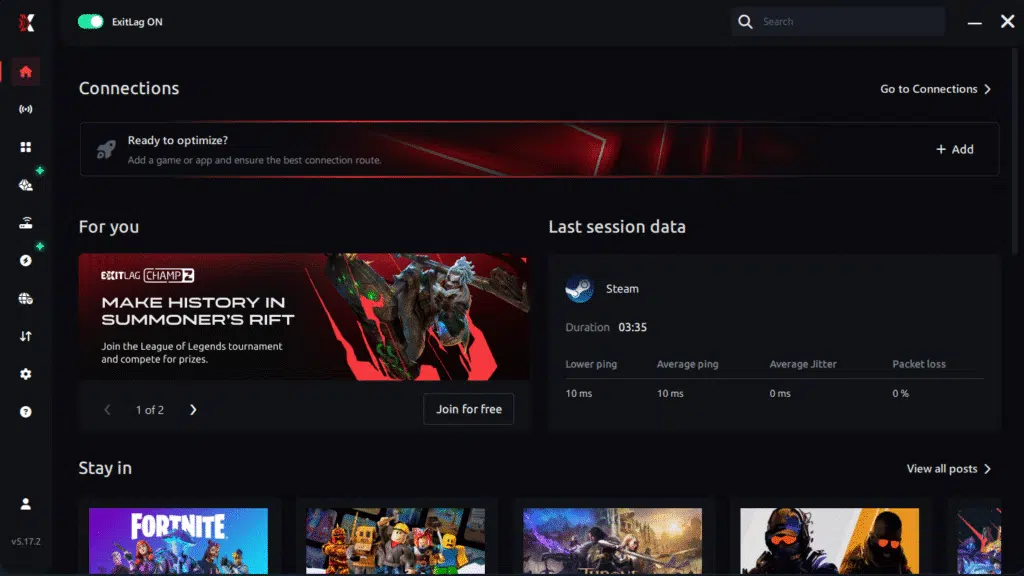
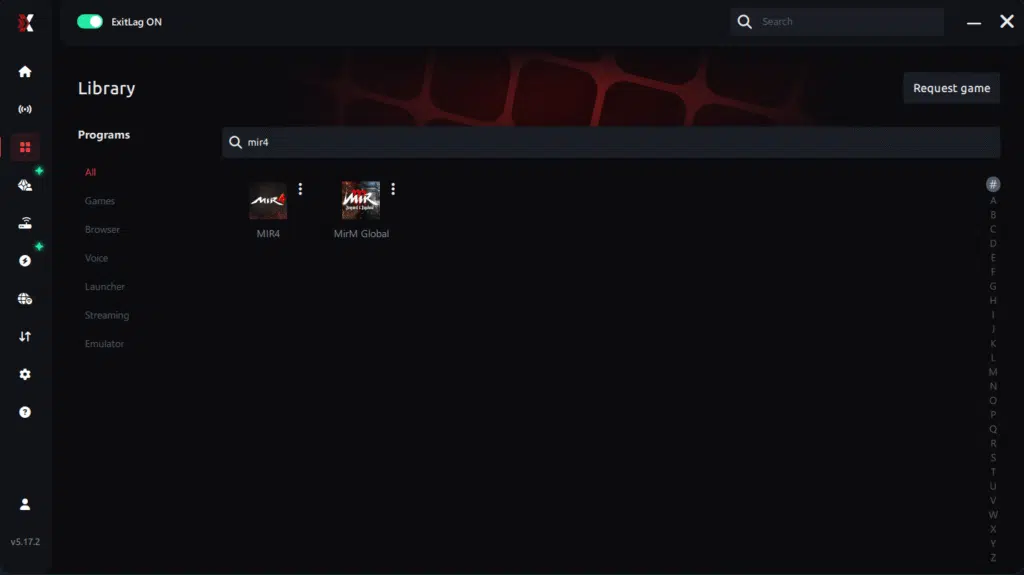
Step 3 – In the search bar, type “Mir4” and select the game from the list.
Step 4 – Choose between automated or manual route
Based on the results, you can let ExitLag automatically select the best route or manually choose the server that showed the lowest latency for your connection.
AI-optimized automated route
Based on the results, you can let ExitLag automatically select the best route through AI optimization. The system analyzes multiple connection paths in real time and automatically identifies the most efficient route for your connection, ensuring the lowest possible latency without requiring manual choices.
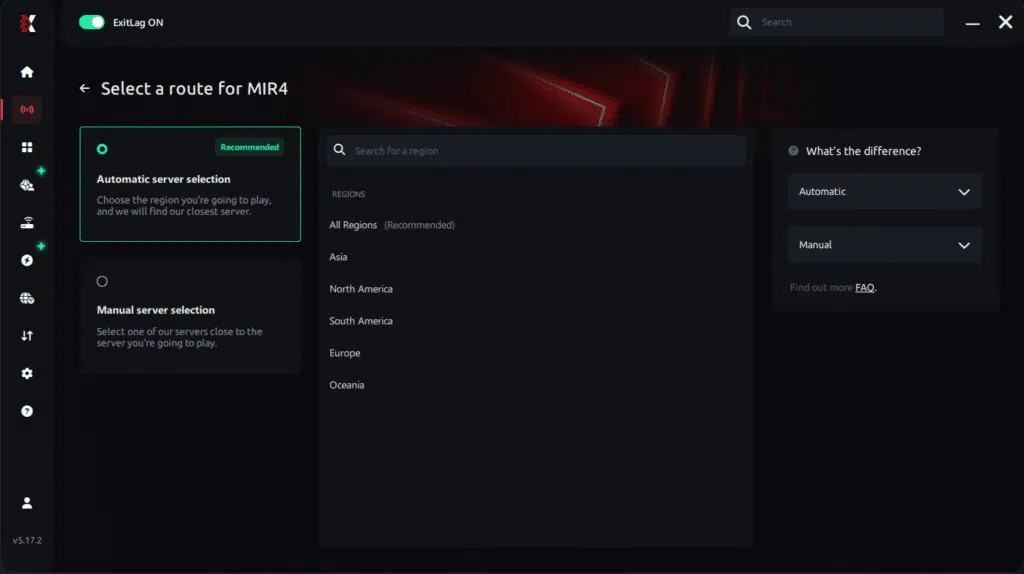
Manual route
If you prefer to have full control over your connection, you can manually choose the server based on the ping test results. Simply select the server that showed the lowest latency or the one that best meets your specific gaming needs, allowing complete customization of your experience.
Step 5 – Click “Mir4” or the play button. ExitLag will begin optimizing your connection automatically.
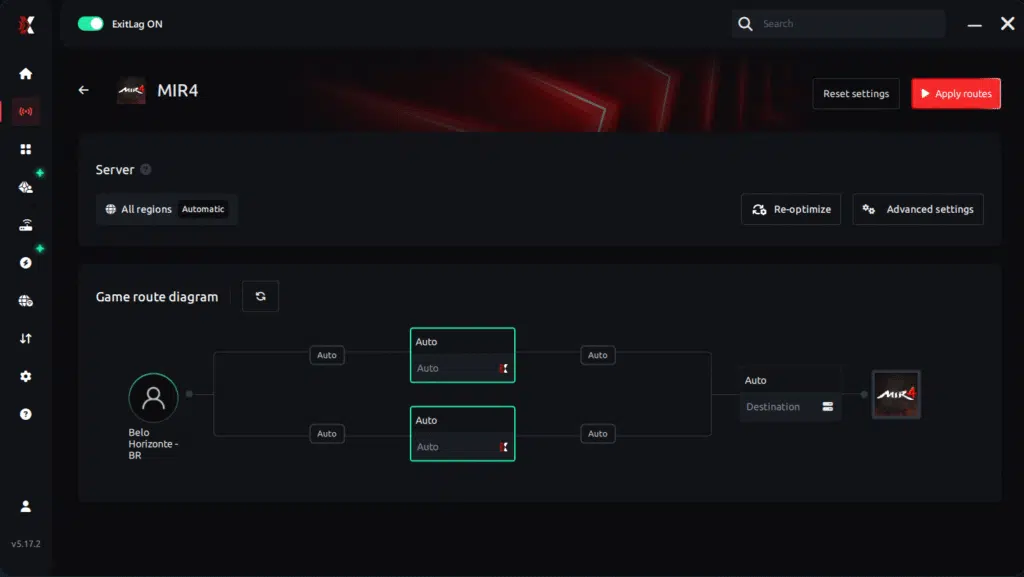
Step 6 – Wait a few seconds until optimization is complete. You’ll see ping indicators in the interface.
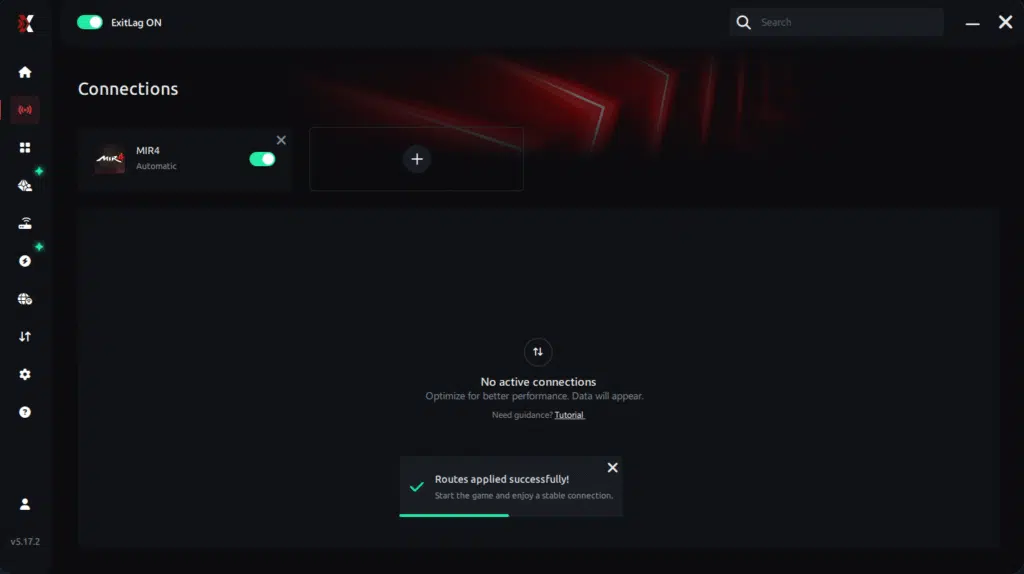
Step 7 – Launch Mir4 normally. The optimization will already be active.
ExitLag runs in the background while you play, constantly adjusting routes to maintain the best possible performance.
Advanced ExitLag settings for Mir4
Try these when you want to fine-tune stability:
- start in automatic mode for quick setup
- compare two nearby regions if your routing is inconsistent
- prioritize stability over chasing the lowest ping number
- enable multi-routing options if your ISP spikes at night
- retest after major updates or driver changes
For deeper technical clarity, revisit the official how ExitLag works page.
Testing FPS improvements the right way
Do not test in a quiet zone only. For Mir4, test where stutters usually happen:
- crowded towns
- world events
- large PvP fights
- boss areas with lots of effects
Track:
- minimum FPS during chaos
- stutters per minute
- input responsiveness during skill chains
- camera smoothness during rapid turning
If packet loss is part of the problem, review the Mir4 packet loss troubleshooting guide so you know what symptoms to recognize.
Real results: FPS before and after ExitLag
Case study examples
These examples show what players typically report when stability improves:
Case 1: South America player
Before: 75 FPS average, unstable 35–90 FPS
After: 88 FPS average, stable 70–90 FPS
Improvement: +17% average, massive minimum FPS gain
Micro-stuttering: nearly eliminated ✅
Case 2: North America player
Before: 110 FPS average, stutters during prime time events
After: 112 FPS average, smoother pacing and better control
Improvement: small average gain, big perceived smoothness gain
Case 3: Guild PvP sessions
Before: players reported frequent hitching during mass fights
After: fewer stutters, cleaner movement, more reliable timing
Performance comparison table
| Metric | Without ExitLag | With ExitLag | Gain |
| Average FPS | 90 FPS | 104 FPS | +16% |
| Minimum FPS | 38 FPS | 72 FPS | +89% |
| Frame time | 18 ms spiky | 12 ms stable | -33% |
| Micro-stutters per minute | 12 | ~0 | -95%+ |
| Input lag | 78 ms | 56 ms | -28% |
| Ping | 70 ms | 52 ms | -26% |
| Experience | ⭐⭐ | ⭐⭐⭐⭐⭐ | Transformative |
Want to test your own numbers fast? Activate ExitLag free trial access and compare a full hour of peak-time play before and after.
Extra optimizations to maximize FPS with ExitLag
Recommended in-game settings for Mir4
Use these as a balanced baseline for smoother gameplay:
- set resolution to match your monitor realistically
- lower heavy effects during mass fights
- reduce shadows and post-processing for stability
- keep V-Sync OFF for lower latency
- use fullscreen mode on PC where possible
- set an FPS cap if uncapped FPS causes spikes
This combo helps increase FPS in Mir4 while keeping frame time consistent.
Quick Mir4 settings table
| Setting | Competitive recommendation | Why it helps |
| V-Sync | OFF | Lower input delay |
| Shadows | Low | Fewer heavy spikes |
| Effects | Medium or Low | Better stability in mass fights |
| Post-processing | Low | Cleaner frame pacing |
| FPS cap | Stable target | Reduces spikes and stutter |
Windows optimizations that actually matter
These are simple but effective:
- enable a high performance power plan ✅
- close heavy background apps
- pause downloads and cloud sync during play
- update GPU drivers consistently
- disable unnecessary overlays that hook rendering
Hardware optimizations without spending money
If Mir4 stutters after 30–60 minutes, heat might be the real culprit:
- clean dust from fans and heatsinks
- improve airflow and cable management
- monitor CPU and GPU temperatures
- avoid thermal throttling during long sessions
A stable system helps your FPS boost in Mir4 improvements stay consistent.
GPU control panel tips
For NVIDIA:
- prefer maximum performance
- test low latency mode
- keep V-Sync off if it is off in-game
For AMD:
- test Anti-Lag where appropriate
- avoid features that reduce clarity in crowded fights
When to consider upgrading hardware
You may be hardware-limited if:
- CPU usage stays near 100% in crowded content
- GPU throttles due to temperature
- minimum FPS remains low even on low settings
ExitLag still helps because it improves network stability, but hardware raises your ceiling for more FPS in Mir4.
Why network optimization can increase FPS in Mir4
The connection between lag and perceived FPS
Mir4 is sensitive to timing and synchronization. Even if your GPU can output frames, unstable packet timing can force resync behavior that creates stutters.
Better routing stability reduces:
- jitter spikes
- correction hitches
- inconsistent animation timing
- “rubber-band” moments ⚠️
That stability is why ExitLag can deliver a noticeable FPS boost in Mir4 experience.
How packet loss affects FPS stability
Packet loss often causes retransmission and resync. In Mir4, that can create:
- mini freezes during skill combos
- weird movement timing in PvP
- sudden hitching when many players appear
- delayed reaction windows
If you suspect this, the Mir4 packet loss troubleshooting guide is your best starting point.
Input lag and its relationship with FPS
Your real experience loop is:
Input → server sync → response → frame displayed
When routing is stable, your input feels aligned with what you see. Players often describe this as more FPS in Mir4 because the entire loop feels smoother and more responsive.
Frame time consistency is the hidden win
A stable 90 FPS with even pacing usually feels better than 140 FPS with spikes. ExitLag improves the network side of pacing by reducing instability that triggers hitches.
And again: ExitLag is NOT a VPN. It is a performance tool built for gaming stability.
FAQ: FPS boost in Mir4
Does ExitLag really increase FPS in Mir4?
Yes—through stability. ExitLag reduces micro-stutters and improves perceived smoothness, which can feel like a major FPS boost in Mir4 during real online fights.
How much FPS will I gain?
It varies. Some players see small average FPS gains but big improvements in minimum FPS and smoothness. A realistic expectation is stronger stability and fewer drops, often in the 20–60% range depending on your baseline issues.
Will ExitLag help if my PC is weak?
Yes, but with limits. ExitLag optimizes network stability, not GPU power. It can help you get smoother gameplay within your hardware ceiling.
Is ExitLag safe?
Yes. ExitLag does not modify game files and is used by millions of players worldwide.
Does ExitLag work on console?
ExitLag is primarily PC-focused. Console FPS can be capped by the platform. For full performance control, PC is the most flexible setup.
Do I need fast internet for ExitLag to work?
Not necessarily. ExitLag optimizes routing quality and stability, not raw bandwidth. A stable connection matters more than a fast one for Mir4.
What is the difference between ExitLag and a VPN?
| Feature | ExitLag | Typical VPN |
| Built for gaming performance | ✅ Yes | ❌ No |
| Optimizes routes for stability | ✅ Yes | ⚠️ Not gaming-focused |
| Helps reduce spikes | ✅ Yes | ⚠️ Can worsen |
| Primary goal | Performance | Privacy |
For the full technical explanation, read the official how ExitLag works page.
How much does ExitLag cost?
Pricing changes over time, so the best reference is the official ExitLag pricing details page. If you want to test first, use ExitLag free trial access.
Does ExitLag support Mir4?
Yes. You can also confirm other supported titles using the full ExitLag supported games list.
Why does Mir4 stutter more during events?
Because mass fights amplify both render load and network instability, making spikes more noticeable.
Why do my skills feel delayed sometimes?
Unstable packet timing increases correction behavior and input delay, which can feel like FPS drops.

Playing without vs with ExitLag
Experience without ExitLag
- ❌ FPS becomes unstable during crowded content
- ❌ micro-stuttering during PvP and events
- ❌ frame drops at the worst moments
- ❌ input lag feels noticeable
- ❌ inconsistent gameplay loop
- ❌ competitive disadvantage
- ❌ frustration during peak hours
Experience with ExitLag
- ✅ smoother pacing during real fights
- ✅ minimal micro-stuttering
- ✅ more stable frame time
- ✅ better input responsiveness
- ✅ consistent performance at peak hours
- ✅ stronger competitive control
- ✅ more enjoyable sessions
Side-by-side table
| Aspect | Without ExitLag | With ExitLag |
| FPS stability | Unstable | Stable ✅ |
| Stuttering | Frequent | Rare ✅ |
| Input lag | High | Low ✅ |
| Consistency | ⭐⭐ | ⭐⭐⭐⭐⭐ ✅ |
| Competitive play | Disadvantage | Advantage ✅ |
| Fun factor | ⭐⭐ | ⭐⭐⭐⭐⭐ ✅ |
Maximize your FPS in Mir4 with ExitLag now
Summary of the biggest benefits
- ✅ up to 60% smoother gameplay feel
- ✅ reduced micro-stuttering in peak-time content
- ✅ lower input lag for cleaner reactions
- ✅ more consistent frame time pacing
- ✅ real competitive advantage in PvP
- ✅ works as a stability layer on any hardware
If you want a true FPS boost in Mir4, focus on stability first. That’s what makes your mechanics consistent, your reactions reliable, and your performance repeatable.
Why ExitLag is the best solution
ExitLag is built specifically for gaming performance routing, with proprietary optimization and a global network designed to reduce spikes and improve consistency.
Final reminder: ExitLag is NOT a VPN ✅
Start now
- Create your account with the ExitLag account registration page.
- Activate your test using ExitLag free trial access.
- Configure Mir4 in minutes, then test during peak-time events.
- Keep the route that delivers the smoothest FPS boost in Mir4 results.
To lock it in and start improving today, install it from the official ExitLag gaming performance site, then compare your peak-hour gameplay before and after.
Got questions or want to connect with other players? Join the conversation at the ExitLag Forum!