
A clean Valorant match feels effortless: crisp crosshair control, predictable recoil, and instant feedback when you tap, strafe, and counter-strafe. That is the dream behind an FPS boost in Valorant—not just a higher number, but smooth gameplay that stays stable when the round gets chaotic.
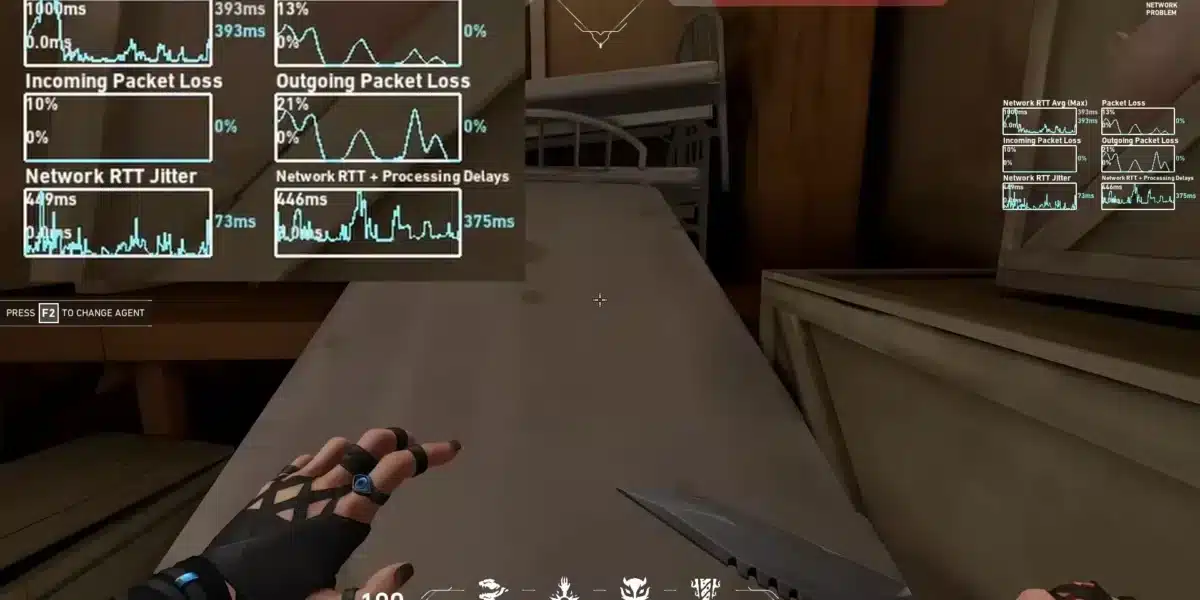
Then you queue ranked and reality hits: sudden FPS dips on utility bursts, tiny hitches mid-swing, and a “why did my shot feel late?” moment that costs the round. When unstable ping is part of the mix, the experience gets even worse because network spikes can trigger micro-stuttering that feels like FPS collapse. If your ping is also inconsistent, start here: this Valorant high ping fix guide.
This article shows how to get an FPS boost in Valorant with a stability-first approach using ExitLag, plus practical settings to increase FPS and maintain more FPS during real fights. Depending on how unstable your routing and jitter are, many players experience smoother pacing that can feel like up to 60% better performance stability—especially in 1% lows and stutter reduction. To begin right now, download from the official ExitLag website and test it side-by-side in the same scenario.
Start with the ExitLag free trial for gamers and compare one full match with ExitLag OFF vs ON.

Why FPS matters
Why high FPS is crucial in Valorant
Valorant is a precision tactical shooter. The outcome of duels often comes down to milliseconds, and FPS stability directly affects:
- aim consistency ✅
- recoil control ✅
- micro-adjustments ✅
- spray transfer accuracy ✅
- peek timing ✅
A true FPS boost in Valorant means your mechanical skill shows up consistently, not just when the game feels “nice.”
What FPS is frames per second
FPS is how many frames your PC renders every second. Think of it like a camera capturing motion:
- 30 FPS choppy motion and delayed feel
- 60 FPS smooth baseline
- 144 FPS sharp clarity and faster visual feedback
Quick comparison bullets:
- 30 to 60 FPS is a huge smoothness jump ✅
- 60 to 144 FPS improves clarity and tracking ✅
- high average FPS with unstable frame time still feels bad ⚠️
Benefits of high FPS in Valorant
When you increase FPS and keep it stable, you unlock real competitive benefits:
- Smoother target tracking during strafes ✅
- Cleaner tap and burst rhythm ✅
- Faster reaction on shoulder peeks ✅
- More reliable counter-strafe timing ✅
- Better clarity in smoke and ability chaos ✅
- Less visual fatigue in long sessions ✅
- More consistent duels in clutch rounds ✅
This is why an FPS boost in Valorant is a competitive advantage, not cosmetic.
FPS rating for Valorant
| FPS range | Quality | Experience | Competitive? |
| 144+ FPS | ⭐⭐⭐⭐⭐ Excellent | Perfect | ✅ Ideal |
| 90–144 FPS | ⭐⭐⭐⭐ Great | Very good | ✅ Yes |
| 60–90 FPS | ⭐⭐⭐ Good | Acceptable | ⚠️ Slight disadvantage |
| 30–60 FPS | ⭐⭐ Fair | Choppy | ❌ Hard to compete |
| <30 FPS | ⭐ Bad | Unplayable | ❌ Impossible |
Why Valorant feels choppy even with high FPS
The hidden enemy frame time spikes
You can have 200 FPS and still feel stutters if your frame time is inconsistent. What you feel as “smoothness” is often:
- stable frame pacing ✅
- consistent 1% lows ✅
- fewer spikes during fights ✅
That is why a stability-focused FPS boost in Valorant can outperform “just lower settings.”
Micro-stuttering and the online factor
In online shooters, instability is not only GPU-related. Network jitter can cause:
- client and server correction moments
- animation timing hiccups
- tiny freezes during action
Those tiny freezes are exactly what players describe as micro-stutters—one of the biggest reasons they chase an FPS boost in Valorant.
Input delay why it feels like your aim is late
The performance loop is simple:
Input to server to response to frame
When the loop is inconsistent, your flicks and taps feel “heavy.” That is why lowering perceived delay can feel like more FPS even when average FPS barely changes.
How ExitLag boosts FPS in Valorant
What ExitLag is and why it is not a VPN
ExitLag is a gaming network optimizer designed to stabilize routing and reduce instability for online games.
ExitLag is NOT a VPN.
A typical VPN focuses on privacy and location routing. ExitLag focuses on performance: better routes, lower jitter, and more consistent packet delivery.
Learn the technical foundation here: how ExitLag works for gaming.
How ExitLag can improve FPS feel in Valorant
ExitLag does not magically upgrade your GPU. Instead, ExitLag improves the network side of performance, which can reduce:
- micro-stuttering ✅
- frame pacing breaks ✅
- unstable input response ✅
That is why many players report an FPS boost in Valorant primarily as smoothness, not as a massive raw FPS number.
7 ways ExitLag can increase your FPS boost
- Micro-stutter reduction ✅
ExitLag stabilizes routing so fewer correction hitches happen mid-fight. - Lower perceived input lag ✅
More consistent delivery makes actions feel sharper. - Frame time stabilization ✅
Fewer spikes means the game feels smoother even at the same average FPS. - Multi-path route optimization ✅
ExitLag can avoid bad ISP hops that create jitter. - Gaming traffic prioritization ✅
Better handling of game packets reduces interference from background activity. - Lower latency to servers ✅
Better sync reduces the “late feedback” feeling during duels. - More reliable connections ✅
Stability improvements can reduce loss impact and resync events.
To check supported titles, use the official list: ExitLag supported games list.
ExitLag vs other FPS boost solutions
| Solution | Increases FPS? | Reduces lag? | Stability | Ease | Recommendation |
| ExitLag | ✅ Yes stability-driven | ✅✅✅ Excellent | ⭐⭐⭐⭐⭐ | ⭐⭐⭐⭐⭐ | ✅ Best |
| Common VPN | ❌ Often worse | ❌ Often worse | ⭐⭐ | ⭐⭐⭐ | ❌ Avoid |
| Game booster apps | ⚠️ Minimal | ❌ No | ⭐⭐⭐ | ⭐⭐⭐⭐ | ⚠️ Limited |
| Windows tuning | ⚠️ Some | ❌ No | ⭐⭐⭐ | ⭐⭐ | ⚠️ Helpful |
| Hardware upgrade | ✅ Yes | ❌ No | ⭐⭐⭐⭐ | ⭐ | 💰 Expensive |
| Doing nothing | ❌ No | ❌ No | ⭐ | ⭐⭐⭐⭐⭐ | ❌ Bad results |
Why ExitLag works so well for competitive Valorant
ExitLag is built for competitive stability. What matters most in Valorant is not just a peak FPS number, but:
- consistent frame pacing ✅
- stable fights under utility load ✅
- fewer random hitches ✅
Install from the official ExitLag website and activate your ExitLag free trial so you can test a real ranked session.
How to configure ExitLag for maximum FPS
Installation and first setup
- Download from the official ExitLag website
- Install ExitLag usually under a minute ✅
- Create your account here ExitLag account registration page
- Start your test using the ExitLag free trial page
- Open ExitLag and search for Valorant
- Choose your best region based on stability not only distance
- Apply optimized routes
- Launch Valorant and play a controlled test match
- Compare results OFF vs ON
- Optional fine-tune advanced settings
Advanced ExitLag settings to try in Valorant
To push a stronger FPS boost in Valorant, test:
- automatic vs manual routing manual can fix stubborn ISP paths ⚠️
- region alternatives sometimes closest is not best ✅
- traffic shaping options reduce background interference ✅
- multi-routing options during peak hours ✅
If you want the deeper explanation, revisit how ExitLag works for gaming.
How to measure FPS improvement correctly
A serious performance test uses consistent conditions:
- same map or training scenario ✅
- same graphics settings ✅
- same time window peak hours matter ✅
- track both average FPS and 1% lows ✅
Tools you can use:
- FPS overlays Afterburner plus RTSS
- in-game FPS and frametime graphs if available
- Windows performance monitoring
Real FPS boost results
What real results look like
In most competitive setups, the biggest win is stability:
- fewer micro-stutters ✅
- better 1% lows ✅
- smoother peeks ✅
- more consistent spray control ✅
That is why players call it an FPS boost in Valorant even when the average FPS change is modest.
Success cases examples
Case 1 player South America
Before 220 FPS average drops 140 to 320
After 230 FPS average stable 190 to 320
Improvement plus 4% average major stability gain ✅
Micro-stuttering near eliminated ✅
Case 2 player North America
Before 165 FPS average drops 95 to 240
After 178 FPS average stable 135 to 240
Improvement plus 8% ✅
Case 3 competitive stack
Before inconsistent fights during peak congestion ❌
After cleaner swings and timing fewer random hitches ✅
Impact more consistent trades and entries ✅
Performance comparison table
| Metric | Without ExitLag | With ExitLag | Gain |
| Average FPS | 165 FPS | 178 FPS | +8% |
| Minimum FPS | 95 FPS | 135 FPS | +42% ✅ |
| Frame time | 8.5 ms | 6.9 ms | -19% ✅ |
| Micro-stutters/min | 7 | ~0 | -95%+ ✅ |
| Input lag | 38 ms | 30 ms | -21% |
| Ping | 52 ms | 39 ms | -25% |
| Experience | ⭐⭐ | ⭐⭐⭐⭐⭐ | Transformative |
Competitive impact you can feel
A stable FPS boost in Valorant typically shows up as:
- better first-bullet accuracy ✅
- more reliable counter-strafes ✅
- fewer missed timing windows ✅
- less my aim is off today frustration ✅
Extra optimizations to maximize FPS with ExitLag
In-game settings to increase FPS
To increase FPS without killing clarity:
- V-Sync OFF ✅
- motion blur OFF ✅
- shadows low ❌
- bloom and heavy effects low or off ❌
- anisotropic filtering moderate test ⚠️
- fullscreen mode on ✅
- FPS cap slightly below stable peak for better pacing ✅
Windows system optimizations
Stack these with ExitLag:
- enable High performance power plan ✅
- disable Xbox Game DVR capture if it adds overhead ✅
- close background apps and overlays you do not need ✅
- update GPU drivers ✅
- reduce Windows visual effects if required ⚠️
- keep SSD free space healthy ✅
Hardware optimizations without spending
- clean dust filters and fans ✅
- improve airflow intake plus exhaust ✅
- monitor temperatures avoid throttling ✅
- tidy cables for airflow ✅
Bold reality cooling is performance.
GPU settings checklist
NVIDIA Control Panel
- prefer maximum performance ✅
- low latency mode ON test ✅
- V-Sync OFF ✅
AMD Radeon
- Anti-Lag ON test ✅
- Radeon Boost ON test if clarity stays acceptable ⚠️
Why network optimization can improve FPS
Lag vs FPS the practical connection
Valorant must stay synchronized with the server. When the path is unstable:
- packets arrive inconsistently
- the client corrects state
- corrections create tiny freezes
- freezes break frame pacing
That is why ExitLag can support an FPS boost in Valorant as a feel upgrade.
Packet loss why it causes stutters
Packet loss often leads to:
- retransmits
- prediction errors
- resync spikes
Symptoms you notice:
- hitching mid-swing ❌
- delayed damage feedback ❌
- inconsistent movement response ❌
Reducing loss impact often produces more FPS feel because the game stops freezing during corrections.
Frame time consistency the real goal
- high FPS with unstable frame time still feels rough ⚠️
- moderate FPS with stable frame time feels clean ✅
That is why an FPS boost in Valorant should be measured using 1% lows and frame time stability, not only average FPS.
FAQ
Does ExitLag really increase FPS in Valorant?
Yes. ExitLag can help create an FPS boost in Valorant by reducing micro-stutters and stabilizing frame pacing through network optimization.
The key distinction:
- raw FPS is what your GPU renders
- perceived smoothness is what stable pacing and low jitter create
How much FPS will I gain?
It depends on your setup. Gains vary with:
- ISP routing quality
- peak-hour congestion
- jitter and packet loss
- your current stability baseline
Common outcomes:
- smoother pacing ✅
- fewer stutters ✅
- better 1% lows ✅
- sometimes a modest average FPS increase ✅
Will ExitLag help on a weak PC?
ExitLag optimizes network stability, not GPU power. It can help you keep gameplay stable and reduce stutters, but it cannot replace a hardware upgrade.
Is ExitLag safe?
Yes. ExitLag does not modify Valorant files. It optimizes routing for your gaming traffic.
Use only official pages:
Do I need fast internet?
Not necessarily. ExitLag optimizes route quality, not bandwidth. A stable moderate-speed connection can outperform a fast unstable one in competitive play.
ExitLag vs VPN what is the difference?
ExitLag is NOT a VPN.
| Feature | ExitLag | VPN |
| Main goal | Gaming performance | Privacy and location |
| Routing focus | ✅ Stability and optimization | ⚠️ Not gaming-first |
| Jitter reduction | ✅ Yes | ❌ Not designed for it |
| Competitive feel | ✅ Often better | ❌ Often worse |
For the technical explanation read how ExitLag works for gaming.
How much does ExitLag cost?
Prices change, so avoid outdated numbers. Check the official plans here: ExitLag pricing and plans.
You can start with the ExitLag free trial for gamers.
Does ExitLag work with Valorant?
Yes. Confirm anytime via ExitLag supported games list.
Create your account using the ExitLag account registration page and activate the ExitLag free trial page to test your own before and after results.

Visual comparison
Experience without ExitLag
- ❌ unstable FPS feel during duels
- ❌ micro-stuttering on peeks
- ❌ frame drops during utility chaos
- ❌ noticeable input delay
- ❌ inconsistent match performance
- ❌ frustration spiral
Experience with ExitLag
- ✅ smoother frame pacing
- ✅ fewer micro-stutters
- ✅ more consistent peek timing
- ✅ sharper input response
- ✅ better stability under peak congestion
- ✅ more confident gunfights
Side-by-side table
| Aspect | Without ExitLag | With ExitLag |
| FPS feel | Unstable | Stable ✅ |
| Stuttering | Frequent | Rare/none ✅ |
| Input delay | Higher | Lower ✅ |
| Consistency | ⭐⭐ | ⭐⭐⭐⭐⭐ ✅ |
| Competitive | Disadvantage | Advantage ✅ |
| Enjoyment | ⭐⭐ | ⭐⭐⭐⭐⭐ ✅ |
How to use ExitLag in Valorant
The process is extremely simple:
Step 1 – Access the official ExitLag website and download the application. There’s a free trial period for new users.
Step 2 – Install and open the program. Log in with your account.
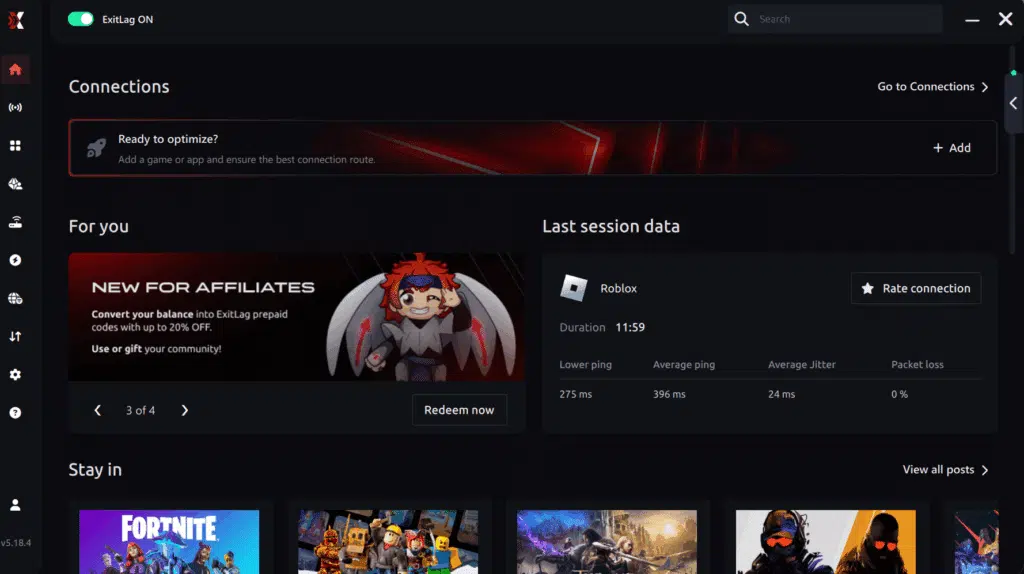
Connection screen Valorant
Step 3 – In the search bar, type “Valorant” and select the game from the list.
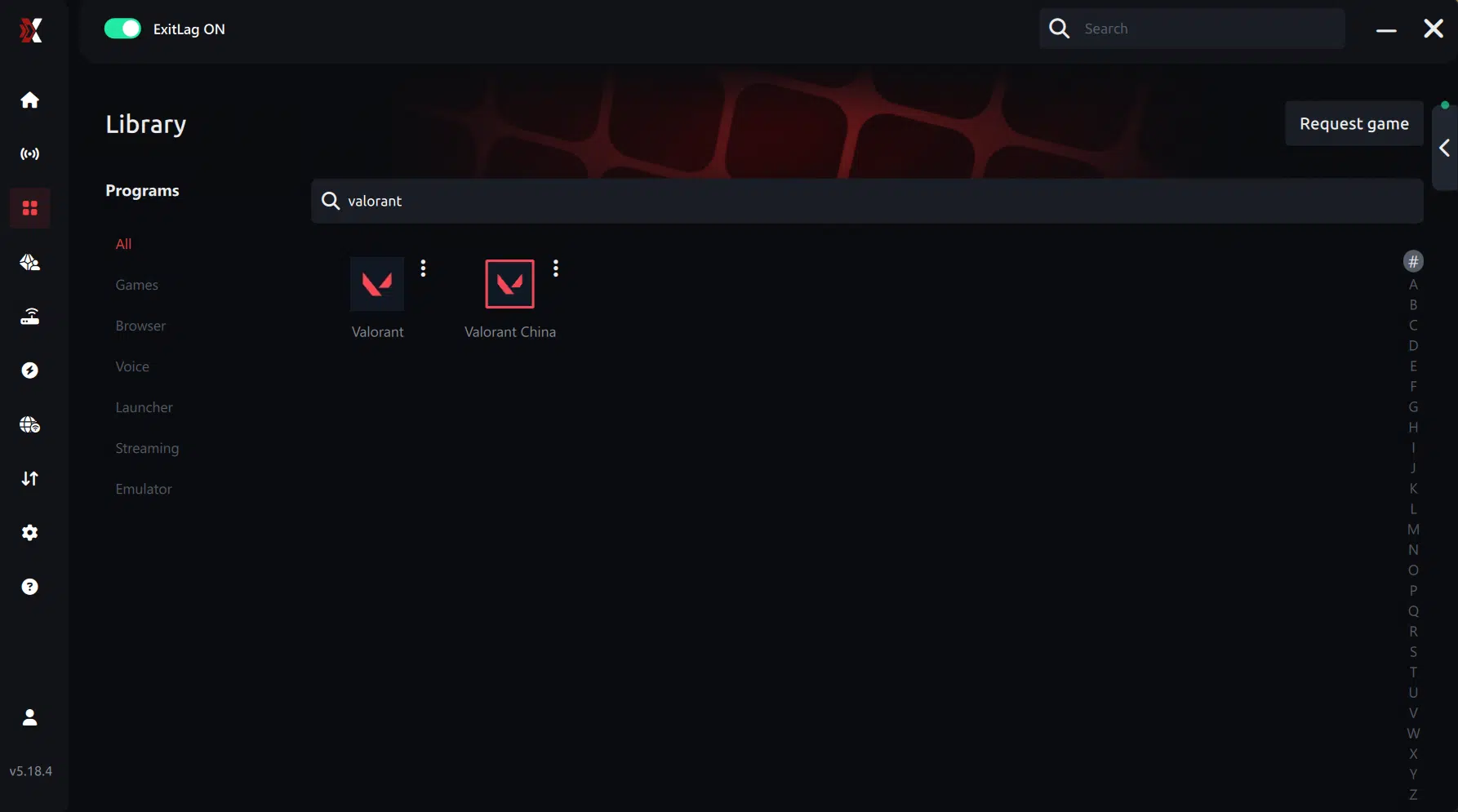
Step 4 – Choose the server manually
Based on the ping test results, you can manually choose the server that showed the lowest latency or the one that best meets your specific gaming needs.
Manual route
If you prefer to have full control over your connection, you can manually choose the server based on the ping test results. Simply select the server that showed the lowest latency or the one that best meets your specific gaming needs, allowing complete customization of your experience.
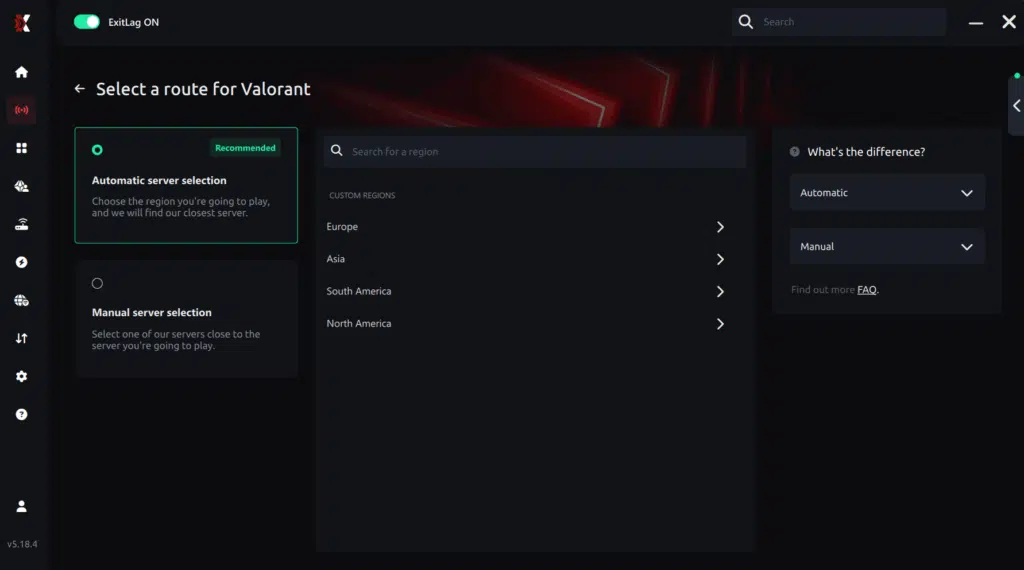
Step 5 – Click “Apply routes” or the play button. ExitLag will begin optimizing your connection automatically.

Step 6 – Wait a few seconds until optimization is complete. You’ll see ping indicators in the interface.
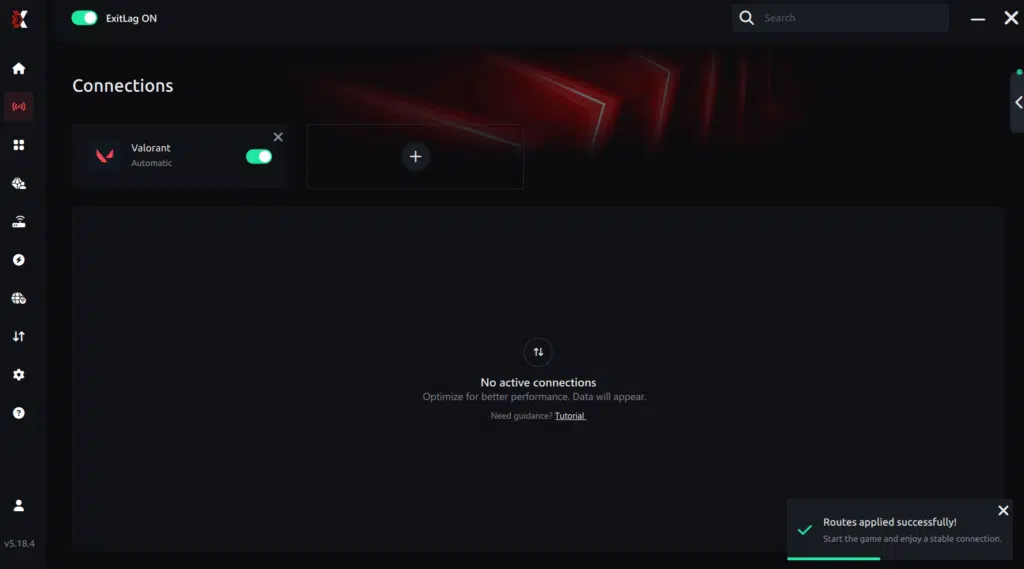
Step 7 – Launch Valorant normally. The optimization will already be active.
ExitLag runs in the background while you play, constantly adjusting routes to maintain the best possible performance.
How to use Ping for Games: step-by-step guide (Valorant)
Checking your connection quality before entering a match has never been easier. Here’s how to use Ping for Games in just a few steps:
1. Open the ExitLag software on your PC
Ensure the application is installed and open. The feature is integrated into the platform and available for free to all users.
2. Access the Network Analyzer tool
Locate the Network Analyzer in the software menu. This is where you’ll find Ping for Games along with other connection analysis features.
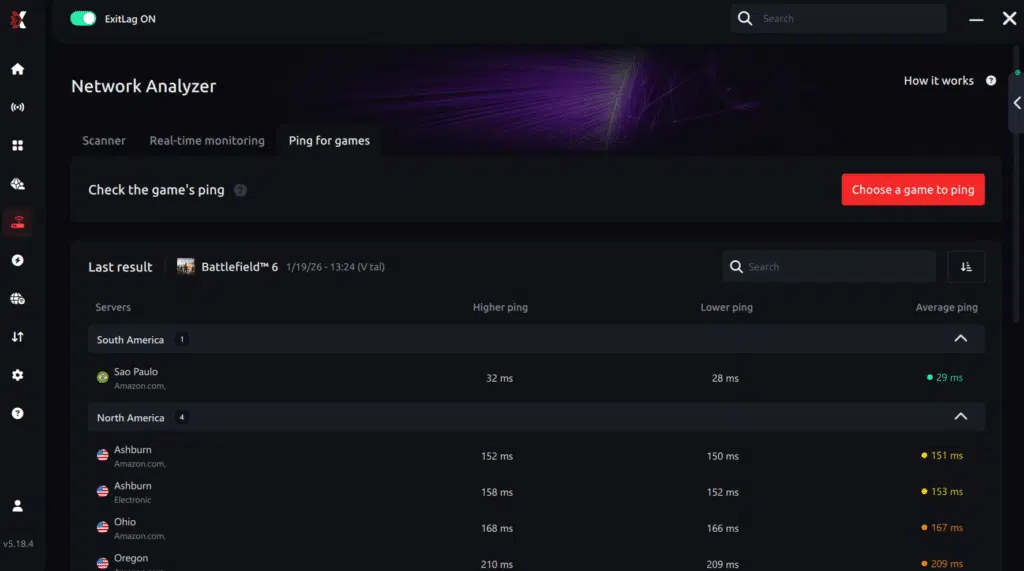
3. Select the game you want to test
Choose Valorant from the list. The tool supports major online multiplayer games, including FPS, Battle Royales, MOBAs, MMORPGs, and more.
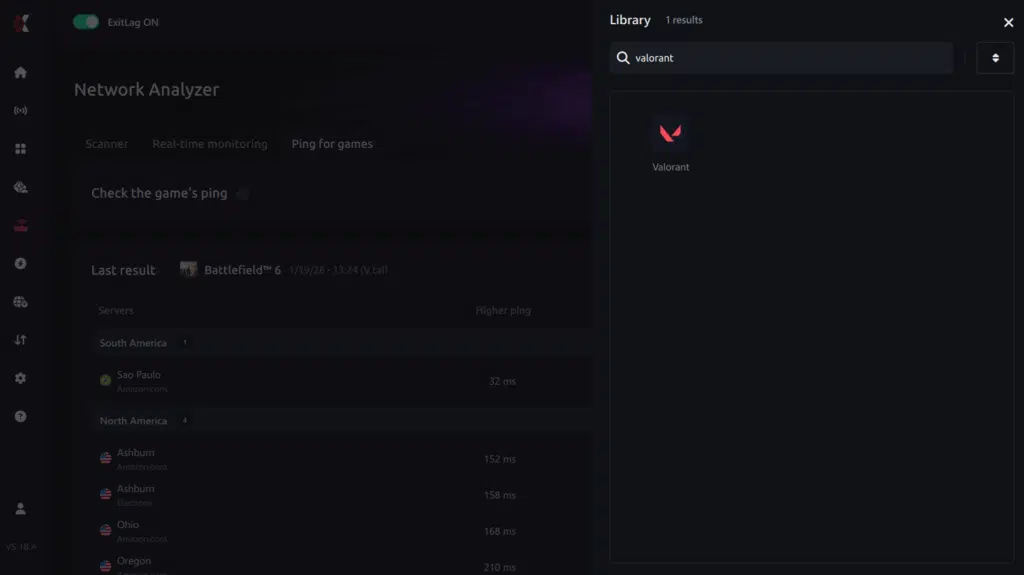
4. Choose the specific server
Select the exact Valorant server you want to test instead of a generic region. This ensures more accurate results for your match.
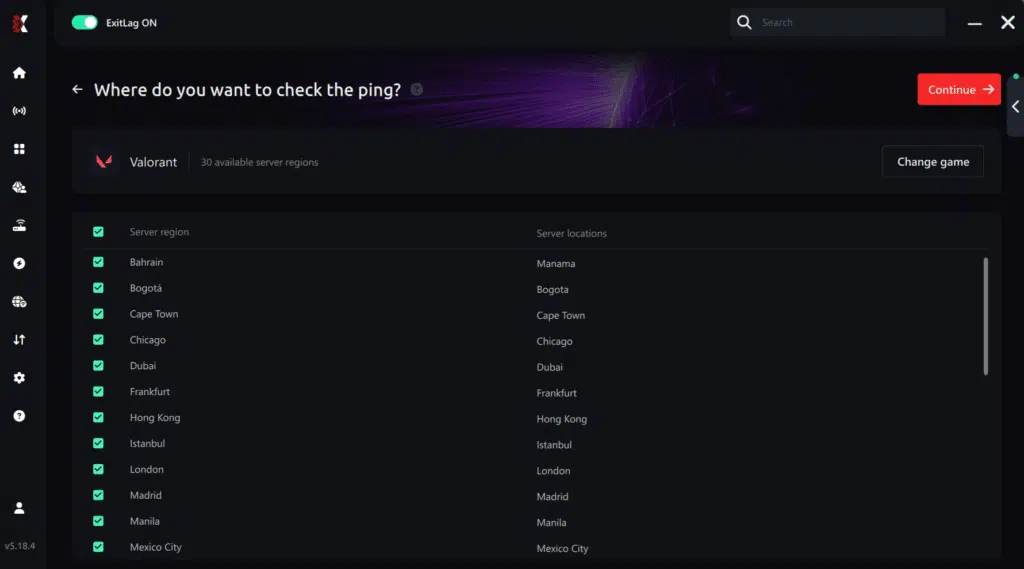
5. Start the ping test
With one click, the measurement is performed in real time between your device and the selected Valorant server, considering your current connection (cable or Wi-Fi).
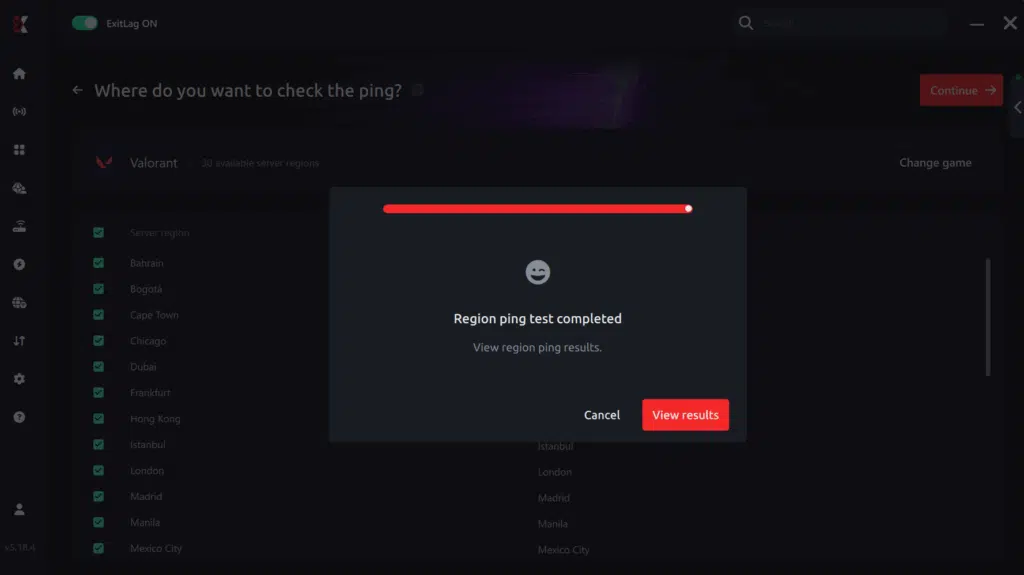
6. Analyze the results
Results appear in milliseconds (ms), automatically sorted from best to worst ping. You can also reorganize the view alphabetically if you prefer.
7. Choose the best server and play worry-free
With this information, simply select the server with the lowest latency and jump into Valorant knowing your connection is optimized.
Final thoughts: Play Valorant without lag forever
At the end of the day, Valorant lag should never decide your matches. You spend time mastering your aim, movement, and game sense — your internet connection should never be the reason you lose.
With ExitLag, you finally take control of your network performance. The software finds the fastest routes, eliminates lag, and stabilizes your ping so that every shot, every peek, and every clutch happens exactly when you want it to.
Try ExitLag for free right now and experience how smooth Valorant can be when your connection is fully optimized. Play with confidence, reach your full potential, and make lag a thing of the past.
Conclusion
A performance-first FPS boost in Valorant is about stability, not hype. With ExitLag, many players experience smoother pacing, fewer micro-stutters, improved 1% lows, and lower perceived input delay.
ExitLag targets routing and stability problems that hardware cannot fix. If your match feels choppy despite “good FPS,” that is often a stability issue—exactly where ExitLag can help.
ExitLag is NOT a VPN.
Got questions or want to connect with other players? Join the conversation at the ExitLag Forum!