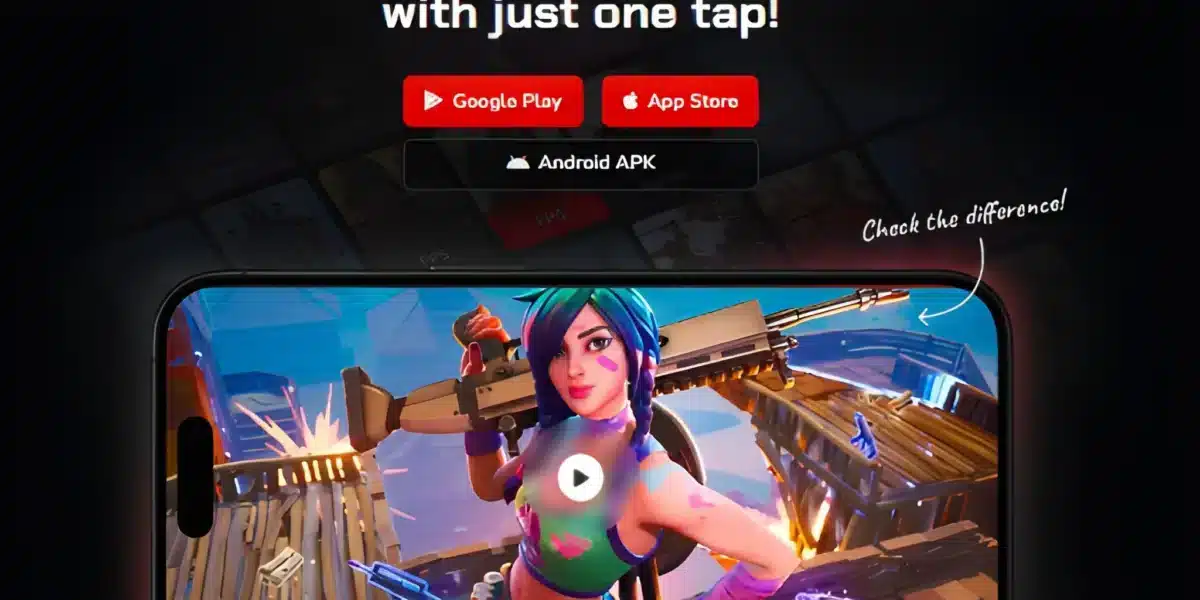
Fortnite Mobile puts one of the biggest games in the world in your pocket, and in 2026 it does so with full cross-play, every game mode, and an account system that keeps your progress, skins, and V-Bucks in sync whether you are playing on your phone, your console, or your PC. The same Victory Royale you chase on a big screen is waiting for you on mobile, and nothing in the game is cut or simplified just because you are on a phone.
What is different on mobile is how you control everything. Touch controls, screen size, thermal management, and connection variability all shape the experience in ways that do not exist on other platforms. Understanding those differences from the start is what separates new mobile players who stick with the game from those who bounce off it after a few frustrating sessions.
This guide covers everything a beginner needs to start playing Fortnite Mobile with confidence: getting the app, setting up your account, understanding the controls, choosing the right mode to learn in, looting efficiently, surviving the storm, and knowing what to do in your first actual gunfight. For everything about the broader Fortnite universe beyond mobile, the ExitLag Fortnite guide is the complete overview.
Step 1: Get the Fortnite Mobile App
Before anything else, you need the app on your device. How you get it depends on your platform and region.
Android: Download from Google Play or the Epic Games Store app. The full download is approximately 15 to 20 GB.
iOS in the United States: Download directly from the App Store. Search for Fortnite by Epic Games and tap Get.
iOS in the EU or Japan: Download from the App Store or install the Epic Games Store on your iPhone and download Fortnite from there.
iOS everywhere else: Use cloud gaming. Open Safari, go to xbox.com/play or play.geforcenow.com, sign in with a free account, and play Fortnite without any download.
For a full regional breakdown and step-by-step installation instructions for every method, how to get Fortnite on mobile covers every scenario. If you specifically need the iOS setup, how to get the Fortnite Mobile app on iOS walks through every method including the Epic Games Store and cloud gaming paths.
Minimum Device Requirements
| Platform | OS | RAM | Storage |
|---|---|---|---|
| Android | Android 10+ | 6 GB (8 GB recommended) | 15 to 20 GB |
| iOS | iOS 17.6+ (iPhone 11 minimum) | Included in phone spec | ~2.5 GB |
| Cloud gaming | Any modern OS | Not required | Minimal |
If your device does not meet these specs, cloud gaming is a fully working alternative. The game runs on remote servers and streams to your screen without any hardware demands on your phone.
Step 2: Create Your Epic Games Account
Fortnite is free. Your Epic Games account is what holds everything: your skins, V-Bucks, Battle Pass progress, friends list, and ranked stats. Creating one takes two minutes.
- Go to epicgames.com or create an account inside the app on first launch
- Enter your email, set a password, and choose a display name
- Verify your email address through the confirmation link Epic sends
- Link your platform account (Apple, Google, Xbox, or PlayStation) to your Epic account in the account settings
Linking your platform account is important. It connects your mobile progress to any other platform where you play Fortnite, so everything you earn on mobile shows up when you later play on PC or console.
Step 3: Understand the Fortnite Mobile Controls
The biggest adjustment for new mobile players is the touchscreen control scheme. It covers aiming, moving, shooting, building, looting, and inventory management all on one screen. The default layout works, but most players benefit from customizing it before their first match.
The Default Layout
The default Fortnite Mobile layout places:
- Left thumb: Movement joystick in the lower left
- Right thumb: Camera/aim area covering most of the right side
- Fire button: Right side, activated by tapping
- Jump: Upper right area
- Crouch: Small button near the movement stick
- Weapon slots: Bottom center
- Build buttons (in Build Mode): Right side cluster
- Loot/Interact: Center when near an item
How to Customize Your HUD
The HUD Layout Tool lets you move, resize, and adjust the opacity of every on-screen element. Access it through:
- Settings (gear icon in the lobby)
- HUD Layout tab
- Tap and drag any element to reposition it
- Pinch to resize
- Use the Lock button to fix elements you are happy with
Key customizations to make before your first real match:
- Enlarge the fire button. The default size is too small for fast-paced tapping. Making it larger reduces missed shots.
- Enable Auto-Sprint. This removes one thumb task and keeps your movement thumb free for camera control.
- Move the crouch button closer to your movement stick. Having to reach far to crouch mid-fight creates unnecessary pauses.
- Reduce HUD opacity on elements you rarely use. A cleaner screen means more visible game space.
Auto-Fire: Use It or Not?
Auto-Fire makes your weapon shoot automatically when your crosshair is over an enemy. For complete beginners, it removes one finger task and lets you focus on movement and positioning. Many casual mobile players keep it on permanently. Competitive players typically turn it off once they develop enough control to fire manually with better timing.
Start with Auto-Fire on. If it feels like it is shooting at the wrong moments, turn it off and practice manual fire in Creative Mode.
Gyroscope Aiming
If your phone supports it, gyroscope aiming lets you tilt your device to assist with fine-tuned aiming. It is optional and divides the community, but many mobile players find it helps with precision once they adjust to it. Find it under Settings, Sensitivity, and enable Gyroscope.
Step 4: Choose the Right Mode to Learn In
Fortnite has multiple game modes in 2026 and the one you start in significantly affects how quickly you improve.
Zero Build: The Best Starting Mode
Zero Build removes building entirely. There is no construction, no gathering wood and stone, and no complex edit mechanics to worry about. Players rely on natural cover, positioning, and gunplay.
This is the recommended mode for every new mobile player because:
- It removes the most complex touchscreen interactions (building buttons, material management)
- It teaches core Fortnite skills that transfer directly into full Battle Royale
- The Overshield system gives you 50 bonus HP on top of your normal shield, making you more durable in early gunfights
- Zero Build and standard Battle Royale share roughly equal player populations, so it is not a lesser experience
Blitz Royale: Best for Quick Learning Sessions
Blitz Royale runs with 32 players instead of 100 and every match ends in under five minutes. You start with a pre-loaded inventory and a random Medallion or Boon that gives you a bonus effect.
More encounters per hour means faster learning. Five Blitz matches teach you more about gunfights, positioning, and storm timing than two standard matches in the same time. Use Blitz when you have a short window or want to practice without the slow early-game looting phase.
Full Battle Royale (Build Mode): Come Here Second
Standard Battle Royale with full building mechanics is the full Fortnite experience. Add it after you have developed basic gunplay instincts in Zero Build. Building on a touchscreen has a learning curve that is much easier to tackle once the non-building mechanics feel automatic.
Step 5: How to Drop, Loot, and Survive Early Game
The Battle Bus and Where to Land
Every match starts on the Battle Bus, which flies across the map on a randomly determined path. Players jump off at will and glide to their chosen landing spot.
For beginners: land away from the center of the flight path. The center of the bus route concentrates the most players per landing zone in the first 60 seconds. Landing at the edges of the map or in unnamed structures gives you time to loot and learn before encountering other players.
After dropping, aim for:
- Buildings with multiple floors (more loot per structure)
- Named POIs at the edge of the map rather than in the center
- Areas visible in the safe zone from the start so you are not immediately moving away from storm
Looting Priority
Your first 60 seconds on the ground are about finding weapons and shields. The priority order:
- Any weapon first. A grey (common) pistol beats no weapon. Pick up the first weapon you see.
- Shields second. Small Shield Potions give 25 HP. Regular shields give 50. Drink them immediately.
- Better weapons as you find them. Swap grey weapons for green, blue, purple, and gold as you encounter them.
- Healing items. Med Mist, Bandages, Med Kits. Carry at least one.
- Mobility items. Shockwave Grenades and Launch Pads for storm rotation and escaping bad situations.
Weapon rarity in Fortnite runs from grey (common) through green, blue, purple, and gold (mythic). Higher rarity means more damage, less recoil, and tighter spread. Always upgrade when you find higher rarity versions of weapons you are already carrying.
The Best Loadout Structure for Beginners
Five inventory slots give you room for a complete kit:
- Assault rifle or SMG: Your main weapon for most engagements
- Shotgun or second weapon: Close-range backup
- Healing item: Always carry at least one heal
- Shield: Small or full shield potions
- Mobility or utility: Shockwave Grenade, Launch Pad, or grenades
Do not fill all five slots with weapons. Players who carry four guns and no healing die in fights they should survive because they cannot recover after taking damage.
Step 6: Understanding and Surviving the Storm
The storm is the circular zone that shrinks throughout the match, eventually forcing all surviving players into a small final circle. Every player must stay inside the safe zone or take continuous damage from the storm.
Reading the Storm Circle
The map shows two circles: the current safe zone (inner circle) and where the new safe zone will be (the indicator after each phase). The storm moves to collapse the distance between them.
On mobile, the minimap in the top right shows your position relative to the safe zone at a glance. Check it every 30 to 60 seconds, especially during active fights.
Storm Damage Per Phase
Storm damage increases each phase:
- Early phases: 1 to 5 damage per second (manageable if you have healing)
- Mid phases: 5 to 10 damage per second (forces faster rotation)
- Late phases: 10 to 25+ damage per second (immediately lethal without heals)
Never intentionally stay in the storm expecting to heal through it in the late game. The damage outpaces healing in the final circles.
Rotation Basics
Rotating means moving from your current position toward the next safe zone before the storm forces you to. The best time to rotate is before the storm starts closing, when you can move at your own pace and pick your path.
Key rotation habits for beginners:
- Check the next safe zone as soon as it appears on the map
- Move before the storm catches you rather than reacting to the damage
- Use movement items (Shockwave, Launch Pad) to cross large distances fast
- Avoid crossing open fields during rotation because you are visible and not focused on fighting
Step 7: Your First Gunfights
Picking the Right Fights
Not every enemy you see is a fight you should take. Beginners often lose matches because they engage everyone they spot rather than evaluating each situation.
Before engaging, ask yourself:
- Am I at full shield and health?
- Do I have cover nearby if the fight goes badly?
- Is there another squad that might third-party this fight while we are both distracted?
- Is this enemy between me and the next safe zone?
If the answer to most of these is unfavorable, let the fight go. Moving into better position before engaging is what separates surviving players from eliminated ones.
Aiming on Mobile
Mobile aiming uses the entire right side of the screen as your aim area. Drag to look, tap the fire button to shoot.
Practical aiming tips for beginners:
- Aim Down Sights (ADS) for medium range: Double-tap the right side to ADS. This narrows your view but improves accuracy significantly at anything past close range.
- Hipfire for close range: At very close range, hipfiring (shooting without ADS) is often faster and more effective because you can track moving targets with full camera movement.
- Use the crosshair as your guide: The crosshair shows where your bullets go. At rest it is tight. Moving makes it expand. Stop moving briefly before firing at range to tighten the spread.
Using Cover
In Zero Build especially, cover is your defense. After every shot you fire, step back behind cover before the enemy can return fire accurately. Do not stand in the open and trade hits.
Natural cover in Fortnite includes:
- Rocks and boulders (cannot be destroyed)
- Trees (can be broken but take time)
- Building walls and doorframes
- Hills and elevation changes
- Cars (provide cover but can explode if shot)
How to Fix Lag in Fortnite Mobile with ExitLag
Lag on Fortnite Mobile comes from two distinct sources: device performance (frame drops, overheating) and network routing (high ping, packet loss). Understanding which you have determines how to fix it.
Enable Net Debug Stats in Settings under the Game UI tab. This overlay shows your real-time ping and packet loss percentage during play.
- High ping with low packet loss: routing problem between your device and Epic’s servers
- Packet loss above 1 to 2%: unstable connection dropping game data
- Low ping but choppy visuals: device-side performance (overheating, insufficient RAM)
Device-side fixes:
- Lower graphics quality and 3D Resolution in Settings
- Close all background apps before launching Fortnite
- Remove your phone case during long sessions to reduce heat buildup
- Use a cable charger rather than wireless charging while playing
Network-side fixes:
- Switch from 2.4GHz to 5GHz Wi-Fi
- Move closer to your router
- Set the correct matchmaking region in Fortnite settings (choose the region closest to you geographically)
Fixing routing with ExitLag:
When local fixes do not resolve the ping, the problem is how your ISP routes data to Epic’s servers. Your provider is not optimizing for gaming; it routes for cost efficiency. The path your data travels may pass through congested or indirect nodes that add latency you cannot address locally.
ExitLag is a connection optimizer used by over 30 million players across 4,000+ game titles including Fortnite. It analyzes multiple network routes in real time and selects the fastest, most stable path between your device and Epic’s game servers.
How ExitLag helps Fortnite Mobile specifically:
- Real-Time Optimization: Selects the lowest-latency route to Fortnite’s servers continuously, keeping your inputs responsive during gunfights and storm rotations.
- Multipath Technology: Sends game data through multiple simultaneous paths. If one drops a packet, the others carry the data without the loss reaching the server. Packet loss drops to near zero.
- Traffic Shaper: Prioritizes Fortnite traffic above every other app on your device. Background processes cannot spike your ping during a match.
- Multi-Internet: Supports up to four simultaneous connections. If your primary connection degrades, a backup takes over without disconnecting you.
ExitLag is available on Android and iOS. Download it, search for Fortnite, enable optimization, and launch the game normally. Check Net Debug Stats in-game to confirm your ping has stabilized.
For the full Fortnite mobile experience including app download and gameplay tips, how to play Fortnite mobile is the companion guide. If you are still setting up the app, is Fortnite on mobile answers every availability question by region and device. For the Fortnite Mobile app on iOS specifically, playing Fortnite iOS covers the setup path for every iOS region.
Pro Tips: Fortnite Mobile for Beginners
- Spend your first session in Creative Mode, not Battle Royale: Creative Mode lets you practice controls, sensitivity, and basic mechanics without the pressure of a real match. Find a creative aim training map (search “aim trainer” in Creative) and spend 20 minutes calibrating your settings before your first real game.
- Change only one setting at a time: Adjusting sensitivity, HUD layout, and graphics simultaneously makes it impossible to know which change helped. Make one change per session, play five matches with it, and evaluate before changing anything else.
- Mute voice chat if you are not playing with friends: Random lobby voice chat can be distracting and sometimes hostile. Muting strangers in Settings under Audio keeps your focus on the game rather than unsolicited commentary.
- Watch your own replays after early eliminations: Fortnite saves recent match replays accessible from the main menu. Watching the 30 seconds before your death from a third-person perspective reveals positioning mistakes, missed cover opportunities, and storm timing errors that real-time play makes invisible.
Common Mistakes New Fortnite Mobile Beginners Make
- Changing sensitivity every few matches before it has time to settle: Sensitivity adjustments take muscle memory time to stick. Players who change sensitivity every session never develop consistent aim because each session starts over. Fix: Choose a starting sensitivity (8 to 12% look sensitivity is a common starting range), commit to it for at least two full days of play, and only adjust if something feels genuinely wrong after that period.
- Engaging every enemy they see regardless of position or resources: Beginners often mistake aggression for skill. Fighting every player they spot burns healing items, exposes position, and risks elimination before the late game. Fix: Evaluate each fight before committing. If you are at low health, behind on position, or between two squads, disengage and heal. Picking fights on your terms produces better results than reacting to everyone who appears.
- Ignoring the minimap during fights: The storm does not stop while you are in a gunfight. Players who focus entirely on a combat encounter without checking the map regularly run into the storm while the fight is still going. Fix: Develop the habit of glancing at the minimap every 15 to 20 seconds regardless of what else is happening. The minimap is in the top right corner and readable with a brief eye movement during any non-critical moment.
Start Your Fortnite Mobile Journey with ExitLag
Fortnite Mobile is the full game in your pocket, with all the depth and excitement of the original available anywhere you have a connection. The fastest path to improving is playing consistently, making deliberate settings adjustments, and not letting connection issues interrupt the moments that teach you the most.
Download ExitLag for Mobile and make sure your connection is never the reason you lose a match you should have won.
For more on the Fortnite mobile app and its full feature set, the Fortnite Mobile app guide covers everything from modes to cross-play progression.
All product names, logos, and trademarks mentioned in this article belong to their respective owners. Fortnite and related marks are trademarks of Epic Games. Apple, iPhone, iOS, and App Store are trademarks of Apple Inc. Android and Google Play are trademarks of Google LLC. They are used for informational and educational purposes only and do not imply endorsement or affiliation with the rights holders.
Got questions or want to connect with other players? Join the conversation at the ExitLag Forum!