
You log into Lineage II ready for a long farm session, a big siege, or intense PvP, but instead of smooth gameplay you get constant jitter, fluctuating ping, and connection instability that ruins everything. Skills sometimes fire instantly and sometimes take forever, characters teleport during mass battles, and your rotations fall apart in key moments. This unpredictability is often worse than simple high ping, because you can’t adapt when you never know when your commands will actually register.
If this feels like your daily reality, you’re not alone — it happens in many online titles listed in ExitLag’s supported games catalog at ExitLag supported games catalog.

What is jitter in Lineage II?
In technical terms, jitter is the irregular variation in your network latency. Instead of measuring only how high or low your ping is, jitter shows how much that ping jumps from one moment to the next.
Latency is the response time between your PC and the game servers. Jitter tells you how inconsistent that response is, which is exactly what makes Lineage II feel random and unresponsive when it gets bad, especially in crowded towns, big clan fights, or GvG.
For example, if your ping goes 50 ms → 120 ms → 80 ms → 150 ms in a short period, that instability creates huge timing issues. Ideally, your ping should stay almost flat, varying only 5–10 ms. Once variation goes beyond that, your character starts feeling delayed, skills desync, and your sieges become a laggy mess.
How jitter affects your gameplay in Lineage II
Jitter affects almost every part of Lineage II, and the impact is very easy to feel in real gameplay:
- Inconsistent command response: Sometimes a skill goes off instantly, other times there’s a noticeable delay, ruining your rotations and combos.
- Unreliable dodges and movement: Dodges, repositioning, and kite patterns become unpredictable, especially when you try to escape focus fire in mass PvP.
- Broken skill chains: Combos that rely on specific timing (stun → nuke → finisher) fail because animations and server registration don’t line up.
- Sudden deaths in sieges: Enemies appear to “jump” or rubberband, and your character drops from full HP to zero with barely any chance to react.
- Frustration in competitive content: Olympiad, arenas, and large-scale clan wars feel unfair when your reactions are punished by network randomness instead of skill.
- Wasted buffs and consumables: Buffs, potions, cooldowns, and key defensive skills may land too late or out of sync with what you see.
- Inconsistent hit registration: Sometimes hits connect perfectly; other times they feel like they never reach the target, even with the same positioning.
- Unreliable targeting and positioning: With varying delays, it becomes harder to predict when your character will stop, cast, or react to commands.
Main causes of jitter in Lineage II
Network congestion
When multiple devices are streaming, downloading, or playing online at the same time, your connection gets crowded. Packets from Lineage II must share bandwidth with everything else, causing irregular delivery times and making jitter appear even if your base speed is decent.
Unstable routing
Your ISP decides which path your packets take to reach the Lineage II server. If these routes change frequently or pass through overloaded nodes, travel time changes constantly. This unstable routing translates directly into irregular latency and unpredictable fights.
Unstable Wi-Fi
Wi-Fi is convenient but naturally prone to interference. Walls, distance, other routers, and household devices all weaken or disrupt the signal. These micro-interruptions become variation in your response time, which you feel as jitter whenever you cast a spell or move during a siege.
ISP-level problems
Some ISPs have congested backbones, poor peering arrangements, or misconfigured equipment. Even when a speed test looks “good,” your route to Lineage II servers can still be inconsistent, especially if the game server is in another country or region.
Distance from the servers
The farther you are from Lineage II’s region, the more routers (hops) your packets must cross. Each hop is a potential point of congestion or failure. Long routes with many hops significantly increase both ping and jitter, particularly during peak hours.
Game-specific traffic patterns
Lineage II is famous for massive castle sieges, GvG, and large clan battles. When hundreds of players gather in the same area, any weakness in routing or bandwidth is amplified. The more real-time data the server must process, the more obvious your jitter becomes.
How to identify and measure jitter in Lineage II
Extended ping test
A good first step is to run a prolonged ping test outside the game. Use your command prompt or terminal to continuously ping a stable host (like your router or a reliable DNS). If the results jump from 40 ms to 150 ms and back, instead of staying close together, you clearly have jitter.
In a healthy connection, ping values remain close, with only small fluctuations. In a bad connection, spikes appear in random intervals — and those spikes are exactly what later feel like delayed skills, broken casts, and inconsistent movement inside Lineage II.
In-game signs
Inside Lineage II, you don’t need a graph to suspect jitter; the gameplay gives you clear hints:
- The displayed ping constantly jumps instead of staying in a narrow range.
- The game feels inconsistent: sometimes smooth, sometimes suddenly sluggish in the same spot.
- You experience intermittent rubberbanding when moving or chasing enemies.
- Skills and commands have variable delay — sometimes they feel instant, other times unresponsive.
- The whole match feels unstable even when your ping value looks “low” in menus or overlays.
When these signs happen regularly, your problem is not just high latency; it’s unstable latency.
Jitter levels table for Lineage II
Here’s a simple reference to understand how different jitter levels affect Lineage II gameplay:
| Jitter range | Ping variation pattern | Impact on Lineage II |
| 0–5 ms | Almost flat line | Ideal stability; skills and movement feel perfectly responsive. |
| 5–15 ms | Small bumps | Very playable; minor inconsistencies most players barely notice. |
| 15–30 ms | Noticeable spikes | You start feeling delayed casts, strange trades, and awkward dodges. |
| 30–50 ms | Frequent jumps | Rubberbanding in sieges, unreliable skill chains, and weird deaths. |
| 50+ ms | Constant heavy swings | Raids, sieges, and PvP become frustrating and often unplayable. |
Basic solutions to reduce jitter in Lineage II
Prioritize your connection
- Use an Ethernet cable
Avoid Wi-Fi when you can. A wired connection massively reduces interference and instability. - Close background applications
Shut down downloads, streaming services, background launchers, and cloud sync tools that consume bandwidth while you play. - Limit other devices on the network
Fewer active devices mean more stable bandwidth for Lineage II, especially during sieges, raids, and GvG. - Disable automatic updates while playing
OS and launcher updates often start unexpectedly, causing sudden variation in your latency that ruins key moments. - Update network drivers and router firmware
Keeping both up to date fixes known bugs and improves response time stability. - Use in-game options wisely
Choose the closest official server, avoid cross-region play if it constantly causes issues, and disable heavy overlays that might interfere with performance.
Configure QoS on router
Quality of Service (QoS) lets you prioritize game traffic over less sensitive tasks. By marking Lineage II traffic as high priority, your router ensures those packets are handled first, even if someone is streaming or downloading at home. QoS doesn’t add speed, but it reduces jitter caused by local congestion and misprioritization of packets.
Check with your ISP
If you still face heavy jitter after optimizing your home setup, contact your ISP and describe the instability you experience during online games. Ask them to:
- Test your line for noise or drops
- Check your modem and local infrastructure
- Evaluate routing to the regions where you play Lineage II
Sometimes the real problem lies deeper in the network, where only your provider can intervene.
ExitLag: the definitive solution to eliminate jitter in Lineage II
What is ExitLag?
ExitLag is a specialized software created exclusively for connection optimization in online games, acting as an intelligent stabilizer between you and the game server. Built by gamers, it focuses on what really matters in Lineage II: stable routes, predictable ping, and minimal jitter, especially in large-scale battles. You can learn more about its core technology at ExitLag core connection technology.
Unlike generic tweaks, ExitLag actively analyzes and optimizes the network paths your game uses. It is designed for PC and mobile gaming (not consoles), where it can directly manage routing to give you a consistently smooth experience in Lineage II.
How ExitLag eliminates jitter in Lineage II
ExitLag uses proprietary Multi-Internet technology to prevent your connection from relying on a single fragile path. Instead, it adds intelligence and redundancy to the way your packets travel to the server. For a full explanation of this process, check the official “how it works” page at ExitLag official how it works page.
Here’s what happens behind the scenes:
- Multiple simultaneous routes
Your data is sent through several optimized paths at the same time. If one suffers delay or congestion, another can still deliver packets quickly. - Intelligent packet selection
ExitLag automatically picks the packets that arrive first and discards slower ones, smoothing out the response time that Lineage II sees. - Real-time route optimization
The software continuously monitors route quality and instantly switches away from paths showing instability, avoiding spikes before they ruin your siege. - Reduction of network hops
By cutting unnecessary routers from the route, ExitLag removes potential failure points that cause jitter and random ping jumps. - Smart buffering and traffic flow control
It manages the flow of packets so that Lineage II servers receive a steady, controlled stream of data, even when your ISP has small fluctuations.
The result is a connection where jitter and variation are greatly reduced, giving you a predictable environment for farming, raiding, and large-scale PvP.
Advantages of ExitLag for Lineage II players
Complete ping stabilization
ExitLag doesn’t focus only on lowering ping; it focuses on keeping it stable. Skills, heals, and crowd control land when you expect them to, not half a second later.
Jitter elimination
By combining multiple routes and intelligent packet selection, ExitLag drastically reduces irregular latency, eliminating the chaotic spikes that ruin sieges and Olympiad.
Improved timing and responsiveness
Stable ping means you can fully rely on your timing for debuffs, nukes, and defensive skills. Your class rotation becomes consistent again.
Competitive advantage in PvP and GvG
In mass PvP, castle sieges, and tournaments, a stable connection is a real edge. You see enemies when they truly are, not where they were a second ago.
Works on any Lineage II server region
Whether you’re playing on local or international realms, ExitLag optimizes routes worldwide so you can choose the best combination of ping and stability.
Simple interface for all players
You don’t need to be a network expert. Just pick Lineage II, apply the optimization, and let ExitLag handle the routing in the background.
Is ExitLag worth using in Lineage II?
ExitLag is especially valuable if you:
- Frequently experience jitter and instability in sieges or mass PvP
- Play on distant or international servers with long routes
- Join competitive content like Olympiad, tournaments, or large GvG events
- Play during peak hours when your ISP routes get overloaded
- Use Wi-Fi or have a provider with inconsistent routing
- Have already tried basic fixes but still lose fights to unpredictable delays
For players who take Lineage II seriously, stable and optimized routing becomes part of the “core gear” for performance. You can explore the available subscription options and plans at ExitLag plans and pricing options.
How to use ExitLag in Lineage II
The process is extremely simple:
Step 1 – Access the official ExitLag website and download the application. There’s a free trial period for new users.
Step 2 – Install and open the program. Log in with your account.
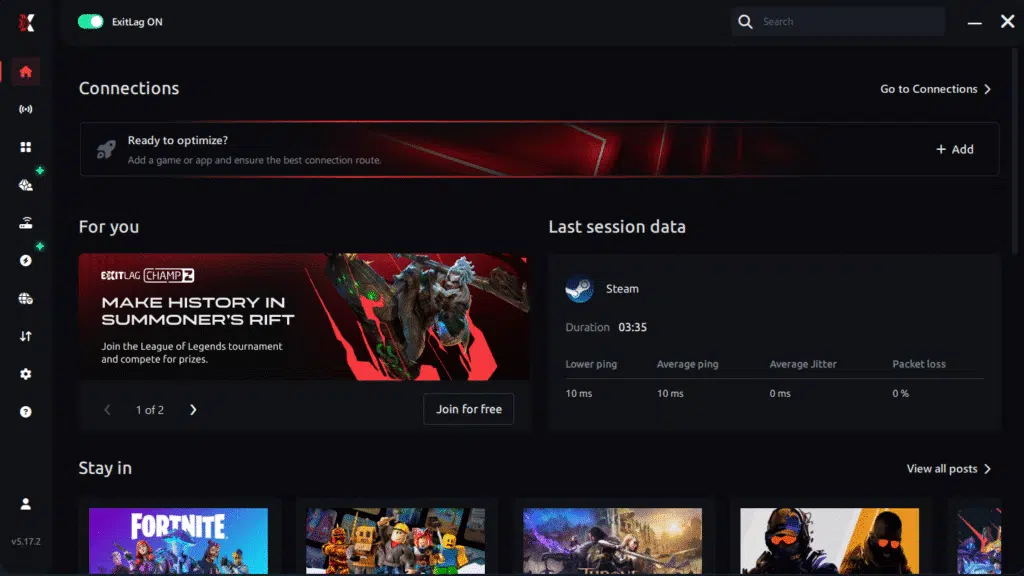
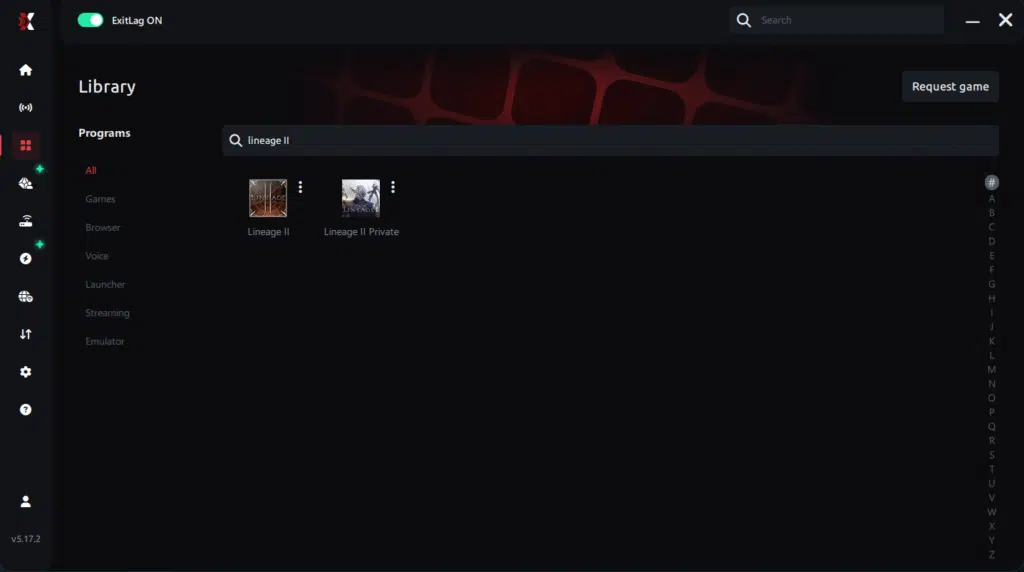
Step 3 – In the search bar, type “Lineage II” and select the game from the list.
Step 4 – Choose between automated or manual route
Based on the results, you can let ExitLag automatically select the best route or manually choose the server that showed the lowest latency for your connection.
AI-optimized automated route
Based on the results, you can let ExitLag automatically select the best route through AI optimization. The system analyzes multiple connection paths in real time and automatically identifies the most efficient route for your connection, ensuring the lowest possible latency without requiring manual choices.
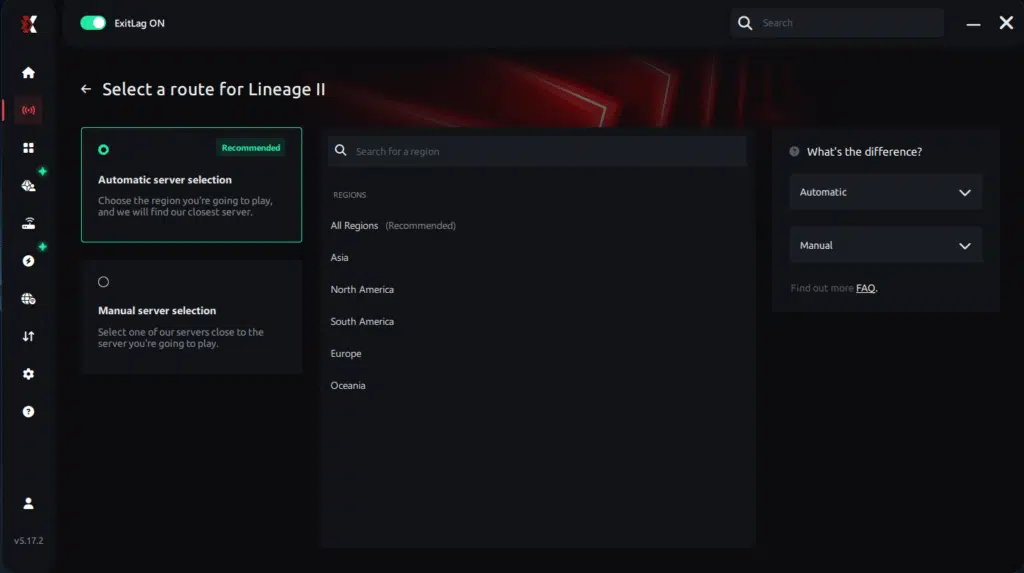
Manual route
If you prefer to have full control over your connection, you can manually choose the server based on the ping test results. Simply select the server that showed the lowest latency or the one that best meets your specific gaming needs, allowing complete customization of your experience.
Step 5 – Click “Lineage II” or the play button. ExitLag will begin optimizing your connection automatically.
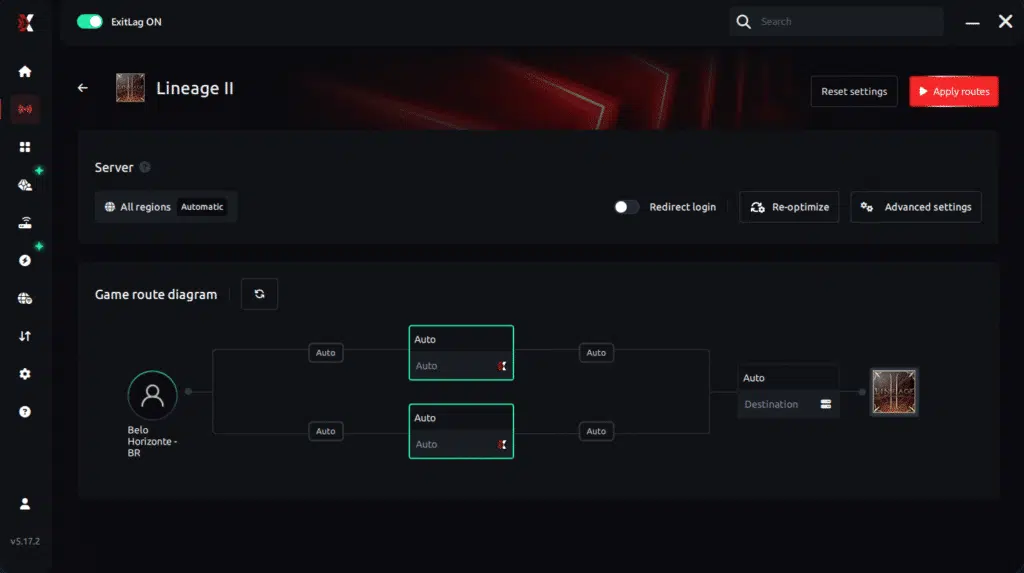
Step 6 – Wait a few seconds until optimization is complete. You’ll see ping indicators in the interface.
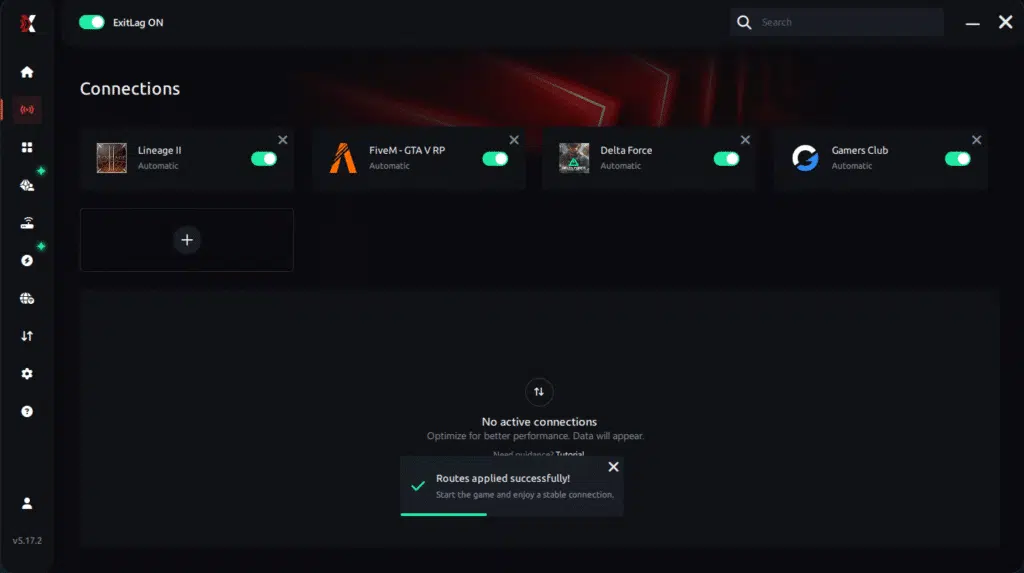
Step 7 – Launch Lineage II normally. The optimization will already be active.
ExitLag runs in the background while you play, constantly adjusting routes to maintain the best possible performance.
FAQ: frequently asked questions about jitter in Lineage II
What is the difference between jitter, lag, and packet loss in Lineage II?
Jitter is the variation in ping over time — how unstable your latency is. Lag is the general delay between pressing a button and seeing a reaction in-game. Packet loss happens when some of your data never reaches the server, causing stutters, missing hits, and desync. You can have low ping but high jitter or packet loss and still have a terrible experience.
Why does my ping keep fluctuating in Lineage II?
Fluctuating ping often comes from home network congestion, unstable ISP routing, Wi-Fi interference, or multiple devices consuming bandwidth simultaneously. Distance to the servers also matters. All these issues create instability and random spikes during farming, raids, and sieges.
Is jitter worse than just having high ping in Lineage II?
In many scenarios, yes. A stable 100 ms ping can be more playable than a wildly inconsistent 30–150 ms ping, because you can adjust to a constant delay but not to unpredictable changes. Jitter breaks your timing in ways that simple high latency does not.
How can I tell if I specifically have jitter while playing Lineage II?
Look for signs like skills that sometimes feel instant and sometimes sluggish, even with similar ping values. Run a long ping test and check how much the results fluctuate. Frequent rubberbanding, delayed casts, and weird deaths in PvP are classic indicators of jitter.
Does Wi-Fi cause more jitter in Lineage II?
Yes. Wi-Fi is naturally vulnerable to interference, signal drops, and congestion. Those tiny disruptions translate directly into variation in latency, which you experience as jitter. A wired Ethernet cable is almost always more stable and is highly recommended for Lineage II.
Does ExitLag help with issues other than jitter in Lineage II?
ExitLag is designed to reduce ping, improve route stability, and mitigate packet loss across hundreds of online games. By controlling and optimizing your path to the server, it improves overall reliability, which means fewer spikes and smoother gameplay in all types of content.
Do I need to keep ExitLag running while playing Lineage II?
Yes. ExitLag must stay open to continuously monitor and adjust your routes. You can minimize it to the system tray, but if you close it, your connection falls back to your ISP’s default, potentially unstable routing.
Is large-scale PvP in Lineage II more sensitive to jitter?
Definitely. In castle sieges, mass GvG, and crowded raids, every movement and cast is timing-critical. Even small jitter becomes very visible, turning carefully planned strategies into chaotic, laggy fights where positioning and reactions are much harder to execute.

Conclusion
Jitter can turn a relaxing farm session or an epic siege in Lineage II into a frustrating sequence of delayed skills, missed opportunities, and random deaths. The worst part isn’t just the delay; it’s the unpredictability that makes your character feel disconnected from your commands. But you don’t have to accept this as normal.
By understanding what jitter is, identifying its causes, and combining basic network hygiene with advanced routing optimization, you can reclaim control over your gameplay. ExitLag stands out as the definitive solution to stabilize your ping, reduce variation, and keep your latency consistent in all types of content. For more tutorials, tips, and in-depth connection guides, explore the official blog at official ExitLag connection guides blog.
A properly optimized connection lets you experience Lineage II the way it was meant to be played: responsive, stable, and competitive, with sieges and PvP decided by your skill and strategy — not by random network instability.If you’re ready to eliminate jitter, stabilize your connection, and feel the difference in your next siege or raid, start your ExitLag free trial now and optimize your routes for Lineage II at start your ExitLag free trial.
Got questions or want to connect with other players? Join the conversation at the ExitLag Forum!