The arrival of new heroes is one of the biggest attractions of Marvel Rivals, and The Wasp remains a particularly interesting possibility for the roster. Known for her size manipulation, flight, agility, and bio-electric abilities, she could bring a very different playstyle to the battlefield. For players searching for Marvel Rivals hero: The Wasp, understanding her potential role is a useful way to prepare for how she could fit into the game’s fast-paced combat.
The Wasp is Janet van Dyne, one of Marvel’s classic heroes and an important member of the Avengers. Although she is currently listed as a non-playable character rather than an official playable hero, her presence in the game’s universe makes her a natural subject of community speculation. If you’re also exploring the existing roster, our Marvel Rivals game guide provides broader information about the game’s mechanics, roles, and competitive environment.
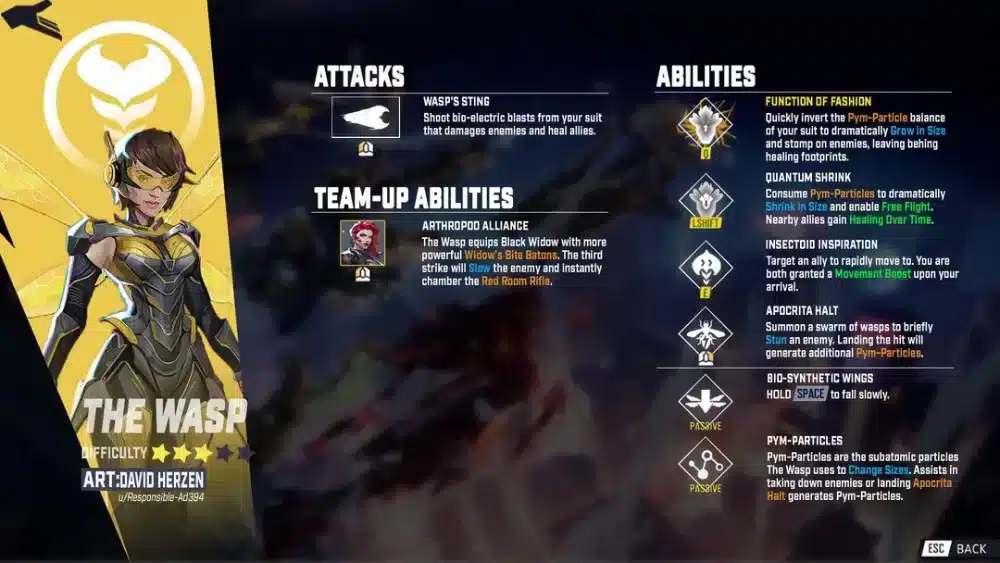
So, what would Marvel Rivals hero: The Wasp actually mean for gameplay? At present, there is no officially confirmed playable Wasp kit to analyze. However, Janet’s established Marvel powers include size reduction, insect communication and control, bio-synthetic wings, and bio-electric blasters. Therefore, any discussion of her abilities, role, or team composition should be treated as potential gameplay analysis rather than confirmed information.
Marvel Rivals hero: The Wasp and her potential role
The most important question surrounding Janet is how her powers could translate into a hero-shooter format. Her ability to fly and manipulate her size gives developers several possibilities, while her blasters could make her effective from different ranges. Because Marvel Rivals already includes heroes with highly distinctive movement systems, Wasp could potentially fit naturally into the game’s vertical and highly mobile combat.
Could The Wasp be a Strategist?
One common community concept positions Wasp as a Strategist. This interpretation makes sense because her bio-electric attacks could potentially be adapted into abilities that damage opponents while providing utility to teammates.
However, this remains speculation. Community-created concepts have proposed healing, damage amplification, anti-healing effects, flight, and size manipulation, but these are fan ideas rather than official abilities.
A Strategist version of Wasp could therefore focus on mobility and utility instead of simply maximizing damage. She could move around the battlefield, support allies from unusual angles, and quickly reposition when the enemy team changes targets.
Why mobility could define her gameplay
Flight would be one of the most obvious ways to differentiate Wasp. Rather than depending entirely on walls, platforms, or jump abilities, she could potentially approach fights from the air and use vertical positioning to create safer angles.
Size manipulation would add another layer. A smaller form could potentially make her harder to track, while her normal form could provide more consistent combat presence. These possibilities are especially interesting because Marvel Rivals frequently rewards players who understand positioning and movement.
The Wasp abilities players could expect
Because there is currently no official playable kit, it is important to separate Janet’s established Marvel powers from abilities that have only been proposed by the community. Her established power set includes size reduction, insect control, bio-synthetic wings, and bio-electric blasters.
Abilities in Marvel Rivals could revolve around mobility
If developers eventually introduce Wasp, several concepts could translate particularly well into Marvel Rivals. Her wings could provide aerial mobility, while her size-changing powers could become an evasive mechanic.
A possible design could include:
- Aerial movement that lets her reposition vertically.
- Bio-electric projectiles that provide ranged pressure.
- A shrinking mechanic that changes movement or survivability.
- A utility-focused ultimate affecting allies or enemies.
These ideas should not be treated as confirmed mechanics. Instead, they demonstrate how Janet’s established comic-book identity could be adapted to the game’s existing design philosophy.
Bio-electric attacks and ranged pressure
Wasp’s bio-electric blasters are another major part of her identity. In a hero shooter, they could provide a reliable ranged attack that allows her to contribute without standing directly beside her teammates.
At the same time, developers would need to balance mobility and damage carefully. A character capable of flying, shrinking, and attacking from range could become difficult to counter if every mechanic were extremely powerful.
That means a hypothetical Wasp kit would likely need meaningful limitations. Cooldowns, reduced damage while airborne, restricted flight duration, or predictable attack patterns could all provide opportunities for opponents to respond.
How to Play The Wasp if she joins the roster
Learning How to Play a highly mobile hero would require more than simply staying in the air. Movement should create better opportunities, not become an objective by itself.
Use vertical positioning intelligently
Aerial positioning can provide visibility over obstacles and create unusual attack angles. However, staying airborne for too long could also make your movement predictable.
A strong approach would be to alternate between high and low positions rather than constantly flying in one direction.
For example:
- Start from a safe position and identify the enemy’s main damage threats.
- Move vertically to create a new angle.
- Apply pressure or provide utility to an ally.
- Reposition before the enemy can focus you.
- Return to your team when your mobility tools are unavailable.
This style would make movement part of decision-making rather than simply a way to avoid walking.
Manage size manipulation carefully
If Wasp receives a shrinking mechanic, using it at the right moment could be more important than using it constantly.
A smaller form could potentially help her escape a dangerous situation or approach an objective. However, if the mechanic reduces offensive output or limits certain actions, using it without a clear purpose could leave her team without enough pressure.
Therefore, players should think about size manipulation as a resource. The goal would be to activate it when its advantages solve a specific problem.
Best Team Compositions for The Wasp
The potential Best Team Compositions for Wasp would depend entirely on her official role and abilities. Nevertheless, her established powers suggest several interesting possibilities.
Pairing Wasp with aggressive heroes
A mobile Strategist could potentially work well beside heroes that frequently enter enemy territory. If Wasp were able to provide healing, buffs, or utility while flying, she could follow aggressive teammates without being forced to remain on the ground.
This would create a team structure where one hero initiates pressure while Wasp provides support from a different angle.
However, she would still need protection. A highly mobile character is not necessarily a durable character, so positioning would remain essential.
Building around vertical mobility
Another potential composition would focus on heroes capable of fighting across multiple elevations.
| Team role | Potential function | Why it could work with Wasp |
| Vanguard | Creates space | Gives Wasp safer areas to operate |
| Duelist | Applies pressure | Benefits from potential utility |
| Strategist | Provides additional support | Helps compensate for Wasp’s mobility |
| Wasp | Mobility and utility | Adds another angle to team fights |
| Duelist | Flanking | Can capitalize on disrupted enemies |
| Vanguard/Strategist | Flexible support | Improves team stability |
This is only a theoretical structure because Wasp’s final role and abilities have not been officially confirmed.
How network stability could affect Wasp gameplay
Highly mobile heroes depend heavily on consistent input response. If Wasp eventually receives flight, rapid movement, or size-changing mechanics, connection instability could make those mechanics feel less predictable.
Why ping matters during fast movement
Marvel Rivals is a real-time multiplayer game where player inputs have to reach the game server and return information to the client. High or unstable latency can make abilities feel delayed and can contribute to rubberbanding or inconsistent hit registration.
This becomes especially noticeable when a character depends on precise repositioning.
For example, a delayed movement command could cause a player to remain exposed longer than intended. Likewise, unstable connectivity during an ability sequence can make the result feel different from what the player expected.
ExitLag and Marvel Rivals connection stability
ExitLag is designed to optimize the network route between a player’s device and the game server. It is not a VPN. Instead, its technology focuses on finding efficient and stable routes for gaming traffic.
For players experiencing connection problems, the process is straightforward:
- Open ExitLag and select Marvel Rivals.
- Apply an optimized route based on the available connection paths.
- Launch the game while the optimization is active.
The objective is not to change Wasp’s abilities or increase her damage. Instead, network optimization can help make the connection more consistent when routing is contributing to high ping or packet loss.
Preparing for The Wasp before an official release
Even without a confirmed playable kit, players can prepare for the type of gameplay Wasp could potentially introduce. Understanding positioning, movement, and team coordination is useful regardless of which hero eventually joins the roster.
Practice movement and positioning fundamentals
Players interested in a future Wasp should focus on fundamentals that translate well to mobile characters.
These include:
- Maintaining awareness of enemy cooldowns.
- Avoiding predictable movement patterns.
- Using cover between attacks.
- Tracking teammates before committing to an engagement.
- Repositioning after providing damage or support.
These habits matter because mobility is only valuable when it creates a meaningful advantage.
Learn to recognize network-related problems
Before changing gameplay settings, players should identify whether a problem is mechanical, graphical, or network-related.
A simple checklist can help:
- Check whether ping suddenly spikes during matches.
- Look for packet-loss indicators or rubberbanding.
- Compare performance across different times or server regions.
- Test whether the issue continues after closing bandwidth-heavy background applications.
- If routing appears to be the problem, test a connection optimizer such as ExitLag.
ExitLag’s Marvel Rivals guides explain that routing, packet loss, and latency can affect how responsive abilities and movement feel during intense fights.
Marvel Rivals hero: The Wasp and future possibilities
The biggest appeal of Wasp is the number of gameplay possibilities created by her existing Marvel powers. She could potentially become a flying Strategist, an agile Duelist, or another role entirely. Each option would create a different relationship between size manipulation, mobility, ranged attacks, and team utility.
What makes Janet different from other heroes?
Wasp’s identity is particularly suited to mechanics involving scale and movement. A shrinking ability could affect how opponents target her, while flight could create vertical routes unavailable to many heroes.
At the same time, developers would need to ensure those mechanics remain readable and counterable. Marvel Rivals works best when players can understand why an interaction happened and identify what they can do in response.
What players should watch for
Since Wasp is currently non-playable, players should be cautious with unofficial ability lists and fan-made concepts. Community discussions can be useful for exploring possibilities, but they should not be confused with official announcements.
If Janet eventually becomes playable, the most important details to monitor will be her official role, movement mechanics, cooldowns, ultimate, and any Team-Up interactions.
Final thoughts on Marvel Rivals hero: The Wasp
For now, Marvel Rivals hero: The Wasp is best approached as a future possibility rather than a confirmed playable character. Janet van Dyne already has a strong foundation for a unique hero design through her flight, size manipulation, bio-electric abilities, and Avengers identity. If she eventually joins the roster, her gameplay could offer a combination of mobility, precision, and team utility unlike many existing heroes.
Until an official kit is announced, players should treat detailed ability lists and proposed team compositions as speculation. In the meantime, improving movement fundamentals, understanding team roles, and maintaining a stable connection are practical ways to prepare for any highly mobile hero. For players who experience network instability in Marvel Rivals, ExitLag can optimize the route used by game traffic, helping create a more consistent connection without functioning as a VPN.
Got questions or want to connect with other players? Join the conversation at the ExitLag Forum!