Valheim house building is much more than placing four walls and a roof. Your home becomes a safe place to sleep, craft equipment, store resources, prepare food, organize portals, and recover before exploring dangerous biomes.
A well-designed Valheim house should combine functionality, structural stability, storage, comfort, and enough space to grow as your progression continues. The best builds are not necessarily the largest ones; they are the houses that make everyday tasks faster while remaining easy to expand.
So, what is a Valheim house? It is a player-built shelter created with Valheim’s modular building system, using materials such as wood, core wood, stone, and increasingly advanced construction pieces. A good house protects important crafting stations, provides shelter and comfort, manages smoke correctly, and gives you an efficient central base for your adventures.
In this guide, you will learn how Valheim housing works, how to plan your first build, improve structural support, create multi-story houses, manage smoke, increase comfort, and use practical layouts and blueprints for different stages of the game.

Valheim House: What Every Good Base Needs
A Valheim house should solve practical problems before you start worrying about decoration.
You can always expand or redesign a building later, but getting the foundation, shelter, fire, and storage right from the beginning makes progression much easier.
Start with the essential rooms
Your first house does not need to be enormous.
A compact starter base should provide enough room for the systems you use most frequently.
Useful areas include:
- A bed;
- A fire;
- A workbench;
- Storage chests;
- Cooking equipment;
- Space for future crafting upgrades;
- A sheltered entrance.
Once these essentials fit comfortably, you can begin thinking about additional rooms and decorative features.
The official Valheim site describes building and expanding settlements as one of the game’s core systems, so expect your base to evolve as you unlock new materials and crafting options.
Leave room for expansion
A common beginner mistake is building every room tightly around the equipment currently available.
That works initially, but new crafting stations and upgrades eventually require additional space.
Instead, leave empty walls or sections where new rooms can connect later.
You can also divide your base into functional zones.
For example, keep crafting in one section, cooking in another, and storage between them.
This makes future Valheim house builds much easier to expand.
Valheim House Building and Structural Stability
Understanding Valheim house building mechanics is essential if you want larger structures.
Valheim uses structural support rules, meaning pieces eventually become unstable when they are too far from reliable support.
Understand the building color system
When you inspect building pieces with the Hammer, their colors indicate structural support.
Generally, strongly supported pieces appear toward blue or green, while weaker connections gradually move toward yellow, orange, and red.
Red pieces are close to the limit of what the current structure can support. If a new piece immediately breaks after placement, you probably need:
- A shorter span;
- Additional beams;
- A vertical support;
- Better foundation contact;
- Stronger building materials.
Instead of repeatedly replacing the same roof section, trace the support path down toward the ground.
Build from a solid foundation
Pieces touching terrain or suitable natural support provide the strongest starting point for a structure.
Therefore, a good Valheim house begins with a level and organized foundation. Before building upward:
- Flatten or prepare the terrain;
- Place foundation pieces carefully;
- Establish the main support columns;
- Build the first-floor frame;
- Add walls;
- Create roof supports;
- Add the roof last.
This approach makes it easier to identify structural problems before the house becomes too complicated.
Valheim House Designs for Different Stages of Progression
There is no single best style among Valheim house designs.
Your available materials, biome, progression level, and personal preferences all influence what makes sense.
Starter Viking cabin
A small rectangular cabin is usually enough during your first days. Keep the interior simple and place the main crafting area close to storage.
A starter layout might contain:
- One central fire;
- Bed along a wall;
- Workbench opposite the bed;
- Storage near the entrance;
- Cooking area close to the fire.
A basic cabin is inexpensive and fast to repair. It also gives you time to gather resources before committing to a larger project.

Viking longhouse
Longhouses are among the most recognizable Valheim houses.
A long rectangular structure provides enough room to organize several functions while maintaining a classic Viking aesthetic.
A practical longhouse can contain:
- Central hearth;
- High ceiling;
- Long crafting area;
- Storage walls;
- Beds or private rooms;
- Trophy displays;
- Portal section.
High ceilings also make smoke management easier when the roof is designed correctly.
Valheim House Ideas for a Better Base
Once basic survival is covered, Valheim house ideas can focus more on improving organization and appearance.
Instead of constructing one giant empty room, divide the space according to how you actually play.
Create dedicated functional areas
One useful approach is separating different activities. For example:
- Crafting workshop;
- Kitchen;
- Storage room;
- Portal room;
- Bedroom;
- Trophy hall;
- Armory;
- Outdoor farming area.
This reduces clutter and makes resources easier to find.
If you regularly play with friends, dedicated spaces also prevent several players from crowding the same room.
Build around the environment
Not every house needs to begin on perfectly flat open land. Interesting Valheim house designs can incorporate:
- Hills;
- Coastlines;
- Large rocks;
- Forest clearings;
- Mountainsides;
- Existing ruins.
Building around natural terrain can create unique designs while also providing strong support opportunities.
Just remember that accessibility matters.
A beautiful base becomes frustrating if every crafting trip requires climbing difficult terrain.
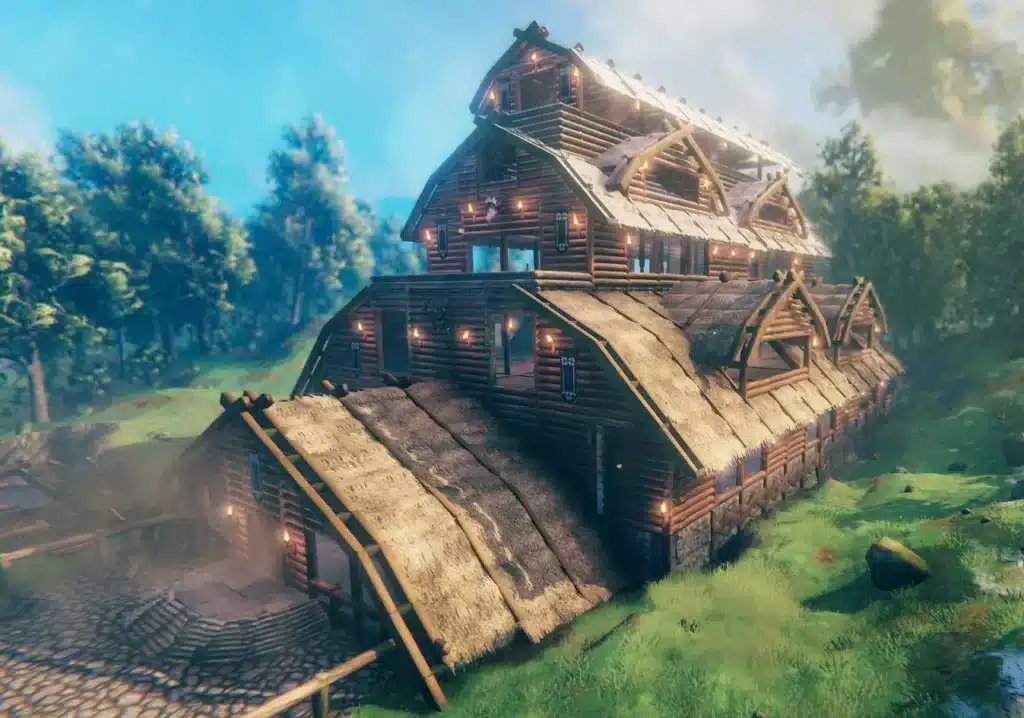
3 Story House Valheim: How to Build Upward
A 3 story house Valheim design is possible, but taller houses require more careful structural planning.
Simply stacking wood walls vertically will eventually push your structure toward its support limit.
Use vertical supports from the ground
The easiest way to build upward is creating strong vertical support lines that begin directly from terrain or another reliable foundation.
Core wood can be particularly useful for taller wooden builds.
As you unlock more advanced construction materials, stronger structural options can support more ambitious buildings.
For a three-story layout, plan the frame before decorating.
Your floors could be organized like this:
| Floor | Recommended purpose |
| Ground floor | Crafting, storage, cooking |
| Second floor | Bedroom, comfort, trophies |
| Third floor | Portals, lookout, decoration |
This keeps the heaviest day-to-day activity near ground level while allowing the upper floors to focus on lighter functions.
Avoid unsupported wide rooms
Tall buildings often fail because players focus only on vertical height. Wide open rooms can also create unsupported roof sections.
If you want a large hall, use beams and interior columns strategically. You can hide supports inside walls, staircases, decorative posts, or furniture layouts.
That way, structural pieces become part of the design rather than looking like emergency repairs.
Valheim House Blueprints: How to Plan Before Building
Using Valheim house blueprints does not require complicated drawings. A simple floor plan can save significant time and resources.
Create a grid-based floor plan
Valheim’s snap-based construction system makes grid planning practical. Before raising walls, build or visualize the floor footprint.
Decide where you want:
- Main entrance;
- Staircase;
- Fire;
- Storage;
- Crafting stations;
- Bedroom;
- Chimney;
- Expansion doors.
This makes it easier to maintain symmetry and prevents important features from competing for the same space.
Example compact blueprint
A simple rectangular Valheim house blueprint could follow this structure:
- Entrance and equipment storage at the front;
- Crafting stations along one wall;
- Storage chests along the opposite wall;
- Fire and cooking in the center;
- Bedroom toward the back;
- Staircase to a future upper floor;
- Chimney positioned above the central hearth.
The advantage of this design is flexibility. You can extend either side without demolishing the original structure.
Smoke and Ventilation in Valheim Housing
Fire is important for Valheim housing, but indoor fires create smoke. A poorly ventilated building can fill with smoke and damage the player.
Build a proper chimney
Smoke needs an unobstructed path upward. One of the simplest solutions is building a chimney over your hearth or campfire.
However, avoid leaving the fire completely exposed to rain.
A practical chimney includes:
- Open vertical space above the fire;
- Walls guiding smoke upward;
- A covered top;
- Enough side ventilation for smoke to escape.
This keeps rain away from the fire while still allowing smoke to leave the building.

Use high ceilings
High ceilings provide additional room for smoke to collect before leaving through ventilation openings.
This is particularly useful in larger Valheim house builds such as longhouses.
Still, a high ceiling alone is not a replacement for ventilation. Smoke needs somewhere to escape.
If smoke remains trapped near the roof, increase the size or efficiency of the chimney opening.
Valheim House Builds and Comfort
Good Valheim house builds should also consider Comfort. Furniture and decorative items contribute to Comfort, which increases the duration of your Rested effect.
Why Comfort matters
The Rested bonus improves important regeneration while you explore, gather materials, build, and fight.
As a result, investing in a comfortable home has practical benefits beyond appearance.
Useful comfort-related furnishings can include:
- Beds;
- Chairs;
- Tables;
- Rugs;
- Banners;
- Fires;
- Other unlocked decorative furniture.
As your progression advances, new items can improve your interior further.
Create a central comfort room
You do not necessarily need comfort items throughout the entire base. A dedicated room near frequently used areas can be more practical.
For example, place your comfort zone near your portals or main exit. Before leaving for an expedition, spend a moment there and refresh your Rested bonus.
This transforms your Valheim house into an effective preparation point rather than simply a storage building.
Storage and Organization for Valheim Houses
Large Valheim houses can become difficult to use if storage is poorly organized. The problem becomes worse as you begin collecting resources from multiple biomes.
Group resources by category
Instead of dropping random materials into whichever chest is empty, use categories. For example:
- Wood and building materials;
- Stone and minerals;
- Food ingredients;
- Finished food;
- Weapons and armor;
- Trophies;
- Seeds and farming;
- Crafting materials.
Signs or visual organization can help you find everything quickly.
Keep storage near crafting stations
The best storage location is usually close to where the materials will be used. Metal resources should be near your forge area.
Food belongs near the kitchen. Building materials can remain near the entrance or workshop.
This prevents unnecessary walking inside large Valheim house designs.
Defending Your Valheim House
A beautiful Valheim house still needs protection. Enemy events and nearby creatures can threaten structures, livestock, and players.
Create an outer defensive layer
Your main walls do not need to be your first line of defense. Depending on your location, useful defenses may include:
- Stakewalls;
- Trenches;
- Raised terrain;
- Gates;
- Defensive towers;
- Clear visibility around the base.
Keeping enemies away from the house prevents damage to important crafting and storage areas.
Choose your location carefully
Base location matters just as much as construction quality. A convenient location should provide reasonable access to:
- Water;
- Resources;
- Safe terrain;
- Future portals;
- Nearby biomes.
For your first major Valheim housing project, the Meadows remain attractive because the environment is generally easier to manage than later-game biomes.
Valheim Multiplayer House Building
Building with friends can make ambitious Valheim house builds much faster.
Valheim officially supports both solo play and cooperative play, including player-hosted worlds and multiplayer adventures.
Divide construction responsibilities
Large multiplayer bases benefit from clear roles. One player can collect wood while another prepares terrain and another builds the structural frame.
Once the foundation is complete, everyone can help with:
- Interior design;
- Storage;
- Farming;
- Portals;
- Defenses.
This reduces resource bottlenecks and makes large builds more manageable.
Keep multiplayer bases organized
Multiplayer houses require more storage and movement space than solo bases. Use wider hallways and enough room around frequently accessed crafting stations.
Also consider multiple storage areas for common resources. A slightly larger Valheim house can feel much more comfortable when several players are using it simultaneously.
FAQ
What is the best Valheim house for beginners?
A compact wooden cabin is usually the best first Valheim house because it is inexpensive, easy to repair, and provides enough room for a bed, workbench, storage, fire, and early crafting equipment.
How do you build a stable Valheim house?
Start from terrain-supported foundations and maintain clear support paths through walls, beams, and columns. If pieces become orange or red, shorten unsupported spans or add stronger vertical supports.
Can you build a 3 story house in Valheim?
Yes. A 3 story house Valheim build is possible, but tall structures require careful use of vertical supports, beams, strong foundations, and progressively better building materials.
What are good Valheim house ideas?
Useful Valheim house ideas include Viking longhouses, compact workshops, coastal bases, multi-story halls, portal hubs, mountain lodges, fortified compounds, and houses built around natural terrain.
Do you need a chimney in a Valheim house?
If you use an indoor fire, you need enough ventilation for smoke to escape. A chimney or covered roof opening is one of the easiest ways to keep a Valheim house ventilated without exposing the fire directly to rain.
Why does my Valheim house keep collapsing?
Structural pieces collapse when they do not receive enough support. Check the color of each piece and trace its support toward the ground, then add beams, columns, or stronger construction materials where necessary.
What should a Valheim house blueprint include?
Good Valheim house blueprints should plan the entrance, support frame, crafting stations, storage, fire, chimney, stairs, sleeping space, and future expansion before you begin decorating.
Valheim House: Build Together With a Better Connection Using ExitLag
A functional Valheim house combines strong support, efficient storage, proper ventilation, Comfort, and enough space to expand as your Viking journey grows.
If network instability, high ping, or packet loss affects your multiplayer building sessions, try ExitLag to optimize your connection and keep your focus on creating the base you want.
Got questions or want to connect with other players? Join the conversation at the ExitLag Forum!