Amethyst Minecraft is one of the most useful and beautiful crystal resources in the game. It appears inside amethyst geodes, where players can find amethyst blocks, budding amethyst, amethyst buds, and fully grown amethyst clusters that drop shards.
The amethyst Minecraft system is different from normal ore mining because you cannot simply take the main growing block home. Budding amethyst stays inside the geode, which means every good farm starts by finding, protecting, and revisiting a natural geode. Mojang has explained that this was intentional, so players would have a reason to return to geodes instead of moving the whole farm elsewhere.
Amethyst Minecraft is valuable for crafting, decoration, exploration, redstone-related builds, armor trim color, and even Allay duplication. Whether you want an amethyst shard Minecraft farm, an amethyst crystal Minecraft decoration room, or an aesthetic cave base, this guide covers everything you need.
Where do you find amethyst in Minecraft?
You find amethyst in Minecraft inside amethyst geodes. These are naturally generated underground structures in the Overworld. A geode has a round structure with smooth basalt on the outside, calcite in the middle, and amethyst blocks inside. Some of those inner blocks are budding amethyst, which can grow crystal clusters over time.
If you are wondering how to find amethyst in Minecraft, the best strategy is to explore underground caves, deep tunnel systems, oceans, aquifers, and exposed cave walls. Geodes often generate with cracks, which can reveal their purple interior from the outside.
Amethyst geodes currently generate between Y=-58 and Y=30, so older advice about searching high underground levels may be outdated for modern versions.
How to identify an amethyst geode
An amethyst geode is easy to recognize once you know its layers. From the outside in, it usually looks like this:
| Layer | Block type | What it tells you |
| Outer layer | Smooth basalt | You found the outside of a geode |
| Middle layer | Calcite | You are close to the crystal chamber |
| Inner layer | Amethyst blocks | The geode contains crystals and shards |
| Special blocks | Budding amethyst | These grow buds and clusters |
When mining, do not rush through the purple blocks. Some of them may be budding amethyst, which is the most important block in the whole structure.
Look closely for the budding texture. Budding amethyst has a distinct pattern and is the only block that grows amethyst clusters. If you break it, you cannot normally collect it in survival mode.
Best places to search for geodes
The best place to search is underground between Y=-58 and Y=30. Caves are especially helpful because they expose more blocks without forcing you to mine every tunnel manually.
Good search methods include:
- Explore large cave systems.
- Check underwater ravines and aquifers.
- Listen for the crystal chime sound.
- Mine around smooth basalt patches.
- Search near deep underground openings.
- Mark every geode with coordinates.
- Build a safe tunnel from your base to the geode.
The most important tip is to save the location. Since budding amethyst cannot be moved normally, a geode is not just a place to loot once. It can become a permanent farming site.
What is amethyst used for in Minecraft?
Amethyst is used for crafting, decoration, sound design, Allay duplication, armor trim color, and redstone-related items. The most common crafting uses are spyglass, tinted glass, block of amethyst, and calibrated sculk sensor. Amethyst shards can also be used in armor trimming and to duplicate Allays when specific conditions are met.
This makes amethyst Minecraft more useful than many players realize. It is not only a decorative purple crystal. It has practical value for exploration, building, and advanced gameplay.
Amethyst shard Minecraft crafting uses
An amethyst shard Minecraft item comes from mining a fully grown amethyst cluster. With the right tool, a cluster drops shards instead of the cluster block itself. The standard drop with a regular pickaxe is 4 shards, and Fortune can increase the amount.
Here are the main shard uses:
| Use | Recipe or function | Why it matters |
| Spyglass | Amethyst shard + copper ingots | Lets you zoom in on distant objects |
| Tinted glass | Glass + amethyst shards | Transparent block that blocks light |
| Block of amethyst | 4 shards | Decorative purple block |
| Calibrated sculk sensor | Sculk sensor + amethyst shard | Useful for advanced redstone |
| Armor trim color | Shard used in smithing | Adds purple trim color |
| Allay duplication | Give shard to dancing Allay | Creates another Allay after cooldown |
Tinted glass is especially useful because it blocks light while staying visually transparent, which makes it helpful for mob farms, dark rooms, and technical builds. Mojang’s amethyst shard article also highlights tinted glass as a recipe made by surrounding glass with amethyst shards.
Decorative and aesthetic uses
Amethyst is also excellent for decoration. Its purple color, crystal shape, and sound effects make it ideal for magical, fantasy, cave, and luxury builds.
Great design uses include:
- Crystal caves.
- Wizard towers.
- Underground bases.
- Enchanting rooms.
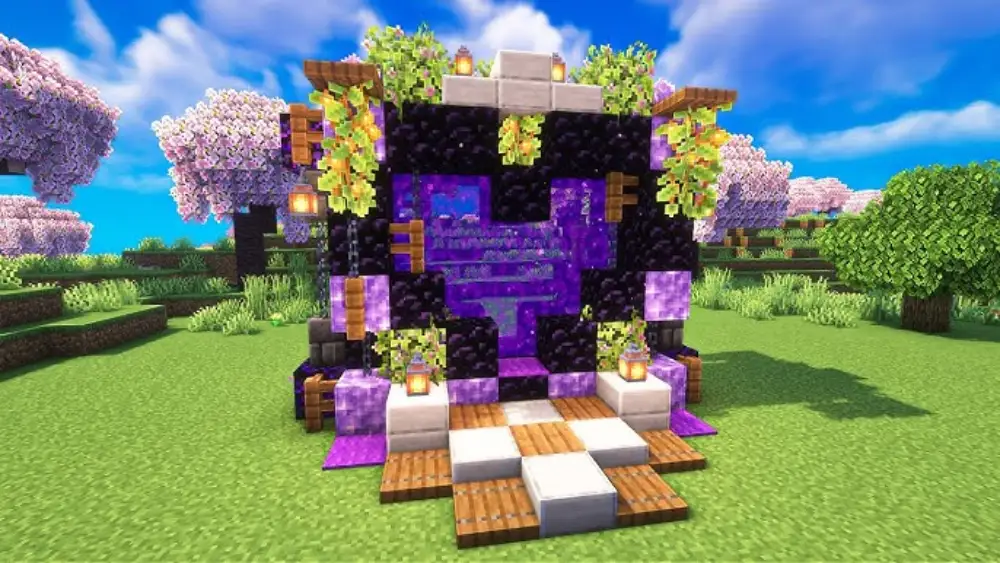
- Nether portal rooms.
- Luxury floors.
- Museum displays.
- Fantasy gardens.
- Purple-themed bedrooms.
- Hidden treasure chambers.
If you are creating an amethyst Minecraft skin player theme, you can also build an amethyst room or base to match your avatar style. A purple crystal outfit, amethyst-themed armor trim, and matching geode base can create a full visual identity for roleplay servers or screenshots.
How do you farm amethyst shards in Minecraft?
You farm amethyst shards by protecting budding amethyst blocks and harvesting fully grown amethyst clusters after they develop. Budding amethyst grows buds over time on exposed sides, and those buds eventually become full clusters that can drop shards.
This is why a farm must be built around a natural geode. You cannot normally mine budding amethyst, move it with pistons, or pick it up with Silk Touch. If it breaks, that growing block is gone.
A good amethyst Minecraft farm is simple: expose budding blocks, protect them, leave space for growth, light up the area, and return regularly.
How budding amethyst works
Budding amethyst is the core of every amethyst farm. It can generate amethyst buds on any of its six sides if there is room. These buds grow through stages before becoming a full amethyst cluster. In Java Edition, each random tick assigned to the budding amethyst block has a chance to create a bud or advance growth on one side.
The growth stages are:
- Small amethyst bud.
- Medium amethyst bud.
- Large amethyst bud.
- Amethyst cluster.
Only the final cluster stage drops amethyst shards when mined without Silk Touch. If you mine an earlier bud stage with Silk Touch, you can collect the bud itself for decoration, but it will not continue growing unless placed on budding amethyst.
How to build an efficient amethyst farm
To build an efficient farm, start by clearing the area around each budding block. You want all six sides exposed when possible, because every open face is a potential crystal growth point.
Follow this amethyst Minecraft farming setup:
- Find a geode.
- Mark its coordinates.
- Light the area to prevent mobs.
- Identify budding amethyst blocks.
- Carefully clear blocks around each budding block.
- Do not break budding amethyst.
- Leave air spaces around exposed sides.
- Build safe walkways.
- Return later when clusters are fully grown.
- Mine clusters with the correct tool.
Use a Fortune pickaxe when you want more shards. Use Silk Touch only when you want to collect the cluster block itself for decoration. The Minecraft Wiki notes that a non-Silk Touch, non-Fortune pickaxe drops 4 shards, while Fortune can increase the maximum yield.
What is the difference between amethyst shards, clusters, and budding amethyst?
The difference is simple: shards are items, clusters are grown crystals, and budding amethyst is the natural block that grows those crystals. Understanding this distinction helps you avoid destroying your farm by mistake.
Many new players confuse amethyst blocks with budding amethyst. They look similar, but they behave very differently. Normal blocks of amethyst can be mined and crafted. Budding amethyst is the special growing block that cannot normally be collected.
Amethyst block types explained
Here is a quick breakdown:
| Name | Type | Can you move it in survival? | Main use |
| Amethyst shard | Item | Yes | Crafting and Allay duplication |
| Block of amethyst | Block | Yes | Decoration and building |
| Budding amethyst | Special block | No | Grows buds and clusters |
| Small amethyst bud | Crystal growth stage | With Silk Touch | Decoration |
| Medium amethyst bud | Crystal growth stage | With Silk Touch | Decoration |
| Large amethyst bud | Crystal growth stage | With Silk Touch | Decoration |
| Amethyst cluster | Full crystal | With Silk Touch, or shards without it | Shard farming and decoration |
For long-term farming, budding amethyst is the most important. For crafting, shards are the most useful. For building, amethyst blocks and clusters are the most decorative.
Which amethyst block is rarest?
Budding amethyst is the rarest and most valuable block from a farming perspective. You can find it inside geodes, but you cannot normally move it. That means every budding block is tied to the location where it generated.
This also means you should never casually mine purple blocks inside a geode until you identify which ones are budding. Breaking normal amethyst is fine. Breaking budding amethyst can permanently reduce that geode’s farming potential.
If you want a renewable shard setup, protect budding amethyst first and decorate later.
What are the best amethyst Minecraft build ideas?
The best amethyst Minecraft build ideas use the block’s color, sparkle, and crystal identity. Amethyst works beautifully in magical builds, caves, fantasy interiors, modern accents, and secret rooms.
Because the blocks have a strong purple tone, they work best as accents rather than everywhere at once. Too much amethyst can overwhelm a build. Used carefully, it creates a premium, mystical look.
Cool amethyst crystal Minecraft builds
An amethyst crystal Minecraft build can be small and detailed or massive and dramatic.
Try these ideas:
- A hidden geode bedroom.
- A crystal cave base.
- A wizard study.
- A purple Nether portal shrine.
- A fantasy library.
- A gemstone vault.
- A magical greenhouse.
- A moon temple.
- A cave spa with water and crystals.
- A glowing underground tunnel.
Amethyst pairs well with:
| Amethyst theme | Good block combinations |
| Magical | Deepslate, candles, bookshelves, tinted glass |
| Luxury | Quartz, dark oak, copper, sea lanterns |
| Cave | Dripstone, moss, calcite, smooth basalt |
| Fantasy | Purple stained glass, end rods, chains |
| Modern | White concrete, blackstone, glass, polished blocks |
For the best effect, keep original geodes intact when possible. Turning a natural geode into a room can look better than mining it completely.
Matching an amethyst Minecraft skin player aesthetic
An amethyst Minecraft skin player aesthetic works especially well for roleplay, fantasy servers, screenshots, and themed bases. If your skin uses purple, crystal, celestial, witch, mage, or end-themed colors, amethyst can make your environment feel connected to your character.
Try matching:
- Purple armor trims.
- Amethyst rooms.
- Tinted glass windows.
- Crystal staff or magic-themed tools.
- A geode base entrance.
- Purple banners.
- Enchanting rooms with amethyst clusters.
- A cave portal room with calcite and smooth basalt.
This creates a unified style. Your base, skin, armor, and screenshots all feel like part of the same character story.

How can ExitLag help while exploring for amethyst in Minecraft?
ExitLag can help Minecraft players when connection instability affects online gameplay. If you are searching for geodes on a multiplayer server, Realm, SMP, or modded server, unstable routing, packet loss, or ping spikes can make exploration feel delayed or inconsistent.
ExitLag’s Minecraft performance guide explains that Minecraft can be single-player, multiplayer, modded, or vanilla, and that unstable network timing in multiplayer can create micro-stuttering, catch-up hitching, and inconsistent responsiveness that feels like FPS drops.
That matters when searching for amethyst Minecraft geodes with friends, mining deep caves, fighting mobs, or building farms on shared servers.
When ExitLag helps Minecraft players
ExitLag is most useful when the issue is network-related. It does not replace your GPU, CPU, RAM, or local graphics settings. However, it can help online Minecraft feel smoother by improving route stability and reducing instability that affects responsiveness.
Use ExitLag if you experience:
- Ping spikes on servers.
- Rubberbanding.
- Delayed block breaking.
- Delayed block placement.
- Chest or inventory lag.
- Movement stutter in multiplayer.
- Packet loss issues.
- Server response delays.
This is especially useful when exploring caves or farming shards online. A lag spike near lava, mobs, or deep drops can ruin a mining trip fast.
When local fixes matter more
If you are playing offline single-player and your game stutters, start with local fixes instead.
Try:
- Lowering render distance.
- Lowering simulation distance.
- Updating graphics drivers.
- Reducing heavy shaders.
- Closing background apps.
- Allocating enough memory for modded Minecraft.
- Installing performance mods if allowed.
- Using an SSD for world loading.
Then, if your issue happens mainly online, ExitLag becomes a better tool to test. The best setup combines local performance optimization with stable routing for multiplayer sessions.
FAQ
You can use amethyst for crafting spyglass, tinted glass, blocks of amethyst, calibrated sculk sensors, armor trim color, and Allay duplication. You can also use clusters and blocks for decoration.
To learn how to find amethyst in Minecraft, search underground for amethyst geodes. They generate in the Overworld between Y=-58 and Y=30 and have layers of smooth basalt, calcite, and amethyst inside.
Mine a fully grown amethyst cluster. A normal pickaxe drops shards, and Fortune can increase the yield. Silk Touch gives you the cluster block instead of shards.
No. Budding amethyst cannot normally be obtained in survival, even with Silk Touch, and it cannot be moved by pistons. That is why farms must stay inside natural geodes.
You do not grow shards directly. Budding amethyst grows buds, buds become clusters, and fully grown clusters drop shards when mined correctly.
An amethyst crystal Minecraft setup is useful for both farming and decoration. Clusters can drop shards, while buds and clusters can also decorate caves, magic rooms, and fantasy builds.
Yes. Amethyst is useful for spyglass, tinted glass, calibrated sculk sensors, armor trim colors, Allay duplication, and decorative building. It is especially useful if you protect a geode for long-term shard farming.
Conclusion
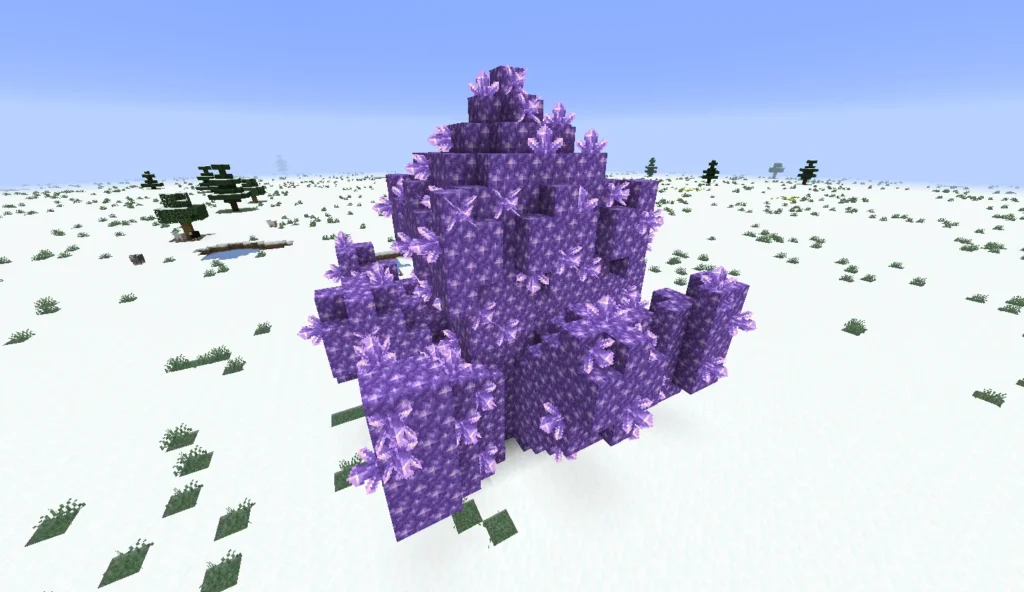
Amethyst Minecraft is one of the most interesting resources in the game because it combines exploration, farming, crafting, and decoration. You do not treat it like a normal ore. Instead, you find a geode, protect the budding amethyst, wait for clusters to grow, and return over time for more shards.
Once you understand the system, amethyst becomes easy to manage. Search between Y=-58 and Y=30, identify geodes by smooth basalt and calcite, protect budding blocks, mine full clusters with the right tool, and use shards for spyglass, tinted glass, calibrated sculk sensors, armor trims, Allay duplication, and beautiful crystal builds.
To make your amethyst Minecraft adventures smoother on multiplayer servers, try ExitLag. It can help reduce routing instability, packet loss impact, and connection-related stutter while you explore caves, farm shards, build geode bases, and play online with fewer interruptions.
Got questions or want to connect with other players? Join the conversation at the ExitLag Forum!