
The Heart of the Sea Minecraft item is one of the most valuable treasures for players who want to explore, mine, or build underwater. Unlike common resources found while mining, the Heart of the Sea is obtained from buried treasure and has one main purpose: combining with Nautilus Shells to craft a powerful Conduit.
Finding a Heart of the Sea Minecraft item requires exploration rather than traditional crafting. Buried Treasure Maps found while exploring structures such as shipwrecks and ocean ruins can lead you toward treasure chests containing the item, turning the search into a small adventure across Minecraft’s oceans.
Once you understand how to find and use the Heart of the Sea Minecraft item, underwater exploration becomes much easier. A properly activated Conduit provides Conduit Power, helping players breathe, see, and mine underwater while also offering additional protection against certain hostile mobs.
What Is the Heart of the Sea in Minecraft?
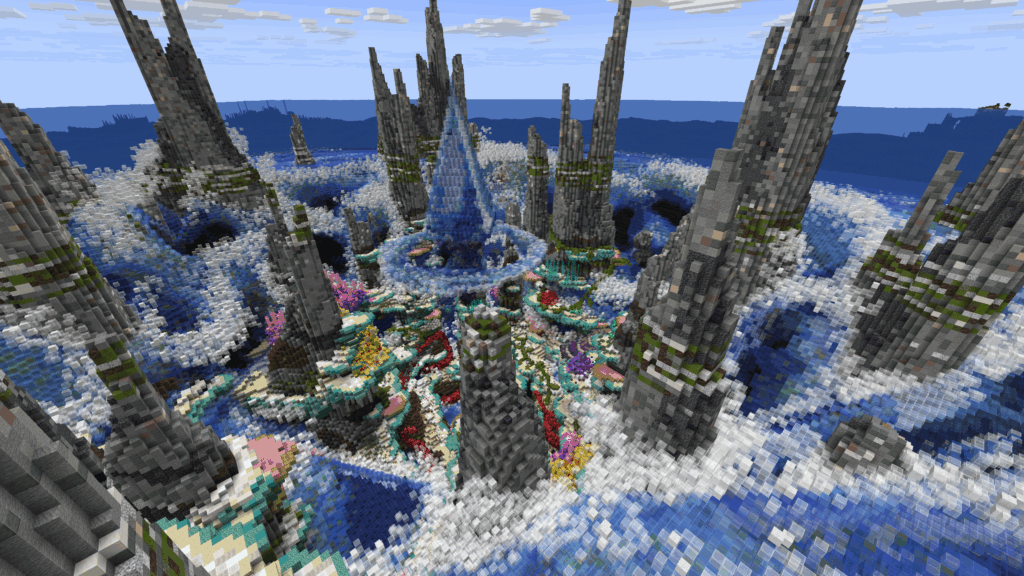
The Heart of the Sea is a rare item introduced as part of Minecraft’s Update Aquatic. That major update transformed the game’s oceans with features such as shipwrecks, ocean ruins, dolphins, Drowned, coral reefs, tridents, and several new underwater mechanics.
Unlike diamonds, iron, or other resources, the Heart of the Sea is not obtained by mining a particular block. Mojang explains that it is found in buried treasure chests, making exploration the central part of acquiring one.
The item itself has only one crafting purpose, but that purpose is extremely valuable. Combining a Heart of the Sea with eight Nautilus Shells creates a Conduit, one of Minecraft’s most useful tools for extended underwater activities.
For players planning an underwater base, clearing an Ocean Monument, or spending significant time beneath the surface, obtaining a Heart of the Sea can therefore become an important progression goal.
What Does Heart of the Sea Do in Minecraft?
If you’re wondering what does Heart of the Sea do in Minecraft, the simple answer is that it allows you to craft a Conduit.
The Heart does not provide its underwater benefits simply by carrying it in your inventory or placing it somewhere. Instead, you first need to gather eight Nautilus Shells and combine the materials on a crafting table.
The recipe is:
1 Heart of the Sea + 8 Nautilus Shells = 1 Conduit
Place the Heart of the Sea in the center of the crafting grid and surround it with eight Nautilus Shells. Mojang confirms this recipe and describes the Heart as an essential ingredient for the Conduit.
Crafting the Conduit is only the first step. You then need to build the correct underwater frame around it before Conduit Power becomes available.
How to Get Heart of the Sea in Minecraft
Knowing how to get Heart of the Sea in Minecraft starts with understanding buried treasure. The item is not available through a normal crafting recipe, so exploring for treasure is the intended Survival route.
A typical search follows this process:
- Explore oceans and coastlines.
- Search shipwrecks or ocean ruins.
- Look for a Buried Treasure Map.
- Open the map and locate the red X.
- Travel toward the marked location.
- Dig around the indicated area.
- Open the buried treasure chest.
- Collect the Heart of the Sea.
Mojang specifically identifies shipwrecks and ocean ruins as places where treasure maps can be found. Following the map to its red X leads you toward buried treasure.
This makes the Heart different from many other valuable Minecraft items. Progress depends less on mining depth or crafting resources and more on exploration.
Where Can You Find Minecraft Buried Treasure?
Minecraft buried treasure generally appears underground near coastal environments. A Buried Treasure Map displays a red X indicating the approximate location of the chest.
The challenge is that the X does not expose the chest directly. You still need to dig around the indicated location, and depending on terrain generation, finding the exact block can take some patience.
When following a treasure map, pay attention to your player marker. Move until your position aligns as closely as possible with the center of the red X, then begin searching the surrounding area.
Bring a shovel for sand and gravel, but keeping a pickaxe available is also useful because terrain around the chest can vary.
Most importantly, avoid abandoning the search after digging only one hole. The map points toward the treasure area rather than displaying the chest itself on the surface.
Once you locate the chest, the reward includes the Heart of the Sea you’re searching for.
How to Find Buried Treasure Maps
The most straightforward method of locating buried treasure is first obtaining a Buried Treasure Map.
Shipwrecks are particularly useful exploration targets because they can contain different types of loot chests. Ocean ruins are another potential source of treasure maps. Mojang specifically recommends these two structures when explaining how to locate a Heart of the Sea.
A boat makes searching ocean environments much faster. While traveling, watch for unusual shapes beneath the water and explore coastlines where shipwreck structures may be partially exposed.
Night Vision and Water Breathing can also help if you’re searching deeper structures, although they aren’t mandatory.
There is another interesting option involving dolphins. Mojang explains that feeding a dolphin raw cod or salmon can cause it to swim toward nearby buried treasure, a shipwreck, or ocean ruins.
The dolphin may not lead directly to buried treasure every time, but it can still point you toward structures that help advance your search.
Can You Craft a Heart of the Sea?
No. There is no normal Survival crafting recipe for the Heart of the Sea.
This distinction is important because players sometimes confuse crafting the Heart with crafting the Conduit. You find the Heart of the Sea, then use it as a crafting ingredient.
Think of the progression like this:
Explore → Find Treasure Map → Locate Buried Treasure → Get Heart of the Sea → Collect Nautilus Shells → Craft Conduit → Build Frame → Activate Conduit Power
The exploration requirement makes every Heart relatively valuable. If you intend to build Conduits in multiple underwater locations, you’ll need additional Hearts rather than simply reproducing them with common crafting materials.
Fortunately, searching for treasure can also provide other useful resources along the way, making ocean exploration worthwhile beyond the Heart itself.
How to Use Heart of the Sea in Minecraft
Learning how to use Heart of the Sea in Minecraft is easy once you have all the necessary ingredients.
You’ll need one Heart of the Sea and eight Nautilus Shells. Place the Heart in the middle slot of a crafting table and fill every surrounding slot with a Nautilus Shell.
Here is what you’ll need for the complete process:
| Item or Requirement | Amount | Purpose |
| Heart of the Sea | 1 | Core crafting ingredient |
| Nautilus Shell | 8 | Used around the Heart |
| Conduit | 1 | Provides Conduit Power when activated |
| Valid frame blocks | 16 minimum | Activates the Conduit |
| Valid frame blocks | 42 maximum | Provides maximum effective range |
Once crafted, the Conduit does not immediately provide its effects. It needs to be positioned underwater and surrounded by an appropriate frame.
That second step is where many players get confused. Having the Conduit in your inventory is not enough, and simply placing it underwater without a valid structure will not fully activate it.
How to Get Nautilus Shells in Minecraft
The Heart may be the centerpiece of the recipe, but eight Nautilus Shells are equally necessary for crafting a Minecraft Heart of the Sea Conduit.
Mojang identifies three main ways to acquire Nautilus Shells: fishing, trading with wandering traders, and obtaining them from Drowned that carry them.
Fishing is accessible but may require patience. Nautilus Shells are treasure items rather than something you’ll catch constantly, so gathering all eight can take time.
Wandering traders can sometimes provide another route, depending on their available trades. Since their inventories vary, however, you cannot rely on every wandering trader to solve your Nautilus Shell shortage.
Drowned are another potential source. Some can appear holding a shell, giving combat-oriented players an alternative to spending long periods fishing.
Because you need eight shells for each Conduit, it is worth collecting Nautilus Shells whenever you encounter them, even before you’ve found your first Heart of the Sea.
How Do You Make a Conduit in Minecraft?
Crafting the Conduit itself is simple once the harder resource gathering is complete.
Open a crafting table and place the Heart of the Sea in the center. Fill all eight surrounding crafting slots with Nautilus Shells.
The resulting Conduit can then be collected from the output slot.
Mojang officially describes the recipe as combining one Heart of the Sea with eight Nautilus Shells.
At this stage, however, you’ve only created the block. A Conduit requires a correctly constructed frame before it can provide Conduit Power.
This is similar to how some other special Minecraft blocks require surrounding structures or environmental conditions before reaching their full potential.
For the Conduit, that means heading underwater with suitable prismarine-family blocks and building a frame around the central block.
How to Activate a Conduit
A Conduit must be surrounded by an appropriate structure while underwater. The frame is built using valid blocks from the prismarine family, and the Conduit needs open water around it rather than being packed directly against the frame.
A minimum activation structure uses 16 valid blocks. As more valid blocks are added to the correct frame configuration, the effective range increases until the complete structure reaches 42 blocks.
That means you don’t necessarily need to build the maximum version immediately.
A practical progression is:
16 blocks → active Conduit
Additional valid frame blocks → increased range
42 blocks → maximum frame
This makes smaller Conduits practical when resources are limited. Later, after collecting more prismarine, you can expand the same structure to maximize its usefulness.
The frame design matters just as much as the number of blocks. Randomly placing 42 prismarine blocks around a Conduit will not automatically create a maximum-power structure.
What Blocks Can Activate a Conduit?
Conduits require specific marine building materials rather than any solid block you happen to have available.
The frame can use appropriate prismarine-family blocks, including options such as prismarine, dark prismarine, prismarine bricks, and sea lanterns.
These materials are strongly associated with Ocean Monuments, which creates an interesting progression loop. Exploring underwater structures gives you access to resources that are ideal for building even more capable underwater setups.
Do not substitute materials such as cobblestone, stone bricks, wood, or glass and expect them to count toward Conduit activation.
You can still use those blocks decoratively around your underwater base, but the functional Conduit frame needs valid blocks positioned correctly.
For a first build, keeping the structure simple is usually better than trying to hide it inside an elaborate underwater building before confirming that everything works.
What Is Conduit Power?
Conduit Power is the status effect that makes the entire Heart of the Sea Minecraft treasure hunt worthwhile.
According to Mojang, Conduit Power combines effects that provide underwater breathing, improved underwater visibility, and faster mining. The Conduit itself also emits light.
These advantages address three of the biggest difficulties associated with underwater activity.
Without support, players need to manage limited air, reduced visibility, and slower mining. With an active Conduit nearby, working beneath the surface becomes dramatically more convenient.
That makes Conduit Power particularly useful for:
- Constructing underwater bases;
- Clearing large underwater areas;
- Mining submerged blocks;
- Exploring underwater structures;
- Working around Ocean Monuments;
- Maintaining aquatic farms or builds.
Instead of constantly returning to the surface or relying entirely on temporary resources, players can establish a persistent underwater working zone.
How Far Does a Conduit Reach?
The effective range depends on how complete the activation frame is.
A minimum frame activates the Conduit, but expanding the structure increases how far Conduit Power can reach. This is why a 42-block frame is useful for larger underwater projects.
The difference becomes noticeable when constructing an expansive base. A small active area may be enough for a compact room, while a large underwater complex benefits significantly from maximum range.
Before building the full frame, think about where you’ll spend most of your time.
Placing the Conduit near the center of your project allows its effective area to cover more of the places where you’re likely to mine, build, or move.
For very large underwater projects, one Conduit may eventually be insufficient. Since each additional Conduit requires another Heart of the Sea and eight Nautilus Shells, planning ahead can save considerable exploration time.
Can a Conduit Attack Mobs?
Yes, a fully constructed Conduit has another useful capability beyond providing Conduit Power.
Mojang states that Conduits can damage nearby hostile mobs that are in contact with water.
This gives a complete Conduit structure both utility and defensive value. Instead of only improving your ability to survive underwater, it can also help deal with threats around the area.
However, you should not treat a Conduit as a replacement for normal combat preparation. Hostile underwater environments can still be dangerous, particularly when exploring structures populated by powerful enemies.
Think of the offensive effect as additional protection around an established underwater area.
For a base or construction project where you’ll spend significant time submerged, that extra defense makes completing the maximum structure even more appealing.
Using a Conduit for Ocean Monuments
Ocean Monuments are among the most obvious places where underwater assistance becomes valuable.
These large structures generate in deep ocean biomes and are inhabited by Guardians and Elder Guardians. Elder Guardians can inflict Mining Fatigue, making breaking blocks significantly more difficult.
A Conduit can make underwater movement and general exploration around the area much more manageable by providing its underwater benefits within range.
However, planning matters. Building a Conduit requires prismarine materials, while Ocean Monuments themselves are a major source of prismarine. This can create a chicken-and-egg situation for a player’s first setup.
If you don’t yet have enough prismarine for the frame, prepare with other underwater tools and resources while tackling your first monument. Once you’ve collected sufficient blocks, future underwater projects become much easier.
Conduits are especially useful after taking control of a monument and converting it into a base, farm, or larger building project.
Heart of the Sea vs. Conduit: What’s the Difference?
The Heart of the Sea and Conduit are closely connected, but they are not interchangeable.
| Heart of the Sea | Conduit |
| Found in buried treasure | Crafted by the player |
| Cannot normally be crafted | Has a crafting recipe |
| Used as an ingredient | Functional underwater block |
| Does not provide Conduit Power alone | Provides Conduit Power when activated |
| Requires exploration to obtain | Requires Heart + 8 Nautilus Shells |
The easiest way to remember the difference is that the Heart of the Sea is the rare ingredient, while the Conduit is the useful block you create from it.
Simply obtaining the Heart does not give you Water Breathing or other underwater advantages.
You must complete the entire progression: acquire the Heart, gather eight Nautilus Shells, craft the Conduit, and build a valid activation frame.
Common Heart of the Sea and Conduit Mistakes
Several simple mistakes can make players think their Heart or Conduit isn’t working correctly.
The first is trying to use the Heart directly. It has no special underwater effect while sitting in your inventory.
Another is crafting the Conduit and simply placing it underwater without an activation structure. The frame is essential.
Players can also make mistakes by using invalid blocks, building the correct number of blocks in the wrong positions, or placing solid blocks too close to the Conduit.
When troubleshooting, check the process in order:
- Is this a Conduit rather than the Heart itself?
- Is the Conduit underwater?
- Are you using valid frame blocks?
- Is the frame shaped correctly?
- Are there at least 16 valid blocks?
- Does the Conduit have the necessary open water around it?
Checking each requirement individually is much easier than repeatedly rebuilding the entire structure.
Is the Heart of the Sea Worth Getting?
For players who rarely venture underwater, obtaining a Heart of the Sea may not be an immediate priority. You can complete many Minecraft objectives without ever building a Conduit.
For underwater builders and explorers, however, the answer changes dramatically.
Conduit Power removes several of the inconveniences associated with spending long periods underwater. That can transform projects that would otherwise require repeated trips to the surface, consumable potions, or more complicated preparation.
The Minecraft Heart of the Sea Conduit is especially valuable for players constructing underwater cities, transforming Ocean Monuments, or creating large aquatic bases.
Treasure hunting also has its own appeal. Searching shipwrecks, exploring ocean ruins, following maps, and finally uncovering buried treasure creates a progression path very different from simply mining underground.
For that reason, the Heart is both a practical item and a reward for exploration.
Heart of the Sea in Minecraft Multiplayer
Searching for buried treasure and building underwater bases can be particularly enjoyable on multiplayer servers.
One player can search shipwrecks while another gathers Nautilus Shells, and the group can eventually combine resources to construct a shared Conduit.
Large multiplayer projects also benefit from the underwater assistance Conduit Power provides. Building an underwater settlement is considerably easier when everyone working within range can breathe, see, and mine more effectively.
Network performance, however, is separate from these game mechanics.
If movement or block interactions feel delayed on a multiplayer server, the Heart of the Sea or Conduit is not responsible. Latency, jitter, packet loss, server performance, and network routing are different factors that can affect multiplayer responsiveness.
Understanding that distinction makes troubleshooting much easier.
Explore Minecraft’s Oceans With ExitLag
The Heart of the Sea Minecraft item can transform underwater exploration once you’ve turned it into an active Conduit, but multiplayer adventures still depend on a stable network connection.
High latency, packet loss, jitter, and inefficient network routing can make online movement and interactions feel inconsistent, particularly when you’re playing on servers located far from your connection.
ExitLag is designed to optimize network routes for supported online games, searching for more stable paths when routing conditions contribute to connection problems.
It won’t help you locate buried treasure or increase the range of your Conduit, but when network routing affects your multiplayer experience, optimization can help provide a more consistent connection.
FAQ
The Heart of the Sea is used with eight Nautilus Shells to craft a Conduit. An activated Conduit provides useful underwater benefits through Conduit Power.
No. The Heart of the Sea does not have a normal Survival crafting recipe. You obtain it from buried treasure.
The Heart of the Sea is found in buried treasure chests. Treasure maps from shipwrecks and ocean ruins can help you locate them.
You need eight Nautilus Shells and one Heart of the Sea to craft one Conduit.
A Conduit can activate with 16 valid frame blocks, while a complete frame uses 42 valid blocks for maximum effective range.
Find the Heart of the Sea and Conquer Minecraft’s Oceans
Finding a Heart of the Sea Minecraft item is only the beginning. Once you locate buried treasure, collect eight Nautilus Shells, craft a Conduit, and build the correct activation frame, underwater exploration becomes much more practical.
Whether you’re exploring Ocean Monuments, creating an underwater city, or working on a multiplayer aquatic project, Conduit Power can turn Minecraft’s oceans into a much easier environment to explore and build in.
Got questions or want to connect with other players? Join the conversation at the ExitLag Forum!